

Starting a food truck business means running a licensed kitchen on wheels from a commissary base. The U.S. Bureau of Labor Statistics (BLS) is the U.S. statistics agency for jobs and pay. It counted 13,123 private mobile food services establishments in late 2025.
My name is Michal Sieroslawski, and I help food trucks get noticed by diners online. Diners now ask AI chats the same questions they once typed into Google. So being recommended in those chats matters more every year.
This order puts the menu math and the money ahead of the truck purchase. The commissary address then comes before the permits that depend on it. Here are the eleven steps to start a food truck business, from first idea to first customers, listed below.
- Choose a Food Truck Concept and Market
- Write a Food Truck Business Plan
- Price the Menu for Profit
- Fund the Truck and Opening Months
- Register the Business
- Secure a Commissary and Parking Base
- Buy and Outfit the Truck
- Insure the Truck and the Kitchen
- Pass Health and Fire Inspections
- Hire a Crew and Market the Launch
- Land in AI Lunch Recommendations
1. Choose a Food Truck Concept and Market
A food truck concept starts with one cuisine done better than every truck nearby. Korean tacos, regional barbecue, loaded fries and breakfast burritos all built followings because each offered a clear twist.
The local scene shows where the gaps sit. New owners visit food truck rallies, read reviews of nearby trucks and note which cuisines draw lines. Restaurants count too, since a truck still competes with every lunch counter on its block.
Free tools make that scouting concrete. Google Trends is a Google tool that shows how search interest in a cuisine changes by city and season. Roaming Hunger is an online marketplace where event organizers book food trucks, so its listings show which cuisines events want. The Service Corps of Retired Executives (SCORE) is a nonprofit mentoring network that offers free business advice on market research.
A workable concept passes four checks before any money is spent. The menu fits a handful of items. Each order can be served fast. The food holds its quality in a small kitchen. One sentence explains why it beats the truck down the street.
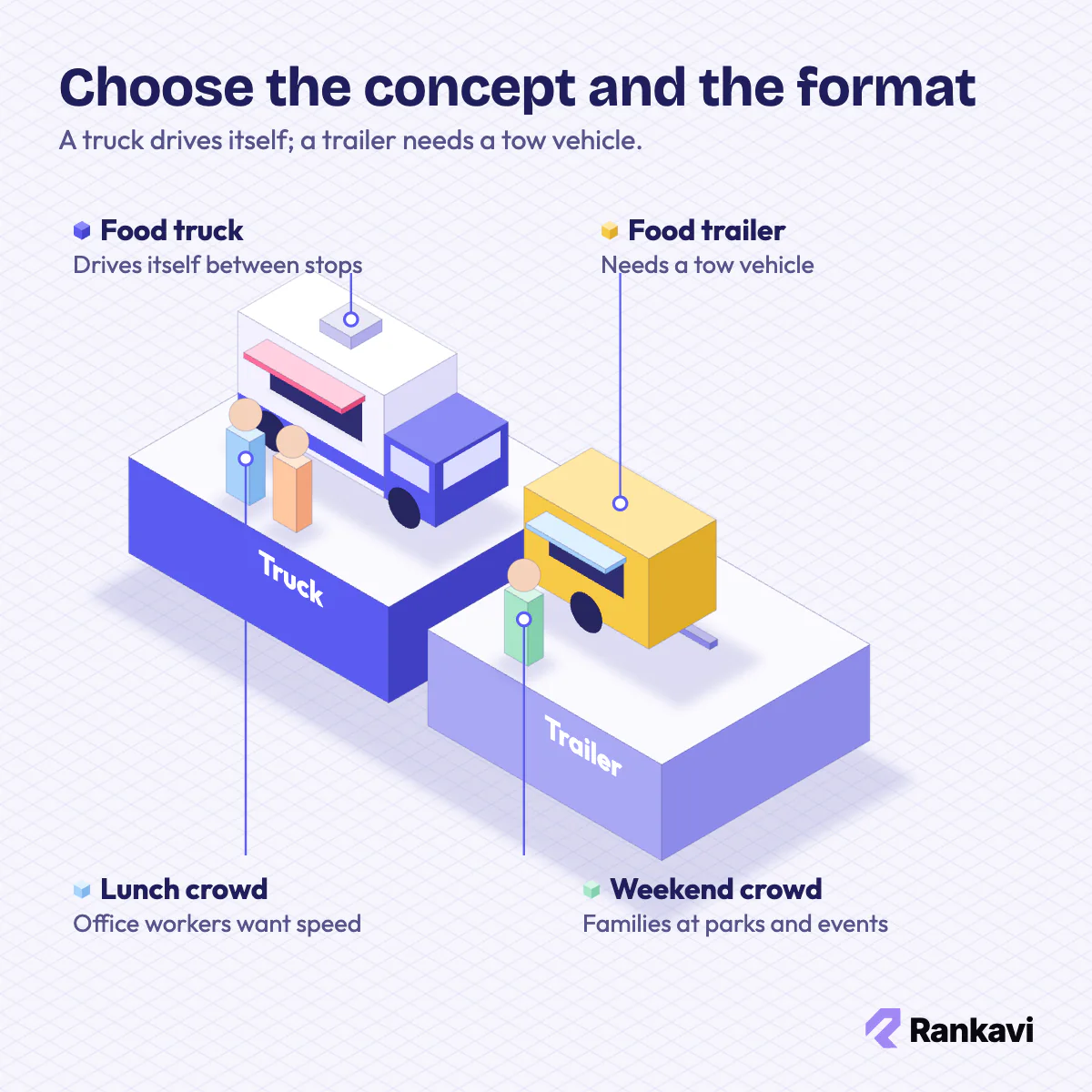
Customers cluster by time of day. Office workers want speed at lunch, families come out at weekend parks, and late-night crowds gather near bars. Each crowd suits a different menu, price point and parking plan.
Weather and seasons shape the menu too. Hot soups and cold drinks sell differently, and rain or heat can cut sales at outdoor stops. Some owners add one seasonal item to cover slow months.
Format matters as much as food. A step van or truck drives itself, while a trailer needs a tow vehicle but often costs less. A food cart or kiosk suits simple items such as coffee or hot dogs. Some cities treat trailers, trucks and carts differently under vending rules, so each format needs a check against local rules.
A pop-up stall at a farmers market tests the recipe before any vehicle exists. Sales and feedback from those weekends show whether the concept holds up with strangers. Units sold per hour, items that sell out and repeat visitors show what to keep. If nothing clears the bar, the concept changes before a vehicle is bought.
A short name, a logo and a social media account tied to the cuisine also belong to the concept. They give early followers a place to watch for launch news.
2. Write a Food Truck Business Plan
A food truck business plan sets the sales targets that every later decision must hit. Lenders read it first, so its key assumption is how many meals the truck sells per service.
A food truck business plan covers seven core sections:
- Summary: executive summary and concept
- Company: description and what sets the truck apart
- Market: analysis of nearby trucks and restaurants
- Team: organization and management
- Menu: dishes and pricing
- Marketing: sales and promotion plan
- Money: funding request and financial projections
Projections model each service on its own. A weekday lunch stop, a brewery evening and a festival weekend produce very different ticket counts. The plan shows break-even per service, not just per month.
Each assumption in the plan needs a trade-off beside it. A busy lunch spot brings steady tickets but fierce competition, while an event brings crowds but charges vendor fees. The plan states which stops carry the most sales and which carry the most risk.
Goals give the plan a horizon. Short-term goals cover the first season of steady stops. Long-term goals may add catering, a second truck or a brick-and-mortar location.
3. Price the Menu for Profit
Menu pricing decides how much of every ticket is left after food and packaging. Owners cost each item by portion before a price goes on the menu board.
Costing starts with the recipe. Owners weigh each ingredient, allow for trimming waste and add the container, napkin and utensil. Plate cost divided by the target food cost share of the price gives the menu price. Scales and scoops keep portions at the costed weight, since extra protein on every plate erodes margin.
A short menu keeps the line moving. A handful of items built around shared ingredients cut prep, waste and space in a tight kitchen. Speed matters because a lunch rush lasts only a short window.
Portable dishes sell best. Tacos, wraps, bowls and sandwiches eat easily while standing. Sides and drinks carry low food cost and lift the average ticket.
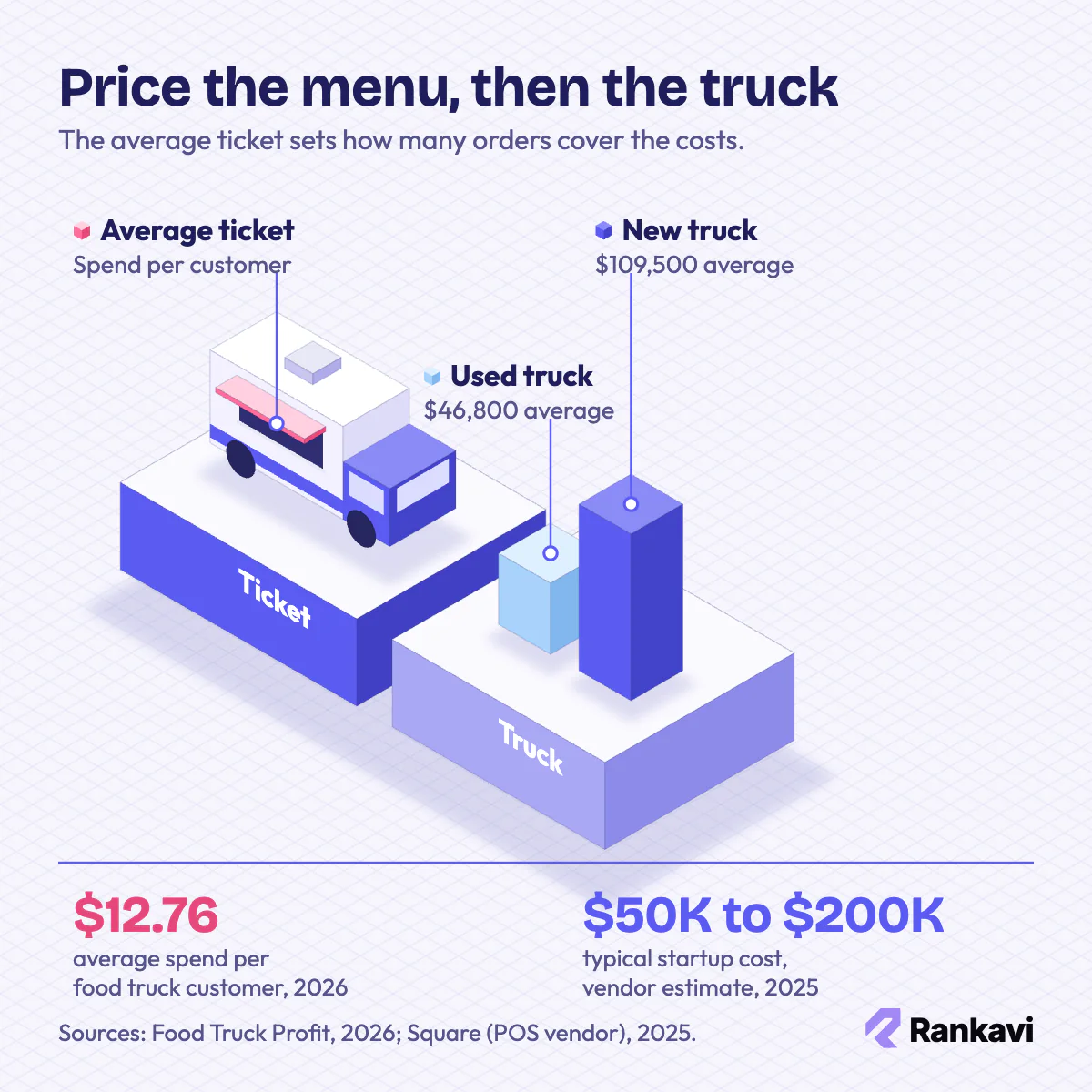
Average ticket is the number food truck owners check first. Food Truck Profit is an industry website that surveys U.S. truck owners each year. It put average customer spend at $12.76 in 2026. Break-even then becomes a count of tickets per service. Fixed costs divided by the profit left on each ticket gives the tickets needed each month.
Square is a point of sale (POS) vendor, and it put typical startup cost at $50,000 to $200,000 in 2025. Concession Nation is a U.S. food truck builder that quotes 8 to 10 weeks for a custom build, as of 2026.
Startup money at a glance:
| Item | Typical figure |
|---|---|
| Startup cost | $50,000 to $200,000 (vendor estimate) |
| Main costs | The truck (average $46,800 used, $109,500 new), commissary rent ($500 to $2,500 a month), wrap ($2,500 to $10,000), kitchen equipment, permits and insurance |
| Typical margin | 32.24% gross and 9.37% net for U.S. public restaurant firms, used here as a proxy for food trucks |
| Time to open | A custom build takes 8 to 10 weeks after the deposit, before permits and inspections |
Source: Square (POS vendor), 2025, and ABCpos (restaurant POS vendor), 2025, vendor estimates; Food Truck Profit owner survey, 2026; Aswath Damodaran, NYU Stern, January 2026; Concession Nation (food truck builder), 2026.
Worked example: An illustrative truck sells 100 orders a day at $13, for 20 days a month. Sales reach $26,000. Food and packaging at an assumed 30% cost $7,800. Commissary rent of $1,500 and insurance of $250 leave $16,450. Labor, fuel, permits, repairs, loans and owner pay come out of that sum.
Card fees, sales tax and delivery app commissions also sit inside the price. Delivery apps take a commission on every order, so some trucks list slightly higher prices there. The worked example above leaves card fees out, so real profit is lower. Event organizers may charge a flat fee or a share of sales, which must be priced in too.
Menu engineering ranks each item by sales count and margin. Popular, high-margin items get top billing on the board. Popular, low-margin items get a small price rise or a cheaper recipe. Combos of a main, a side and a drink raise the average ticket.
Prices follow food cost and local demand, not guesses. Owners compare nearby trucks, then set each price to cover ingredients, containers and card fees. A price review follows the soft launch and any jump in key ingredients.
4. Fund the Truck and Opening Months
Funding covers the truck, the kitchen build-out, the first permits and enough cash for slow weeks. The vehicle is the largest single line in almost every food truck budget. A budget start is possible: Square said in 2025 that a used truck with minimal upgrades can come in under $30,000.
Main startup cost categories:
| Cost category | What it covers |
|---|---|
| Truck or trailer | Purchase, lease or retrofit of the vehicle |
| Kitchen equipment | Cooking, refrigeration, sinks and fire suppression |
| Permits and licenses | City, health and fire approvals |
| Commissary | Monthly base kitchen and parking fees |
| Branding | Wrap, logo and menu board |
| Working capital | Inventory, fuel, repairs and slow days |
A secured vehicle loan works much like a car loan. The truck serves as collateral, so the rate is often lower than an unsecured loan. Equipment financing from builders and dealers fills a similar role.
Many founders stack several sources. The U.S. Small Business Administration (SBA) is a federal agency that guarantees small business loans. It funds microloans through nonprofit lenders and backs larger loans through banks. Savings and crowdfunding cover the gap a lender leaves.
Some veterans argue against borrowing at all:
“…don’t have debt. If you can’t buy a truck cash don’t buy it.”
— A food truck owner of more than five years in a YouTube comment
Each source has a trade-off. A loan brings fixed payments even in slow weeks. Crowdfunding avoids debt but takes time and a following. Equipment financing keeps cash free but ties the debt to the equipment. Savings carry no interest but put personal money at risk.
Working capital keeps the truck running while sales build. Rainy days, breakdowns and cancelled events all hit cash flow. A reserve covering several months of operating costs protects the business through its first season.
5. Register the Business
Registering a food truck creates the legal company that owns the vehicle, signs the commissary agreement and pays staff. Many owners form a limited liability company (LLC). That shield keeps a road accident or food claim away from personal assets.
The Internal Revenue Service (IRS), which is the federal tax agency, gives truck owners a free employer identification number (EIN). Truck owners need it for payroll, the seller’s permit and a business checking account. Truck income and expenses stay separate from personal money from the first day.
A sole proprietorship is the simplest form but leaves personal assets exposed. An LLC adds a liability shield at the cost of state filing fees and yearly paperwork. Owners often ask an accountant or attorney to match the form to the plan.
Food sales usually carry sales tax. A state seller’s permit lets the truck collect and remit that tax. The business name also needs a search, since catchy truck names repeat across cities.
6. Secure a Commissary and Parking Base
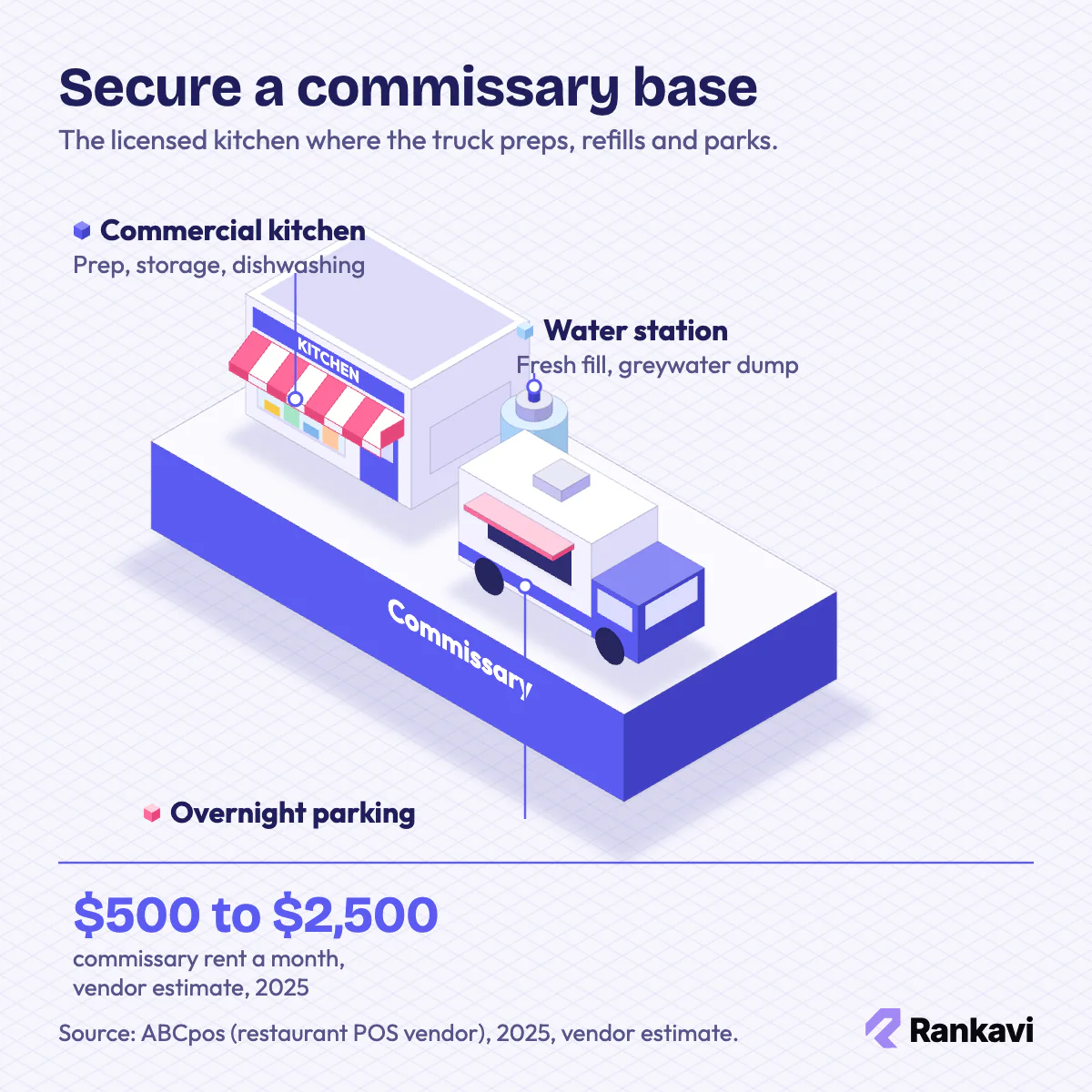
Most cities require a food truck to operate from a licensed commissary kitchen. The commissary is where the truck preps food, stores supplies, fills water, dumps greywater and often parks overnight.
The health department usually asks for a signed commissary agreement with the permit application. That address becomes the truck’s official base. ABCpos, a restaurant POS vendor, estimated commissary rent at $500 to $2,500 a month in 2025.
A commissary agreement names what the base provides. Typical items are prep space, cold storage, water, greywater disposal, overnight parking and trash service. A visit before signing shows whether those items are available during the hours the truck needs them.
Vending rules decide where the truck can sell. Cities limit parking time, set distances from restaurants and ban some streets entirely. A call to the city’s vending office before signing anything prevents a dead-end route.
Good stops follow the crowd. Downtown business districts and campuses peak at lunch, while breweries, parks and food truck parks fill evenings and weekends. Private lots need written permission from the owner.
Festivals and concerts draw big crowds but charge vendor fees. Owners estimate the likely tickets before paying to join an event.
7. Buy and Outfit the Truck
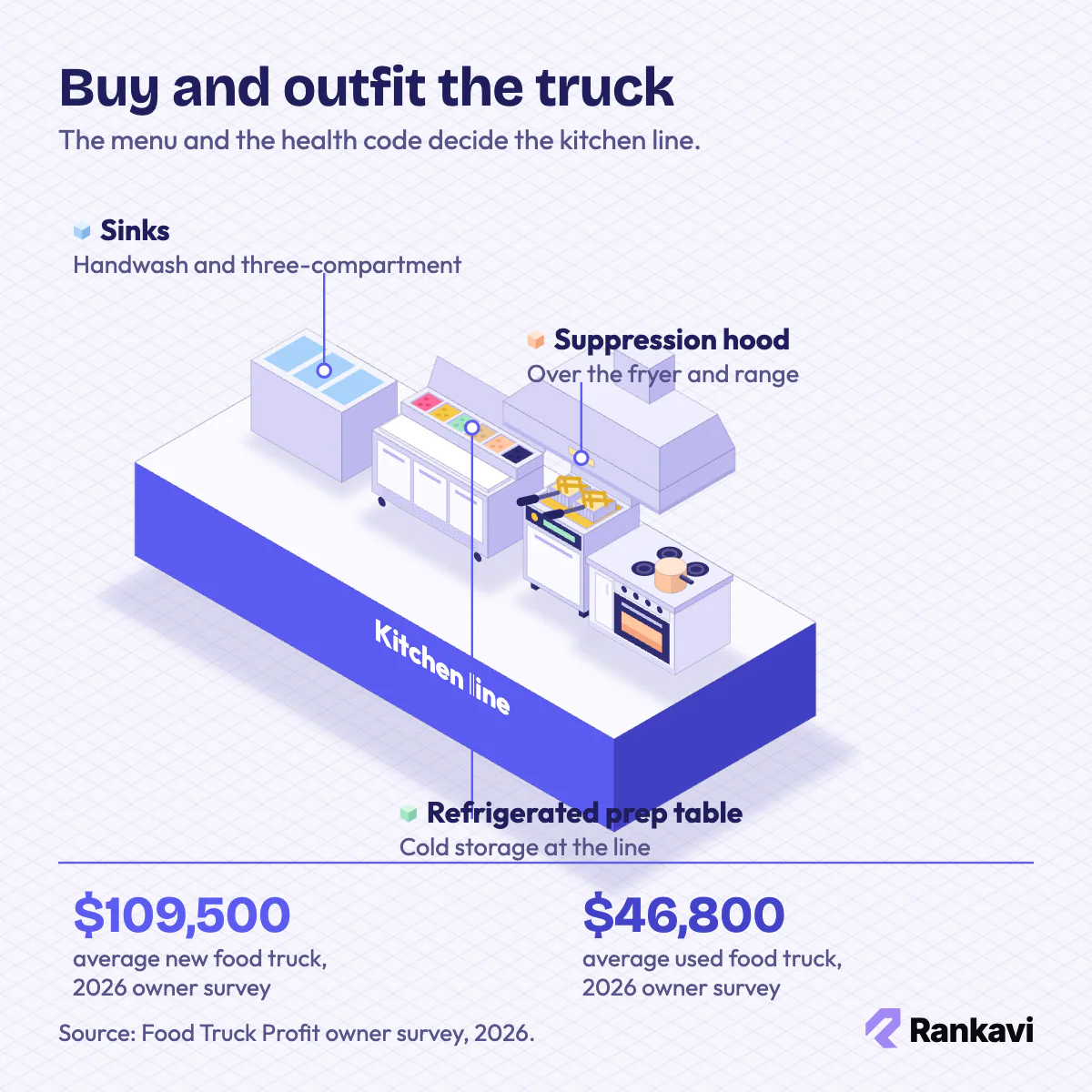
The truck choice determines the kitchen layout, the repair bill and the inspection result. Food Truck Profit’s 2026 survey put the average new truck at $109,500 and a used one at $46,800.
New custom builds arrive to code, while used trucks may need retrofits. Concession Nation quotes 7 to 8 weeks for a standard build after the deposit, as of 2026. Leasing lowers the upfront bill but gives up equity.
Health rules come before the purchase. Local codes set the number of sinks, water tank sizes, refrigeration and ventilation. The health department can share its plan review checklist so the truck is built to pass.
Typical food truck equipment:
| Equipment | Examples |
|---|---|
| Cooking | Griddle, fryer, range or oven |
| Cold storage | Undercounter refrigerator, refrigerated prep table, freezer |
| Sanitation | Handwashing sink, three-compartment sink, fresh and greywater tanks |
| Fire safety | Suppression hood and grease-rated extinguisher |
| Power | Generator or shore power, propane tanks |
The build choice carries trade-offs. A new custom build arrives to code but costs the most and takes weeks. A used truck costs less but may hide repair bills. A mechanic inspects the engine and the kitchen before purchase. A trailer saves money but depends on a tow vehicle.
A mobile POS system takes cards, contactless and phone payments. It needs offline mode, because signal drops at busy events. Sales reports show which items earn their space on the menu.
8. Insure the Truck and the Kitchen
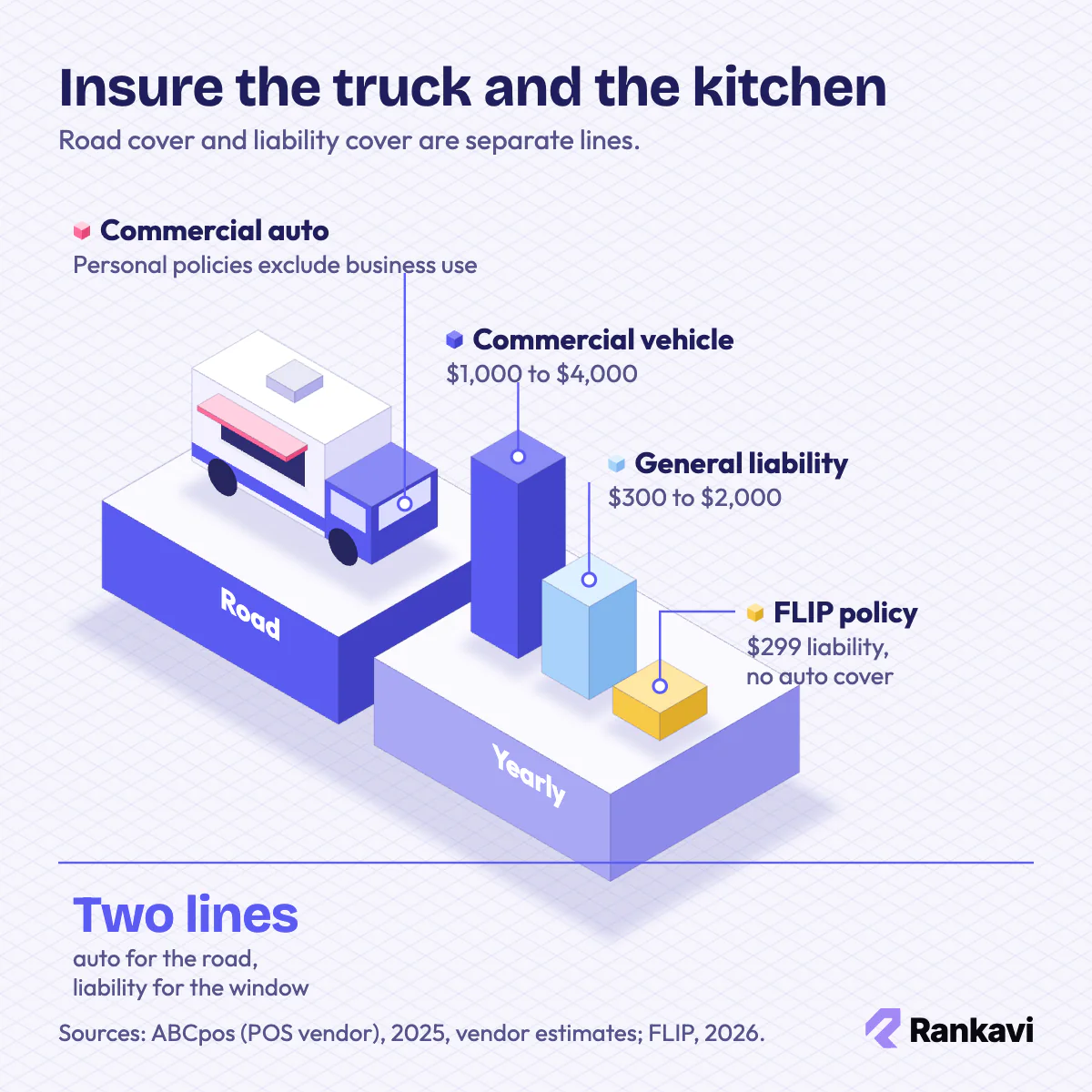
Food truck insurance protects the owner from road accidents, kitchen fires and customer claims. A personal auto policy usually excludes a vehicle used for business.
Commercial auto coverage pays for crashes while driving between stops. ABCpos estimated it at $1,000 to $4,000 a year in 2025, with general liability at $300 to $2,000. General liability covers a customer who slips at the window or gets sick.
The Food Liability Insurance Program (FLIP) is an insurance program for food vendors. As of 2026, its food truck liability policy costs $299 a year and excludes commercial auto unless added.
Coverage often includes more than liability and auto. Property coverage protects the kitchen equipment. Commodity coverage protects spoiled food after a power loss. Premiums depend on the truck’s value, the menu, the driving record and the operating area. Owners compare quotes from several insurers.
Workers’ compensation applies once staff join, and state rules decide when. Events, commissaries and private lots often ask for a certificate of insurance naming them before the truck can park.
9. Pass Health and Fire Inspections
Inspections give the truck its legal right to cook and sell. Rules vary by city and county, so the local health department is the first call.
Common food truck permits and licenses:
| Permit or license | Why it matters |
|---|---|
| Business license | Permission to operate in the city or county |
| Mobile food vendor permit | Vending zones, hours and parking rules |
| Health permit | Plan review and inspection of the truck |
| Fire department permit | Propane and suppression checks |
| Vehicle registration | Road safety and commercial plates |
| Food handler and manager certificates | Safe handling by the crew |
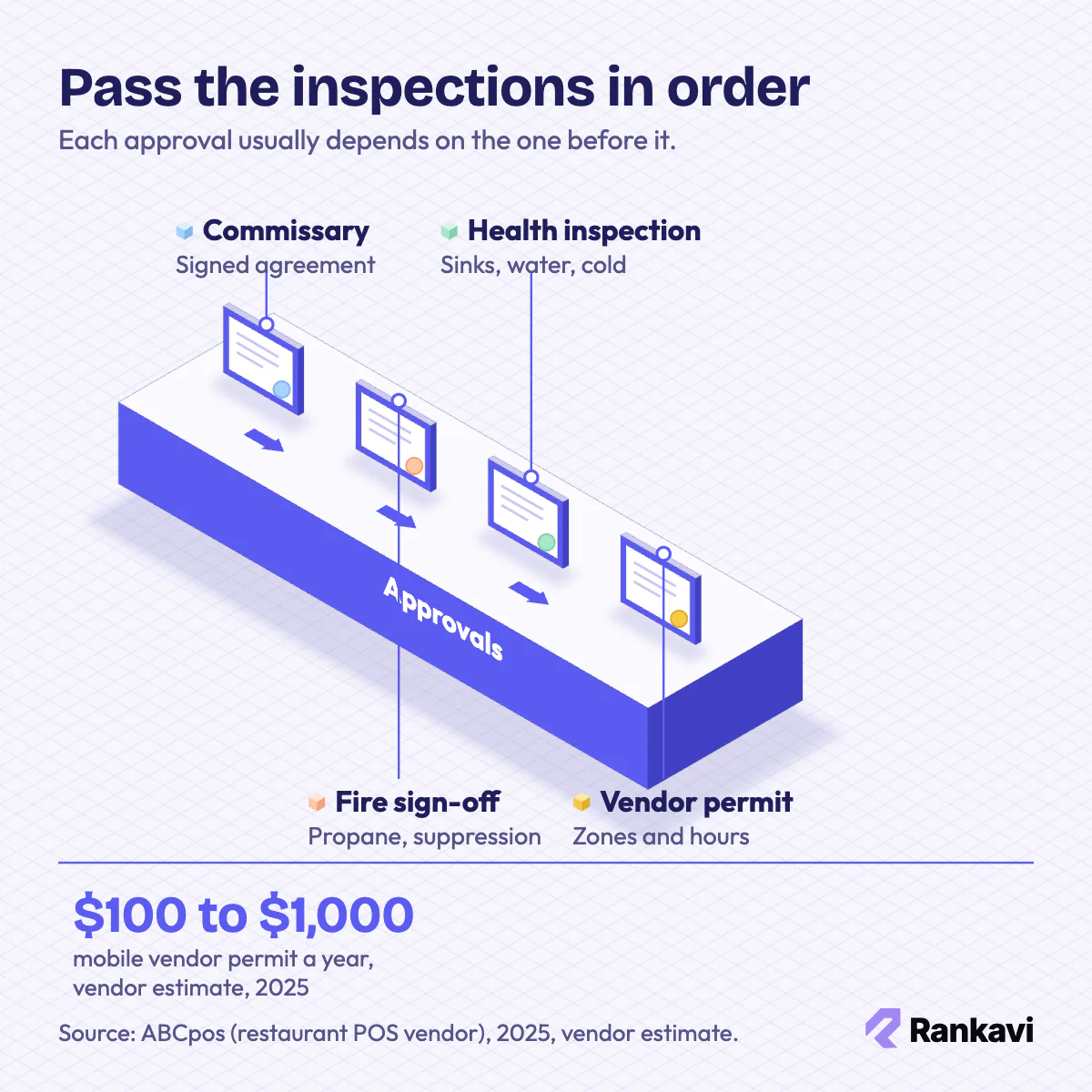
The vendor permit alone ran $100 to $1,000 a year in ABCpos’s 2025 estimate. The health inspection then checks the truck itself: sinks, hot water, refrigeration, pest sealing and the commissary agreement. Many cities need the fire sign-off first.
A certified food protection manager is often required on every shift. ServSafe is a food safety certification program of the National Restaurant Association that offers manager and handler credentials. Some cities require handler cards for every employee.
Approvals take longer than many owners expect:
“Just found out once I get the truck, I have to wait another 4-5 months for my food license.”
— A new food truck owner in a YouTube comment
Plan review comes before the final inspection in many places. The health department checks drawings of the layout first, then inspects the finished truck. Inspectors often fail trucks for missing hot water, unsealed gaps or a missing commissary agreement. A call to the department before the build prevents repeat visits.
Truck size matters on the road. Heavier vehicles may need a commercial driver’s license (CDL), so owners check the truck’s weight rating before buying.
10. Hire a Crew and Market the Launch
A food truck usually runs with a small crew. Food Truck Profit found the average truck employed 1.8 full-time workers in 2026. Cross-training lets anyone cover the grill or the window during a rush.
Pay sets the hiring budget. The BLS reported a $17.98 median hourly wage for restaurant cooks in May 2025. The truck wrap then works as the main advertisement on every street the truck parks.
Hiring has trade-offs. Part-time staff keep cost down during slow weeks but leave less depth when someone calls in sick. Fewer, cross-trained workers keep the line moving and cost more in wages per head. The owner often works the window at first to learn which tasks slow service.
Social media tells followers where the truck parks today. Daily location posts, photos of signature dishes and event schedules keep regulars coming back. Google Business Profile is Google’s free listing, and it adds hours, photos and reviews to Search and Maps.
Repeat business comes from habit. A loyalty offer, a clear weekly schedule and fast service bring regulars back. Event organizers and breweries also book trucks that draw crowds, which turns a good launch into steady bookings.
A soft launch tests the line before opening day. Friends, neighbors and local food writers try a reduced menu. The crew then fixes slow tickets and portions before the public arrives.
11. Land in AI Lunch Recommendations
AI visibility means a truck gets named when diners ask a chatbot where to eat nearby. Questions like “best tacos near downtown” now go to Claude, ChatGPT and Google AI Overviews.
Those assistants repeat what other sites say. Local food blogs, review pages, event listings and “best food trucks in town” roundups feed their answers. A new truck mentioned on those pages early gives the models something to cite.
Accurate listings help these assistants. A complete Google Business Profile, consistent hours and a clear cuisine description make the truck easier to describe. Reviews and event pages that repeat the same name and cuisine back that up.
Coverage grows slowly, with no promised placement. Rankavi is a software as a service (SaaS) platform that publishes brand mentions in articles on indexed third-party websites. Truck owners who want Anthropic’s assistant to know their name can start with Claude mention placements.