

Starting a food business takes a chosen product, a kitchen the law allows, the right permits and a first market. The U.S. Bureau of Labor Statistics (BLS), which publishes federal business counts, recorded 42,763 private food manufacturing establishments in 2025.
Quick introduction: I’m Michal Sieroslawski, and I help food businesses show up in Google and AI search. AI search is a growing way for customers to find food businesses, and recommended names start ahead.
The order fixes the product and its unit price first. Kitchen rent, permits and equipment then serve a product that already pays. The following list shows how to start a food business in eleven steps.
- Choose a Food Business Model
- Develop and Test the Recipe
- Price Each Product for Profit
- Fund the Startup Costs
- Register Your Food Company
- Find a Kitchen That Qualifies
- Get Food Permits and Licenses
- Insure Against Product Liability
- Buy Equipment and Packaging
- Sell at Markets and Local Shops
- Surface in Google AI Mode Food Answers
1. Choose a Food Business Model
A small food business starts with one clear format. Home-made jams, a market stand, packaged sauces, meal prep and a coffee cart each follow different rules.
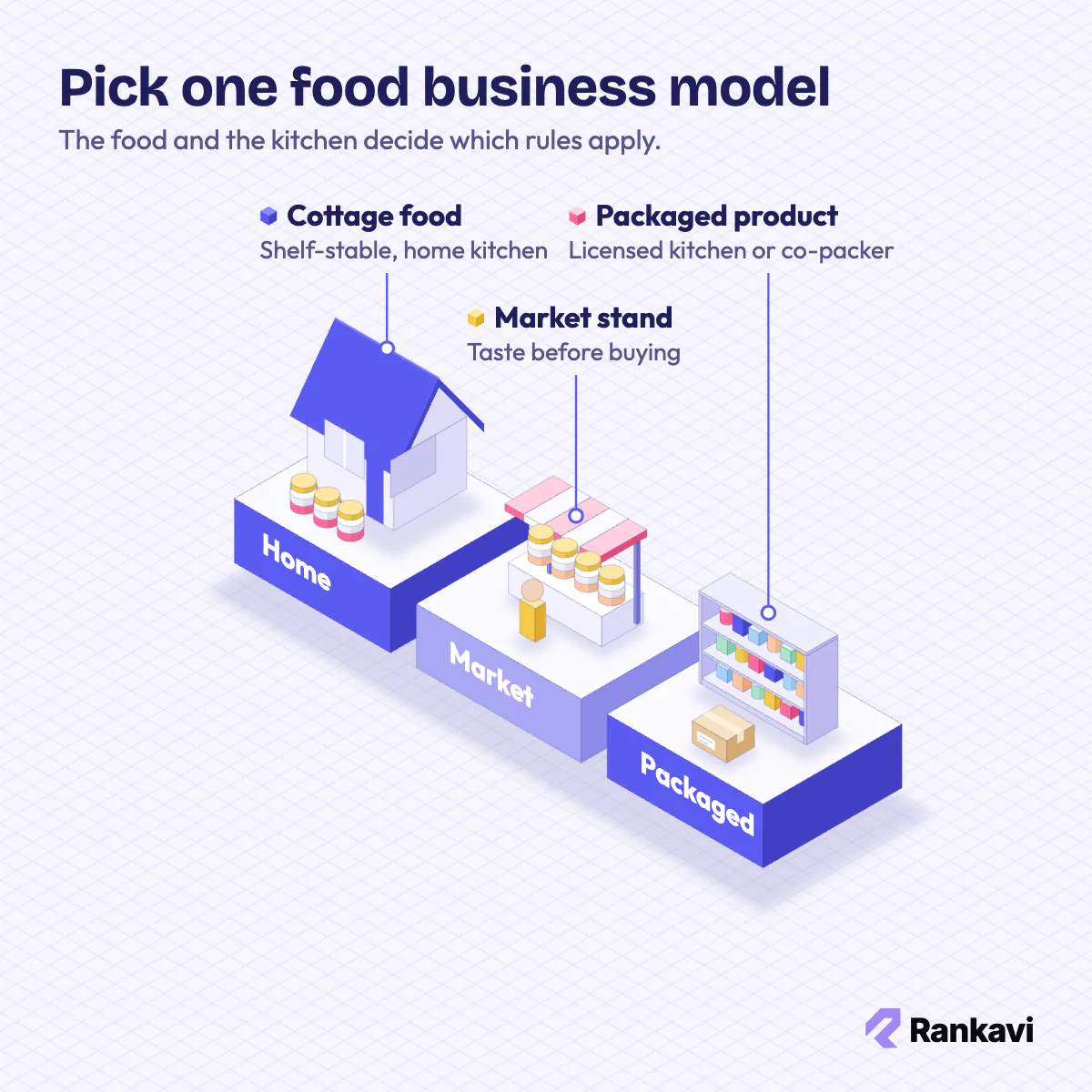
Food type decides the legal path. Shelf-stable foods such as breads, candy and jams can often come from a home kitchen. Foods that need refrigeration for safety must come from a licensed commercial facility.
Common small food business models:
| Model | Where the food is made |
|---|---|
| Cottage food products | A home kitchen under the state cottage food law |
| Packaged food products | A licensed kitchen, incubator or co-packer |
| Market stand or cart | A licensed kitchen, then sold at markets and events |
| Home-cooked meals | A home kitchen only where the state allows it |
| Meal prep and delivery | A licensed commercial or shared kitchen |
Local research reveals where an opening exists. A founder visits farmers markets and grocery shelves, compares competitor prices and reads their reviews. A missing flavor, diet or price point marks the gap.
Each model trades control against effort. A home kitchen costs the least but caps products and sales. A co-packer removes the cooking work but sets minimum order sizes. A shared kitchen sits between the two.
Target customers shape the product. Their age, income and buying habits decide portion size, packaging and where the product sells. Taste tests with real buyers confirm the guess before production starts.
2. Develop and Test the Recipe
Developing a food product involves turning a home recipe into a safe, repeatable batch with a fixed formula. Every ingredient gets weighed, so each batch tastes and behaves the same.
Scaling changes a recipe. Doubling or tripling a batch shifts cooking times, texture and flavor, so producers run several test batches. Each trial gets a written record.
Some products need a safety review. A process authority, often a food scientist at a state university, reviews acidified and canned foods. Lab tests check acidity (pH) and water activity, which decide whether bacteria can grow.
Allergens need special care. The U.S. Food and Drug Administration (FDA), which regulates most packaged foods, lists nine major food allergens. Sesame joined that list in 2023. Milk, eggs, wheat, soy, peanuts, tree nuts, fish, shellfish and sesame must be declared.
Packaging gets chosen early. A refrigerated dip needs a different container than a shelf-stable granola, and the container size limits the label space.
A packaged food label carries five core elements:
- Statement of identity: the common name of the food.
- Net quantity: weight or volume in both U.S. and metric units.
- Ingredient list: every ingredient by weight, with major allergens declared.
- Business name and address: the maker, packer or distributor.
- Nutrition Facts: required on most packaged foods unless an exemption applies.
3. Price Each Product for Profit
A food price sets how much each unit earns after ingredients, labor and overhead. Producers work out the cost of one jar, loaf or meal before they print a price tag.
Cost per item has three parts. Ingredients and packaging come first. The owner’s time comes next, priced as an hourly wage. Overhead such as kitchen rent, permits and insurance gets spread across every unit.
A markup turns cost into profit. The final price covers the full unit cost and leaves a buffer for spoiled batches, repairs and growth. Pricing below cost is a common early mistake.
Markup and margin are different measures. Markup is profit as a share of cost, while margin is profit as a share of the price. Mixing them up leads to prices that look healthy but earn less than planned.
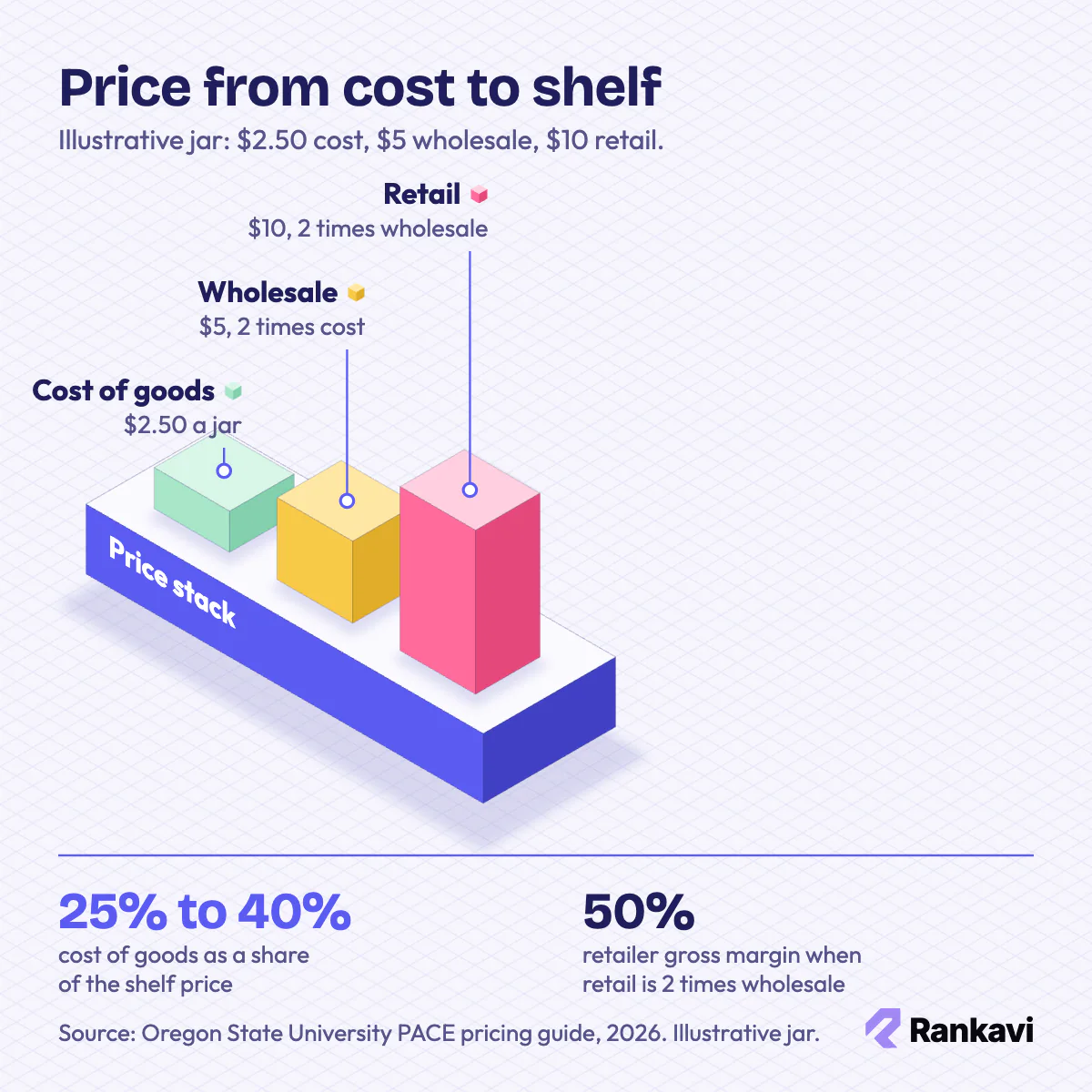
Wholesale prices sit below retail prices. Oregon State University runs a food product development course through its continuing education program. Its pricing guide, read in 2026, puts wholesale at 2 to 2.5 times the cost of goods.
Retailers then double the wholesale price, which gives them a 50% gross margin in that 2026 guide. Cost of goods should land at 25% to 40% of the shelf price, the guide’s 2026 benchmark.
Local prices give a sense check. Producers compare similar items at nearby markets and stores, then test small price changes and watch repeat sales.
4. Fund the Startup Costs
Funding a food business covers ingredients, packaging, kitchen time, permits, insurance and the first months of operating cash. Many small producers start lean and grow from sales.
A startup budget lists every cost before money gets spent. Equipment, packaging, licenses, insurance, kitchen rent, testing and marketing each get a line.
A feasibility study comes before the full plan. It tests whether the product, market, skills and money add up. The business plan then adds sales projections, cash flow and a balance sheet.
Funding usually comes from savings, family loans, bank or credit union loans, grants and crowdfunding presales.
Microloans fit small launches. Nonprofit lenders make them with backing from the Small Business Administration (SBA), which offers federal loan programs. The SBA put the average microloan at about $13,000 on its 2026 page.
Starting small protects cash. Renting kitchen time instead of building a facility avoids fixed debt payments while the product proves itself.
Each funding source has a trade-off. Savings need no repayment, though a failed launch costs the founder personal money. Loans add monthly payments, and presales on crowdfunding sites need a finished product and a delivery date to promise.
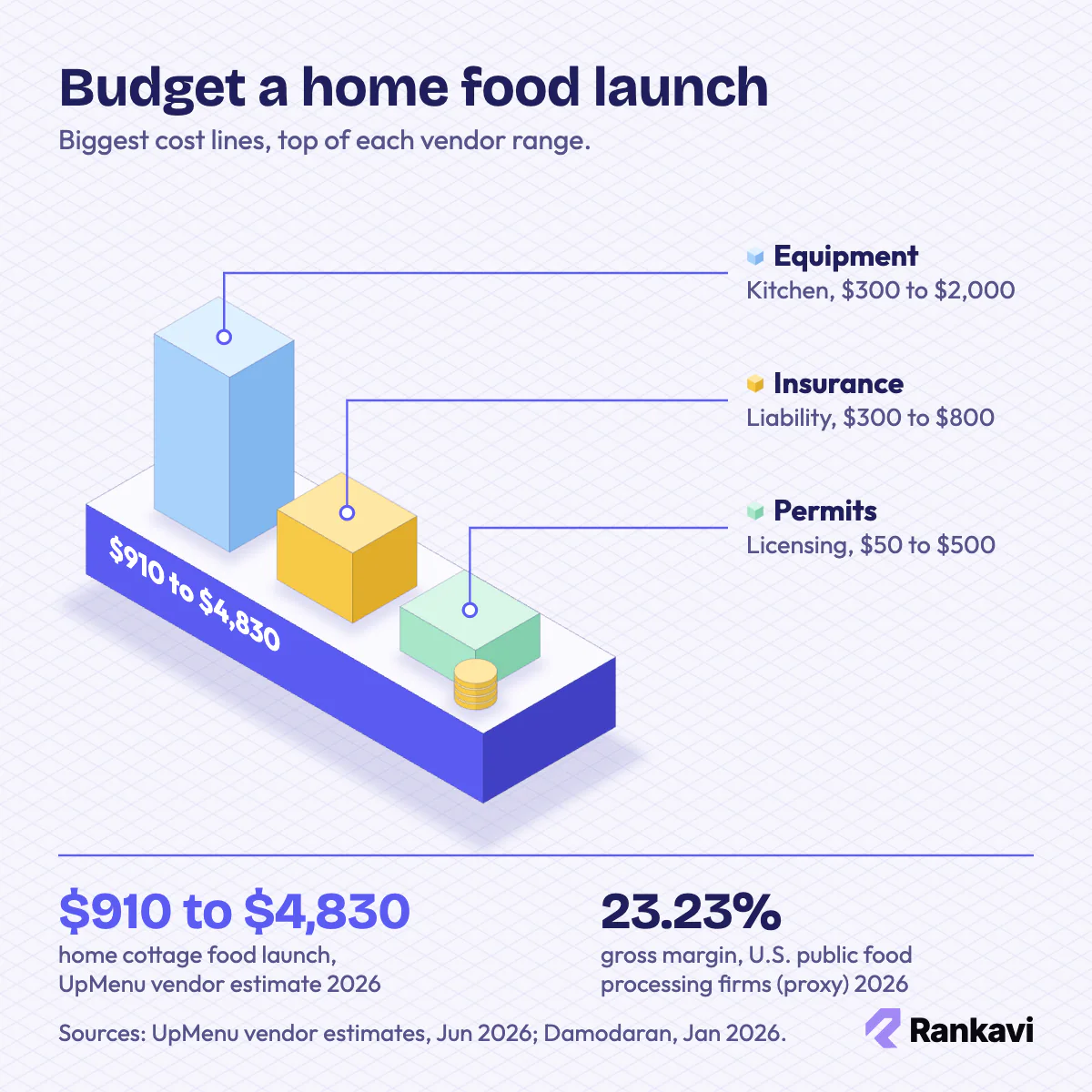
UpMenu, which offers online ordering software to food businesses, published vendor estimates for home food launches in June 2026. Its 2026 guide puts a small cottage food operation at $910 to $4,830.
Startup money at a glance:
| Item | Figure |
|---|---|
| Startup cost | $910 to $4,830 for a home cottage food launch; most launch for under $2,500 |
| Main costs | Kitchen equipment $300 to $2,000, liability insurance $300 to $800, permits and licensing $50 to $500, packaging, first ingredients |
| Typical margin | 23.23% gross and 2.82% net for U.S. public food processing firms (proxy for packaged food) |
| Time to open | Varies with state cottage food rules or a kitchen plan review; no reliable public benchmark exists |
Sources: UpMenu, an online ordering software company, vendor estimates, June 2026; Aswath Damodaran, NYU Stern, sector margins for 78 food processing firms, January 2026.
Example: An illustrative home jam maker prices a jar at $10 retail and keeps cost of goods at 25%.
| Input | Figure |
|---|---|
| Retail price per jar | $10 |
| Cost of goods per jar (25% of retail) | $2.50 |
| Wholesale price to a shop (2 times cost, half of retail) | $5 |
| Profit per jar sold direct / wholesale | $7.50 / $2.50 |
| Launch budget plus one year of insurance | $2,500 + $299 = $2,799 |
| Jars to recover the launch, all sold direct | 374 |
| Jars to recover the launch, all sold wholesale | 1,120 |
5. Register Your Food Company
Registering a food business gives it a legal identity for contracts, bank accounts and permit applications. Most small producers choose between a sole proprietorship and a limited liability company (LLC).
Each structure trades simplicity for protection. A sole proprietorship needs no state filing but leaves personal assets exposed. An LLC or corporation separates business debts from personal property. Farm-based producers sometimes join a cooperative.
Tax numbers come next. Food producers get a free employer identification number (EIN) from the Internal Revenue Service (IRS), which runs federal tax collection. Many states also issue a separate state tax account number for sales and income taxes.
A trade name needs its own filing. A producer who sells under a brand instead of a legal name files a “doing business as” (DBA) name. A separate business bank account keeps sales and costs clean for tax time.
6. Find a Kitchen That Qualifies
A qualifying kitchen determines which foods a business may legally make and where it may sell them. Health departments approve the kitchen, so it gets chosen before the permit application.
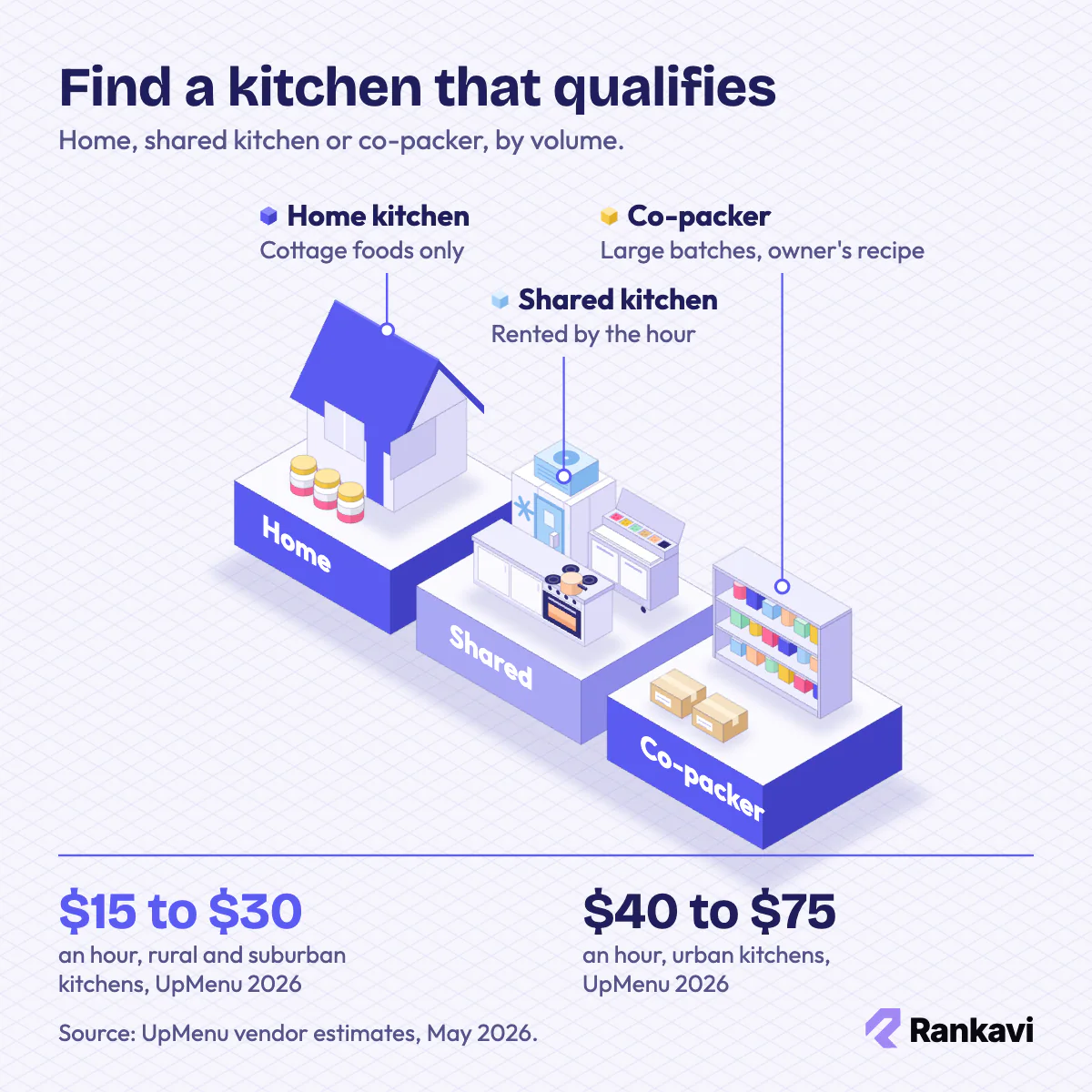
Home kitchens work only under cottage food rules. Those rules often bar pets, children and family cooking from the kitchen during production. Some states inspect the home, while others accept a self-certification.
Kitchen options for small food producers:
| Option | Best fit |
|---|---|
| Home kitchen | Shelf-stable cottage foods in small volumes |
| Shared or incubator kitchen | Equipped space rented by the hour, often with business support |
| Church or restaurant kitchen | A permitted kitchen rented during its off hours |
| Co-packer | A contract manufacturer that makes large batches to the owner’s recipe |
| Own commercial kitchen | Steady volume that justifies building or leasing a facility |
Incubator kitchens suit packaged products. Many run through universities, nonprofits or economic development groups. Some add help with recipes, safe processes and business planning.
Hourly rent depends on the region. UpMenu estimated in May 2026 that rural and suburban kitchens rent for $15 to $30 an hour. Urban kitchens ran $40 to $75 an hour in its 2026 vendor estimate.
Home businesses also face local zoning. Cities may require a home occupation permit, and homeowners associations can add their own limits.
7. Get Food Permits and Licenses
A food permit means a health or agriculture agency has approved the food, the kitchen and the process. The right agency depends on what the business makes and where it sells.
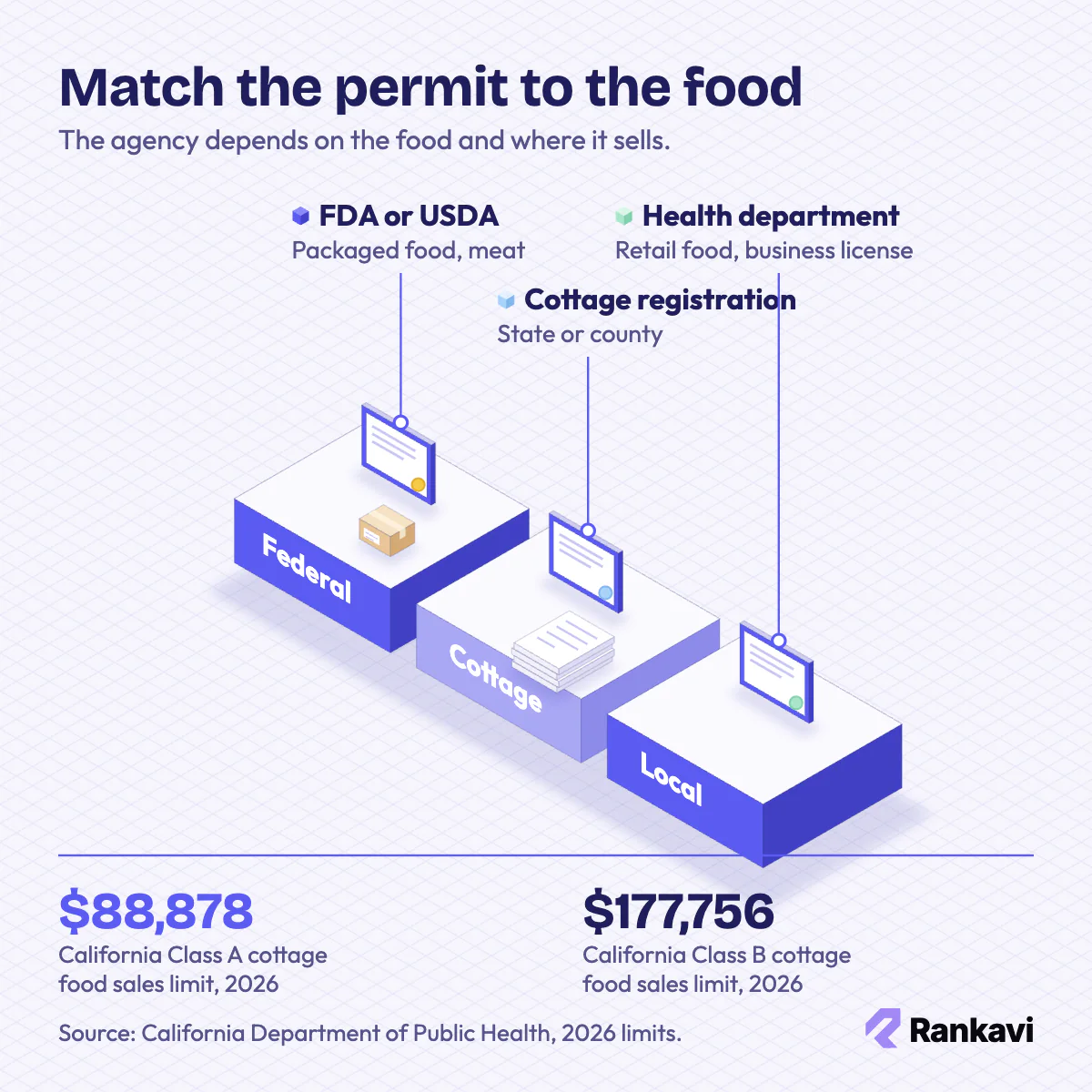
Federal and state roles split by food and channel. The FDA covers most packaged foods sold across state lines. The U.S. Department of Agriculture (USDA) regulates meat, poultry and some egg products. Restaurants and food trucks answer to state and local health departments.
Food facilities that make, pack or hold food must register with the FDA before production and renew every other year. Private homes, restaurants, retail food stores and farms are exempt from that registration.
Cottage food operations register with the state or county. Each state sets its own list of allowed foods, sales channels and annual sales cap. Some states require a kitchen inspection first.
California shows how caps work. The California Department of Public Health (CDPH) sets the state’s cottage food rules. It adjusts the sales limits for inflation each year. For 2026, Class A direct sellers may gross $88,878 and Class B sellers $177,756.
Training usually comes with the permit. Many states require an approved food safety course or a food handler card. Home meal permits, such as California’s microenterprise home kitchens, require a stricter manager-level food safety exam.
Local licenses complete the set. Most cities require a general business license. A sales tax permit applies where the state taxes the food sold.
8. Insure Against Product Liability
Product liability insurance protects a food business when its product makes a customer sick or causes an injury. Allergic reactions, contamination and foreign objects are typical food claims.
Retailers often require proof of coverage. Grocery stores and distributors usually ask food processors for a certificate of product liability insurance before stocking a product. Many farmers markets ask vendors for proof too.
Homeowners and renters policies rarely cover business activity. A home-based producer needs a separate business policy or a rider that names the food operation.
Policy wording deserves a close read before purchase. A food policy should name the exact products made and the places they are sold. A market stand, a shop shelf and online sales may each need to be listed.
The Food Liability Insurance Program is an insurance program that sells policies to small food businesses. As of 2026, the Food Liability Insurance Program lists cover from $299 a year. That 2026 policy carries $1,000,000 per occurrence and a $2,000,000 aggregate limit.
Core policies for small food businesses:
| Policy | What it covers |
|---|---|
| Product liability | Illness or injury caused by the food |
| General liability | Customer injuries and property damage during business activity |
| Business property | Equipment, ingredients and finished stock |
| Commercial auto | Vehicles used for deliveries and market days |
9. Buy Equipment and Packaging
Equipment needs follow the product, the kitchen and the expected volume. A shared kitchen supplies ranges and mixers, so a renter mostly buys smaller tools and packaging.
Appliances should match the first year’s volume. A modest mixer or oven often handles early production better than an oversized commercial unit. Equipment with swappable parts can grow with demand.
Core equipment for a small food producer:
| Category | Typical items |
|---|---|
| Appliances | Oven, stovetop, refrigerator, freezer, stand mixer, food processor |
| Prep tools | Scales, thermometers, knives, cutting boards, sheet pans |
| Storage | Airtight food-safe containers, racks and shelving |
| Packaging | Jars, boxes, tamper-evident seals, vacuum sealer, label printer |
| Sanitation | Handwashing station, sanitizer, dish soap, fire extinguisher |
Suppliers matter as much as equipment. Wholesale clubs and restaurant suppliers handle bulk staples, while local farms add fresh, seasonal ingredients. Reliable delivery days and clear food safety records help pass inspections.
Buying used equipment saves cash but adds risk. Commercial appliances should be food-grade and easy to clean. A shared kitchen often allows tool testing before any purchase.
10. Sell at Markets and Local Shops
The first sales channel turns a tested product into steady orders and honest customer feedback. Farmers markets, craft fairs and pop-up events let shoppers taste before they buy.
Samples sell food faster than signs. A small taste at a market booth or brewery pop-up converts curious shoppers. Each market day also shows which flavors sell out.
Local stores and cafes become the next step. A producer brings samples, a price sheet and proof of insurance to store managers. Food co-ops and coffee shops often welcome local products.
Wholesale and consignment work differently. A wholesale buyer pays for the product up front at the lower wholesale price. Consignment leaves the stock with the shop, and the producer is paid only after items sell.
Online orders widen reach within legal limits. Many cottage food laws allow sales only inside the state, so websites often offer local pickup or in-state delivery.
A clear brand helps buyers remember the product. A short name, simple logo and Instagram photos build recognition. A Google Business Profile, which is Google’s free listing in Search and Maps, collects reviews. Happy regulars spread the word fastest.
11. Surface in Google AI Mode Food Answers
Local shoppers increasingly ask AI tools where to buy food. Google AI Mode, ChatGPT and Gemini now answer searches like “best local hot sauce” or “homemade cookies near me”.
Those answers repeat what trusted sites already say. Local food guides, market vendor lists, gift roundups and review pages decide which small producers get named.
Rankavi is a software as a service (SaaS) platform that publishes brand mentions in articles on indexed third-party websites. Food producers can use it to get Google AI Mode citations through food, gift and local shopping articles.