

Starting a dropshipping business takes a focused niche, reliable suppliers, a trustworthy online store and steady marketing. The seller never holds stock. The U.S. Census Bureau, which publishes official retail data, reported that U.S. e-commerce sales grew 12.2% year over year in the second quarter of 2026.
Quick introduction: I’m Michal Sieroslawski, and I help dropshipping stores get found online. More shoppers now ask ChatGPT to recommend a dropshipping store, so showing up there matters.
The order matters because each step tests the idea before money goes into ads. Demand, suppliers and margins get checked first, so the store launches with products that can earn a profit. The eleven steps below take a dropshipping business from plan to launch.
- Choose Your Dropshipping Niche
- Research Demand and Competitors
- Find Reliable Suppliers
- Test Products With Samples
- Price Each Product for Profit
- Budget for Startup Costs
- Register the Business Legally
- Build Your Online Store
- Market the Store to First Buyers
- Scale With Data and Branding
- Get Found When Shoppers Ask AI
1. Choose Your Dropshipping Niche
Choosing a dropshipping niche means picking one specific market segment and the buyers inside it before any store goes live. Every later choice, from suppliers to ad copy, follows from that segment.
A strong niche starts with a problem, not a product. Daily annoyances point to products with a clear before and after benefit. Such products sell better than items that sit in every local big box store.
Niches come in two kinds. Problem-based niches solve a daily frustration. Passion-based niches serve a hobby that buyers already spend money on, such as fishing or gardening.
Three idea sources show where buyers already spend:
- Amazon Best Sellers: This list ranks the top-selling products in each category.
- Movers & Shakers: This list shows the biggest recent gains in sales rank.
- Reddit communities: These forums reveal the exact words frustrated buyers use about a problem.
The Amazon lists show what sells. Reddit shows how buyers describe the problem in their own words.
Precise audiences make the work easier. “Owners of high-energy dogs in apartments” beats “dog owners” as a starting point. A narrow group like this is called a micro-niche. A micro-niche sharpens product selection and ad messaging.
Wide categories create the opposite problem. Crowded categories such as generic phone cases leave little room to stand out on anything but price.
Product type matters as much as the audience. Evergreen products with year-round demand carry less risk than viral trends. Size and durability shape costs too. Lightweight, non-fragile items cost less to ship and arrive damaged less often.
A few categories add legal duties on top of these choices. The U.S. Consumer Product Safety Commission (CPSC) sets federal product safety rules.
Children’s products under a CPSC rule need a written Children’s Product Certificate. That certificate rests on tests from a CPSC-accepted third-party lab, an outside testing company. Products with licensed characters or copied brand logos invite trademark claims.
2. Research Demand and Competitors
Market research shows whether real buyers want the niche and how crowded it already is. A niche idea becomes a tested decision only after this check.
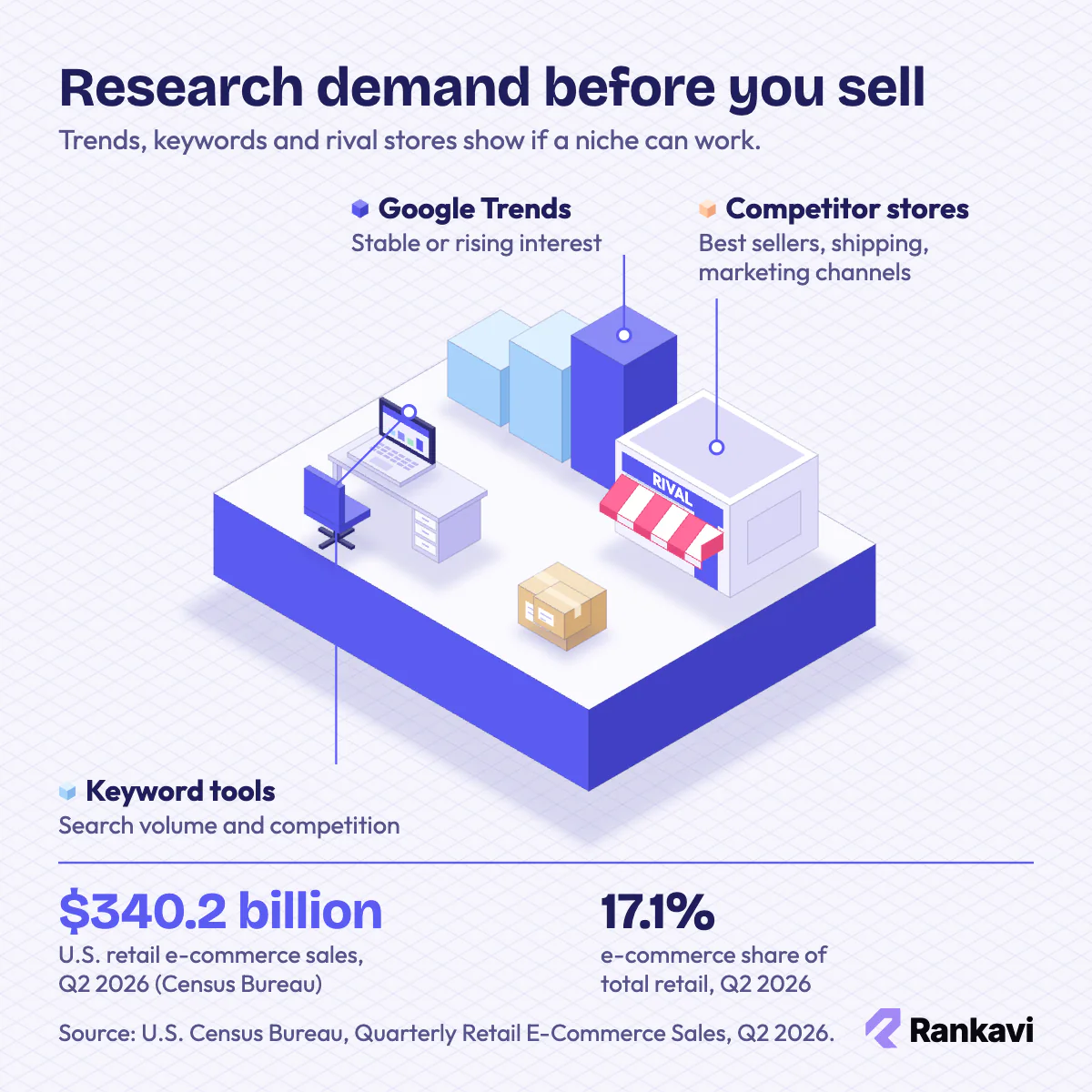
The first question is whether interest in the product lasts. Google Trends is a free Google tool that charts search interest for a product over time. Stable or rising curves signal lasting demand. Sharp spikes followed by drops usually mark a short-lived fad.
A trend curve shows direction, but it does not show how many people search or who else sells to them. Three kinds of sources fill in what the curve leaves out:
- Keyword tools: These tools add search volume and competition levels to the picture. Free options such as the WordStream keyword tool cover the basics. Paid tools like Ahrefs and Semrush go deeper into rival traffic. Google Keyword Planner is a keyword research tool inside Google Ads. It estimates monthly searches and the average ad cost for each keyword.
- Ad libraries: These show what rivals pay to promote. The Meta Ad Library is a public, searchable collection of ads running across Facebook and Instagram. TikTok Creative Center shows trending ads on TikTok.
- Marketplaces: These add real sales signals. AliExpress listings show how many units have sold. The online marketplace eBay offers a sold-listings filter that shows completed sales and prices.
The question being asked decides which source to open. Keyword tools size the audience, ad libraries show where rivals spend, and marketplaces show units already sold.
Online demand keeps growing overall. The U.S. Census Bureau estimated retail e-commerce sales at $340.2 billion in the second quarter of 2026, or 17.1% of total retail.
Competitor stores reveal what already works. A close look covers layout, best sellers, product descriptions, shipping rates and marketing channels, and each detail becomes a benchmark.
A rival’s traffic does not appear on its store page. SimilarWeb, a web traffic analytics service, estimates a rival store’s monthly visits and main traffic sources.
Buyers point out what those stores get wrong. Negative reviews on rival listings point to gaps. Complaints about slow shipping, poor sizing or flimsy parts mark what a better offer must fix.
Gaps matter most. A rival that charges for shipping on small orders opens room for a free shipping offer. Products already sold by big box stores or Amazon Prime are best avoided.
3. Find Reliable Suppliers
A reliable supplier determines product quality, shipping speed and much of the brand’s reputation. Buyers blame the store, not the supplier, for every late or broken parcel.
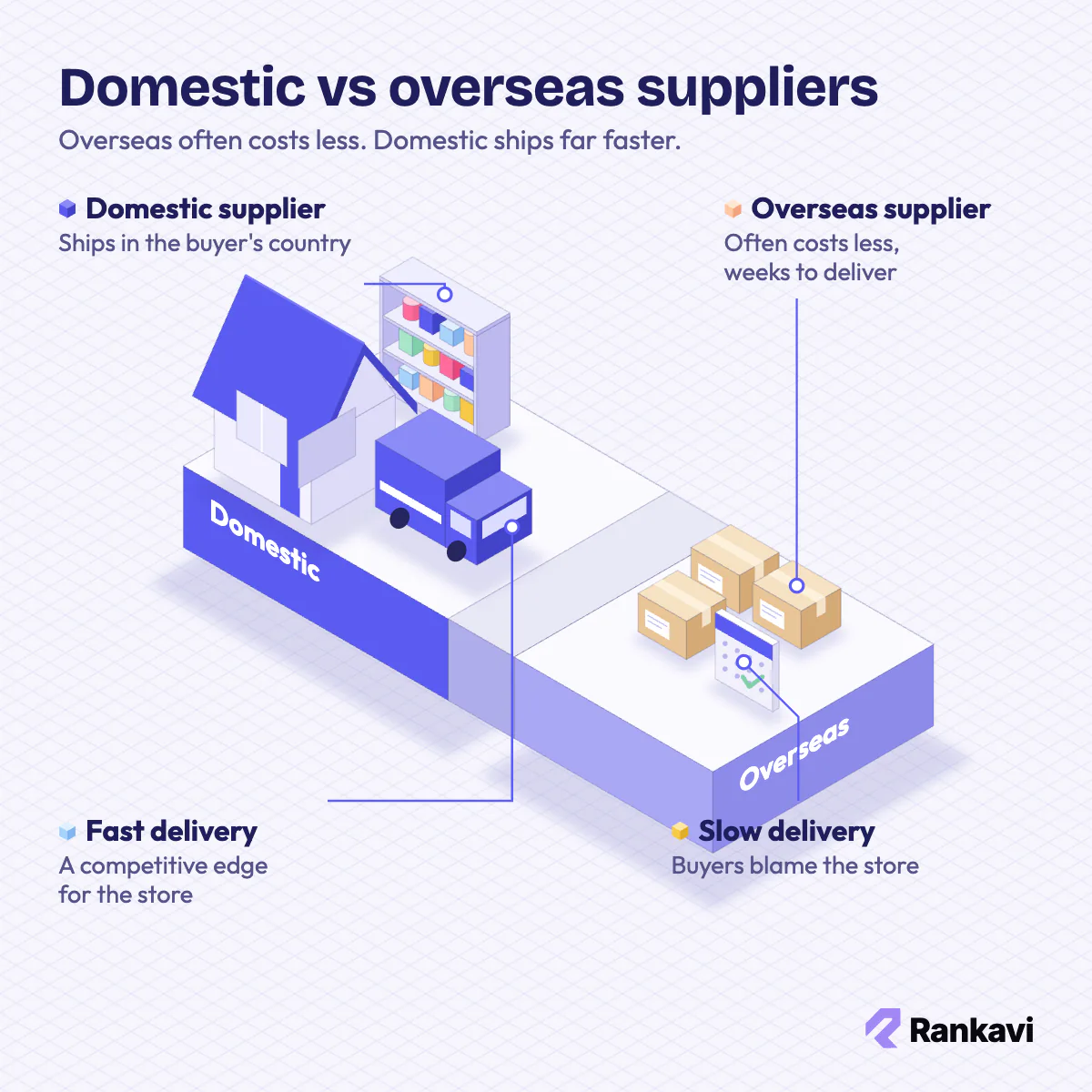
Supplier platforms and directories speed up the search, and each source has a different strength.
Common supplier sources:
| Source | Strength |
|---|---|
| AliExpress | Low-cost products and wide selection |
| DSers | Bulk order processing for AliExpress products |
| Alibaba | Direct work with manufacturers and private label |
| CJdropshipping | Quality control and branding services |
| Zendrop | Suppliers focused on the United States |
| Spocket | Products from US and European suppliers |
| SaleHoo | Directory of vetted wholesale suppliers |
| Printify | Print-on-demand products |
DSers is a sourcing and fulfillment platform that moves store orders to suppliers such as AliExpress. It processes orders in bulk, which saves typing each one by hand.
AliExpress and Alibaba both connect stores to Chinese sellers, so the split between them needs explaining. Minimum order quantity (MOQ) is the smallest number of units a supplier will sell at once. AliExpress sellers ship single units, while many Alibaba manufacturers set a minimum order, which suits private label more than testing.
Where the supplier sits changes the trade-off again. Domestic suppliers ship far faster than overseas ones. Overseas sourcing often costs less, but delivery takes weeks. A supplier inside the target country turns fast shipping into an edge.
A good partner shows five signs:
- Reliable shipping: Orders go out on time and reach buyers when promised.
- Fair prices: Unit costs stay reasonable instead of inflated.
- A quality catalog: The product range holds up when inspected.
- Strong reviews: Past buyers report good experiences.
- Helpful support: Someone answers questions when an order goes wrong.
Direct answers settle which supplier clears that bar. Questions about return policies and processing times come before any commitment. A service level agreement goes further and puts shipping times in writing.
Fake suppliers remain a real risk. Some take payment and never deliver, while others sell counterfeit goods. Verified platforms, reviews and test orders filter most of them out. Warning signs include wire-transfer-only payment, no verifiable business address and prices far below every rival.
Trade Assurance is Alibaba.com’s buyer protection program. It holds payment until delivery and allows refund claims for missing, late or defective orders.
Even an honest supplier can sell out of a product. A backup supplier for each best seller keeps the store running if the first one runs out of stock.
4. Test Products With Samples
Sample testing puts the real product in the seller’s hands before customers see it. One sample order confirms quality, packaging and actual delivery time.
Photos and descriptions never prove quality. Samples from several suppliers fix that by allowing a direct comparison of materials, packaging and function. One good unit still proves little on its own. Consistency across batches matters as much as the first unit. Ordering more than one unit, sometimes in separate orders, shows whether quality holds.
Once the samples arrive, the comparison comes down to a few specific points. The following are the four checks a sample order makes possible:
- Stitching and material feel: The seller inspects the seams and handles the material directly.
- Print sharpness and color: The print on the sample gets held against the listing photos.
- Function: The sample confirms the item works as advertised.
- Packaging: The box shows how the item survives the trip. A crushed box on arrival reveals a packing problem.
A sample order is paid like a normal purchase, shipping included. The trip also gets timed. The delivery time measured on it becomes the shipping estimate the store can honestly promise. A supplier that refuses to send a sample has already given its answer.
“For a beginner, I’d start with DSers or Spocket, test a few products, order samples, and see how the supplier actually performs before paying for more tools.”
— A merchant on an ecommerce platform community forum
Print-on-demand offers a route to unique products. Printful is a print-on-demand company that prints a custom design only after an order arrives. It then ships the item under the seller’s brand. Printify, a rival print-on-demand service, works the same way. Because both run the same model, samples from both allow a print quality comparison.
The sample has a second use. It also supplies original photos and video. These replace supplier stock images that rival stores already use.
Branding can reach past the photos to the product itself. White-label products give the store room to build its own brand. Unbranded items accept the seller’s logo and packaging. A branded product competes less directly on price with major retailers.
5. Price Each Product for Profit
Dropshipping pricing decides whether each order earns money after every cost is paid. The supplier price is only the starting point.
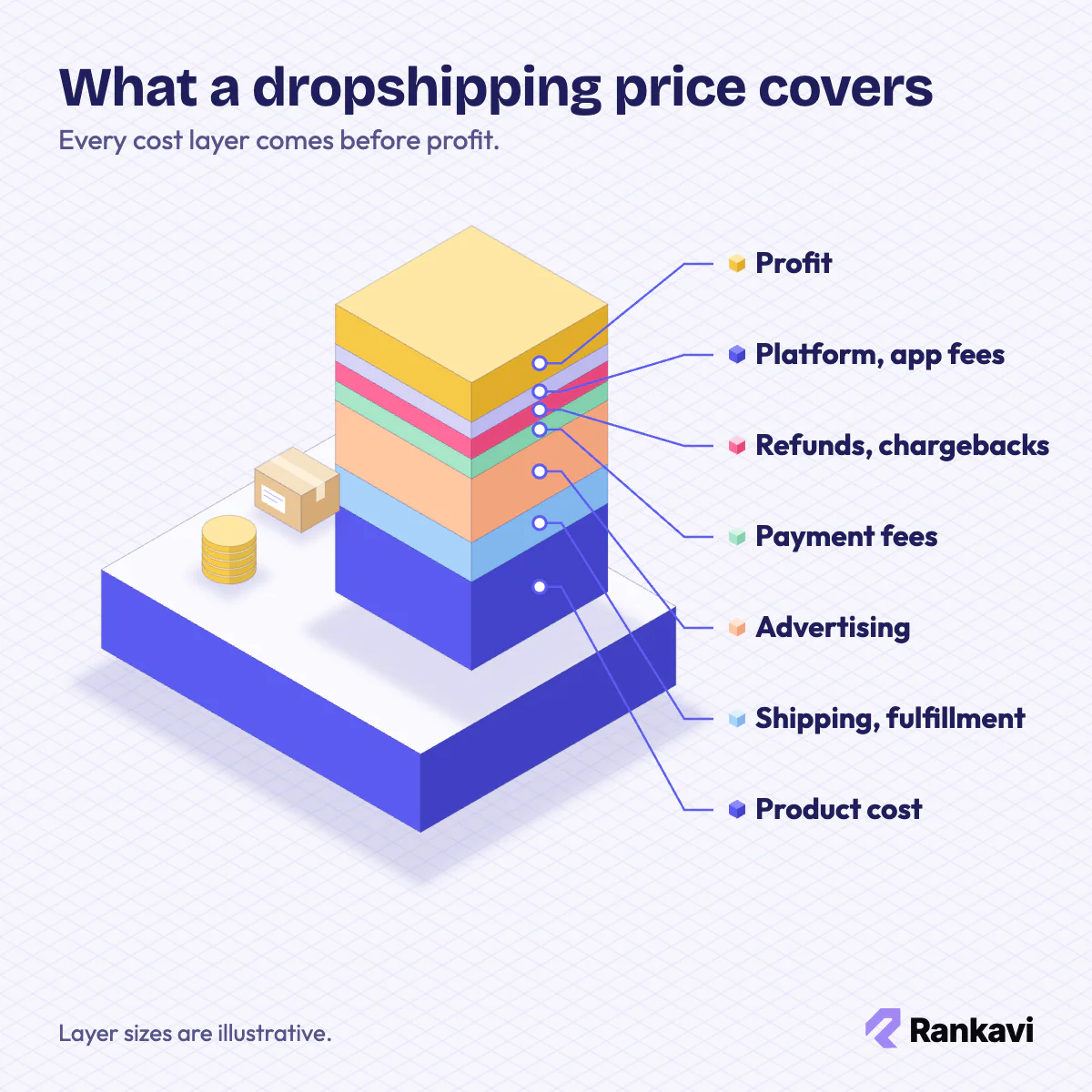
The gap between the supplier price and the selling price has to absorb everything else an order costs. Many beginners ignore those hidden costs and lose money once ads and refunds arrive. Each price has to cover six costs:
- Product cost: The amount paid to the supplier for the item itself.
- Shipping and fulfillment fees: What it costs to get the order to the buyer.
- Advertising and marketing: The spend needed to bring a buyer to the store.
- Payment processing fees: The share each checkout provider takes from the sale.
- Refunds and chargebacks: The money lost when a buyer returns an order or disputes the charge.
- Platform and app fees: The regular cost of the store software and its add-ons.
Card fees alone take a fixed bite. Shopify is a commerce platform, and its US Basic plan charges 2.9% plus 30 cents per online card sale as of 2026, per ecomm.design’s pricing review.
PayPal is a payment company, and it costs more. PayPal charges 3.49% plus 49 cents on US PayPal Checkout sales under fees effective October 2026. Shopify also adds a 2% fee on the Basic plan for third-party processors, as of 2026.
A chargeback costs more than the lost sale. Shopify Payments charges a $15 fee per US chargeback as of 2026, returned only if the store wins.
Imported products now carry duties even at low values. U.S. Customs and Border Protection (CBP) is the federal agency that collects import duties. CBP indefinitely suspended the $800 de minimis duty-free exemption for all countries in 2026. Duties on overseas parcels therefore belong in the product cost.
With every cost listed, one number shows whether a price works. Contribution margin after ad cost is the number to check first.
Per order, it equals the price minus product, shipping, card fees and the ad spend needed to win that order. The ad spend depends on how many paid visits it takes to produce one sale.
Shopify’s blog cited a 2.66% global average conversion rate across all ecommerce in 2026 from Dynamic Yield, a personalization vendor. That cross-industry figure is a proxy, and new dropshipping stores often convert lower. At that rate, roughly 38 paid visits produce one order, so the click price sets break-even.
Ad dashboards report that same math in their own units. Break-even return on ad spend (ROAS) turns the margin into the number those dashboards show. It equals the price divided by the margin before ads.
Worked example: An illustrative store sells a $40 pet gadget costing $16 with shipping. Card fees take $1.46, leaving $22.54 per order before ads. At 38 visits per order, break-even is about 59 cents a click. A $400 test at 50 cents a click buys 800 visits, 21 orders and $473 margin. After ads and a $29 plan billed yearly, about $44 remains, before refunds, owner pay and taxes.
That math checks a price, but a store still needs a first price to test. Keystone pricing means setting the price at double the landed cost. Shopify’s compare-at price field shows a crossed-out original price next to the sale price.
Shipping costs can sit inside that price instead of beside it. Free shipping is a pricing choice. Building shipping into the product price keeps the margin and shows buyers one simple total.
Value beats the lowest price. Clear positioning, strong product pages, fast shipping and trust signals support a higher price. Profit per order beats total revenue as a guide.
6. Budget for Startup Costs
A dropshipping startup budget covers the store, the tools and the first marketing tests, not inventory. The supplier gets paid only after a customer buys.
No upfront stock is the model’s biggest advantage. Sellers avoid warehouse space and unsold products. A listing that never sells costs only the time spent on it.
The figures below show what the remaining costs add up to.
Startup money at a glance:
| Item | Figure |
|---|---|
| Startup cost | About $30 to $40 per month fully organic on Shopify, about $600 per month with paid tools and ads, $1,400+ for aggressive testing |
| Main costs | Shopify Basic plan ($39 a month, or $29 billed yearly in the US), ad testing ($300 to $500 a month), supplier and research apps ($0 to $99 a month each), domain ($14 to $25 a year), samples |
| Typical margin | 15% to 30% profit margin after product, shipping, fees and ads |
| Time to open | One to three weeks for a first-time seller |
Sources: ecomm.design, 2026; TrueProfit, 2026; AutoDS, 2026; Doba, 2026. TrueProfit, AutoDS and Doba sell dropshipping software, so these rows are vendor estimates.
Of those lines, ad testing usually takes the largest share. TrueProfit, a vendor that sells profit-tracking software, advises at least $300 to $500 a month for paid tests in 2026. That amount buys enough clicks to judge a product. The money goes to Meta Ads, TikTok Ads or Google Ads. A small budget split across all three leaves each one with too few clicks to judge.
The app budget covers a sourcing tool such as DSers, Zendrop or Spocket, plus a review app. Most stores need only one sourcing app at launch.
A cash reserve covers refunds. The store refunds the buyer at once, while a supplier credit may take longer or never come.
Early costs drop further when free tools stand in for paid services. Three free options cover the basics at launch:
- Free store themes: The store can open on a free theme instead of a paid one.
- Canva: This free design tool makes the store’s graphics.
- Organic social posts: Unpaid social posts stand in for paid promotion.
Each one gets replaced only when sales justify the upgrade.
Some wholesalers also charge monthly fees or set minimum orders. Those figures belong in the budget before signing.
7. Register the Business Legally
Registering a dropshipping business involves choosing a legal structure, a name and the local licenses the store needs. Payment processors and supplier accounts both ask for these details.
Many sellers start as a sole proprietorship. Once sales grow large enough to justify liability protection, they form a limited liability company (LLC) instead.
The following are the five registrations a dropshipping store works through:
- Employer identification number (EIN): This free number comes from the Internal Revenue Service (IRS), which is the federal tax agency. An EIN opens business banking and wholesale accounts.
- State LLC filing: An LLC is filed with the state’s Secretary of State. The same office records the official business name.
- Doing business as (DBA) name: A store trading under a name other than its registered one files a DBA.
- General business license: Most cities and counties require one even for an online store.
- Sales tax permit: This one carries extra weight in dropshipping. The store, not the supplier, charges buyers tax. The store also hands suppliers resale certificates, which show the goods are bought to resell.
Sales tax can reach beyond the home state. In South Dakota v. Wayfair, the U.S. Supreme Court ruled in 2018 that states may tax sellers without a physical presence.
Government registration is only half the picture. Marketplaces set their own dropshipping rules. Amazon requires the seller to be the seller of record and handle all customer service. On eBay, dropshipping is allowed only from wholesale suppliers, never by buying from another retailer.
8. Build Your Online Store
The online store turns traffic from ads, social media and search into paid orders. Owning that store gives full control over branding, pricing and customer data.
That control starts with the platform the store runs on. Several ecommerce platforms suit dropshipping, and each one fits a different kind of seller. Shopify wins beginners with its apps and ease of use. WooCommerce, BigCommerce and Wix eCommerce cover other needs. The table below matches each platform to the seller it fits best.
Popular store platforms:
| Platform | Best fit |
|---|---|
| Shopify | Beginners who want apps and simple setup |
| WooCommerce | WordPress users who want full customization |
| BigCommerce | Growing stores that need to scale |
| Wix eCommerce | Beginners who want built-in design tools |
Once the platform is chosen, the store needs a look and a set of pages. A clean free theme works fine at launch. About, Contact, Shipping Policy and Return Policy pages earn trust. Product pages focus on benefits with sharp images.
Some of those policy pages come ready-made. Shopify generates refund, privacy and terms of service policies from a built-in template. Review apps such as Judge.me and Loox add customer photo reviews to product pages.
A store that earns trust still needs a way to collect money. Shopify Payments is the simplest checkout option on Shopify. A PayPal Business account adds a second choice many buyers prefer. A test purchase confirms checkout works before launch.
Where that checkout gets used matters too. TikTok and Instagram are phone apps, so ad traffic from them lands on phone screens. A test purchase on a phone checks that path.
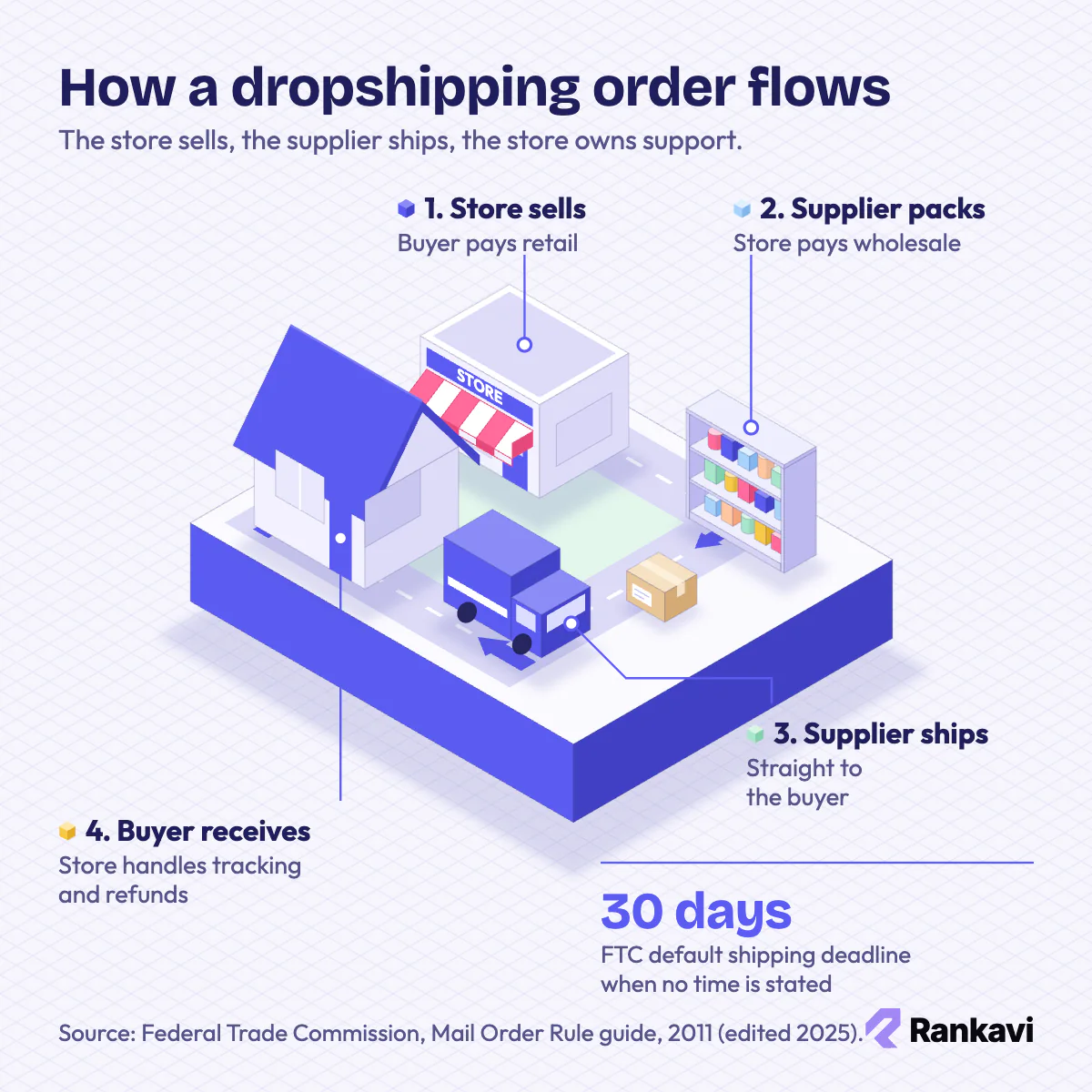
Order handling starts the moment a sale arrives. DSers or a similar app can forward the order automatically. The seller then forwards any remaining orders, uploads the tracking number and answers every message. Damaged or missing items still get refunded by the store.
Shipping promises carry legal weight. The Federal Trade Commission (FTC), which protects U.S. consumers, enforces a mail order rule. Without a stated time, a store must ship within 30 days. Any delay requires a notice offering the buyer a cancellation.
9. Market the Store to First Buyers
Dropshipping marketing puts the first targeted visitors in front of a store that would otherwise sit empty. One or two channels work better than many at once.
Picking the first channel comes down to where the buyers already spend their time. Whichever platform the audience uses most becomes the first channel. TikTok and Instagram Reels suit products with a visual wow factor. Facebook and Pinterest reach other buyer groups.
Short video ads show the product solving a problem, and a smartphone is enough to film them.
Meta Ads Manager and TikTok Ads Manager run these campaigns. A small daily budget gives the ad platform time to find the right audience. TikTok Spark Ads boost an existing organic post as an ad.
A tracking pixel records which visitors bought. The Meta Pixel and TikTok Pixel send purchase data back, so each platform finds similar buyers.
Return on ad spend and cost per acquisition (CPA) show whether a test pays. Each result is compared with the break-even ROAS from the pricing step.
Three free channels support paid ads and build reach:
- Organic social posts: These posts build reach without any ad spend.
- Email campaigns: Mailchimp sends them. Klaviyo, an email and text message platform for online stores, offers an alternative to Mailchimp.
- Blog content: Helpful blog content builds reach as well. Search engine optimization (SEO) lets those posts draw Google buyers over time.
Google lists products for free too. Google Merchant Center is Google’s tool for listing a store’s products. Its free listings can appear on Google Search, the Shopping tab, YouTube and Gemini at no cost.
Reach can also be borrowed instead of bought. Influencer marketing borrows an audience that already trusts the creator. A product shown by a niche influencer reaches buyers without a large ad spend. The FTC’s Endorsement Guides require a free product or payment to be disclosed clearly when buyers would not expect it.
User-generated content (UGC) creators film product videos for a fee. The store then runs those videos as its own ads.
10. Scale With Data and Branding
Scaling a dropshipping store involves reading the data, keeping what works and building a brand around it. Growth comes from repeating proven products and channels.
The first numbers come from the store itself. Google Analytics is Google’s web analytics service, and it tracks how visitors move through the store. Its funnel events show how many shoppers abandon a full cart. Those shoppers picked a product and then left without paying. Reminder emails and retargeting ads win back part of that group.
Store data shows what happens after a click. The ads that buy those clicks need their own review. After a few days, weak ads get switched off and the budget moves to winners. Deciding which products deserve that budget takes three numbers:
- Customer acquisition cost (CAC): the amount the store spends on marketing to win one customer.
- Average order value (AOV): the average amount a shopper spends in a single order.
- Customer lifetime value (LTV): the total amount a customer spends at the store over time.
Together they show which products earn repeat profit.
Scaling takes two forms. Vertical scaling raises the budget on a winning ad. Horizontal scaling adds new audiences, products or platforms.
Winning ads also wear out as the same people see them again, so fresh videos replace them. Misses are part of the same process. A failed first product is a lesson, not a reason to quit.
Automation tools take over repetitive work as orders grow. Inventory Source and Spark Shipping sync stock levels and route orders to suppliers. This prevents sales of out-of-stock items.
Dropshipping can serve as a bridge to a full brand. Best sellers become branded versions with custom packaging, a step called private labeling.
Some stores later hold their own inventory for better margins and quality control. Stored goods still have to reach buyers. A third-party logistics (3PL) company such as ShipBob stores that inventory and ships each order.
A brand worth scaling needs protection. The U.S. Patent and Trademark Office (USPTO), which registers brand names and logos, handles federal trademark filings.
11. Get Found When Shoppers Ask AI
AI visibility means a store gets named when shoppers ask ChatGPT, Gemini or Perplexity where to buy a product. Those answers draw on gift guides, product roundups and review pages that already mention the store.
The wording inside those mentions matters, because of how shoppers phrase their questions. Dropshipping buyers rarely search for a store name. They ask for “a quiet dog water fountain for a small apartment” instead. Product pages and outside mentions should use that same wording.
Google AI Overviews and Amazon’s Rufus shopping assistant answer the same kind of question inside search and Amazon.
Product schema markup labels price, stock and reviews in code that machines read. Asking an assistant the exact buyer question shows whether the store appears today.
A new store lacks the review history big retailers have. A few honest mentions in niche roundups give assistants a reason to include it.
Earning those mentions is a service a store can buy. Rankavi is a software as a service (SaaS) platform that publishes brand mentions in articles on indexed third-party websites. Stores pay $12 per mention in the 50-credit pack. Stores hoping Google’s assistant will suggest them can start with Gemini citations.