

Starting a dog walking business takes little gear but real trust, because owners hand over dogs and house keys. The U.S. Bureau of Labor Statistics (BLS), which publishes national wage data, counted 266,910 employed animal caretakers in May 2025.
I am Michal Sieroslawski, and I help dog walking businesses show up in Google and AI search. Many dog owners now begin their search for a dog walking business inside an AI chat. That makes a place in those answers worth working toward.
The order below fixes the service menu and walk rates before any filing fee gets paid. Permits, insurance and client contracts then come before the first house key changes hands. To start a dog walking business, follow the twelve steps below.
- Choose Your Dog Walking Services
- Research Demand in Your Neighborhood
- Write a One-Page Dog Walking Plan
- Price Walks by Length and Group Size
- Budget the Startup Costs
- Register Your Business and Open a Bank Account
- Get Local Permits and Pet First Aid Training
- Insure and Bond Your Walks
- Pack a Walker’s Gear Kit
- Set Up Contracts, Keys and Scheduling Software
- Market to Dog Owners Nearby
- Feature in Copilot and Other AI Answers
1. Choose Your Dog Walking Services
A new dog walker first decides which walks to sell and which dogs to accept. That menu sets the gear, the insurance and the price sheet in later steps.
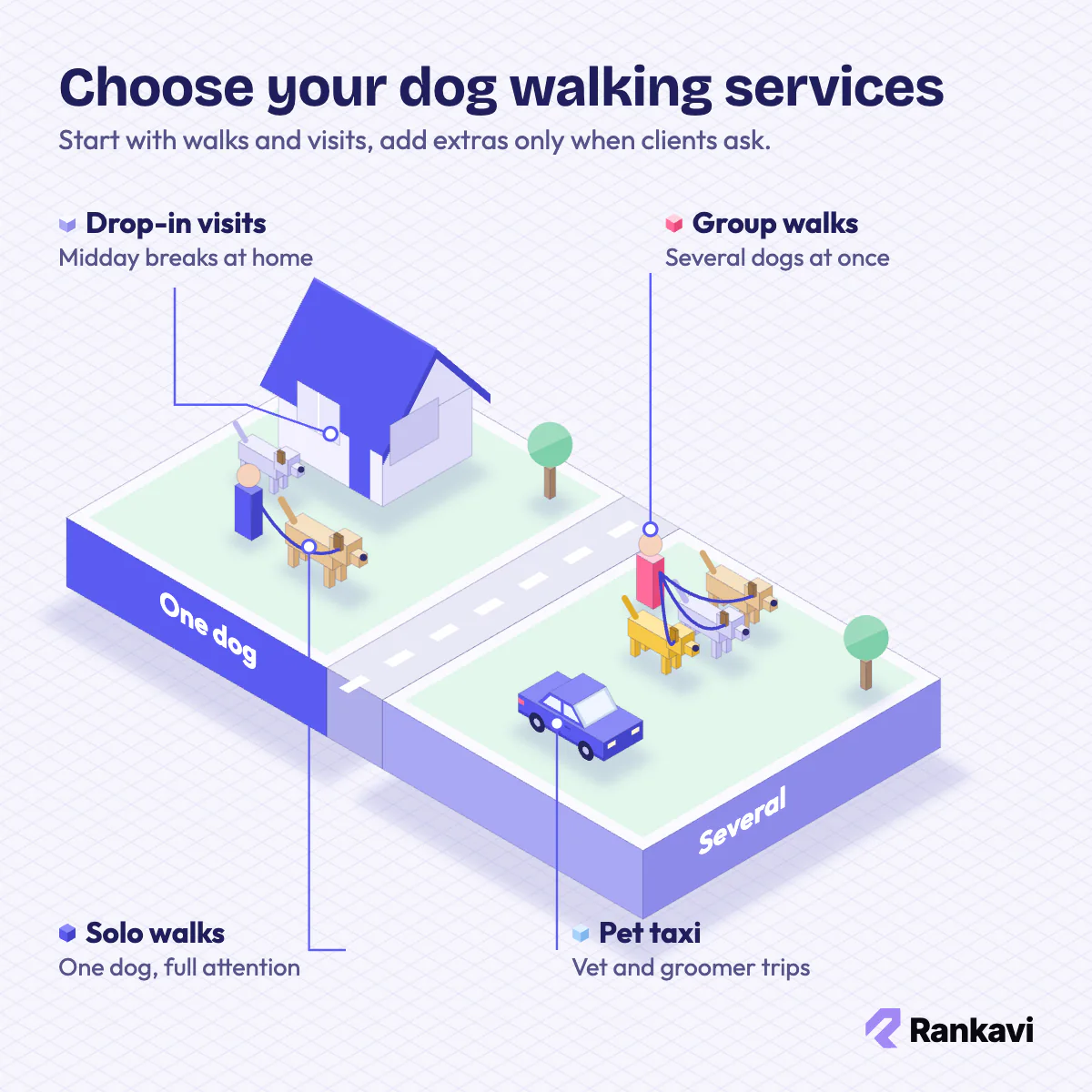
Solo walks are the simplest starting service. One dog gets full attention, and the walker learns its habits quickly. Group walks, by comparison, move several dogs at once and multiply revenue per hour. They suit walkers with experience reading dog behavior.
Group walks also carry trade-offs. More dogs raise the risk of fights and escapes, and some cities cap the group size. A walker who dislikes that risk can stay with solo walks and still earn well.
Drop-in visits fill the gaps between full walks. A short home visit gives a puppy, a senior dog or a small breed a bathroom break and some play. Owners with long workdays often book these midday visits.
Common add-on services:
| Add-on | Typical client |
|---|---|
| Dog running or hiking | Owners of high-energy breeds |
| Pet sitting and overnight stays | Owners who travel |
| Medication visits | Owners of senior or sick dogs |
| Pet taxi | Owners who need vet or groomer trips |
A short menu works best at launch. Three walk lengths and one drop-in visit cover most requests. New services join the list only when several clients ask for the same thing.
Dogs that pull, react to other dogs or show aggression need a closer look. Many walkers decline those dogs at first. Others accept them for solo walks only, since one bad incident can cost clients.
2. Research Demand in Your Neighborhood
A demand check shows whether enough busy dog owners live close together to fill a daily route. A dense area keeps travel time low and visits on schedule.
The national pool is large. The American Pet Products Association is a trade association for pet product businesses. Its 2025 National Pet Owners Survey counted 71 million U.S. households with a dog.
Service area size depends on the setting. In a big city, a walker covers a few blocks or one neighborhood. In a small town, the same business may need several zip codes. Travel time between homes belongs in every decision.
Competitor checks come next. Rover, which operates an online marketplace for pet sitting and dog walking, shows which walkers already work nearby. Doggy daycares and boarding kennels compete for the same owners too.
Dog parks give honest answers. Owners there explain which walkers they use and which services they cannot find. Those gaps become the selling points of a new company.
Dog count is not the only measure. A busy route also needs enough clients on the same few streets to avoid long gaps between visits.
Public records add a rough headcount. Many counties require dog licenses, and those lists are often public at the city or county office. A license list estimates how many dog owners live in each area.
3. Write a One-Page Dog Walking Plan
A dog walking plan fits on one or two pages because the business has few moving parts. The plan still forces clear answers before money gets spent.
A dog walking plan covers five sections:
- Summary: services, service area and goals
- Market: target owners and local competitors
- Operations: walk schedule, gear and software
- Finances: startup budget and monthly income target
- Marketing: first channels for winning clients
Income timing is the key assumption in this plan. A client list grows slowly, so many walkers keep a full-time or part-time job at first. The plan sets the client count that allows the switch.
Two benchmarks frame the income target. The BLS reported a median wage of $17.00 an hour for employed animal caretakers in May 2025. Pet Sitters International is an educational association for pet sitters and dog walkers. Its 2026 survey reported average 2025 gross revenue of $112,423 among U.S. members.
The workload deserves an honest line too. Walks happen in rain, heat and snow. Holidays bring the busiest weeks because clients travel, so a solo walker needs a backup plan for sick days.
A backup plan can be another trusted walker who covers visits, with the client told in advance. Without cover, one sick day means missed visits and unhappy owners.
“My daughter likes being her own boss but if she is ill or wants some time off things are a bit more difficult although I do help out.”
— A dog walker’s parent on the MoneySavingExpert forum
4. Price Walks by Length and Group Size
Pricing dog walks sets one clear rate for each walk length and visit type. Clear rates matter because price is often the first thing an owner checks on a website.
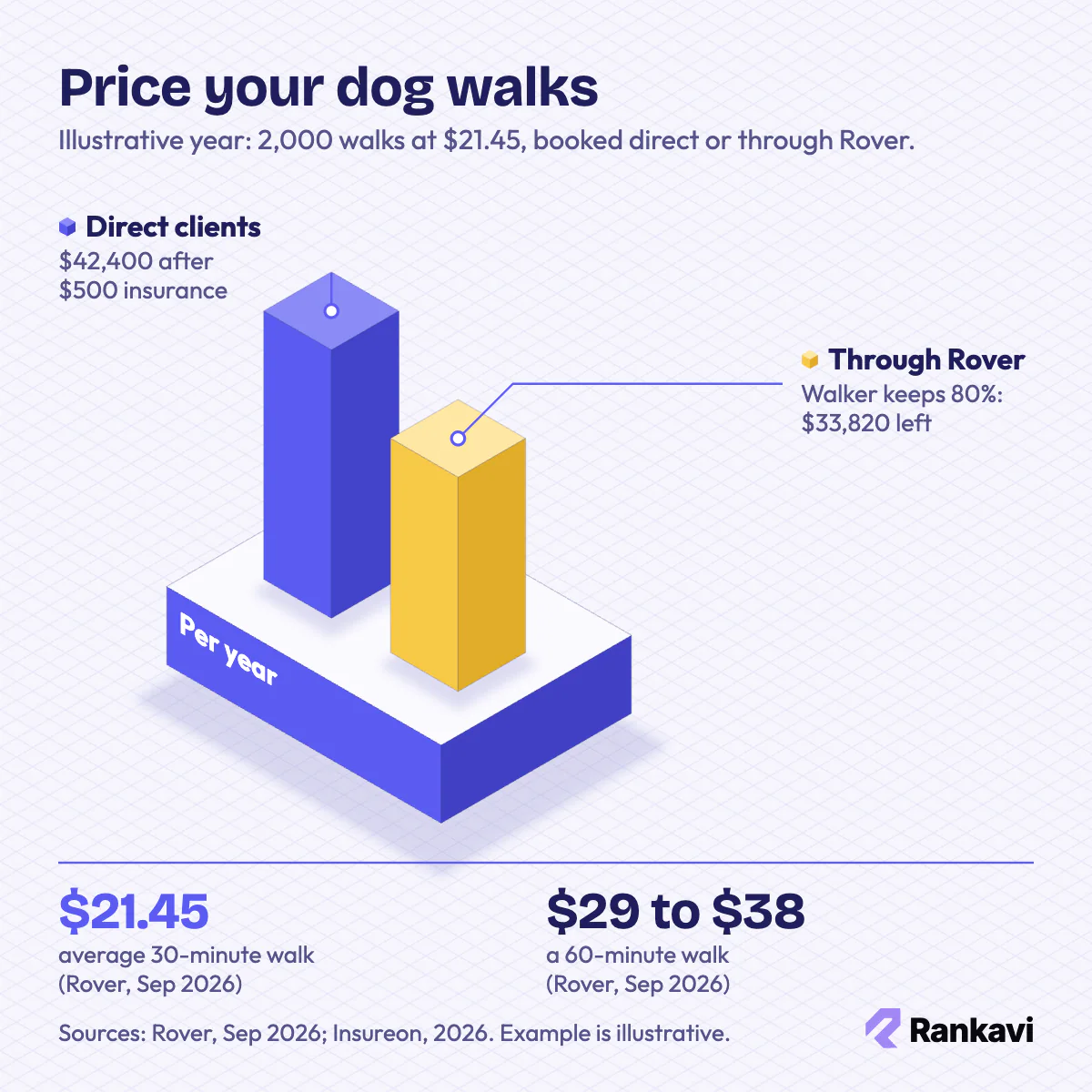
The going rate is the key number in this trade. Rover, a pet care marketplace, put its average U.S. rate for a 30-minute walk at $21.45 in September 2026. Its September 2026 rate table showed $29 to $38 for a 60-minute walk.
Startup money at a glance:
| Item | Figure |
|---|---|
| Startup cost | $500 to $1,000 for a solo walker |
| Main costs | General liability insurance (about $500 a year), state filing and local license fees, website, flyers, walking supplies |
| Typical margin | 33.38% gross, 7.03% net for listed business and consumer services firms (proxy; solo walkers carry far lower overhead) |
| Time to open | Varies with state filing and city permit times; no published benchmark |
Source: Pet Care Insurance, a pet care insurer, vendor estimate, June 2026; Insureon, an online insurance agency, median quotes, 2026; Aswath Damodaran, NYU Stern margin data, January 2026.
Walk length is the simplest pricing unit. Many walkers sell short, medium and long walks, and price drop-in visits at the same rates. Some charge per half hour with a discount for longer sessions.
Position sits near the local average. The cheapest rate in town rarely covers costs, and the highest rate needs a clear reason, such as medical training. Every rate must cover labor, insurance, fuel and marketing, with profit left over.
Extras add income without new clients. A second dog from the same home gets a lower add-on rate. Same-day requests, early or late walks and peak holiday dates carry surcharges. Every extra belongs on the website and in the service agreement.
A written rate sheet also makes later increases easier to explain. Clients should get notice of any change before it takes effect.
Worked example: As an illustration, a solo walker books eight 30-minute walks a day at $21.45. The walker works five days a week for 50 weeks. That is 2,000 walks and $42,900 a year booked direct. Insurance at $500 leaves $42,400 before fuel and taxes. The same walks through Rover pay 80%, or $34,320, leaving $33,820 after insurance. Direct booking keeps $8,580 more a year.
5. Budget the Startup Costs
A dog walking budget covers the few costs that come before the first invoice. Most of the money goes to paperwork, insurance and marketing, not equipment.
Startup costs fall into a handful of groups. Business registration, a local license, insurance and a basic website come first. Marketing materials, a pet first aid class, association dues and supplies follow.
Ongoing costs are modest but steady. Fuel, vehicle upkeep, insurance renewals and software fees repeat every month. Walkers who drive between homes feel fuel costs most.
Personal savings matter more than loans in this trade. The client base takes months to build, and income stays uneven in the early weeks. A small cash cushion covers personal bills while the route fills.
Cutting costs early rarely pays off in this trade. Skipping insurance or first aid training saves little and exposes the owner to the biggest losses. Equipment is the safest place to spend less, since a used leash works as well as a new one. Small Business Administration (SBA) microloans exist, but few walkers need one.
6. Register Your Business and Open a Bank Account
Registering a dog walking business means choosing its legal form and filing its name with the state. That filing lets the company sign client contracts and open accounts.
Two structures dominate this trade. A sole proprietorship is the simplest form, and the owner and business are legally the same. A limited liability company (LLC) separates personal assets from business debts and claims. Many walkers choose an LLC because a dog bite claim can be expensive.
A sole proprietor who trades under a brand name files a “doing business as” (DBA) name. Before filing, the owner checks state business records and trademark records for conflicts. The matching domain and social handles should be free too.
The Internal Revenue Service (IRS), the federal tax agency, issues an employer identification number (EIN) free of charge. An EIN is needed to hire staff and usually to open a business bank account. A separate account keeps client payments apart and protects the LLC’s liability shield.
Walkers who work alone do not have to form an LLC on day one. A sole proprietorship can start earning at once. The owner can switch to an LLC later. An LLC does not replace insurance, because it protects personal assets only in some situations.
7. Get Local Permits and Pet First Aid Training
Licensing a dog walking business involves the permits that let it operate in its city. Rules vary widely, so the city or county office is the first stop.
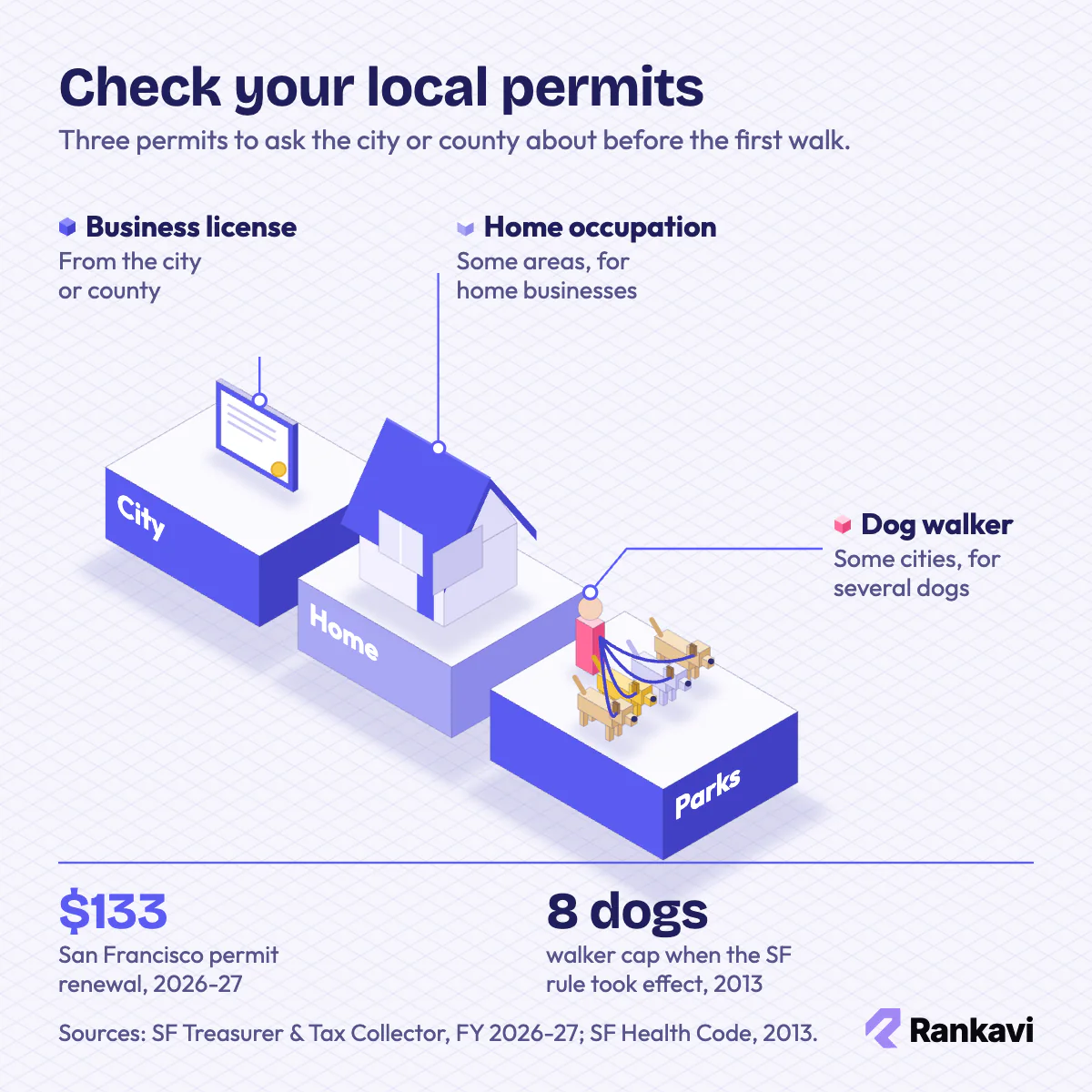
New walkers check three local permits:
- Business license: issued by the city, or by the county outside city limits
- Home occupation permit: required in some areas for home-based businesses
- Commercial dog walker permit: required by some cities for walking several dogs in public
San Francisco shows how strict a city permit can get. San Francisco Animal Care and Control issues the city’s commercial dog walker permits. The city’s 2026-27 license rate table lists a $133 renewal fee. When the rule took effect in July 2013, it required a permit for four or more dogs and capped walkers at eight.
No national license exists for dog walkers. Pet first aid and cardiopulmonary resuscitation (CPR) courses still teach walkers to handle choking, wounds and heatstroke. Clients value a certificate because emergencies happen on walks.
Associations add credibility. The National Association of Professional Pet Sitters is a nonprofit trade group that runs a certified pet sitter program. Pet Sitters International also offers certification and education to its members.
8. Insure and Bond Your Walks
Dog walker insurance protects the business when a dog bites, escapes or gets hurt on a walk. Many clients ask for proof of insurance before handing over keys.
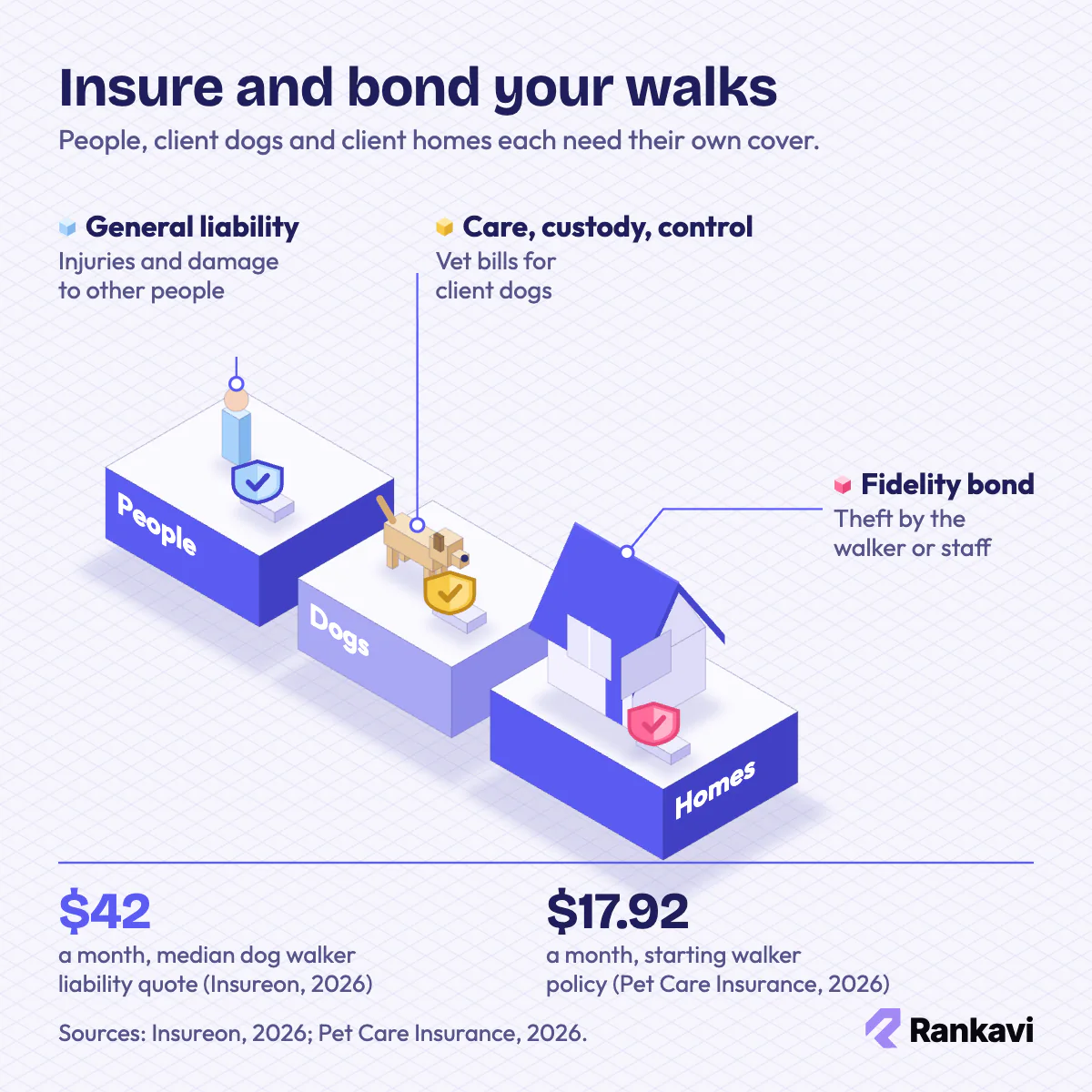
General liability is the core policy. It covers injuries to other people and damage to their property, such as a loose dog knocking over a cyclist. Insureon, an online insurance agency, put the median quoted premium for dog walkers at $42 a month, or $500 a year, in 2026.
Standard liability policies exclude animals in the policyholder’s care. Care, custody and control coverage, also called animal bailee coverage, fills that gap. It pays vet bills for an injured client dog. Pet Care Insurance, an insurer for pet care professionals, listed in 2026 a walker policy with pet protection from $17.92 a month, or $194 a year.
A fidelity bond covers theft by the walker or staff. Clients trust walkers with their homes, so “insured and bonded” is a strong line on a website. Workers’ compensation joins the list once the first employee is hired.
Insurance terms differ by policy, so the exclusions deserve a careful read. Questions to ask an agent include whether group walks, off-leash time and dog transport are covered. A policy that excludes any of these leaves a gap exactly where claims tend to happen.
9. Pack a Walker’s Gear Kit
Dog walking gear fits in a backpack, and most items come from any pet store. A spare leash and a few basics prevent most problems on a route.
A basic walking kit holds five items:
- Leashes: a spare leash and a slip lead for emergencies
- Waste bags: a large supply on every walk
- Water: a collapsible bowl and a water bottle
- Treats: for recall and good behavior
- First aid kit: bandages, wipes and tick removal tools
Weather gear keeps the schedule running. Rain jackets, good walking shoes and reflective vests for dark mornings are part of the job. In hot months, walkers shorten routes and carry extra water.
A car widens the service area but adds costs. Walkers who drive dogs to parks need crates or seat harnesses. Transporting dogs also calls for the right auto insurance.
10. Set Up Contracts, Keys and Scheduling Software
Client paperwork keeps every walk, key and payment clear from the first visit. Clear terms prevent disputes over cancellations, vet bills and lost keys.
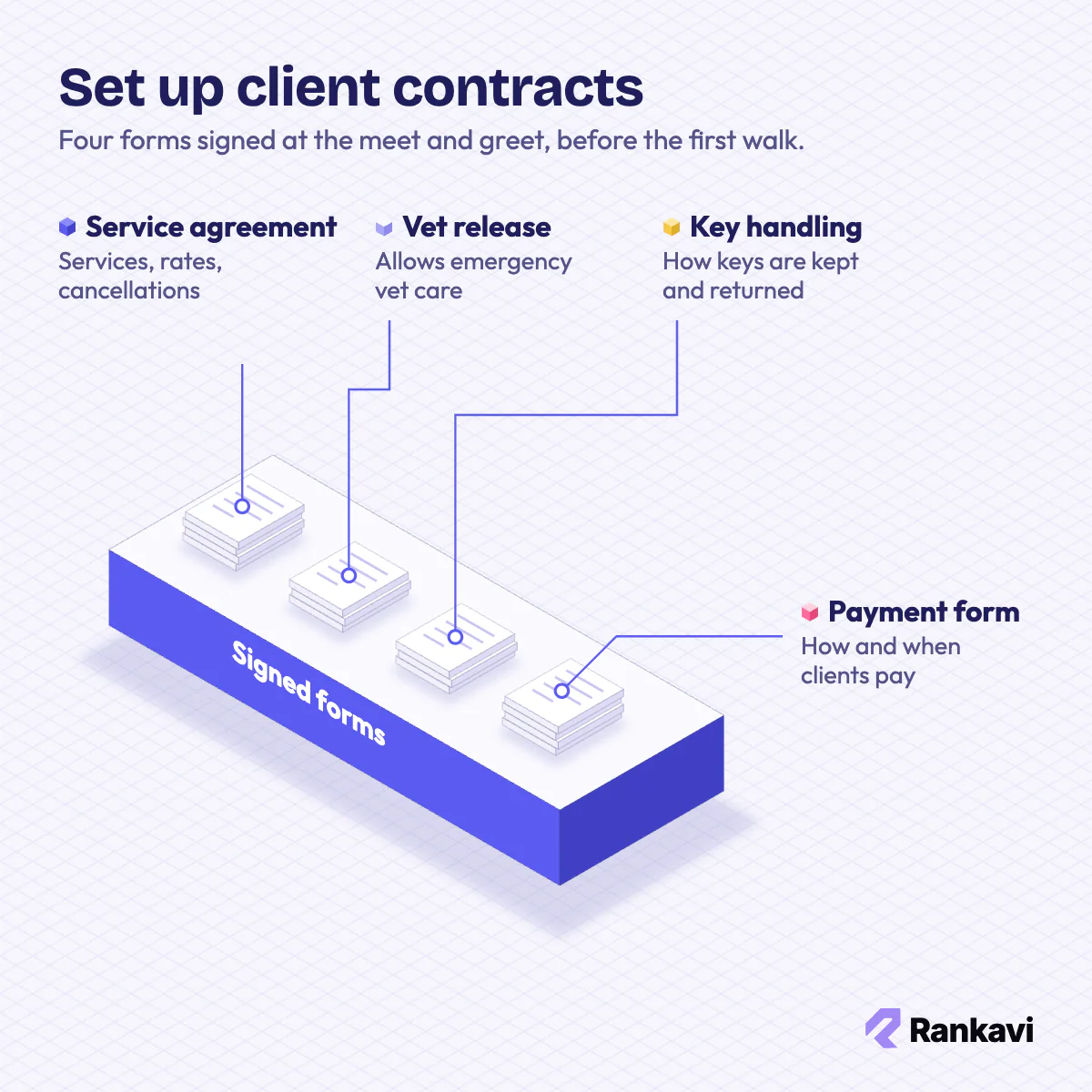
Core client documents:
| Document | Purpose |
|---|---|
| Service agreement | Lists services, rates and policies |
| Vet release form | Allows emergency vet care |
| Key handling form | Records how keys are stored and returned |
| Payment authorization | Sets how and when clients pay |
A lawyer should review every template before use. A cancellation policy belongs in the service agreement so walkers get paid for last-minute changes.
The meet and greet is the first client visit. The walker meets the dog, reviews policies and collects signed forms. That first visit also tests whether the dog fits solo or group walks.
The meet and greet is also the time to ask about vaccines, medical needs and behavior triggers. Written notes from this visit give any backup walker what is needed to care for the dog safely.
Scheduling software keeps a growing route organized. Time To Pet, which is pet care software for walking and sitting businesses, handles bookings, invoices and client messages. Accounting software such as QuickBooks Online tracks income and expenses for tax time.
11. Market to Dog Owners Nearby
Most dog walking clients come from nearby streets, so local marketing beats broad advertising. Word of mouth stays the strongest channel once the first owners are happy.
A website works as the digital storefront. It lists services, rates, the service area, policies and a booking form. Owners check it before they call.
Photos of the walker with dogs, a short bio and clear safety policies answer the questions owners worry about most. These details help owners decide whom to trust with a dog and a key.
“She set up her own website and this has been far the best advertising tool.”
— A dog walker’s parent on the MoneySavingExpert forum
Google Business Profile is Google’s free listing for Search and Maps. Reviews there and on Yelp build trust quickly, and prompt, polite replies show reliability.
Local partners send steady referrals. Veterinary clinics, groomers and pet stores meet dog owners every day. Business cards, flyers and door hangers in the target streets add reach.
Marketplace apps can bring early bookings at a cost. Rover’s help center stated in September 2026 that U.S. providers pay a 20% service fee. The same 2026 page lists a separate 11% booking fee for owners. Walkers often move repeat clients to direct booking.
12. Feature in Copilot and Other AI Answers
Dog owners now ask AI assistants for walker suggestions, much as they once asked neighbors. Microsoft Copilot, ChatGPT and Google AI Overviews draw names from directories, review sites and local “best dog walkers” lists. A new company that appears on those sites gives the assistants something to repeat.
Rankavi is a software as a service (SaaS) platform that publishes brand mentions in articles on indexed third-party websites. Walkers who want Copilot to find them can start with Microsoft Copilot brand mention placements on relevant pet care sites. Earning a place in those answers still depends on reviews and good service over time.