

Starting a crypto business means choosing a digital asset model, registering it with regulators and protecting customer funds before launch. Pew Research Center found in 2024 that 17% of U.S. adults had ever invested in, traded or used cryptocurrency.
A bit about me: my name is Michal Sieroslawski, and I help crypto businesses appear when users search online. AI answers are quickly becoming a starting point for users. The businesses named in those answers get the first look.
The order settles the model and the money before licenses. Each later step then fits the business the founder runs. Below are the thirteen steps, in the order most crypto founders take them.
- Choose a Crypto Business Model
- Research Crypto Users and Rivals
- Write a Compliance-First Business Plan
- Build the Platform or Product
- Set Fees and Revenue Streams
- Fund the Launch and Licensing
- Form the Company and Open Banking
- Register With FinCEN and State Regulators
- Insure Assets and Post Surety Bonds
- Protect Customer Assets in Custody
- Run AML Checks and Tax Reporting
- Market the Platform Responsibly
- Show Up in Gemini AI Answers About Crypto
1. Choose a Crypto Business Model
Choosing a crypto business model decides which rules apply, how much capital the company needs and who it serves. The model shapes every later step.
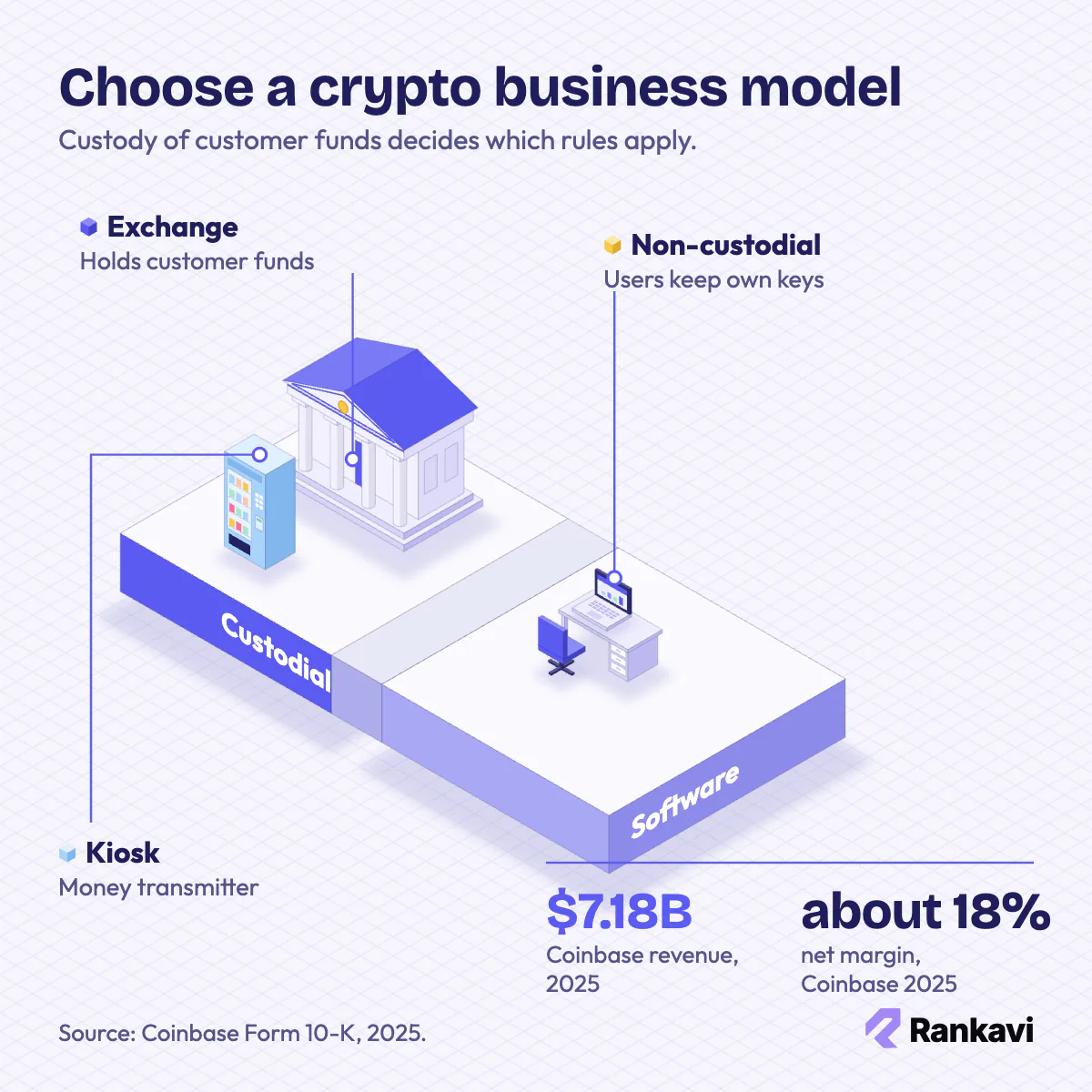
Custody is the first split. Exchanges, hosted wallets and crypto kiosks hold or move customer funds, so regulators treat them as money transmitters. Non-custodial software, where users keep their own private keys, usually falls outside that definition.
Several common models sit on that spectrum. A centralized exchange matches buyers and sellers, while a peer-to-peer (P2P) exchange connects traders directly through escrow. Kiosk operators place machines in shops, and token issuers create new digital assets.
Lower-risk models suit a first venture. Crypto education, analytics tools, payment plugins for merchants and blockchain development services avoid holding client money. These businesses still follow tax and consumer protection rules.
Custodial and non-custodial models trade cost for control. Custodial models need more capital and legal work but earn from trading fees and spreads. Non-custodial software launches faster and usually earns from subscriptions or service fees.
Non-custodial does not mean unregulated. A lawyer reviews whether the design still counts as money transmission. Token issuers need a separate legal check, because a token can count as a security.
The target customer narrows the choice further. Retail traders, merchants, institutions and developers each need different products, support and compliance depth.
Startup money at a glance:
| Item | Figure |
|---|---|
| Startup cost | Varies by model; software firms skip licensing, while custodial firms post state bonds from $300,000 (Texas minimum) to $7,000,000 (California maximum) |
| Main costs | Platform build, legal and licensing work, surety bonds and net worth, security audits, marketing |
| Typical margin | Coinbase, which is a publicly listed U.S. exchange, earned $1.26 billion net income on $7.18 billion revenue in 2025, about 18% net (large-firm proxy) |
| Time to open | Licensing reviews take 3 to 6 months in Texas and 18 to 24 months or more in New York |
Sources: Spark (a bitcoin and stablecoin developer platform), vendor estimates, 2026; Coinbase Form 10-K, 2025.
2. Research Crypto Users and Rivals
Researching the crypto market determines whether real users want the product and trust it enough to deposit funds. Trust is the main hurdle for any new crypto brand.
Pew Research Center, a nonpartisan research organization, reported in 2024 that 63% of U.S. adults had little or no confidence that crypto is reliable and safe. A newcomer therefore competes on security and clarity, not hype.
Competitor research covers features, fees, supported coins and supported states. Large exchanges already serve most mainstream traders. Gaps often sit in niche coins, local payment methods or underserved customer groups.
User interviews test the idea before code is written. Short surveys in crypto communities reveal which problems users would pay to solve.
A short interview script asks what the person uses today, what frustrates them and what they would pay to fix. A waitlist page tests demand before launch, with the pass mark set before the test starts.
A comparison sheet records each rival’s fees, supported coins, supported states and sign-up steps. Visible licenses, security audits and clear insurance terms answer the trust gap that Pew Research Center found.
3. Write a Compliance-First Business Plan
A crypto business plan turns the product, the revenue model and the regulatory path into one document. Banks, payment partners and regulators all read it closely.
Lenders and regulators expect a plan to cover six core sections:
- Model: This section describes the business model and the target customers.
- Regulation: This section maps the licenses the company needs, by state and by activity.
- Policies: This section sets out the anti-money laundering rules and the customer identification rules. Anti-money laundering rules are the steps a company takes to stop criminals from moving illegal money through it. Customer identification rules explain how the company checks who each customer is.
- Security: This section explains custody and wallet design. Custody means how the company holds and protects customer crypto.
- Finances: This section presents the revenue model and the financial projections.
- Partners: This section covers the banks and payment providers the company works with.
The regulatory map matters most of the six. It lists every activity the company performs. It then shows the license each activity triggers in each state.
A compliance analyst at a bank or regulator often reads the plan. A compliance analyst is a reviewer who checks whether a company follows the law. Because the analyst tests each claim, every claim in the plan needs a written answer behind it. For the same reason, the plan also states what the company will not do. Examples include serving restricted jurisdictions or opening anonymous accounts.
This written detail helps with more than approval. A strong compliance pack also helps the company open bank accounts. Before banks accept a crypto client, they review its source of funds, transaction flows and written policies.
4. Build the Platform or Product
The product build turns the plan into software users can trust with their money. Founders choose between building from scratch, licensing white-label software or buying an exchange script.
Building from scratch gives full control over features and security. White-label software launches faster, although the founder depends on the vendor for fixes and updates.
Design and usability decide whether new users finish signup. Clear onboarding, simple deposit flows and visible fees reduce abandoned accounts.
Testing comes before any public launch. Independent smart contract audits review code that holds value. A phased rollout with a small group of users exposes bugs while losses stay small.
Vendor contracts settle who owns the source code and what happens if the vendor shuts down. Wallet, node and payment services often come from specialist providers instead of in-house systems.
A first release covers signup, identity checks, deposits and withdrawals. Extra features wait until those basics run reliably.
5. Set Fees and Revenue Streams
Pricing a crypto platform sets how the business earns from trades, services and listings. Fees must stay visible because customers compare them across exchanges.
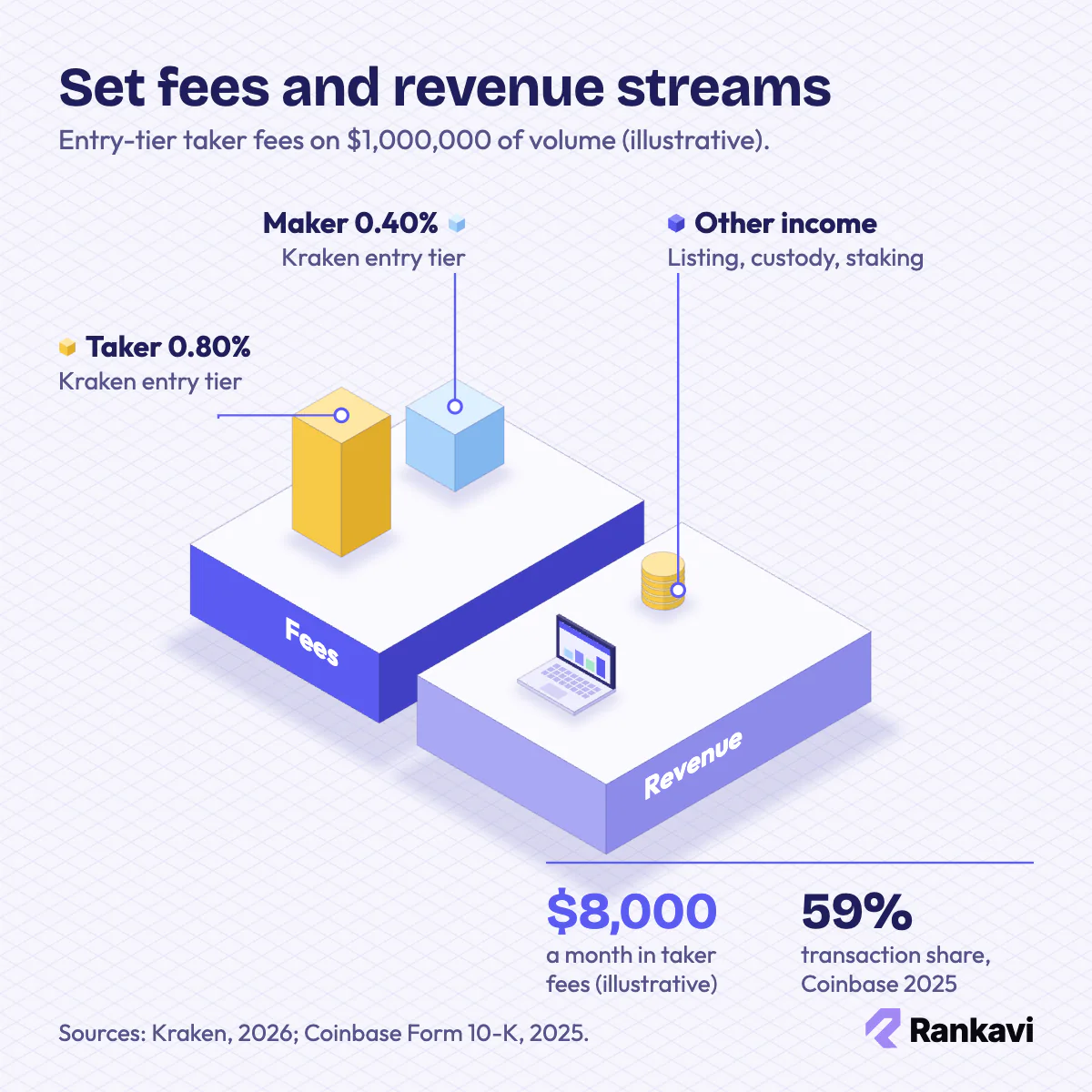
Trading fees are the main income for exchanges. Coinbase’s 2025 Form 10-K showed transaction revenue at 59% of its net revenue. Kraken is a U.S.-founded exchange. It charged 0.40% maker and 0.80% taker fees at its entry tier as of 2026.
The maker-taker model rewards traders who add liquidity with lower fees. Rates fall as monthly volume rises, so new platforms compete hardest on entry-tier pricing.
Fee models include flat fees, volume tiers, spreads and subscriptions. A spread is the gap between the buying and selling price. An app with no listed fee can still earn from it. Showing the full cost before a customer confirms a trade avoids complaints.
Example: a new exchange charges Kraken’s entry-tier taker fee on its first $1,000,000 of monthly taker volume (illustrative).
| Input | Amount |
|---|---|
| Monthly taker volume | $1,000,000 |
| Taker fee | 0.80% |
| Monthly fee revenue | $8,000 |
| One compliance officer at the median wage, per month | $6,728 |
| Left after that one salary | $1,272 |
| Result | Volume at this level barely covers a single compliance hire |
Other revenue lines spread the risk. Withdrawal fees, token listing fees, premium subscriptions, staking services and custody fees all add income.
Kiosk fees draw extra scrutiny. The Financial Crimes Enforcement Network is the Treasury bureau that enforces anti-money laundering rules. Its 2025 notice cited 10,956 kiosk complaints and $246.7 million in 2024 losses reported to the Federal Bureau of Investigation.
6. Fund the Launch and Licensing
Funding a crypto startup covers software, legal work, licensing capital and the months before revenue arrives. Regulated models need far more money than software businesses.
Startup costs fall into five groups. Platform development, legal work, bonds and net worth, security audits and marketing take most of the budget.
Licensing capital often exceeds the software budget. State regulators require money transmitters to hold minimum net worth and post bonds before approval.
Venture capital funds most custodial exchanges. Angel investors, strategic partners and founder savings fund smaller software or education businesses. Token sales carry securities risk and need legal review first.
Runway matters because license reviews take many months. The company pays staff and lawyers long before it can serve customers in every state.
Working through a licensed partner can cut launch capital. The trade-off is lower control and fees paid to the partner. Launching in a few states first spreads licensing costs over a longer period.
A contingency reserve covers license reviews that run longer than planned.
7. Form the Company and Open Banking
Forming a crypto company creates the legal entity that holds licenses, signs bank agreements and owns the code. Crypto founders usually pick a corporation or a limited liability company (LLC).
A corporation suits founders who plan to raise venture capital or issue stock options. An LLC suits smaller service and software businesses with a few owners.
The Internal Revenue Service (IRS) is the federal tax agency, and it issues a free employer identification number (EIN). The company needs that number for tax filings, payroll and bank applications.
Banking is often the hardest part. Many banks avoid crypto clients, so founders approach several banks and payment providers at once with the compliance pack ready.
A bank usually asks for the formation documents, the EIN letter and a list of owners. It also asks for written compliance policies and the source of funds. A refusal from one bank does not end the search, so applying to several in parallel saves time.
8. Register With FinCEN and State Regulators
Licensing a crypto business means registering the company federally and obtaining a license in each state where customers live. Custodial models, which hold customer funds, face the heaviest requirements.
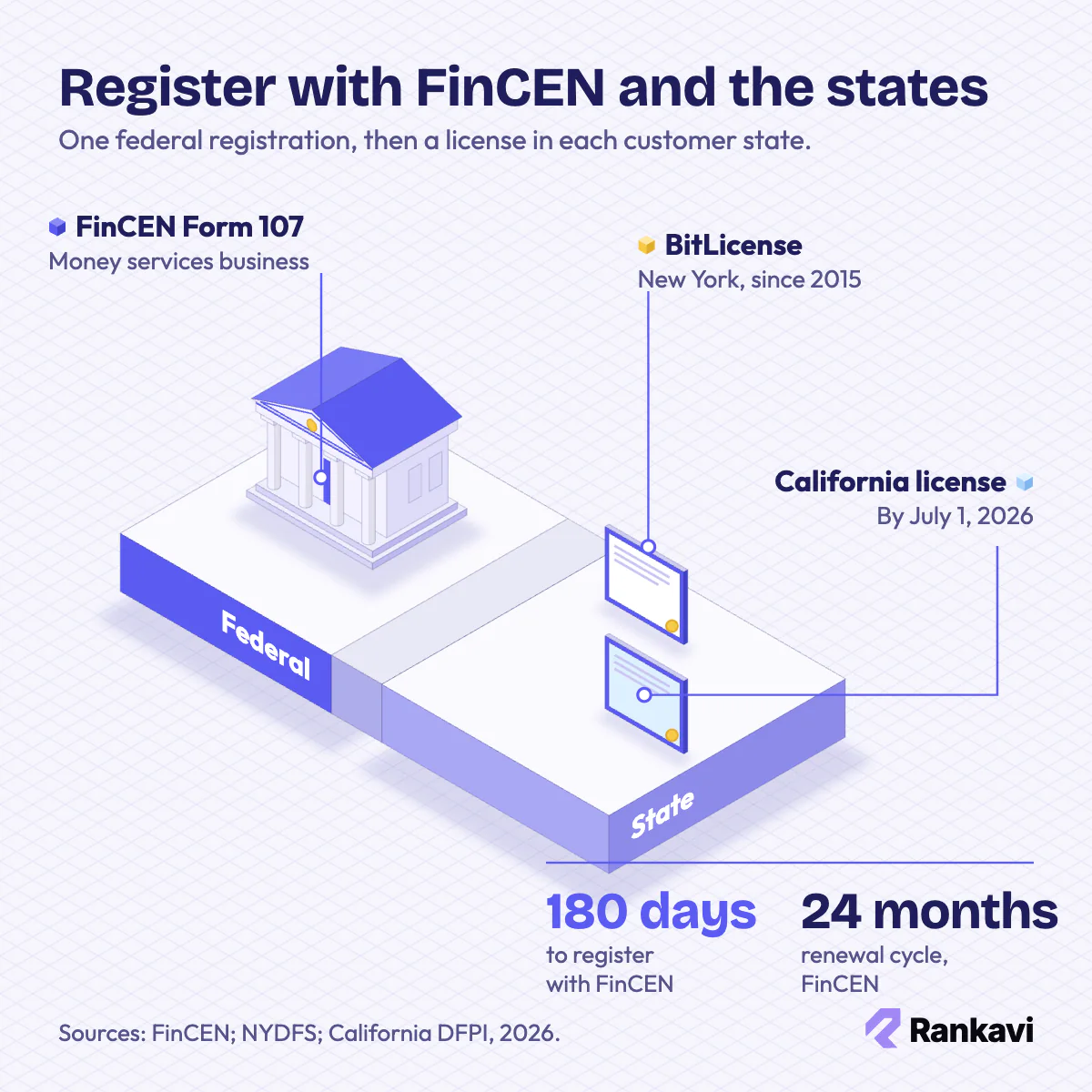
The federal step comes first. The Financial Crimes Enforcement Network (FinCEN) enforces the Bank Secrecy Act. FinCEN treats exchangers, hosted wallets and kiosks as money transmitters. A money transmitter is a business that moves money for other people. These businesses file FinCEN Form 107 within 180 days of starting. They then renew the registration every 24 months.
This federal filing has limits. FinCEN registration is a notice filed with the bureau, not an approval. It does not replace a state license, and each state decides separately.
State licenses come next. Most states require a money transmitter license for crypto transmission. The Nationwide Multistate Licensing System (NMLS) is the online portal for many of these applications.
Key US registrations:
| Registration | Who needs it |
|---|---|
| FinCEN money services business registration | Exchangers, hosted wallets and kiosks |
| State money transmitter license | Firms moving customer funds in that state |
| New York BitLicense | Virtual currency businesses serving New York residents |
| California digital financial assets license | Firms exchanging, storing or transferring crypto for Californians |
The New York State Department of Financial Services (NYDFS) issues the BitLicense. The BitLicense has been required since June 24, 2015. The California Department of Financial Protection and Innovation (DFPI) is the state’s crypto regulator. It required a license or a completed application by July 1, 2026.
Software developers, miners and merchants accepting crypto are generally exempt from the BitLicense. Since these exemptions apply only in general terms, a crypto lawyer confirms the exact scope before launch.
Some companies work through a licensed partner instead of holding every license themselves. In that case, the company still checks which licenses the partner holds before relying on them.
9. Insure Assets and Post Surety Bonds
Insurance for a crypto business protects the company and its customers when hacks, theft or errors cause losses. Regulators and banks often ask for proof of coverage.
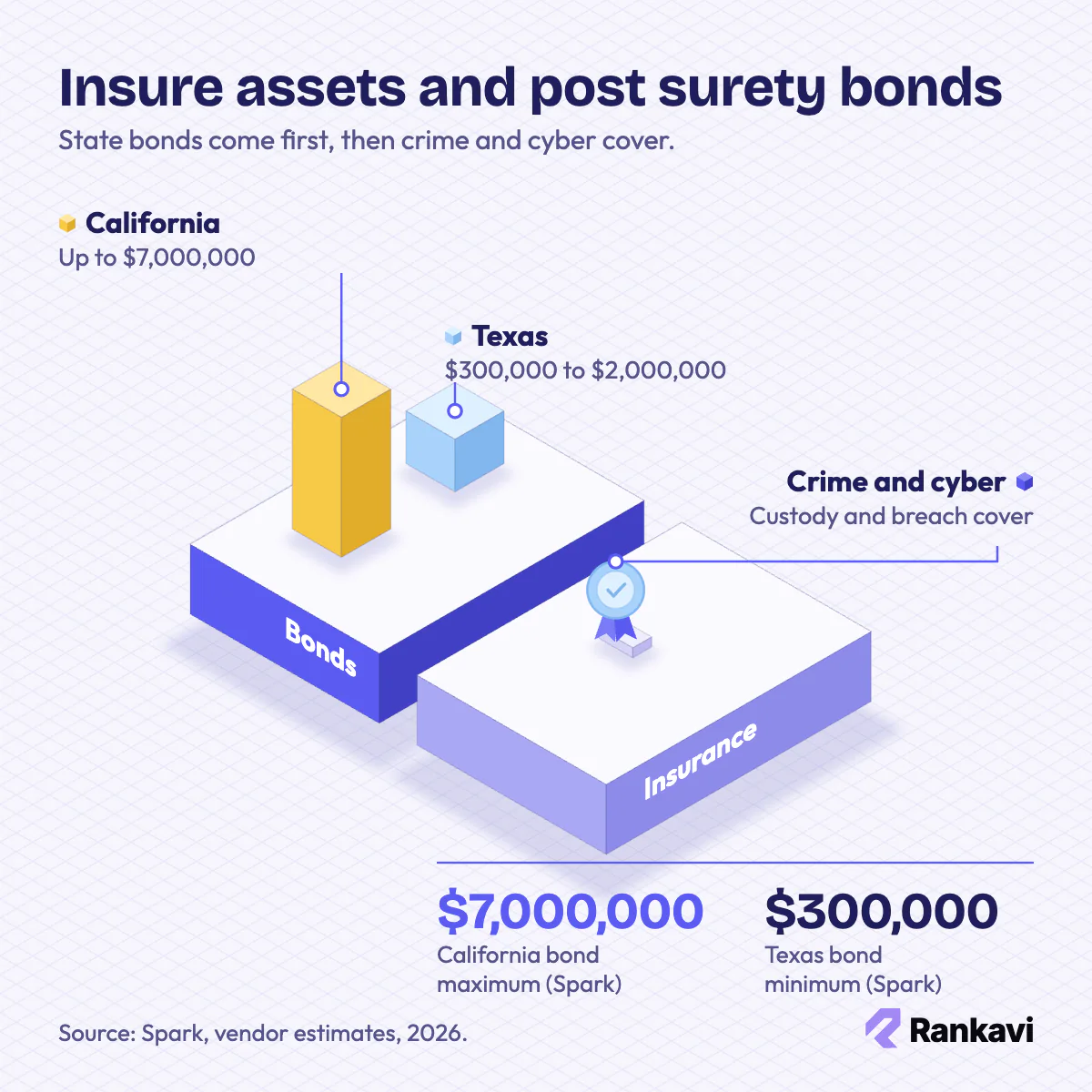
Surety bonds come first for money transmitters. Spark, a developer platform, listed Texas bonds at $300,000 to $2,000,000 and California bonds up to $7,000,000 in 2026 vendor estimates.
Crime and specie insurance covers stolen digital assets held in custody. Cold storage usually wins better terms than hot wallets.
Cyber liability insurance pays for breach response, legal costs and customer notifications. Directors and officers coverage protects leaders when investors or regulators bring claims.
A surety bond protects the regulator and the customers, not the company. The company repays the surety for any claim, and the yearly premium is a fraction of the bond amount. Insurance and bonds are separate products, and neither replaces strong custody controls.
10. Protect Customer Assets in Custody
Custody design keeps customer funds safe from hackers, insider theft and lost keys. Security failures end crypto businesses faster than any competitor.
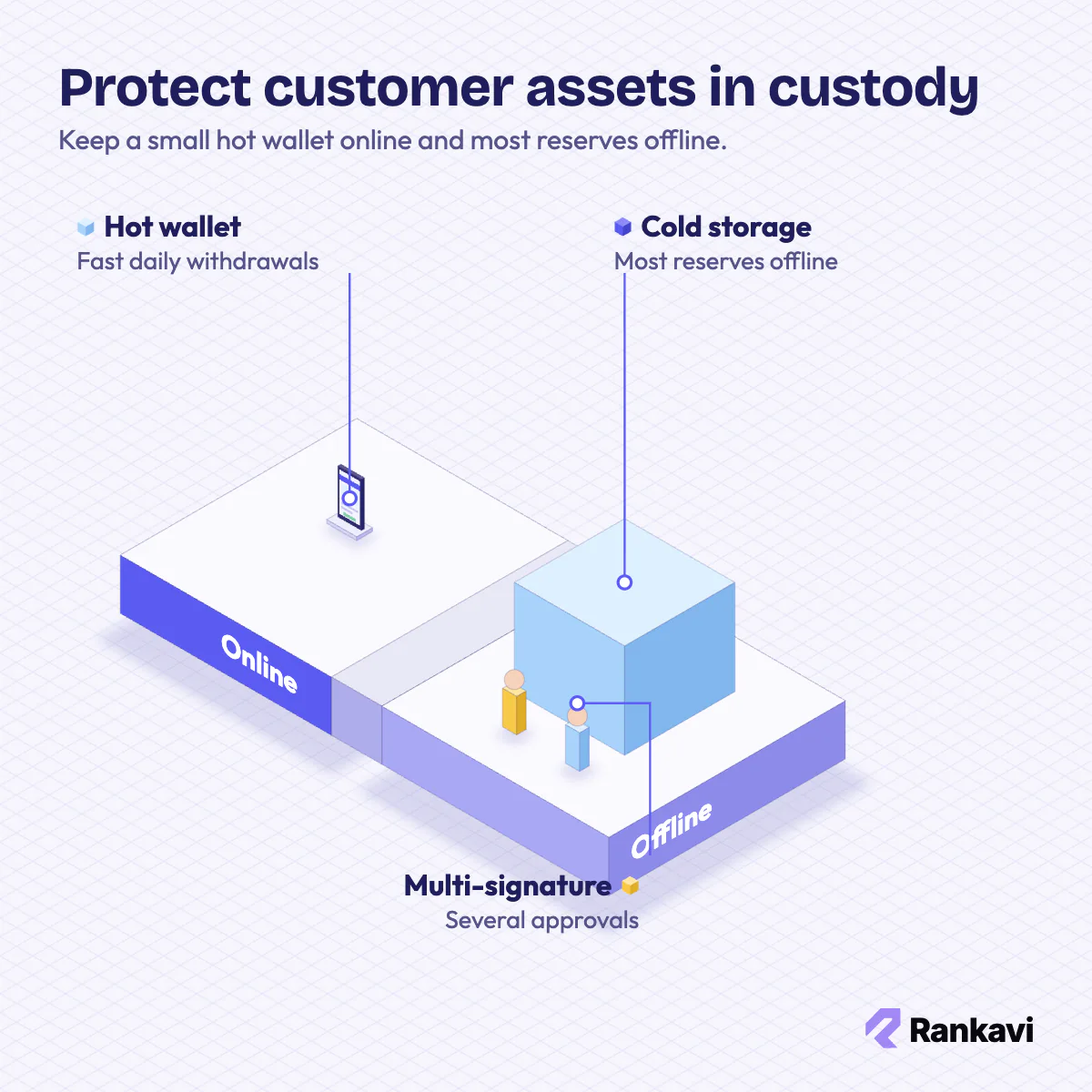
Hot and cold wallets split the job. Hot wallets stay online for fast withdrawals, while cold wallets keep most reserves offline.
Custody options:
| Option | Main strength |
|---|---|
| Hot wallet | Fast withdrawals for daily activity |
| Cold storage | Offline protection for most reserves |
| Multi-signature wallet | Several approvals before funds move |
| Third-party custodian | Specialist security and insurance |
Key management needs written rules. Multi-factor authentication, role-based access and separated duties stop one person from moving funds alone.
An incident response plan covers breaches, lost keys and fund recovery. Regular drills test the plan before a real attack.
Customer assets stay separate from company funds, and the terms of service state who owns them. Daily reconciliation compares wallet balances with the internal ledger. A third-party custodian removes day-to-day key handling, although the company still chooses and monitors the provider.
11. Run AML Checks and Tax Reporting
Daily compliance involves verifying customers, screening transactions and filing reports with federal agencies. A written anti-money laundering (AML) program is mandatory for money services businesses.
The Office of Foreign Assets Control (OFAC) is the Treasury office that publishes U.S. sanctions lists. The program covers six core compliance tasks:
- Identity checks: verifying each customer at signup
- Sanctions screening: checking names against sanctions lists
- Monitoring: flagging unusual transaction patterns
- Reporting: filing suspicious activity reports (SARs) with FinCEN
- Travel rule: passing sender and recipient data on larger transfers
- Tax forms: reporting customer sales to the IRS
FinCEN’s historical 2019 guidance applies the travel rule to crypto transfers of $3,000 or more. Current IRS rules require U.S. digital asset brokers to report customer sales on a dedicated Form 1099, with basis for assets acquired after 2025.
Each money transmitter names a compliance officer who owns the program. The U.S. Bureau of Labor Statistics (BLS) publishes federal wage data and reported a median annual wage of $80,730 for compliance officers in May 2025.
Recordkeeping supports every report. The platform logs on-chain and off-chain transactions so examiners can trace each transfer.
A risk assessment by customer type, product and country sets how deep each check goes. Staff training and a periodic independent review keep the program current.
12. Market the Platform Responsibly
Marketing a crypto business starts with trust signals, not promises of returns. Licenses held, security audits and clear fees belong on the homepage.
Educational content attracts careful users. Guides, market explainers and security tips answer the questions newcomers already search for.
Community channels build early loyalty. Discord, X and Telegram groups give users direct contact with the team.
Referral programs reward existing users for bringing friends. Marketing claims stay accurate and avoid any promise of profit or anonymity.
Ad platforms restrict crypto advertising, so each platform’s policy is read before a campaign starts. Paid promotions and influencer posts are labeled clearly. A compliance reviewer approves each ad, post and email, and approved copies are archived.
13. Show Up in Gemini AI Answers About Crypto
Visibility in AI search puts a crypto brand in front of users before they compare platforms. Many users now ask Gemini or ChatGPT which exchange, wallet or crypto tool to trust.
Those engines summarize review sites, crypto media and comparison articles they already trust. A new platform gains from being named on those pages early, while its brand is still unknown.
Gemini here means Google’s AI assistant, not the Gemini crypto exchange. A consistent brand name across the website, listings and articles helps engines match every mention to one company.
Rankavi is a software as a service (SaaS) platform that publishes brand mentions in articles on indexed third-party websites. Crypto founders can use it to earn brand references in Gemini through articles about wallets, exchanges and blockchain tools.