

Starting a craft business takes a product people already buy, a price that covers time and materials, and basic paperwork. The U.S. Bureau of Labor Statistics (BLS), which publishes federal job data, counted 53,400 craft and fine artist jobs in 2025, and 58% were self-employed.
I am Michal Sieroslawski, and I help craft businesses get found online. AI chats are becoming how buyers compare craft businesses, so being included matters.
The order puts demand tests and pricing before any spending, and paperwork before the first fair or online sale. Below are the eleven steps, in the order most craft founders take them.
- Choose Your Craft Niche
- Validate Demand Before Buying Stock
- Write a Simple Craft Business Plan
- Price Your Crafts and Fund the Launch
- Register and Insure the Business
- Set Up a Safe Home Studio
- Obtain Permits and a Sales Tax ID
- Plan Shipping and Order Fulfillment
- Sell at Craft Fairs and Online
- Grow With Wholesale and New Lines
- Reach Craft Buyers Through Google AI Overviews
1. Choose Your Craft Niche
Choosing a craft niche decides which product the business makes, who buys it and how fast it sells. The choice shapes every later step, from supplies to sales channels.
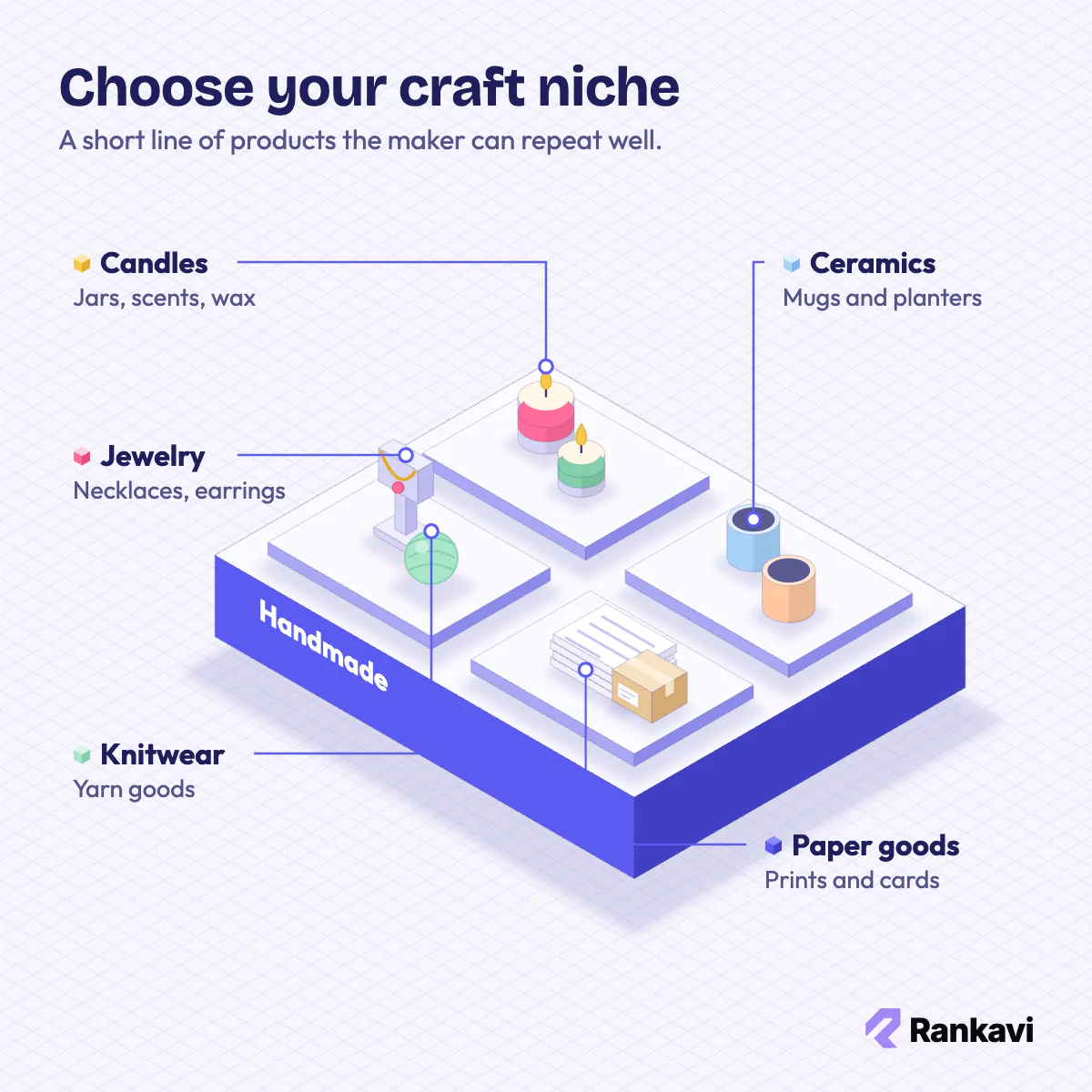
Common handmade categories include jewelry, candles, ceramics, knitwear, home decor, bath products and printed paper goods. A maker narrows the list to items they can produce well, quickly and consistently.
A small, focused product line beats a crowded catalog at launch. Three to five well-made products keep material costs low and reveal buyer preferences sooner.
Every handmade line needs a clear reason to be chosen. A unique selling proposition (USP) names a difference buyers can see, such as reclaimed materials, sensitive-skin metals or custom lettering. One short sentence works best: what the maker makes, for whom, and why it is different.
Several criteria separate a good niche from a weak one. Supply is one: a maker needs reliable sources of wax, clay, metal or yarn. Competition is another, since a crowded category needs a clear difference. Seasonality matters too, because gift items sell in bursts.
Materials shape cost and skill. Soy wax candles, stoneware ceramics and sterling silver jewelry differ in tools, learning time and breakage. Some niches carry safety rules, covered in step 7.
Repeat production is the hidden test of a niche. A maker who dislikes making the same item many times over will burn out once orders arrive.
2. Validate Demand Before Buying Stock
Validating demand shows whether real buyers pay for a craft before money goes into materials. Market signals replace guesswork about what will sell.
Etsy is an online marketplace for handmade, vintage and craft supply listings. Amazon Handmade is Amazon’s storefront for goods made by approved artisans. Both, along with Pinterest, reveal similar items, review counts and price ranges.
Google Trends is a free Google tool that compares search interest over time, such as candle making against embroidery kits. Interest that returns every year beats a single short spike.
Favorites and pins show interest, while sales and reviews show payment.
eRank is an Etsy research tool that estimates search demand and competition. eBay’s Terapeak shows what similar items sold for.
Google Trends compares terms over several years, which separates a seasonal craft from a lasting one. Pinterest Trends shows what shoppers search for on Pinterest.
Competitor reviews expose gaps in the market. Three- and four-star reviews often repeat the same request, such as a larger size or a sturdier clasp. Those requests become product ideas.
Friends and family tend to say yes out of politeness, so only sales to strangers count. A pass mark set before the test keeps the result honest. One example is a target number of paid orders at a price that covers costs. A failed test leads to a change in price, design or audience, followed by a new test.
A small paid batch settles the question. The maker sells a handful of units online or at a local market before buying supplies in bulk. A preorder page with photos and a launch date works the same way.
Demand signals and what they reveal:
| Signal | What it reveals |
|---|---|
| Marketplace reviews | Whether similar items sell |
| Search trends | Whether interest lasts or spikes |
| Three- and four-star reviews | Unmet buyer requests |
| Small paid batch | Whether buyers pay the planned price |
3. Write a Simple Craft Business Plan
A craft business plan sets out what the business sells, to whom, through which channels and at what profit. A few pages are enough for a home-based maker.
The plan lists the products, the ideal customer, the main competitors and the chosen sales channels. An operations section notes where production happens and how orders ship. A financial section holds the pricing method and income goals.
Income goals work best against a real benchmark. The BLS reported a median annual wage of $46,080 for wage-earning craft artists in May 2025.
The plan also records intent for the Internal Revenue Service (IRS), which collects federal taxes and sets the hobby rules. The IRS lists 11 factors to separate a business from a hobby. Examples are accurate books, time and effort spent, and changes made to improve profit. No one factor outweighs the others.
A competitor section names three to five similar shops and compares their prices, photos and policies. An ideal customer section describes who buys, why and when, such as a gift buyer shopping before a holiday.
Weekly capacity is the plan’s key assumption for a maker. The plan states how many units one person makes weekly, when supplies get reordered and how custom requests fit. Peak gift seasons need their own production schedule.
4. Price Your Crafts and Fund the Launch
Pricing a craft determines whether each sale pays for materials, the maker’s time and a profit. The same numbers then set the startup budget and the break-even point.
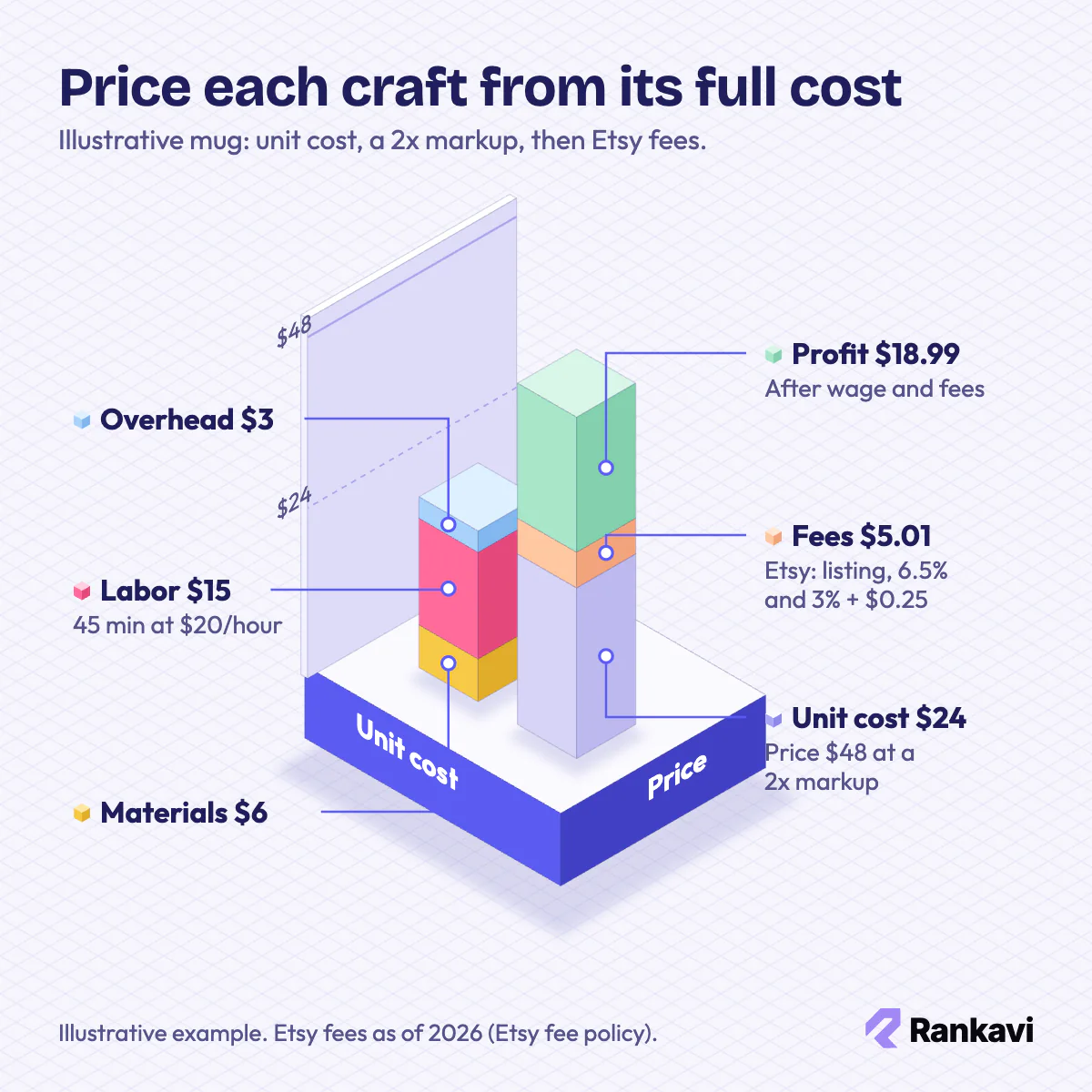
Unit cost comes first. It adds materials, production time at a chosen hourly rate and a share of overhead. The BLS reported a median hourly wage of $26.58 for craft and fine artists in May 2025, a fair benchmark for that rate.
Markup is the number most makers check first. FitSmallBusiness, a small business advice publisher, put the typical handmade markup at 2x to 3x total cost in December 2025. That multiple pays for selling fees, discounts and slow months.
Online channels take their cut before profit. Etsy charges a $0.20 listing fee and a 6.5% transaction fee, as of 2026. US sellers on Etsy Payments also pay 3% plus $0.25 per order in processing in 2026.
Amazon Handmade deducts 15% or $0.30 per unit, whichever is greater, as of 2026. It also waived the $39.99 monthly selling plan fee for approved Handmade sellers in 2026. Shopify is a commerce platform for independent online stores. Its Basic plan cost $29 per month, billed annually, in 2026.
Startup money at a glance:
| Item | Craft business figure |
|---|---|
| Startup cost | $100 to $2,000+ (FitSmallBusiness, 2025); $500 to $3,000 for most home-based makers (PowerHomeBiz, 2026) |
| Main costs | First materials, basic tools, packaging, shop or website fees, booth fees, insurance |
| Typical margin | 20% to 50% net profit margin (FitSmallBusiness estimate, 2025) |
| Time to open | Varies: a home studio can open within weeks, while children’s products wait for lab testing |
Sources: FitSmallBusiness (small business advice publisher), December 2025; PowerHomeBiz (home business publisher), March 2026. Time to open is a qualitative estimate because no source gives a figure.
Example: A maker sells a handmade ceramic mug on Etsy (illustrative figures; shipping left out).
| Input | Value |
|---|---|
| Materials | $6.00 |
| Labor (45 minutes at $20 per hour) | $15.00 |
| Overhead share | $3.00 |
| Unit cost | $24.00 |
| Price at a 2x markup | $48.00 |
| Etsy fees ($0.20 listing, 6.5% transaction, 3% + $0.25 processing) | $5.01 |
| Profit per mug after the maker’s wage and fees | $18.99 |
Two pricing methods apply. Cost-plus pricing adds a markup to unit cost, as in the example above. Value-based pricing sets the price by what buyers in the niche already pay for similar work. A price must still cover the maker’s wage, not only materials.
Break-even units equal monthly fixed costs divided by the profit per unit. Fixed costs include booth fees, software and insurance.
Many makers fund the launch themselves.
They use existing tools, take preorders before buying in bulk, and reinvest early profits.
Break-even arrives once monthly sales cover fixed costs at the planned margin. Outside funding is a second route. The U.S. Small Business Administration (SBA) reports that microloans go up to $50,000, with an average near $13,000, in 2026. Nonprofit intermediary lenders make the credit decisions. Crowdfunding sites such as Kickstarter let backers pay for a product before it exists.
5. Register and Insure the Business
Registering a craft business means choosing a legal structure, a name and a tax identity before regular sales begin. Insurance then protects the owner when a product causes harm.
Most solo makers start as a sole proprietorship because it needs little paperwork. A limited liability company (LLC) separates personal assets from business debts. Candles, skin care and children’s items carry more risk, so those makers often form an LLC sooner.
Selling under a shop name that differs from the owner’s legal name calls for a doing business as (DBA) filing. The U.S. Patent and Trademark Office (USPTO), which registers trademarks, runs a database of brand names already taken.
The IRS taxes a single-member LLC as a separate entity from its owner by default. The owner reports its income on Schedule C and pays self-employment tax, the same as a sole proprietor, in 2026. An LLC can elect corporate taxation instead.
An employer identification number (EIN) comes free from the IRS. A separate business bank account then keeps craft income and supply costs apart from personal spending.
Product liability insurance covers injury or damage caused by an item after sale. Many craft fairs and wholesale buyers ask for proof of coverage. A business owner’s policy bundles liability and property coverage for small businesses. A standard homeowners policy may not cover business stock or business liability.
6. Set Up a Safe Home Studio
A home studio gives the maker a dedicated space to produce, store and pack goods without daily cleanup. A spare bedroom, garage or basement corner is enough at the start.
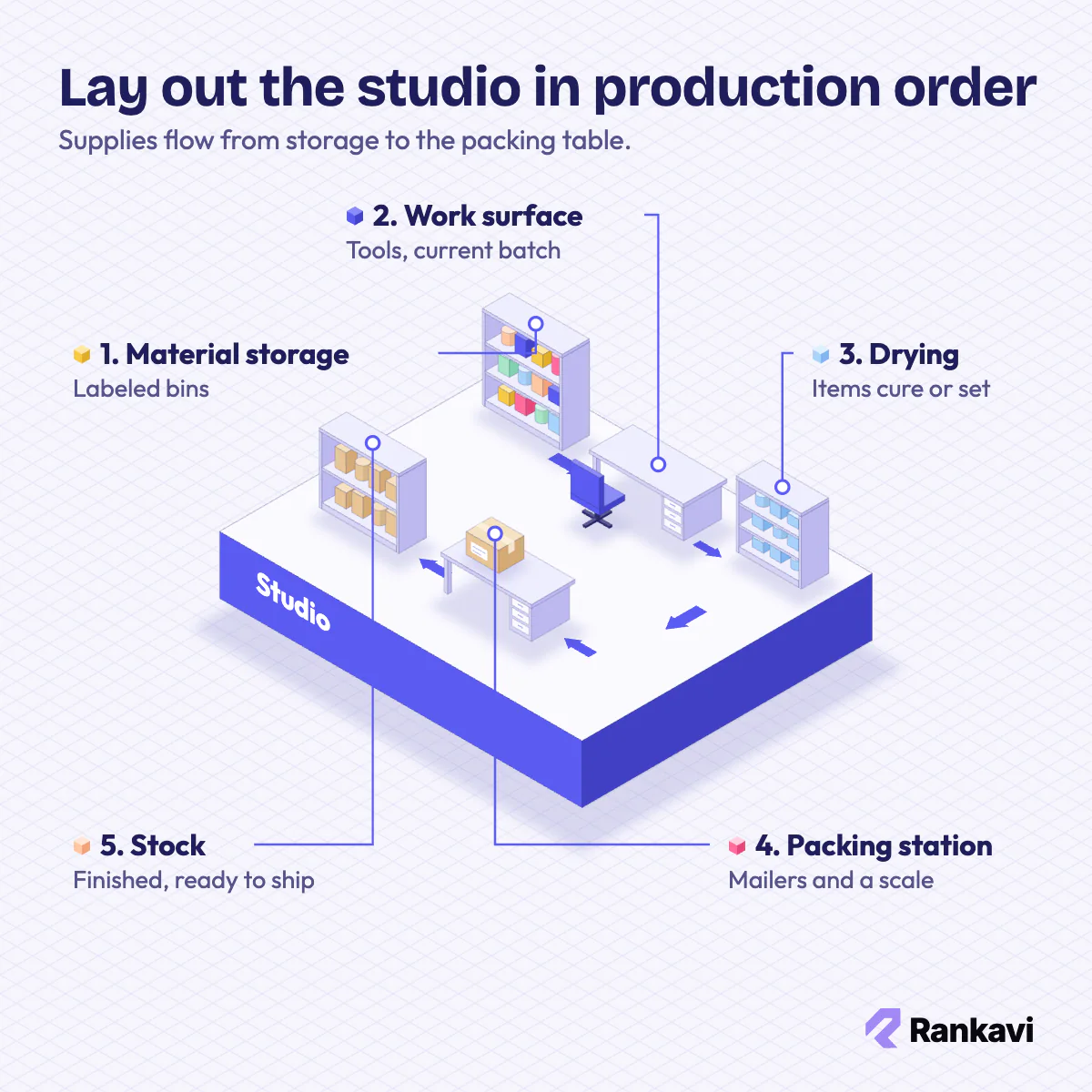
The layout follows the production order. Materials sit near the work surface, finished items near the packing station, and shipping supplies beside the door. That flow saves steps on every order.
Safety depends on the craft. Heat, resin, dyes and sharp tools call for ventilation, gloves, eye protection and a fire extinguisher. Flammable stock stays away from heat sources.
Suppliers publish a safety data sheet for many materials, such as resin and dyes. The sheet lists hazards, safe handling and first aid. Pets, children and food stay out of the work area.
The first supply order stays small. Enough material for a test batch shows how it behaves before cash goes into bulk stock. Samples from two suppliers protect the bestseller if one runs out.
Studio zones in production order:
| Zone | Holds |
|---|---|
| Material storage | Labeled bins of raw supplies |
| Work surface | Tools and the current batch |
| Curing or drying area | Items that need time to set |
| Packing station | Boxes, mailers, labels and a scale |
| Finished stock | Ready-to-ship items |
7. Obtain Permits and a Sales Tax ID
Licensing a craft business covers the local and state approvals a maker needs to sell legally from home. The exact list depends on the city, the state and the product.
Many cities and counties ask for a general business license. A home-based studio often also needs a home occupation permit, which confirms that zoning allows the work.
Selling physical goods usually requires a sales tax permit, also called a seller’s permit. The same registration often lets a maker buy materials tax-free with a resale certificate. Craft fair organizers frequently ask for this permit.
State agencies issue the sales tax permit, usually through an online portal. Names differ by state, such as seller’s permit, sales tax license or certificate of authority. The permit also sets the filing schedule for collected tax.
Marketplaces such as Etsy and Amazon collect sales tax in many states under marketplace facilitator laws. Sales at fairs or through a personal website still fall to the maker.
The U.S. Consumer Product Safety Commission (CPSC), which regulates consumer product safety, requires third-party testing for children’s products. As of 2026, makers with prior-year revenue of $1,436,864 or less qualify as small batch manufacturers. Their output cap is 7,500 units of a covered product, as of 2026, and registration with the CPSC is renewed yearly.
The U.S. Food and Drug Administration (FDA), which oversees cosmetics, approves color additives before sale but not most ingredients. Soaps sold with moisturizing or skin claims can fall under these cosmetic rules.
8. Plan Shipping and Order Fulfillment
Order fulfillment involves packing, labeling, shipping and tracking every sale until it reaches the buyer. A plan written before the first order prevents late parcels and bad reviews.
Shipping prices start with a packed item. The maker weighs and measures the product inside its box and padding, then compares carrier rates. That figure decides between flat-rate, calculated or free shipping.
The U.S. Postal Service (USPS) is the national mail carrier and a common choice for small craft parcels. Label tools such as Pirate Ship or Shippo print discounted labels at home.
A simple order tracker keeps work on schedule. A spreadsheet or the Etsy or Shopify dashboard logs each order, its custom requests and its shipping status. The same records feed bookkeeping before tax season.
Clear policies prevent disputes. The shop states processing time, delivery estimates, returns rules and what happens with damaged parcels. Made-to-order and personalized items usually need their own return terms.
9. Sell at Craft Fairs and Online
A sales channel puts handmade goods in front of buyers who are already shopping for them. Most new makers start with one online shop and one local event.
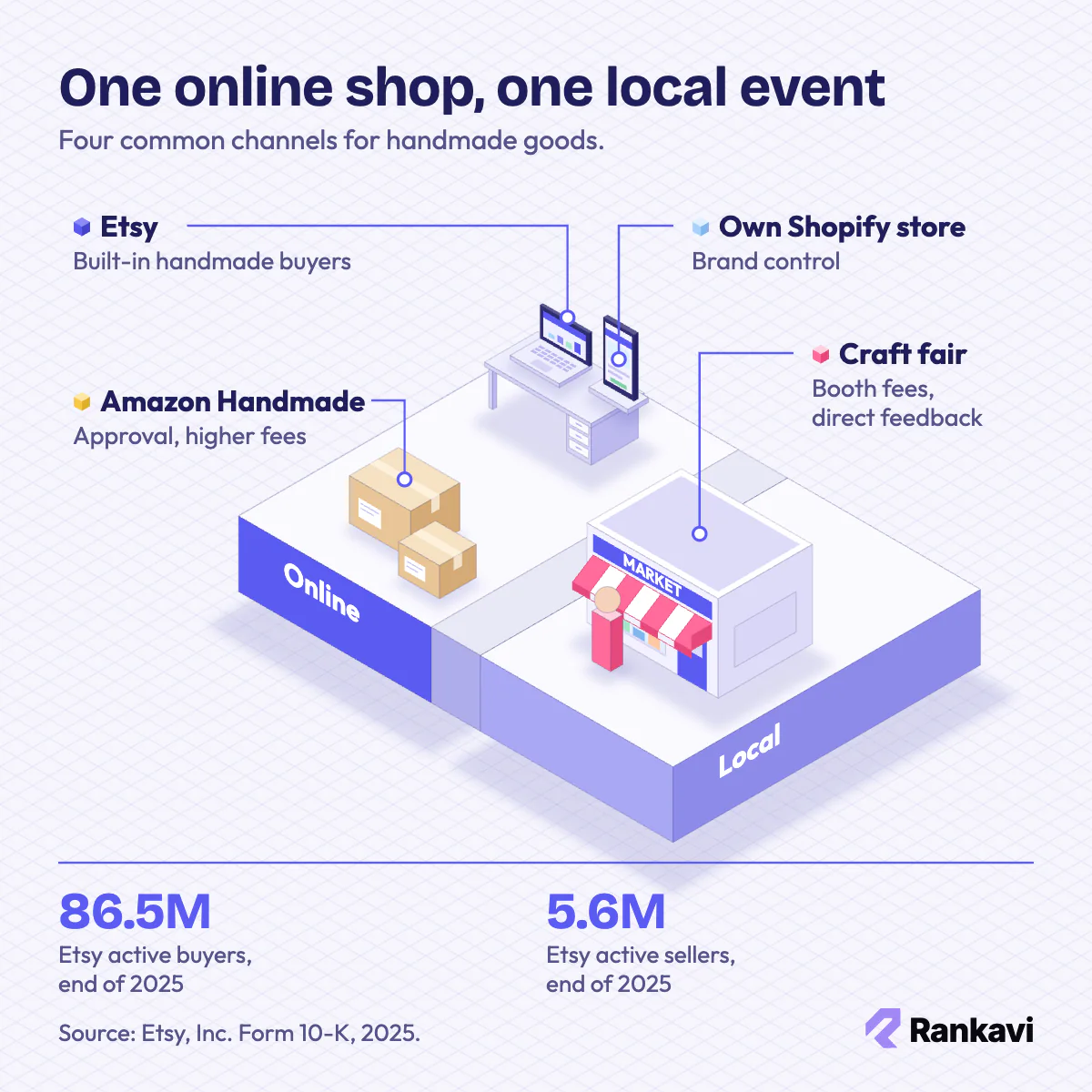
Main sales channels for handmade goods:
| Channel | Best for | Trade-off |
|---|---|---|
| Etsy | Built-in handmade audience | Fees and heavy competition |
| Amazon Handmade | Makers with steady output | Approval and higher selling fees |
| Own Shopify store | Brand control and customer data | Maker drives all traffic |
| Craft fairs and markets | Direct feedback and local fans | Booth fees and travel |
Etsy’s audience is large but crowded. Etsy, Inc. reported 86.5 million active buyers and 5.6 million active sellers on its marketplace at the end of 2025.
Craft fairs let buyers touch the work and show which pieces stop people walking past. Booth rent still has to earn its place:
“I have a booth there every year, but most years I pay more for the rent of the booth than I earn.”
— A craft seller on the Permies forum
Photos sell online crafts. Natural light, plain backgrounds, close-ups and an in-hand shot for scale help buyers judge size and finish.
Instagram and Pinterest suit visual crafts. A few process videos and finished-piece posts each week build a following. An email list collected at fairs and checkout turns first buyers into repeat customers. Each order ends with a polite request for a review.
10. Grow With Wholesale and New Lines
Growth turns a one-person craft shop into a business with several income streams. It starts with numbers rather than more products.
A monthly review tracks revenue, expenses, net profit, units sold and traffic sources. Bestsellers earn a price rise or variations. Slow items get reworked or retired.
Wholesale and consignment open boutique and gift shop shelves. Wholesale raises volume but lowers the price per unit, so the maker checks margins before signing an order.
Artist co-ops offer a middle path. Several makers share one storefront, its overhead and the shifts behind the counter.
“…for me getting a booth at local markets and joining an artists co-op has lead to the most growth for my business.”
— A maker on the Square Community forum
Product extensions raise the order value. Gift sets, bundles, make-at-home kits and digital patterns reuse existing designs and skills.
Outside help frees time for making. Packing, shipping and customer messages are the first tasks to hand off. A third-party logistics (3PL) provider can later store stock and ship orders.
11. Reach Craft Buyers Through Google AI Overviews
AI visibility means appearing in the answers buyers read before they visit any shop. Gift shoppers now ask Google, ChatGPT and Perplexity for handmade ideas and trusted makers.
Google AI Overviews are AI-written summaries shown at the top of Google search results. Those summaries lean on gift guides, maker directories, local press and review sites. A new craft brand that appears on those pages has a better chance of being named.
Rankavi is a software as a service (SaaS) platform that publishes brand mentions in articles on indexed third-party websites. Handmade shops can order articles from $12 each, and most go live in under 24 hours. Its page on Google AI Overviews brand references explains how handmade shops get included in gift idea answers.