

Starting a courier business takes a delivery niche, a suitable vehicle, commercial insurance and a few steady local accounts. The U.S. Bureau of Labor Statistics (BLS), which publishes national job data, counted 983,300 light truck drivers in the U.S. in May 2025.
A bit about me: my name is Michal Sieroslawski. I help courier companies get found by local businesses on Google and in AI chats. AI answers are quickly becoming a starting point for local businesses. Showing up there helps a new courier company reach people it would otherwise miss.
The order prices runs and lines up money before any filing, so registration, licenses and insurance match the chosen vehicle. Marketing and hiring come last, once the van can legally carry paid loads. Here are the twelve steps to start a courier business, from first idea to first customers, listed below.
- Choose Your Courier Niche and Service Area
- Write a Courier Business Plan
- Price Deliveries by Distance and Urgency
- Fund the Van and First Months
- Register the Courier Company
- Get USDOT Numbers and Local Licenses
- Insure Cargo, Vans and Drivers
- Buy a Cargo Van and Delivery Gear
- Set Up Dispatch and Tracking Software
- Market to Clinics, Law Firms and Local Shops
- Hire Drivers and Grow Contract Routes
- Appear in Copilot and AI Courier Answers
1. Choose Your Courier Niche and Service Area
A new courier first decides what to carry and for whom. That choice sets the vehicle, the insurance and the permits for every later step.
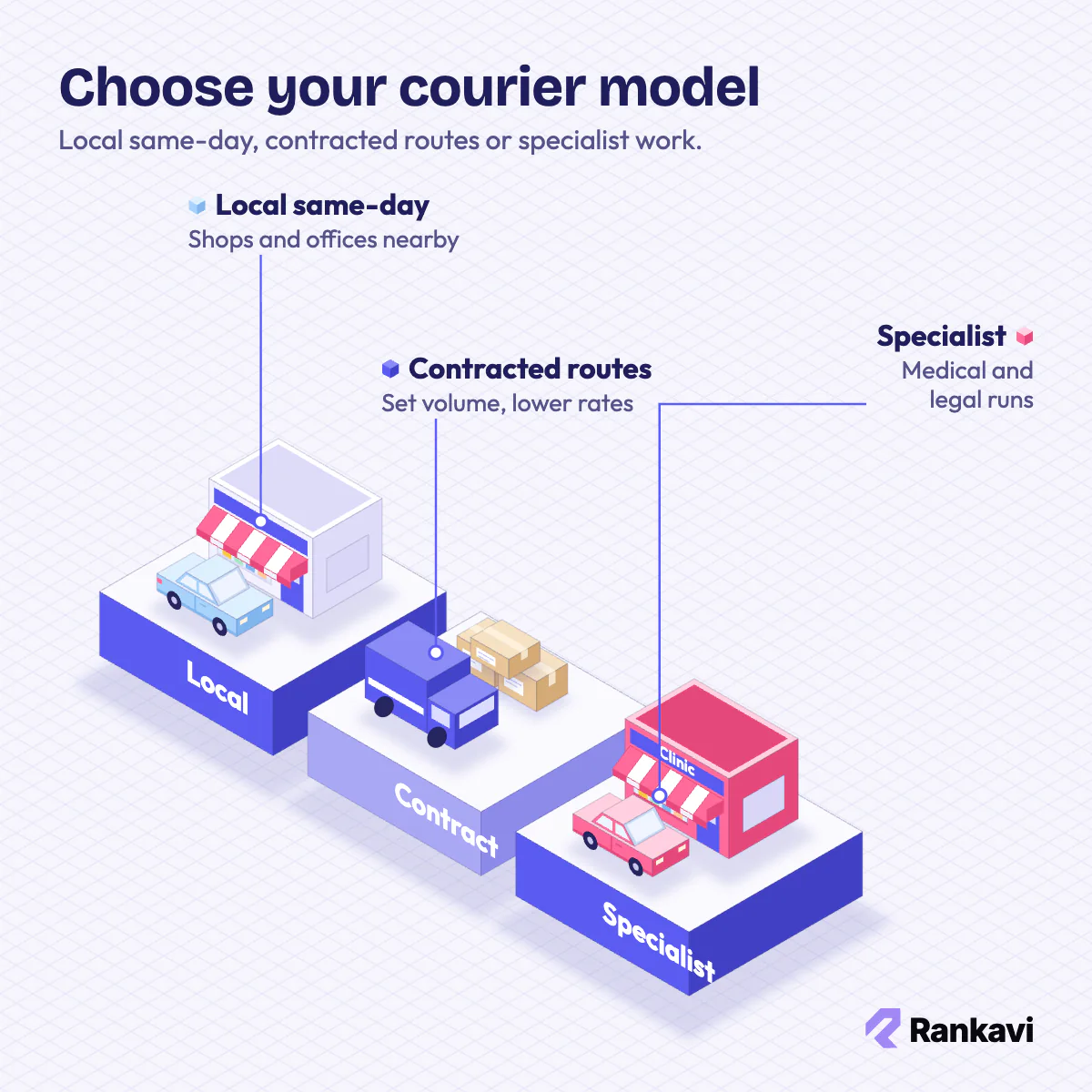
Courier work splits into four models. Local same-day delivery serves nearby businesses directly. Contracted routes deliver for a larger carrier with set volume. Specialist couriers move medical, legal or high-value items. On-demand platform work fills gaps between clients.
Common courier models:
| Model | Who pays | Best vehicle | Main trade-off |
|---|---|---|---|
| Local same-day delivery | Local businesses and residents | Car or small van | Owner finds every client |
| Contracted routes | A larger carrier or retailer, such as the Amazon Delivery Service Partner program, FedEx Ground contractors or Veho | Cargo van | Steady volume, lower rates |
| Specialist courier | Clinics, labs and law firms | Car or van, often with coolers | Higher rates, stricter handling |
| On-demand platform work | Roadie, GoShare, Uber Direct or DoorDash Drive | Whatever the platform accepts | Platform sets the rates |
Medical courier work moves specimens, records and pharmacy orders between clinics and labs. Those clients value reliability over volume. Once a courier earns their trust, the runs tend to repeat every week.
Target clients cluster by industry. Florists, bakeries and print shops need fast local drops. Law offices send signed documents. Online sellers on Facebook Marketplace and Etsy need pickups too. Auto parts stores send parts to repair garages all day. Furniture stores need two-person delivery.
On-demand apps such as Amazon Flex, Roadie and Spark Driver let a new courier try deliveries without a company. A few weeks of that work shows which hours are busy and how long a stop takes. It also fills slow weeks after the business opens.
Each niche has entry rules. Medical couriers handle patient information. Clinics often ask for training under the Health Insurance Portability and Accountability Act (HIPAA). A signed business associate agreement is common. Specimen work follows the OSHA Bloodborne Pathogens Standard. Legal couriers need proof of delivery and a record of every handoff. Alcohol, pharmacy and cannabis runs depend on state rules, so those need checking before targeting such clients.
The niche also points to a vehicle. Documents, small parcels and food fit a car. Contract routes and larger loads need a cargo van such as a Ford Transit or Ram ProMaster. Furniture needs a box truck and a helper.
The service area should hold busy commercial districts. Drive time defines an area better than miles on a map. A 30-minute rush-hour trip is a very different distance. Dense districts give more stops per hour and less empty driving. Rural areas pay more per run but cost more fuel on the return. Tolls, congestion zones, airport access rules and hospital loading docks add friction to a route.
Demand research has four parts:
- Count competitors: a search for “courier near me” on Google Maps shows each rival’s hours, services and review count.
- Read complaints: low reviews on Google Maps and Yelp reveal gaps, such as no weekend pickups.
- Count targets: the number of florists, clinics, law offices and shops inside the area shows whether enough clients exist.
- Ask clients: a visit to ten target businesses shows what they use now and what goes wrong.
Seasons shape the schedule. Florists peak around Valentine’s Day and Mother’s Day. Retail and online sellers surge from November through December. Medical routes run early in the morning and in the evening, and urgent calls can come at any hour. The owner decides early whether to work nights and weekends.
A simple scorecard helps choose between niches. Each niche earns 1 to 5 on reachable clients, competition, vehicle fit, handling rules, repeat business and schedule. One anchor niche, such as medical runs, comes first. On-demand work fills the gaps, and a second niche follows once the first has steady clients.
2. Write a Courier Business Plan
A courier business plan sets out the services, clients, costs and sales targets before money goes into a van. Lenders and leasing companies read it first.
A lender expects these core plan sections:
- Executive summary: the business on one page, written last, with the amount needed
- Services: the delivery types and speeds on offer
- Market: target clients and the service area
- Competition: rival couriers and the gap the business fills
- Marketing: how the first accounts get won
- Operations: hours, delivery windows and backup cover
- Financials: projected costs, revenue and break-even
- Risks: loss of a key client, fuel price rises, van downtime and slow-paying accounts
A lean plan works for an owner who funds the start alone. Lenders and leasing companies expect a fuller one. Free templates and reviews come from local Small Business Development Centers.
The competition section names real rivals. National carriers such as FedEx and the U.S. Postal Service lead on parcels. Uber Direct, DoorDash Drive and Roadie cover on-demand runs. Local courier firms are usually the closest rivals. One sentence then states the gap, such as signed medical runs or evening deliveries after carrier cutoffs.
The operations section lists hours and delivery windows. One-hour, same-day and overnight options each need different staffing. A courier that promises after-hours runs must plan who answers the phone. The section also says what happens when a van breaks down or a driver is out. A backup driver, a rental van or a partner courier can cover that gap.
The financials section lists startup costs and monthly costs, with each line marked as an assumption. Variable cost per mile covers fuel, tires and upkeep. Business clients often pay weeks after invoicing. The cash flow forecast must show money to cover that wait. Break-even equals fixed monthly costs divided by the profit on each delivery.
The plan ends with a first-year earnings goal. It then works out how many deliveries reach that goal. That count becomes the weekly sales target for the owner. The goal is net income to the owner, not revenue. Operating costs are added before the delivery count is worked out. The plan is updated against real delivery numbers after the first 90 days.
3. Price Deliveries by Distance and Urgency
Pricing a courier service decides how each run turns distance, time, weight and urgency into a fee. The rate must cover fuel, upkeep and the driver’s time before any profit.
Courier pricing models:
| Model | How it charges | Best fit |
|---|---|---|
| Flat zone fee | One price inside a set radius | Dense downtown runs |
| Mileage rate | A fee per mile driven | Longer suburban trips |
| Hourly rate | A fee per hour on the job | Multi-stop or waiting jobs |
| Weight or size tier | Higher fee for heavier items | Parcels and bulky goods |
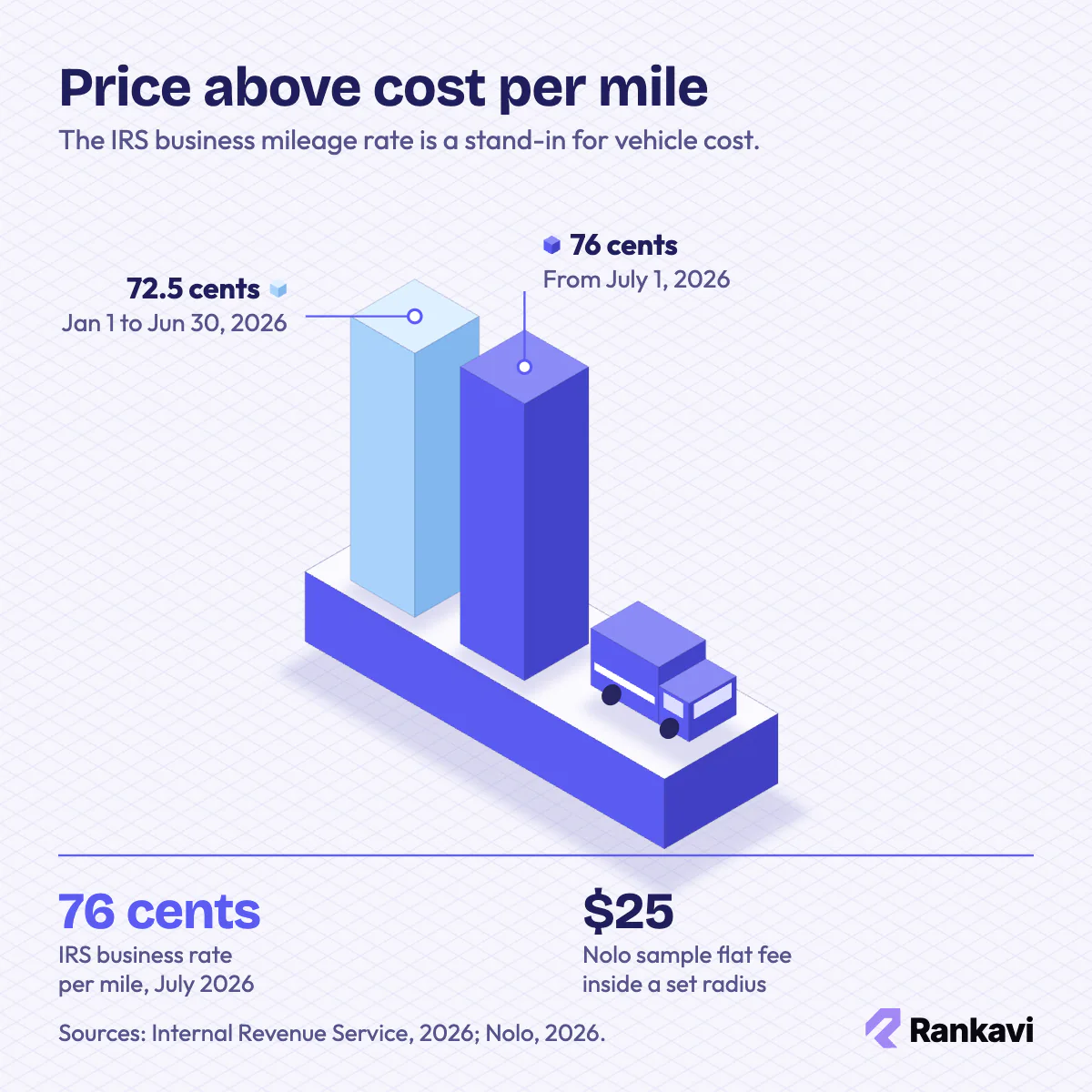
Nolo, a legal publisher, gives a flat $25 fee inside a set radius as a sample local rate, as of 2026. Surcharges handle the exceptions. Rush jobs, heavy items and drops outside the zone carry extra fees. A fuel surcharge protects the margin on long trips when fuel prices rise.
Cost per mile is the number couriers check first. The Internal Revenue Service (IRS) set its business mileage rate at 76 cents from July 1, 2026, up from 72.5 cents. That rate is a common stand-in for the full cost of running a vehicle.
The IRS rate is a tax deduction figure, so it is only a stand-in. A true cost floor adds fuel, tires, upkeep, insurance and the van payment. It then divides by the paid miles.
Empty return miles raise that floor. A one-way run with no load back costs far more per paid mile than the map distance shows. A minimum charge keeps short runs from losing money. A per-stop fee covers multi-drop routes, and a wait-time fee starts after a short free window.
Urgency tiers set the fee ladder. Scheduled runs booked ahead carry the base rate. Same-day, rush and urgent medical runs carry higher fees because they pull a driver off other work. Extras also appear on the rate card:
- Time extras: after-hours, weekend and holiday runs
- Handling extras: signature or identity checks, stairs and two-person carries
- Cost pass-throughs: tolls and parking
- Service extras: failed delivery, redelivery and late cancellation
Underpricing is the classic first-year mistake. A mileage fee below that cost loses money before the driver earns anything. Competitor prices set the ceiling, while vehicle costs set the floor. Uber Direct, DoorDash Drive, Roadie and GoShare publish rates that set the low end for small, simple drops. A specialist courier can charge more for reliability, a named driver and signed proof of delivery.
Contract accounts pay more reliably than one-off jobs. Clear rate cards help those clients book without calling. A contract rate card often adds volume tiers, a monthly minimum and a fuel surcharge. The surcharge follows a public fuel price index.
One-off customers can pay by card or in advance. An online quote calculator shows the price before the booking. Routed miles give fairer quotes than straight-line miles.
Sales tax on delivery charges varies by state, so the state revenue department has the final word. Rates are reviewed each quarter, or sooner when fuel or insurance costs move.
4. Fund the Van and First Months
Funding a courier startup covers the vehicle, insurance, licenses and software until client invoices start paying. Owners who already have a reliable vehicle need far less cash.
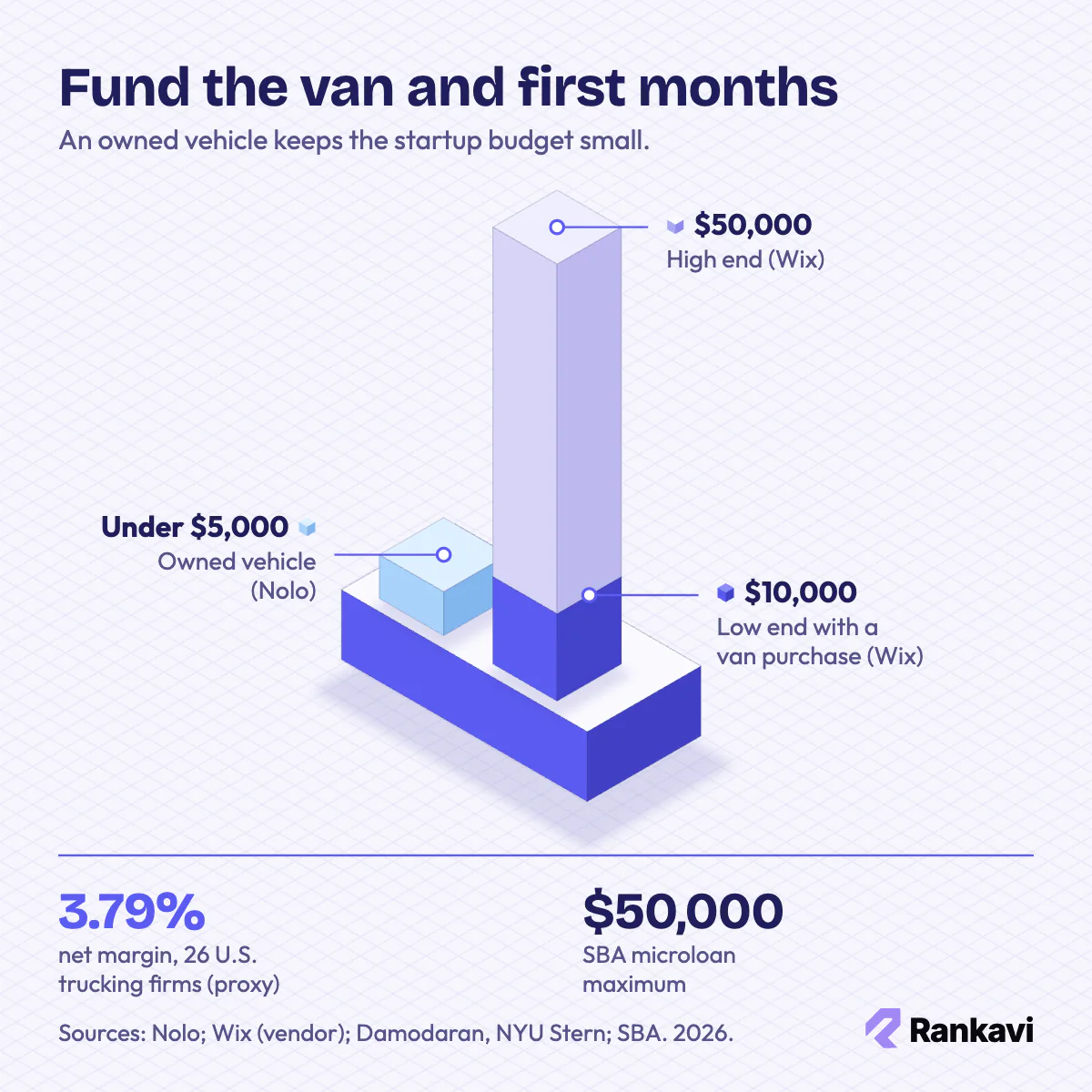
Startup costs depend mostly on the vehicle. As of 2026, Nolo puts a local delivery service at less than $5,000 when the owner already has a vehicle. Wix, a website builder, estimated $10,000 to $50,000 in its 2026 guide, with vans at $10,000 to $30,000 each.
Working capital matters more than many owners expect. Business clients often pay invoices weeks after the delivery. Fuel and driver pay still leave the account every day.
Leasing a van saves cash upfront and allows quick changes in fleet size. Buying costs more at the start but avoids monthly lease payments later. Many couriers lease the first extra vehicle.
Lease terms need a close read. Closed-end leases cap mileage and charge for extra miles, which hurts a courier who drives about 150 miles a day. A commercial lease or a lease-to-own deal can fit better.
Renting a cargo van for a month tests demand before a purchase. A used van cuts the price but needs a larger repair reserve. A history report and an independent inspection come first.
Cash needs go beyond the sticker price. Sales tax, title, registration, the first insurance payment, shelving and a tire and repair reserve all come due early. A cash reserve of several months of fixed costs covers the wait for invoices. Invoice factoring can bridge a late payer, but it costs a share of each invoice. Merchant cash advances cost far more and suit emergencies only.
Personal savings fund most first courier vans. Bank loans fill the gaps.
The U.S. Small Business Administration (SBA) backs microloans up to $50,000 through nonprofit lenders, and the average microloan is about $13,000 as of 2026. Larger needs fit an SBA 7(a) loan from a bank. Vehicle loans from banks, credit unions and van makers use the van itself as collateral. Lenders usually ask for a business plan, tax returns and a personal guarantee.
Small Business Development Centers help prepare the file at no cost.
Startup money at a glance:
| Item | Figure |
|---|---|
| Startup cost | Under $5,000 with an owned vehicle; $10,000 to $50,000 with a vehicle purchase |
| Main costs | Van ($10,000 to $30,000 each), insurance ($2,000 to $9,000 a year per courier van), dispatch software ($1,000 to $5,000), marketing ($1,000 to $5,000), licenses and permits ($500 to $2,000) |
| Typical margin | 21.19% gross and 3.79% net for 26 U.S. public trucking firms, a proxy for small couriers |
| Time to open | Varies with state filings and insurance quotes; no national figure exists |
Sources: Nolo (legal publisher), 2026; Wix (website builder) and Logrock (insurance broker), vendor estimates, 2026; Aswath Damodaran, NYU Stern, January 2026.
Margins are thin in delivery work. Aswath Damodaran, a finance professor at NYU Stern who publishes annual industry datasets, put net margin for 26 U.S. trucking firms at 3.79% in January 2026.
Worked example: This illustrative owner-driver runs 12 flat-zone deliveries a day at $25 each, earning $300. The van covers 150 miles at 76 cents a mile, so vehicle costs take $114. That leaves $186 for a 10-hour day, about $18.60 an hour. Steady contract runs on tighter routes are what lift that figure.
5. Register the Courier Company
Registering a courier company means filing it with the state as a legal entity that signs contracts and holds insurance. Many delivery clients ask for that entity before the first run.
Most couriers form a limited liability company (LLC). Every delivery puts a vehicle on the road with someone else’s goods. An LLC keeps personal savings apart from business debts and claims against the company. It does not cover the owner’s own negligence behind the wheel, so auto and cargo insurance still apply. A sole proprietorship needs no filing but leaves personal assets exposed.
Filing follows a set order. The owner checks the name in the state business database and in trademark records. A registered agent with an in-state address receives legal papers. The owner or a paid service can serve.
The Articles of Organization are then filed with the state, usually online. An operating agreement sets ownership and pay, and banks and insurers often ask for it. The LLC is best formed in the state where the vans run. A company formed elsewhere must still register at home. Many states also require an annual report.
The IRS issues an employer identification number (EIN) online at no cost. The EIN covers federal taxes, payroll and the business bank account.
Only the IRS site issues the EIN free, so paid look-alike sites are unnecessary. A single-member LLC reports profit on the owner’s personal return. An S corporation election can change how owner pay is taxed. That is a question for an accountant once profit is steady. Clients also request a Form W-9 before they pay, and the EIN goes on it.
A separate bank account keeps courier income and fuel costs clean for taxes. Mixing personal and business money is the usual way an LLC loses its protection. The trading name can differ from the legal name through a “doing business as” filing.
6. Get USDOT Numbers and Local Licenses
Licensing a courier business involves a local business license plus vehicle rules set by weight and route. Requirements differ by state, so the city, county and motor vehicle agency come first.
Most couriers need a city or county business license. Some states also require a license for carrying food or other regulated goods. A home office may need a zoning check before the license is issued.
U.S. Department of Transportation (USDOT) numbers come from the Federal Motor Carrier Safety Administration (FMCSA), which oversees commercial carriers. As of 2026, FMCSA requires one for vehicles rated at 10,001 pounds (4,536 kilograms) or more in interstate commerce. Some states extend the rule to trips inside the state.
The test is the gross vehicle weight rating (GVWR) printed on the door-jamb sticker, not the weight of the load. Many full-size cargo vans sit below the line. Heavier 3500-class vans can cross it.
A courier who drives a personal car or a light van inside one state usually needs no USDOT number. Drivers on gig apps such as Amazon Flex generally need none either.
FMCSA issues the number at no charge through its online registration system, and paid filing services add nothing. FMCSA says a carrier must update its registration every 24 months. A missed update can deactivate the number and bring civil penalties.
A separate operating authority applies to carriers that haul regulated freight for hire across state lines. FMCSA charges a filing fee for each type of authority. Most local courier vans do not need it.
A carrier with a USDOT number also shows the company name and number on both sides of the vehicle. Drivers of vehicles in the regulated weight class need a medical examiner’s certificate. Contract drivers with their own heavier vans may need their own number. Otherwise they run under the owner’s through a lease.
Larger box trucks require a commercial driver’s license (CDL). Many box trucks are rated just under the CDL line. Most small courier vans stay far below it.
Medical specimens and chemicals can trigger hazardous materials rules regardless of vehicle size. Routine specimens usually ship as UN3373 Biological Substance, Category B. That class has lighter packaging rules. Dry ice and lab chemicals bring fuller rules.
Local licenses go beyond the basic city or county license. A home office may need a home occupation permit. Food runs may need a health department permit. Prescription runs depend on the state board of pharmacy.
Airport pickups can need a ground access permit. Operating without a required number can bring fines and out-of-service orders. Insurers or clients may also refuse the company.
7. Insure Cargo, Vans and Drivers
Insuring a courier business protects the owner from claims for crashes, lost parcels and driver injuries. Clients often ask for proof of coverage before signing a contract.
Personal auto policies usually exclude driving for hire. A claim during a paid delivery can be denied. Commercial auto insurance covers the vehicle while it works.
Cargo insurance pays for loss or damage to client goods in transit. Medical devices, legal files and electronics make this cover essential. Typical exclusions include theft from an unlocked van, spoilage when refrigeration fails and damage from poor packing. High-value items such as cash and jewelry are often excluded too. Specimens and electronics may need an added endorsement.
The law and clients ask for different things. Every commercial van must meet its state’s minimum auto liability. Federal financial responsibility rules apply only to heavier vehicles in interstate commerce. Clients often ask for far more than the law does. The contract makes cargo cover mandatory in practice.
Logrock, a commercial insurance broker, put courier van insurance at $2,000 to $9,000 a year in February 2026. New ventures, dense metro routes and higher limits push quotes up.
Most couriers carry four core policies:
- Commercial auto: the vehicle while it works
- Cargo: client goods in transit
- General liability: third-party injury and damage
- Workers’ compensation: employee injuries on the job
Drivers who are independent contractors fall outside workers’ compensation. Many couriers add occupational accident cover for them instead. Misclassifying an employee as a contractor can bring back premiums and penalties. Drivers who use their own cars need hired and non-owned auto cover, or the owner’s liability stays exposed.
Clients often set the liability limit in the contract, so quotes come before signing. A certificate of insurance (COI) is a one-page proof of coverage issued by the broker, often within hours.
Clients may ask to be named as additional insured. That endorsement must be added before the contract starts. Quotes need the vehicle identification number, the garaging address, driver records, the service radius and expected mileage.
Premiums follow driver records, radius, cargo type, claims history and deductible. Clean records, dash cams, higher deductibles and bundled policies are the usual ways to lower them. An independent broker compares several carriers.
Delivery platforms set their own coverage rules and often cover only active jobs. They do not replace the courier’s own policies.
8. Buy a Cargo Van and Delivery Gear
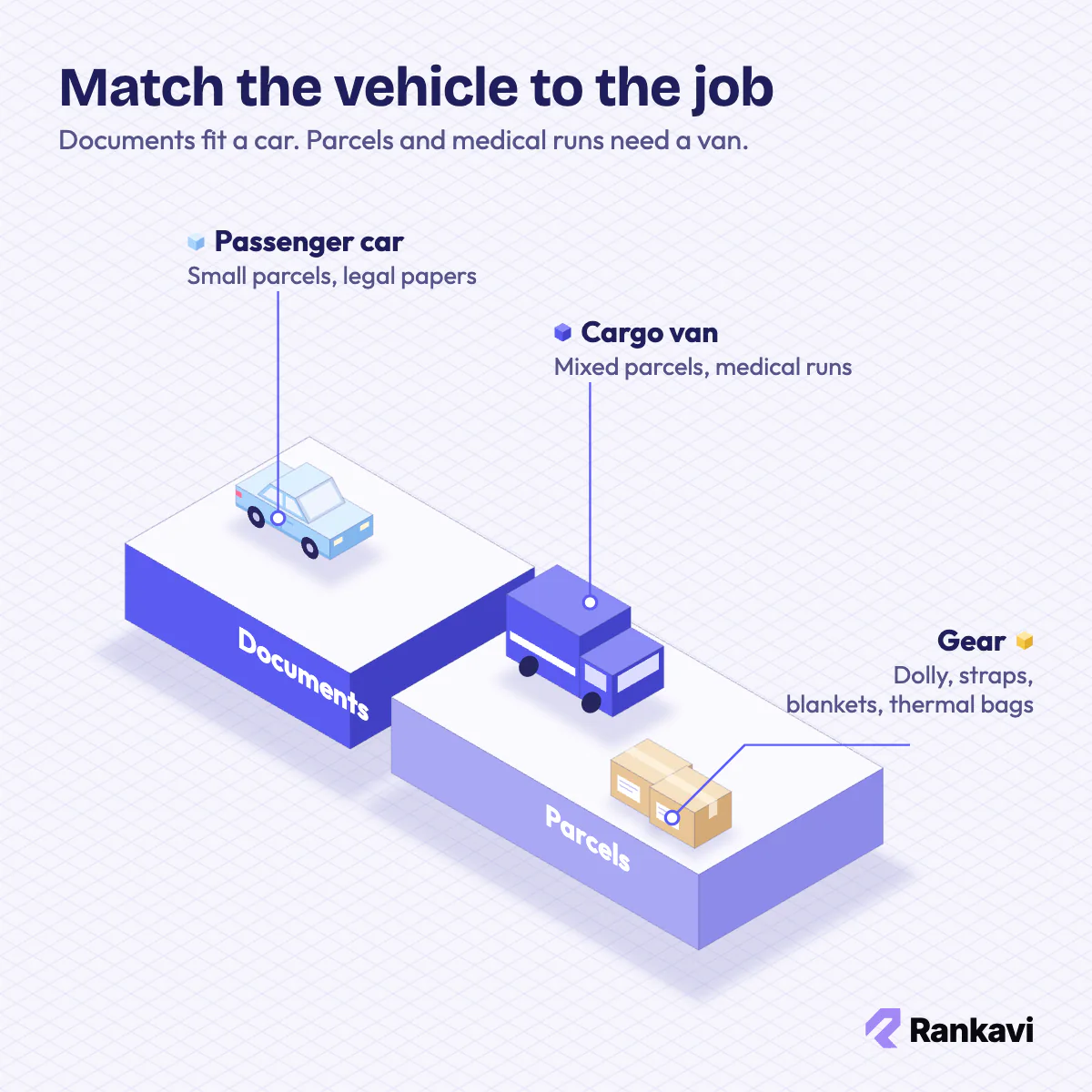
The niche decides the vehicle. A car handles documents, while furniture runs need a cargo van or truck.
Courier vehicles by job:
| Vehicle | Best for |
|---|---|
| Bicycle or motorcycle | Fast downtown documents |
| Passenger car | Small parcels and legal papers |
| Cargo van | Mixed parcels and medical runs |
| Box truck | Furniture and bulk loads |
Cargo volume and payload decide the van size. A compact van such as the Ram ProMaster City fits parcels and small medical runs. Full-size vans such as the Ford Transit, Ram ProMaster and Mercedes-Benz Sprinter come in several roof heights and lengths. A low roof suits parcels and totes, while a high roof lets a driver stand and stack shelving. Payload matters as much as space, because boxed goods can reach the weight limit before the van is full. Box trucks add a liftgate for furniture and pallets.
Buying route and fuel type also matter. A new van brings a warranty and the highest price. A used van costs less but needs a vehicle history report and an independent inspection. Renting first tests a niche.
Gas vans are the cheapest to buy and repair, and diesel suits heavy loads. Electric vans such as the Ford E-Transit cut fuel costs on short city routes. Range and charger access limit them. Fuel cards track spending per vehicle.
A personal vehicle needs a full mechanic inspection before paid work. Fuel efficiency and cargo space matter most. Low mileage cuts breakdown risk on tight delivery windows.
Small gear protects the goods. A dolly or hand truck moves heavy boxes. Ratchet straps, moving blankets and thermal bags keep loads secure and at the right temperature.
Shelving, a bulkhead behind the driver and E-track rails organize the cargo area. Medical runs add insulated coolers, gel packs and a temperature logger. A fire extinguisher, first-aid kit, reflective triangles and a dash cam complete the safety kit. Decals or a wrap turn the van into a moving ad.
Scheduled maintenance keeps the van on the road. A missed delivery from a breakdown can lose a client. Oil changes, tires and brakes follow a written calendar.
9. Set Up Dispatch and Tracking Software
Dispatch software takes orders and assigns them to drivers in one screen. It replaces phone calls and paper logs once more than one vehicle runs.
Route optimization plans multi-stop runs in the shortest order. Shorter routes save fuel and fit more stops into each shift.
Real-time tracking lets clients follow a package on a map. Proof of delivery adds signatures and photos at each drop. Those records settle disputes about missing parcels.
Courier software usually handles these jobs:
- Booking: order entry and online booking
- Dispatch: assigning jobs to drivers
- Routing: multi-stop route optimization
- Tracking: live maps and client alerts
- Proof: signatures and photos at each drop
- Billing: invoices at contracted rates
Billing tools store each client’s contracted rates. Many link to QuickBooks or Xero for accounting.
A solo driver can run on a phone, Google Maps and a spreadsheet. Software pays off once the business runs a second vehicle or many daily stops. Most vendors offer free trials, so a week of real routes shows whether a tool fits. Courier-focused options fall into three groups:
- Dispatch platforms: Onfleet, Tookan and Bringg handle dispatch, driver apps and customer tracking
- Route optimizers: OptimoRoute, Routific and Circuit plan multi-stop runs
- Lighter tools: Detrack and Shipday cover proof of delivery for small fleets
Vendors usually charge per driver per month or per task. Setup fees, text alert charges and extra user seats can add to the bill. Before signing, a buyer compares same-day and scheduled dispatch, branded tracking links and rate tables for wait time. Data export matters when switching vendors.
The driver app runs on iOS and Android phones. Offline mode and low battery use matter on long routes. Medical couriers also need chain-of-custody records, and legal couriers need signed, time-stamped receipts. Drivers should be told that the app tracks location during shifts. Monthly review of on-time rate, stops per hour and cost per stop shows whether the software saves money.
10. Market to Clinics, Law Firms and Local Shops
Direct visits win the first courier accounts. The owner lists nearby offices, clinics and shops, then calls or walks in with a card. Follow-ups turn a first conversation into a trial run.
The first call goes to the person who books errands. That is the office manager at a clinic, the legal secretary at a law firm or the shop owner. Mid-morning on weekdays avoids lunch rushes and patient peaks.
A short pitch covers the service area, the response time and one offer, such as a free first delivery. A card and a one-page rate sheet support it. Buyers may ask for a COI.
Clients already have options. Many use staff errands, DoorDash Drive, Uber Direct or a large carrier. A local courier wins with a named driver, direct phone contact, flexible pickup windows and one monthly invoice. Clinics value HIPAA awareness, and law firms value signed records. Offices usually expect a monthly invoice, while shops can pay by card on file.
Google Business Profile is Google’s free business listing for Maps and local search. A complete profile puts the courier in front of nearby offices. It needs the courier category, a service area, hours and van photos. A simple website with online booking supports that listing.
Early reviews from first clients build trust fast. A direct review link sent after a good delivery works. Paying for reviews breaks Google’s rules. Bing Places, Apple Business Connect, Yelp and Nextdoor add free visibility. The local chamber of commerce adds referrals.
Partnerships bring repeat volume. Restaurants, florists and small online stores often lack their own drivers. A courier that becomes their regular partner gains steady weekly runs.
A wrapped van advertises on every route. Branded uniforms, flyers and postcards reach the same local area. An introductory discount gets a hesitant client to try the first delivery. A defined trial, such as one free delivery or a set number of stops, works better than a vague offer. A spreadsheet or free tracking tool logs each business contacted, the outcome and the next follow-up. Monthly counts of contacts, trials and accounts won show which channel works.
11. Hire Drivers and Grow Contract Routes
Growth starts when the owner turns work away. A first driver only helps once there is enough steady volume to fill the shift.
BLS reported a median annual wage of $39,200 for couriers and messengers in May 2025. Drivers need clean driving records and local road knowledge. Background checks matter because drivers handle client property. Training covers safe lifting, package handling and customer contact.
Clear triggers show when to hire. The owner is turning down paid jobs. The van is booked most of every shift. An on-call backup driver is a low-risk first hire and also covers sick days.
Classification matters early. Couriers may hire employees or work with independent contractors. The choice changes taxes, insurance and how much control the owner has over routes. The IRS common-law test looks at behavioral control, financial control and the relationship between the parties. Some states, including California, use a stricter test. A driver who follows set routes, schedules and uniforms is rarely a true contractor. Misclassification can bring back taxes, back wages and state fines.
Screening protects client property. Insurers often approve each driver by motor vehicle record, and many set a minimum age. Background checks from vendors such as Checkr or Sterling need written consent under the Fair Credit Reporting Act.
Medical couriers add HIPAA and bloodborne pathogen training. Pay models include hourly, per stop and per route pay, and each shifts risk differently between owner and driver. Job boards such as Indeed and ZipRecruiter, plus referrals from other drivers, bring in applicants. Predictable routes and on-time pay help keep them.
Contract routes are recurring, scheduled stops at an agreed rate. Buyers include clinical labs, pharmacies, hospitals, banks, auto parts chains and law firms. The U.S. Postal Service also awards highway contract routes. A written contract sets the rate per stop or route, the term, a fuel surcharge, payment terms and insurance minimums. A service level agreement adds on-time targets.
Partner programs offer another path. The Amazon Delivery Service Partner program contracts small companies to run Amazon delivery routes. FedEx runs a similar contractor model. These programs supply volume but set their own rules and rates. They also concentrate risk in one customer, so a courier that keeps other accounts stays safer.
Feedback keeps contracts renewing. On-time rates, first-attempt success, damage claims, complaint counts and short surveys show where service slips. A courier that reviews these numbers monthly keeps clients longer. A quarterly review with each client before renewal also supports a rate increase.
Growth then follows a sequence: a backup driver, a second van, a dispatcher and finally a route manager.
12. Appear in Copilot and AI Courier Answers
Office managers and clinic staff now ask AI assistants which courier to call. Microsoft Copilot is the assistant that office staff meet inside Windows, Edge and Bing. It often answers with named local companies. Many of those offices already work inside Microsoft tools all day.
Those answers lean on directories, review sites and “best courier” lists. A new courier gains from appearing on those pages while its review count is still small. ChatGPT, Google Gemini and Perplexity answer similar questions. Large carriers fill generic answers. A new courier stands out by naming its niche and city.
Copilot draws on the Bing index, so free setup starts there.
A claimed Bing Places for Business listing and a site verified in Bing Webmaster Tools help Bing find the company. IndexNow sends new pages to Bing quickly. Listings on Google Business Profile, Apple Business Connect, Yelp and Facebook add more sources. The same name, address and phone number on every listing helps assistants match them to one business. LocalBusiness markup on the website adds service area, hours and phone in a form machines read.
Reviews help too. A few detailed reviews that mention the niche and city beat many generic ones. No one can buy a place in an AI answer or guarantee one.
Each month, the owner asks Copilot and the other assistants the questions a clinic would ask. The owner records whether the company is named. New listings can take weeks to appear, so the test is repeated.
Rankavi is a software as a service (SaaS) platform that publishes brand mentions in articles on indexed third-party websites. Couriers that want to get recommended in Copilot can start with a few placed mentions.