

Starting a consulting business takes expertise that clients will pay for, a clear niche and a legal structure. The U.S. Bureau of Labor Statistics, which publishes federal job data, counted 1,077,100 management analyst jobs in 2025, and 14% of those workers were self-employed. Most consultants begin alone from a home office.
I’m Michal Sieroslawski, and I help consulting businesses build their visibility online. ChatGPT and Google’s AI Overviews now suggest consulting businesses by name, and that list matters.
The order runs from offer and prices, to funding and legal setup, to winning and keeping clients. Each step builds on the one before it. The eleven steps below take a consulting business from plan to launch.
- Choose Your Consulting Niche
- Write a Consulting Business Plan
- Price Your Consulting Services
- Fund the First Months
- Register Your Business
- Check Licenses and Credentials
- Insure Your Consulting Practice
- Set Up Contracts and Client Systems
- Market Your Consulting Business
- Grow With Partners and Support
- Get Shortlisted When Buyers Ask AI
1. Choose Your Consulting Niche
A consulting niche decides which problem the consultant solves and for which type of client. The niche shapes pricing, marketing and the quality of clients from the first day.
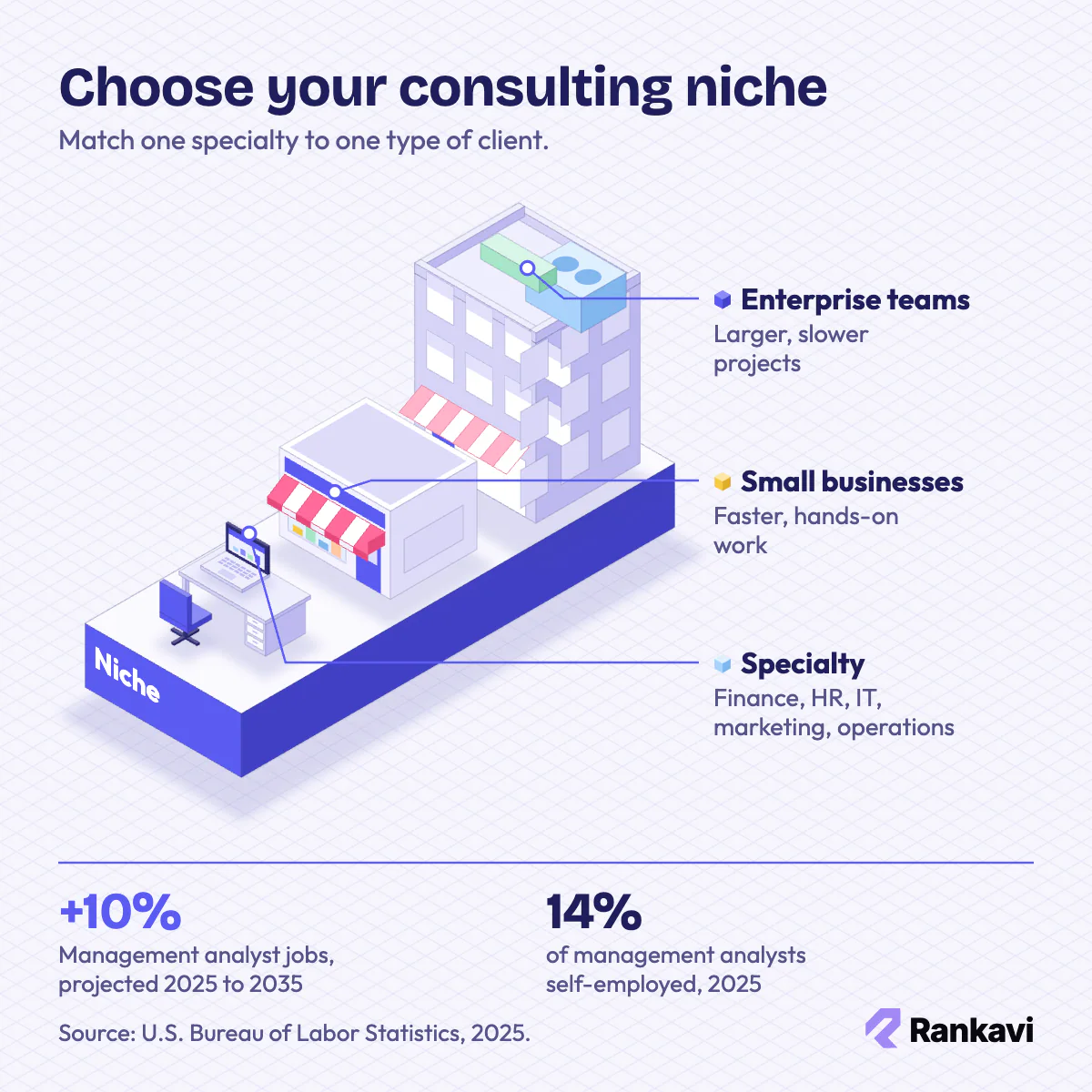
A consultant’s career background usually points to the strongest specialty. Common choices include finance, human resources, information technology, marketing, operations and sales. Environmental, social and governance work is a newer option.
A specialty like finance is still broad, so the next step is to define the niche more sharply. A niche can be drawn along four lines:
- Industry: The niche covers one sector, such as healthcare or manufacturing.
- Function: The niche covers one business function, such as finance or human resources, across sectors.
- Problem: The niche covers one named problem, such as passing an audit or cutting customer churn.
- Client stage: The niche covers one point in a company’s life, such as a first funding round or an acquisition.
The strongest niches combine two of these lines. Pricing strategy for software companies is one example.
A specialist is easier to remember, refer and defend on price. The trade-off is a smaller pool of buyers. A niche that is too narrow can run out of clients.
Demand keeps growing: the U.S. Bureau of Labor Statistics (BLS) projects 10% employment growth for management analysts from 2025 to 2035.
The ideal client matters as much as the specialty. Small businesses face different problems from enterprise teams. Early-stage founders need different help than established operators.
An ideal client profile puts this choice in writing. It lists company size, industry, the buyer’s job title and the budget owner. It also names the trigger that makes a buyer call, such as a failed audit or a new regulation.
A value proposition states that problem in one plain sentence. One useful formula reads: “helps a target audience solve a key problem with a specific solution.” Vague claims like “helps businesses improve” attract nobody.
Demand needs proof before money goes into branding. Conversations with people who fit the client profile reveal their challenges and budgets. Small paid pilot projects then confirm both demand and capacity.
Good validation questions ask about past behavior, not opinions. Good questions cover what the problem costs, what the buyer has already tried and who signs off on spending. A paid yes counts as proof. Compliments do not.
A search on LinkedIn, which is Microsoft’s professional network, shows which rivals already serve the niche. Some competition confirms that buyers spend money on the problem. The gap to look for is a client size, region or problem that rivals leave open.
The first choice does not have to be final. A niche can change after the first few clients. A move to an adjacent niche keeps earlier work useful. One example is taking the same problem into a new industry.
2. Write a Consulting Business Plan
A consulting business plan sets out the services, target clients, goals and financial picture of the practice. The document does not need to be long. A one-page version works for many solo consultants.
A consulting business plan usually has seven sections:
- Executive summary
- Service overview
- Industry analysis
- Customer analysis
- Competitive analysis
- Financials
- Marketing plan
A short mission statement states what the practice is for and anchors the later goals.
Goals turn the plan into a measurable roadmap. Typical goals cover signed retainers, revenue milestones and early case studies. A retainer is a client’s agreement to pay a set fee for ongoing work. Specific, measurable, attainable, relevant and time-based (SMART) targets keep progress visible.
Then there is the end game. Some consultants want to replace a job. Others want a one-person firm, a team, or a saleable business with a client list.
Whatever the end game, the numbers in the plan rest on one key assumption. That assumption is billable hours per week. Billable hours are the hours a consultant charges to clients. Every revenue line depends on this number.
Forecasts work best in conservative, expected and optimistic versions, each with its own billable hours. The plan also names the risk of one client providing most revenue.
The U.S. Small Business Administration (SBA) runs federal small-business programs. It describes two plan formats. A lean startup plan fits an owner who wants to start fast and revise often. A traditional plan suits anyone asking a bank for financing.
Two SBA-backed sources offer free help. The Service Corps of Retired Executives (SCORE) is a nonprofit that runs volunteer mentoring backed by the SBA. Free plan reviews come from SCORE. Small Business Development Centers are a second free option. These SBA-backed centers provide counseling and training on planning, financing and marketing.
3. Price Your Consulting Services
Pricing turns expertise into revenue through a chosen billing model. The model affects income stability as much as the rate itself.
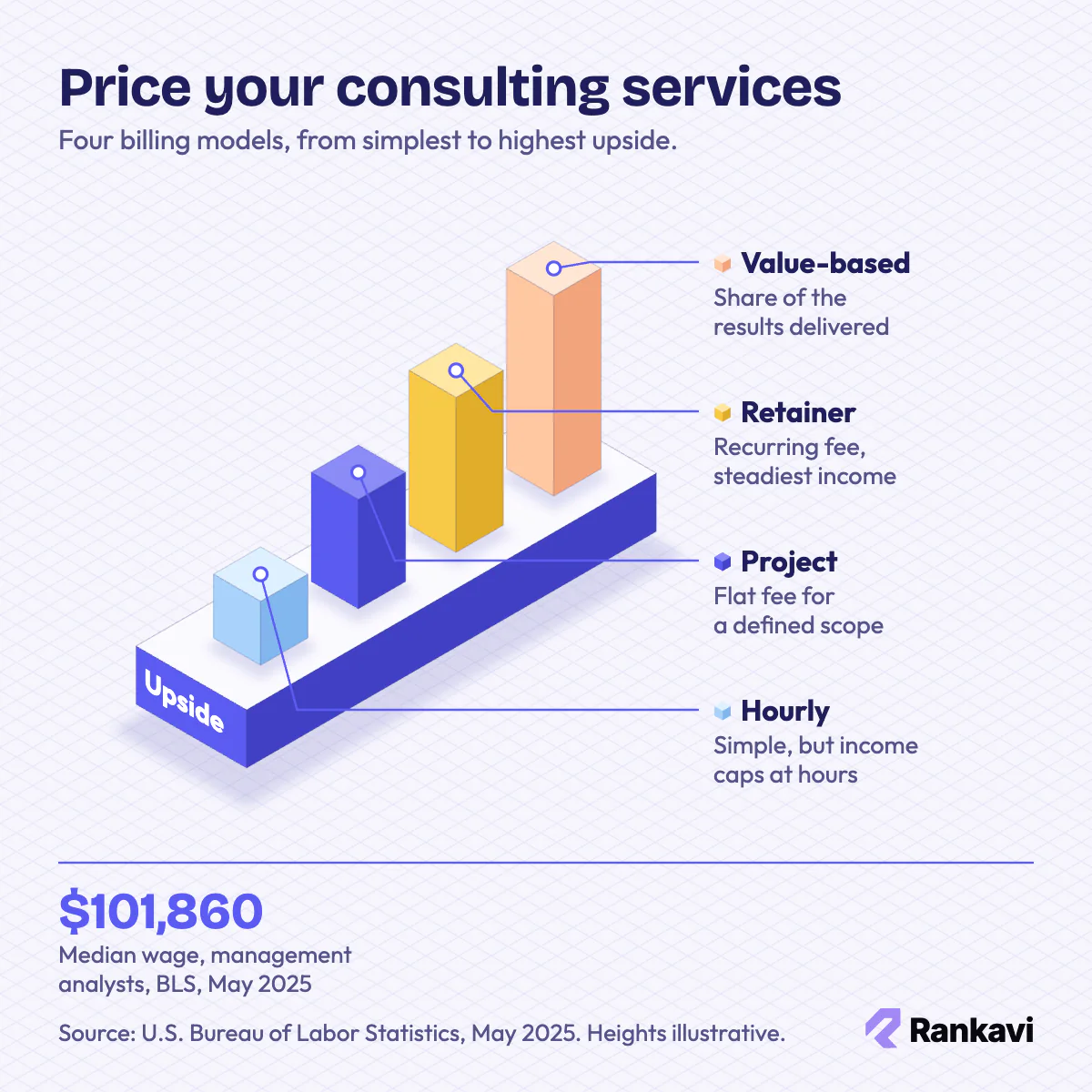
Each model ties pay to something different: time, a set scope, an ongoing relationship or results. The four main consulting pricing models compare as follows:
| Model | How it bills | Main trade-off |
|---|---|---|
| Hourly | Each hour worked | Simple, but income caps at available hours |
| Project-based | Flat fee for a defined scope | Predictable for clients, risky if work runs long |
| Retainer | Recurring weekly or monthly fee | Most stable income, often at a slightly lower rate |
| Value-based | Share of the results delivered | Highest upside, suited to experienced consultants |
Most new consultants start with hourly or project fees. As their track record grows, they move toward retainers and value-based work.
Some consultants want to avoid tracking every hour. They quote a day rate instead, which is a flat fee for a full working day. Hybrid models also exist, such as a monthly retainer plus a separate project fee.
Whatever the model, the rate has to pay for time no client is billed for. Billable utilization measures this. It is the share of available hours that actually get billed, and consultants check it first.
SPI Research reported in 2026 that professional services firms billed just 66.4% of available hours in 2025. That was a record low. Rates must therefore cover the unbilled third, plus self-employment tax and benefits.
One firm owner described the same gap:
“Starting a new business, you will most likely be working a lot of non-billable hours for each billable hour.”
— A consulting firm owner on the EngineerBoards forum
Because so many hours go unbilled, a minimum rate can be worked out backward. First, add up a year of target take-home pay, taxes, benefits and business costs. Then divide that total by the hours the consultant can realistically bill.
Salaried pay offers one benchmark. The BLS reported a median annual wage of $101,860 for management analysts in May 2025. Consulting Success, a consultant training firm, found in 2025 that 39% of consultants charge $100 to $250 an hour.
Worked example: Take an illustrative solo consultant at $150 an hour. Billing 26 of 40 weekly hours for 46 weeks gives about 1,200 hours. That is $180,000 in revenue. A $6,000 launch is repaid after 40 billable hours. Yearly insurance and software of $4,000 take about 27 more. All of this is before self-employment tax, income tax and health cover. It also assumes a full pipeline.
Packages make buying decisions easier. Each package can offer a different level of engagement with a set timeframe and price. Competitor rates in the same niche give a starting benchmark for those prices.
A small paid diagnostic or audit works as an entry offer. It filters out buyers who are not serious. It can also lead into a larger engagement.
When a client pushes back on price, cutting scope protects the rate better than a discount. Increases usually start with new clients, and existing clients get advance notice.
4. Fund the First Months
Funding a consulting business covers the startup costs and the gap before the first invoice is paid. Consulting needs little capital compared with most businesses.
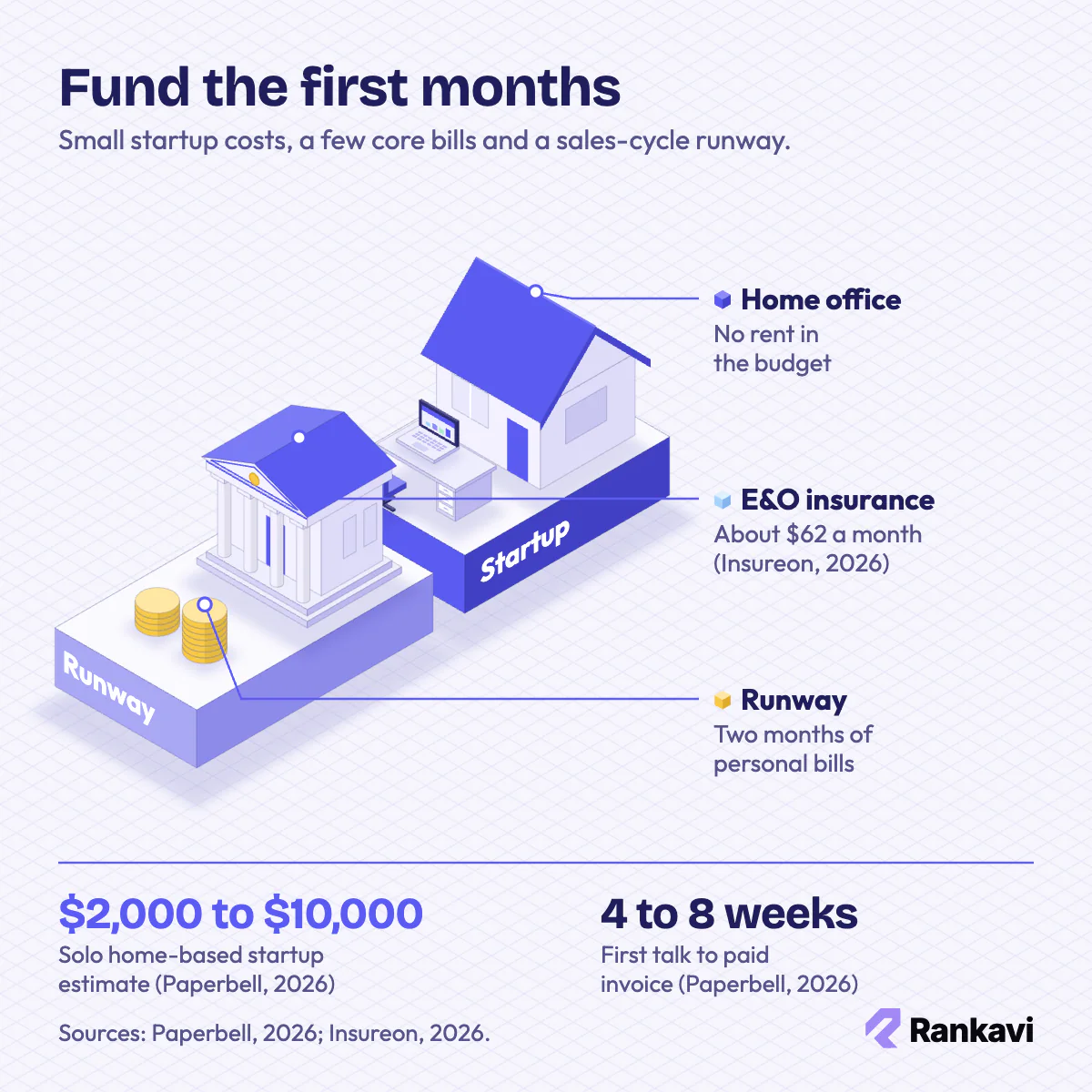
Startup money at a glance:
| Item | Solo home-based consulting practice |
|---|---|
| Startup cost | $2,000 to $10,000 (Paperbell, 2026) |
| Main costs | Website, legal setup, professional liability insurance (about $62 a month, Insureon), essential software |
| Typical margin | 20% to 40% gross margin for boutique firms (Consulting Success, 2025); 9.9% average earnings before interest, taxes, depreciation and amortization (EBITDA) for professional services firms, a firm-wide proxy (SPI Research, 2026) |
| Time to open | About 4 to 8 weeks from the first sales conversation to the first paid invoice (Paperbell, 2026) |
Sources: Paperbell, 2026; Insureon, 2026; SPI Research, 2026; Consulting Success, 2025.
The cost and timing estimates come from Paperbell, a client-management software vendor. The margin figures describe whole firms with staff and offices. A home-based solo practice without rent usually keeps more of each fee.
Because startup costs are low, the bigger money question is cash runway. Runway is the savings that pay personal bills before income arrives. It matters more than equipment. The first invoice can take four to eight weeks to arrive. A reserve of at least two months of personal bills bridges that gap.
Payment terms can stretch the wait even further. On Net 30 terms, a client has 30 days after the invoice to pay. A deposit or a monthly retainer shortens that gap.
Health cover is a personal cost that a salaried job used to carry. It belongs in the monthly budget alongside rent and food.
Taxes need their own reserve. The Internal Revenue Service (IRS) sets the self-employment tax. As of 2026, it is 15.3% on net earnings of $400 or more. Consultants usually pay it through estimated quarterly taxes. These are tax payments made during the year rather than all at once.
Self-employment tax is not the whole bill. Federal and state income tax come on top of it. The IRS expects estimated tax payments from anyone who expects to owe $1,000 or more, as of 2026. The year has four payment periods. Under the 2026 rules, paying 90% of this year’s tax or 100% of last year’s tax avoids the underpayment penalty.
Some launch costs come back at tax time. IRS Publication 583 (December 2024) lets a new business elect to deduct up to $5,000 of start-up costs in its first year.
Once the costs, reserve and taxes are clear, the next question is where the money comes from. Five options can cover the first months:
- Personal savings: Personal savings fund most consulting launches.
- SBA microloan: This small loan can cover a laptop and website if savings fall short.
- Investors: Investors rarely suit a one-person service firm.
- Part-time contract work: Part-time contract work can bridge the first months.
- A former employer: A former employer sometimes becomes the first client, if the employment agreement allows it.
With money lined up, the legal setup can follow.
5. Register Your Business
Registering a consulting business means choosing a legal structure and filing it with the state. The filing creates the entity that signs client contracts and opens accounts.
Paperwork is lightest for a sole proprietorship. It needs little paperwork, but the owner stays personally liable for business debts and claims.
A limited liability company (LLC) is a separate legal entity. It protects the owner’s personal assets if a client sues the business. Many solo consultants choose this route for that reason.
Once profits clear a fair salary, an S corporation election can trim self-employment tax. The trade-off is payroll filings. The election is made on IRS Form 2553.
Most consultants form the business in the state where they live and work. A registered agent receives legal notices for an LLC, and the owner can usually act as their own.
U.S. companies no longer file beneficial ownership reports. The Financial Crimes Enforcement Network (FinCEN) runs that reporting for the Treasury. It removed the rule for U.S. companies in March 2025.
After choosing a name, the owner gets a free employer identification number (EIN). The IRS issues it online in minutes. A separate business bank account keeps consulting income apart from personal money.
6. Check Licenses and Credentials
Licensing determines whether a consultant may legally offer a given service in a state or city. No single official license exists for consulting in general. Instead, the rules depend on where the consultant works and what kind of work they do.
Location decides the first set of rules. Many cities and counties still require a general business license or permit. The state’s official website and the local clerk’s office list these rules. The SBA notes that license needs depend on both business activity and location. It points owners to their Secretary of State’s website for state rules.
Business activity decides the second set of rules. Some consulting fields are regulated professions. In these fields, clients and regulators expect proof of qualification before work starts. Five consulting fields carry their own licensing or registration rules:
- Accounting: Accounting consultants usually hold a certified public accountant (CPA) license.
- Engineering: Engineering consultants may need a professional engineer (PE) license.
- Investigation: Investigative consultants face state licensing and background checks.
- Political consulting and lobbying: Political consultants and lobbyists register with the state or federal government.
- Tax preparation: Tax consultants who prepare federal returns for pay need a preparer tax identification number (PTIN) from the IRS.
Unregulated fields still reward credentials. Clients expect the same standards they would set for an in-house hire. Business consultants often hold a relevant degree or a Master of Business Administration (MBA). Cybersecurity consultants usually show technical certifications.
The Institute of Management Consultants USA, a volunteer body founded in 1968, certifies management consultants. Its Certified Management Consultant (CMC) credential is earned with documented client assignments and references.
The application summarizes at least three client assignments and names three to five client references. Clients recognize the Institute of Management Consultants USA mark as proof of a Certified Management Consultant’s track record.
For marketing consultants, the American Marketing Association, founded in 1937, offers optional education and certification. Membership in the American Marketing Association also signals current training.
The most useful credentials are the ones buyers in the niche name in their job posts and requests for proposals. A credential that buyers never ask for adds cost without adding trust.
7. Insure Your Consulting Practice
Consulting insurance protects the practice when a client claims that advice caused a financial loss. Cover belongs in place before the first engagement starts.
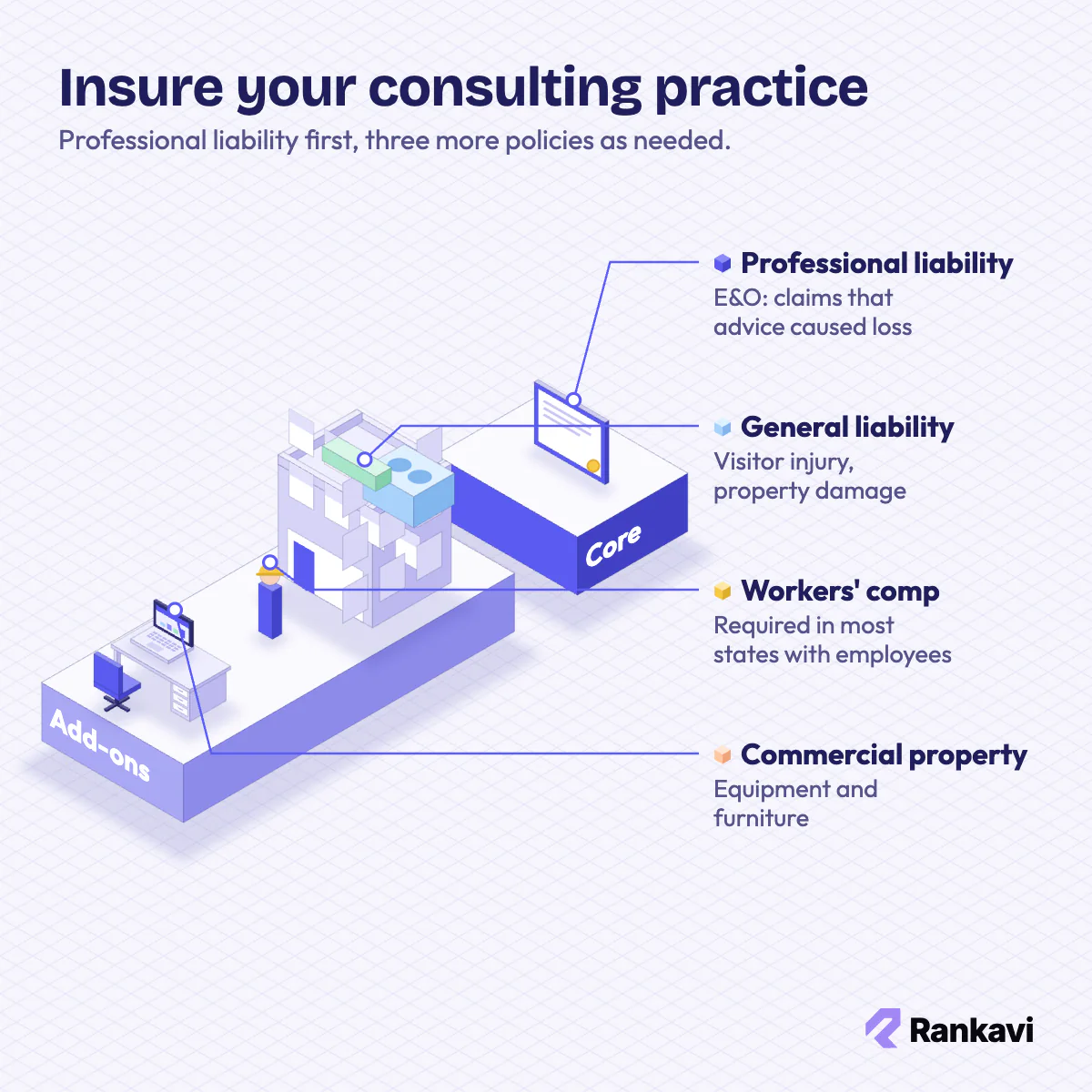
Claims can follow even good work. For example, a marketing client may blame the consultant when a revenue goal falls short. Defense costs arise whether or not the consultant is at fault.
For consultants, the core policy is professional liability. It is also called errors and omissions (E&O) insurance. It helps pay legal defense costs and damages after a claim of negligence or a missed deadline. Negligence means failing to take reasonable care in the work. Insureon, an online insurance broker, reported in 2026 that consultants pay an average of $62 a month for it.
Policy wording matters as much as price, because the wording decides when a claim gets paid. A claims-made policy pays only if it is active when the claim is filed. That leaves past work exposed once the policy ends. Tail coverage, also called an extended reporting period, fills this gap. It keeps past work protected after a policy ends.
Larger clients often ask for a certificate of insurance before the contract is signed. This document shows that the policy is in force. An LLC does not replace this cover, because it pays no legal defense costs.
Professional liability covers advice, but a practice faces other risks as well. The table below compares the common policies.
Common consulting insurance policies:
| Policy | What it covers |
|---|---|
| Professional liability (E&O) | Claims that advice or errors caused financial harm |
| General liability | Injury to visitors and damage to property the business does not own |
| Workers’ compensation | Medical costs and lost wages for injured employees |
| Commercial property | Equipment, furniture and premises after fire, theft or water damage |
| Cyber liability | Costs after a breach of client data or systems |
| Business owner’s policy | General liability and property bundled into one policy |
Workers’ compensation becomes required in most states once the business has employees. Home-based consultants also check whether a home business policy covers their equipment.
8. Set Up Contracts and Client Systems
Client systems keep every engagement consistent, documented and paid on time. Contracts, invoicing and onboarding form the core of those systems.
A consulting contract defines scope, deliverables, payment terms and how either side can end the work early. A signed letter of engagement also sets availability and response times.
Repeat clients often sign a master services agreement (MSA) for the overall terms. Each project then gets its own statement of work (SOW) with scope, timeline and fee. A non-disclosure agreement covers sensitive information shared before the work starts.
Beyond scope and payment, the key clauses cover intellectual property ownership, confidentiality and a limit on liability. A clause on independent contractor status confirms that the consultant is not an employee.
Invoicing software sends bills and tracks payments. Automatic reminders follow up on late invoices without awkward emails.
Payment terms belong in the contract. A deposit before work starts and milestone payments on longer projects protect cash flow. A late fee and a stop-work rule for overdue balances give reminders some weight.
Onboarding starts each project with shared expectations. Welcome materials, an intake questionnaire and a kickoff meeting gather context before work begins.
Scope changes need a written process. Clear milestones and billing stages stop unpaid extra work from creeping into fixed-fee projects. A change order records the added work, fee and timeline, and the client approves it before work begins.
Each project ends with sign-off on the deliverables and a final invoice. The consultant then removes system access and returns or deletes client data.
9. Market Your Consulting Business
Marketing a consulting business puts the consultant in front of people who already trust the work. The first clients usually come from the existing professional network.
Former colleagues, managers and peers form the warmest market. A direct message that explains the service and asks for referrals often fills the first slots. Weak ties, meaning people outside the consultant’s immediate circle, bring many later clients.
The consultant can use three tools to help new people find the work and judge it:
- LinkedIn: This platform suits most business-to-business consultants, meaning those who sell to other companies. Regular posts about the problems the consultant solves attract the right audience better than promotional posts.
- A simple website: A website adds credibility and gives referrals a place to send people. At the start, one clear page is enough. It lists services, clients served and results.
- A lead magnet: This is a checklist or short guide that readers get in exchange for their contact details. It builds an email list. A short email sequence then invites readers to book a call.
The Federal Trade Commission (FTC) enforces the federal rules for marketing emails. Each message needs a working opt-out, which lets readers stop the emails. Each one also needs a valid postal address. Opt-out requests must be honored within 10 business days.
Testimonials and small case studies become the strongest marketing assets. Each one describes the problem, the approach and the result. Some work is done under a non-disclosure agreement, a contract that keeps details private. That work can still become an anonymized case study, with names removed, if the client gives written approval.
The FTC also covers testimonials, under its Endorsement Guides. A testimonial must reflect the client’s honest experience. A testimonial given in return for a discount or free work needs that connection disclosed.
A reply leads to a discovery call, which is a first talk about the client’s needs. The call covers the problem, its cost, the budget and who decides. A short proposal follows soon after the call.
A simple tracker shows which channel works. It counts conversations started, calls booked, proposals sent, wins and the source of each client.
“Word-of-mouth referrals are the single-most important source of business (from personal experience and the experience of other small consulting firm owners I know).”
— A consulting firm owner on the EngineerBoards forum
10. Grow With Partners and Support
Growing a consulting practice involves adding capacity without adding fixed costs too fast. Partners, outsourcing and standard services carry most early growth.
Subcontractors fill skill gaps on larger projects. A subcontractor is an outside worker the firm hires to do part of a client project. Partners with complementary skills, not competing ones, help in the same way. That lets the firm win work a solo consultant could not deliver alone.
Former colleagues and LinkedIn are the usual places to look. Upwork is an online freelance marketplace that also lists independent consultants by skill.
Once the firm brings in a subcontractor, that person must stay genuinely independent. The IRS judges this on behavioral control, financial control and the type of relationship.
Paying a contractor also creates a reporting duty. For 2026 payments, the firm reports each contractor it paid $2,000 or more to the IRS.
Beyond the tax rules, a written subcontractor agreement sets the terms of the work itself. It covers four main points:
- Confidentiality: The subcontractor keeps private information private.
- Ownership of the work: The agreement states who owns what the subcontractor produces.
- No approach to clients: The subcontractor promises not to approach the firm’s clients.
- Passed-down duties: The agreement passes down the duties that the client contract places on the firm.
Subcontractors add capacity for client work. Outsourcing adds capacity in a different way. It takes other tasks off the consultant’s desk, which frees billable time. Billable time means the hours a client pays for. Bookkeeping, social media and administrative work are common first tasks to hand off.
A diverse client base reduces risk. Clients across several industries, or across the public and private sectors, protect income when one sector slows.
Productized services support controlled growth. A productized service is a standard offer with a fixed scope. It lets the firm take more work without a matching rise in hours. A fixed-fee audit or a set workshop is a common example. Because the format repeats, parts of the work are also easier to hand to subcontractors or outsourced help.
Adding people is not the only path, though. Staying solo and raising rates is also a valid way to grow. It adds income without adding the work of managing others.
11. Get Shortlisted When Buyers Ask AI
AI visibility means a consulting practice gets named when a buyer asks an assistant for an advisor. A founder might ask Gemini for “an operations consultant for a 40-person manufacturer” before calling anyone. ChatGPT, Perplexity, Claude and Microsoft Copilot answer the same kind of question.
Assistants build those shortlists from what other sites already say. Professional directories, association member lists, podcast show notes and “top consultants” roundups all count. Referrals still matter, but a new practice with no outside mentions rarely gets named.
A quick check shows where a practice stands. The owner asks each assistant the questions a buyer would ask and notes which firms and sources appear. The same firm name, niche and city on every listing helps an assistant match those mentions to one practice.
Rankavi is a software as a service (SaaS) platform that publishes brand mentions in articles on indexed third-party websites. Consultants can order mentions from $12 per article. More independent sources can, over time, support a firm’s Gemini visibility.