

Starting a construction business takes a chosen sector, a contractor license, insurance, a bond and cash to carry jobs. The U.S. Bureau of Labor Statistics (BLS) found 56.5% of construction establishments opened by March 2020 still operating in March 2025.
I’m Michal Sieroslawski, and I help construction companies show up in Google and AI search. Asking an AI assistant is becoming a normal way for property owners to compare construction companies. A mention in those replies can bring in customers before any ad does.
The order settles prices and money before paperwork, so the license, bond and insurance fit a plan the owner can already pay for. Opening a construction business follows the twelve steps below.
- Research Your Market and Pick a Sector
- Write a Construction Business Plan
- Price Jobs From Real Costs
- Fund Startup Costs and Cash Flow
- Register Your Contracting Company
- Get a Contractor License and Permits
- Insure and Bond Your Business
- Buy Tools, Vehicles and Safety Gear
- Set Up Estimating and Job Costing Software
- Market to Homeowners and Builders
- Hire Crews and Grow With Subcontractors
- Win a Spot on AI Contractor Shortlists
1. Research Your Market and Pick a Sector
Researching the market decides which kind of construction work the company bids on and for whom. That choice shapes the license class, the equipment and every price that follows.
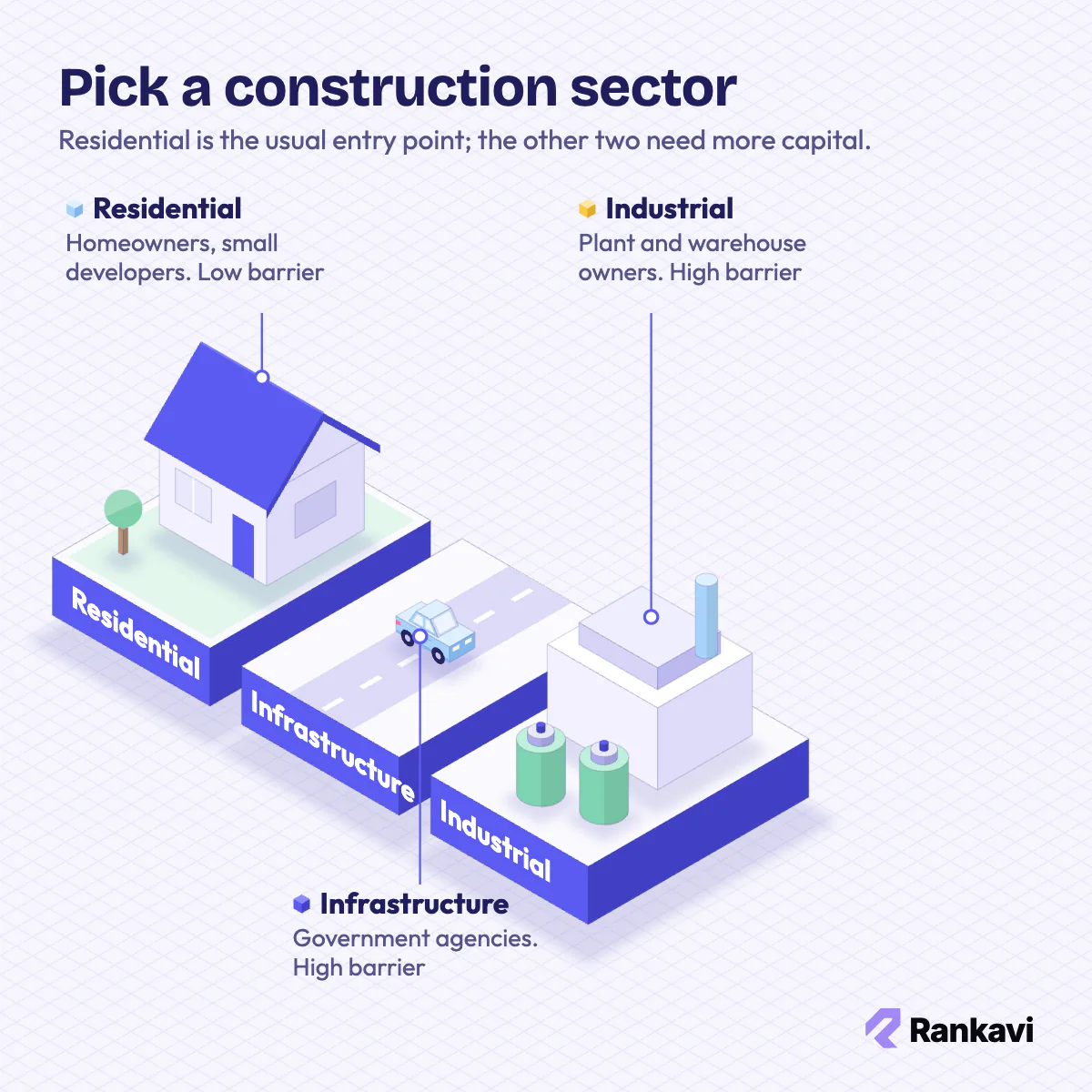
The first step is picking a sector. Construction splits into three broad sectors: residential, infrastructure and industrial. Commercial building sits between them, so the four options compare as follows:
- Residential: Homeowners and small developers hire residential builders. This sector is the usual entry point for a new company. Jobs are smaller and clients are plentiful.
- Commercial: Offices, stores, restaurants and clinics hire contractors for new builds and tenant fit-outs. These jobs run larger than home projects. They are often won through bids or general contractor referrals.
- Infrastructure: Infrastructure work for government agencies needs heavy capital, bonding capacity and experienced crews.
- Industrial: Plant and warehouse owners hire contractors for industrial work. Like infrastructure, it needs heavy capital, bonding capacity and experienced crews.
Inside any sector, the type of work matters just as much. The three types of work compare as follows:
- New construction: This work depends on land, financing and the housing market.
- Remodeling and repair: This work brings smaller jobs and repeat clients.
- Storm and water restoration: This work follows the weather and insurance claims.
Private and public clients also buy in different ways. Private owners hire through referrals and negotiated quotes. Government agencies post bids on public portals. They often require bonds and prequalification, which means the agency checks a contractor’s record before accepting bids. As a result, public jobs add bonding and paperwork before the first bid goes in.
A second choice sits inside the sector: how much of each project the company handles. A general contractor runs whole projects and coordinates the other trades. A specialty contractor sells one trade, such as framing, concrete, roofing or electrical work. Many founders start in the trade they already know.
Local research tests the idea against real demand. Owners count nearby builders, read their reviews and note their prices. Building permit records and proposed projects show where work is heading. Gaps in remodeling, additions or aging-in-place upgrades often point to a niche.
A written comparison turns the research into a decision. Owners score each option on startup capital, typical job size, payment speed, competition and seasonality. The founder’s own trade experience goes into the same score. Climate also decides how many working months a sector gets each year.
2. Write a Construction Business Plan
A construction business plan sets out the work, the market and the money before the first bid goes out. Lenders, sureties and partners read it to judge whether the company can finish what it signs.
A construction plan covers six core sections:
- Business and management structure: how the company is set up and who runs it.
- Services and jobs to bid: the work offered and the kinds of jobs the company will chase.
- Target market and competitors: the clients served and the firms competing for them.
- Staffing and subcontractor plan: who does the work, on the crew and through subs.
- Marketing strategy: how the company will reach clients.
- Revenue goals, lending sources and startup costs: earnings targets, loan sources and opening costs.
Construction plans also state the accounting method and billing terms. A cash-basis contractor records money when it moves. An accrual-basis contractor records it when it is earned, which suits long jobs billed in stages.
How much detail the plan needs depends on who will read it. An owner funding the start alone can work from a one-page lean plan. A full plan with a startup cost table and three years of projections suits a bank or surety.
Those projections need their assumptions spelled out. The plan shows the overhead rate and the target gross and net margin. It also shows the cash needed before the first payment and how many jobs the crew can run at once.
The key assumption is bid volume. New owners often overestimate how many bids they will win. They also tend to underestimate overhead. Conservative win rates, grounded in local research, hold up better with a bank or surety.
A short risk section rounds out the plan. It names threats such as material price swings, weather delays, change orders and slow-paying clients. Each risk gets one line on how the company will handle it.
3. Price Jobs From Real Costs
Pricing construction work turns labor, materials, overhead and profit into one number the client signs. Pricing too low is the most common reason young contracting firms run out of money.
Labor cost is more than the wage. Labor burden is the extra cost an employer pays on top of each paid hour. It has three parts:
- Payroll taxes: In September 2026 guidance, the Internal Revenue Service sets the employer share at 6.2% for Social Security and 1.45% for Medicare.
- Workers’ compensation: These premiums are also part of labor burden.
- Benefits: Any benefits the firm provides also add to the cost of each paid hour.
Even with burden counted, a firm can’t bill every paid hour to a client. Travel, estimating and rework go unbilled. Overhead such as the truck, phone, software and insurance then gets spread across every billable hour.
After labor and overhead, the estimate adds markups on the rest of the job. Materials carry a markup that covers waste, handling and supplier runs. Subcontracted work carries its own markup for coordination and risk. Net profit also gets its own planned line in the estimate. It is not whatever money happens to remain.
Markup and margin are different numbers. Markup is added on top of cost, while margin is a share of the final price. The same percentage therefore yields a smaller margin than markup. Owners who confuse the two price below the profit they planned.
Gross margin, the share of the price left after direct job costs, is the benchmark most builders check first. The National Association of Home Builders (NAHB) represents home builders and remodelers. It reported a 20.7% average gross margin for single-family builders in 2023. That figure covers home builders only. Remodelers and specialty trades should treat it as a rough reference, not a target.
Estimates also list what they leave out. Permit fees, dump fees, equipment rental and sales tax on materials are easy to forget. Allowances are placeholder amounts for finishes the client has not picked yet.
Material prices can also rise after the estimate goes out. A price validity date sets how long the price holds. An escalation clause lets the price change if material costs jump. Together they protect against lumber, steel or copper price jumps.
Once the costs are known, the contractor has to choose how to charge for them. Each model fits a different kind of job.
Common pricing models:
| Model | Best fit |
|---|---|
| Time and materials | Jobs with an unclear scope |
| Flat rate per task | Repeat service jobs |
| Unit pricing | Repetitive installs priced per square foot or per item |
| Fixed bid | Defined projects with full drawings |
| Cost-plus | Custom work where the client accepts open books |
| Guaranteed maximum price | Larger projects where the client wants a cost ceiling |
The model also decides who pays when costs run over. A fixed bid puts cost overruns on the contractor. Cost-plus and time and materials put more of that risk on the client.
Payment terms protect the price. Contractors take a deposit at signing. They bill larger jobs by milestone, meaning at set stages of the work. The final invoice waits until the punch list is done. The punch list is the last set of small fixes before the job closes.
Deposits face legal limits in some states. California’s Contractors State License Board (CSLB) sets a legal cap on home improvement down payments. As listed in 2026, the cap is 10% of the price or $1,000, whichever is less.
Changes need a written change order, priced and signed before the extra work starts.
4. Fund Startup Costs and Cash Flow
Funding a construction startup covers tools, vehicles, licensing, insurance and the cash gap before clients pay. The gap matters because contractors buy materials and pay crews weeks before progress payments arrive.
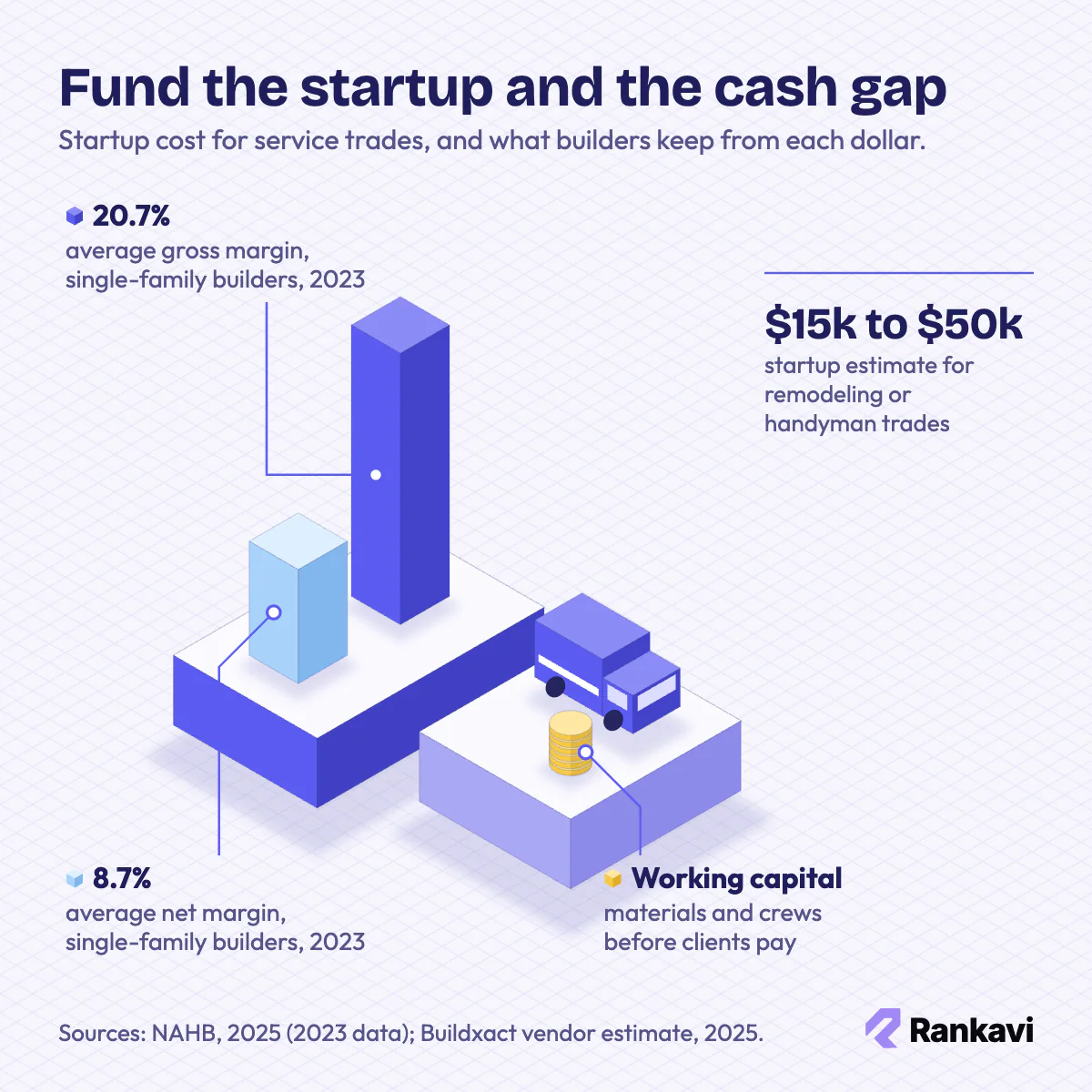
Startup money at a glance:
| Item | Typical figure |
|---|---|
| Startup cost | $15,000 to $50,000 for remodeling or handyman trades; over $150,000 for a general contractor with employees, vehicles and heavy equipment |
| Main costs | Tools and vehicles, general liability insurance (an average of about $1,950 a year for general contractors), license and bond fees, software, working capital |
| Typical margin | 20.7% average gross and 8.7% average net margin for single-family builders (2023 data); not a benchmark for remodelers or specialty trades |
| Time to open | Weeks in states without contractor licensing; months where exams and experience checks apply |
Sources: Buildxact (software vendor), vendor estimate, 2025; Insureon (insurance agency), average premium, 2026; National Association of Home Builders, 2025 (single-family builders, 2023 data).
How much a founder needs depends on the trade and on the gear the owner already has. Buildxact, a construction software vendor, estimated in 2025 that remodeling or handyman trades can start on $15,000 to $50,000. By the same 2025 estimate, a general contractor with employees, vehicles and heavy equipment can pass $150,000. No government or trade-association source publishes a startup cost range.
The startup bill is only part of the plan. The National Association of Home Builders reported that single-family builders averaged a 20.7% gross margin and an 8.7% net margin, based on 2023 data. Remodelers and specialty trades should not treat those numbers as their benchmark.
Worked example: An illustrative home builder closes $400,000 of jobs in year one at those averages. A 20.7% gross margin leaves $82,800 after materials, labor and subcontractors. Keeping 8.7% net, or $34,800, means overhead must stay under $48,000. General liability at $1,950 already uses about 4% of that overhead budget. The figures are illustrative only.
Money for materials and crews goes out weeks before client payments come in. Working capital, the cash that covers day-to-day costs, is the line founders most often underfund. Progress billing can leave invoices unpaid for months.
The delay comes from how construction gets paid. Clients often hold back part of each payment, called retainage, until the job is complete. Payment terms on larger jobs can leave each invoice open for weeks. Deposits and milestone billing shrink the gap. They make the client fund materials as the work goes.
Loans backed by the U.S. Small Business Administration (SBA) are a common first source. This federal agency guarantees part of each loan. Three SBA programs each fit a different need:
- 7(a) loans: In 2026, these reached up to $5 million for working capital and general use. They run through partner lenders.
- Microloans: These went up to $50,000 in 2026, which suits a small trade start. They also run through partner lenders.
- 504 program: This program was capped at $5.5 million in 2026. It funds real estate and long-life equipment.
The lender looks at the owner before the business. Personal credit, trade experience, a business plan and the owner’s own cash in the deal all count. Lenders may also ask the owner to sign a personal guarantee. That makes the owner personally responsible for repaying the loan.
SBA loans are not the only source. Four other funding options differ in cost and risk:
- Business line of credit: It bridges the cash gaps between projects.
- Equipment financing: It spreads the cost of machines and trucks over their working life.
- Supplier trade credit and business credit cards: These cover small materials runs at lower risk.
- Merchant cash advances: These repay through daily debits from the business account. That squeezes cash flow on jobs that pay monthly, so this funding can cost more than it saves.
Buying equipment also changes the tax bill. Section 179 of the federal tax code lets a business deduct qualifying equipment in its first year of use. Some property, such as a truck, gets both business and personal use. For this mixed-use property, federal rules in 2026 required business use above 50%.
5. Register Your Contracting Company
Registering a contracting company gives it a legal form that holds the license, signs contracts and absorbs claims. Job site injuries and property damage make that liability shield worth more than in desk-based trades. A liability shield keeps claims against the business away from the owner’s personal assets.
The first choice is the company’s legal form. The three main options are two legal forms and one later tax election:
- Sole proprietorship: This is the easiest form to set up. It gives no shield, so job site claims can reach the owner’s personal assets.
- Limited liability company (LLC): Many contractors choose this form. It shields personal assets and offers flexible tax treatment.
- S corporation taxation: This is a tax choice, not a separate legal form. Profitable firms often elect it later.
The shield has limits. It does not cover a personal guarantee on a loan or supplier account. A personal guarantee is the owner’s promise to repay the debt if the business cannot. Mixing personal and business money can also let a court reach the owner’s assets. A separate business bank account keeps the two apart.
Once the form is chosen, the company needs a name. The name gets checked against the state database before filing with the Secretary of State. Sometimes the company will trade under a name that differs from its legal name. That trade name needs a doing business as (DBA) filing.
With the name cleared, the company can be formed. Forming an LLC means filing articles of organization with the state. Every state also requires a registered agent with a local address. The registered agent receives legal papers for the company. An operating agreement then sets out ownership and who can sign contracts. This matters most when the company has partners.
After the company exists, it needs a federal tax number. This is an employer identification number (EIN), issued by the Internal Revenue Service (IRS). Some licensing boards, including California’s, license the LLC itself. In those cases, the entity must be formed before the license application.
The legal name should match across the license, contracts, insurance and bank account. After that, annual state reports keep the company in good standing.
6. Get a Contractor License and Permits
A contractor license means the state has confirmed the company’s experience, exams and finances. Unlicensed contractors risk fines, unenforceable contracts and stop-work orders.
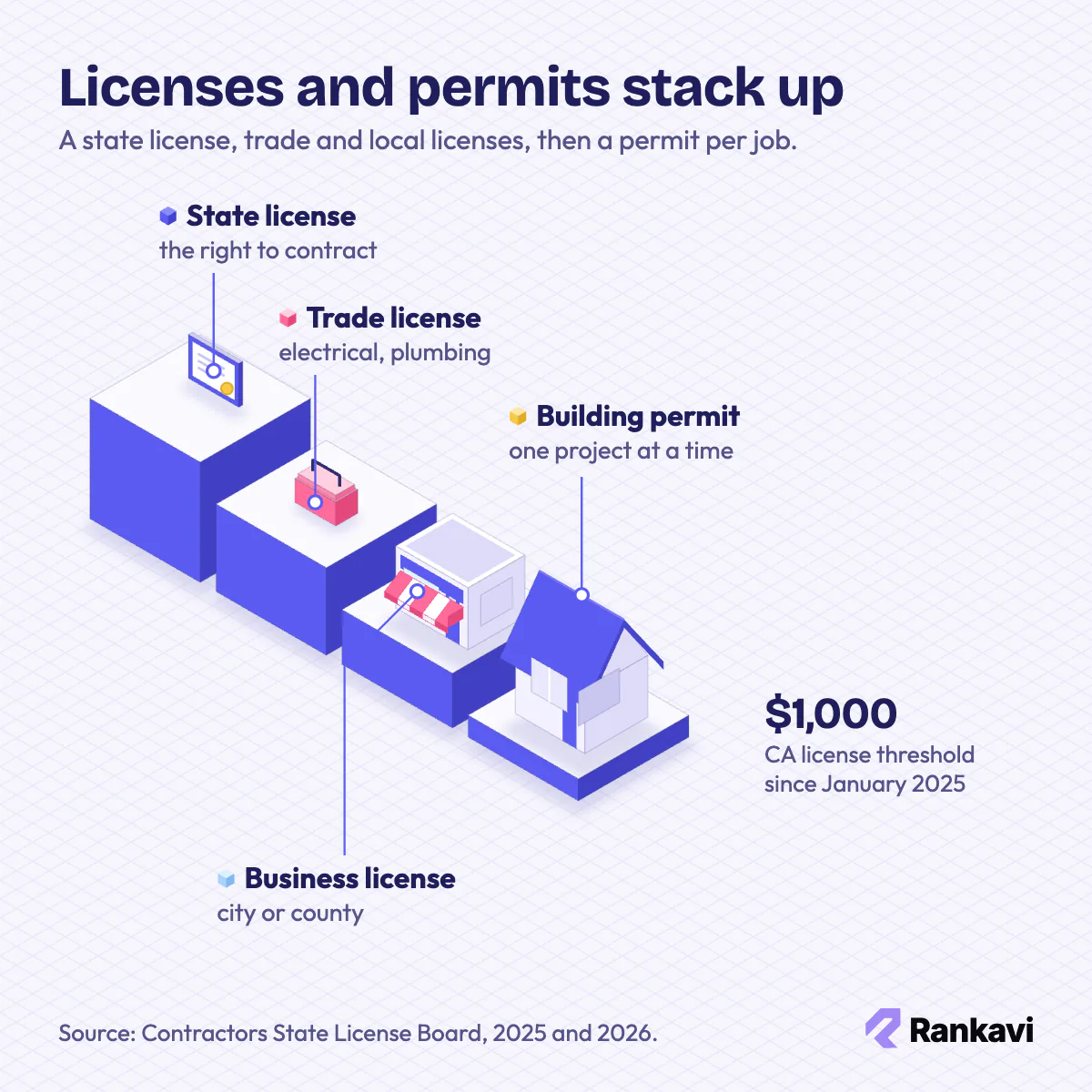
State rules differ widely. States handle contractor licensing in three main ways:
- State board licensing: A state board licenses general contractors directly.
- Local licensing: The state leaves licensing to cities and counties.
- Registration only: The state asks contractors to register but does not require a full license.
Most boards ask for proof of experience, a trade exam and a business and law exam.
California shows how strict a state board can be. The Contractors State License Board (CSLB) licenses and regulates the state’s contractors. On January 1, 2025, it raised its minor-work exemption to $1,000.
This exemption covers small jobs that can be done without a license. Since 2025, it applies only when the job needs no permit and no workers are hired. Otherwise, even a smaller job requires a license.
Getting that license also costs money. As of 2026, the CSLB listed a $450 application fee. It also listed a $200 initial license fee for a sole owner in 2026. Non-sole owners, such as LLCs, paid $350 for the initial license in 2026.
The fee is only part of the process. An applicant must also pick the right license class, because each class covers different work. The CSLB license classes fall under three letters:
- Class A: Covers general engineering.
- Class B and B-2: Class B covers general building and Class B-2 residential remodeling.
- Class C: Covers specialty trades, such as C-10 electrical, C-36 plumbing and C-39 roofing.
In any class, an applicant must show four years of journey-level work in the trade. Journey-level means work done as a fully trained worker. That experience must come from the last ten years.
These requirements take time to meet, but skipping the license costs more than a fine. Under California Business and Professions Code section 7031, an unlicensed contractor cannot sue to collect payment. The client can also sue to recover everything already paid.
The experience rule can stop a new founder from qualifying alone. Many licenses solve this by naming a qualifying individual, the person who passed the exams for the company. A founder without enough experience can partner with a licensed qualifier. The founder can also keep working for another contractor until eligible.
State licenses are not the only credential. Federal rules add one for older homes. The Environmental Protection Agency (EPA) certifies firms under its lead-safe Renovation, Repair and Painting rule. Firms that disturb paint in homes built before 1978 need this certification. The firm certification fee was $300 for five years, per the EPA fee page updated in 2025.
A state license is only one layer of approval.
License and permit layers:
| Layer | Issued by | Covers |
|---|---|---|
| State contractor license | State licensing board | The right to contract |
| Trade license | State or local board | Electrical, plumbing or mechanical work |
| Business license | City or county | Operating locally |
| Building permit | Local building department | One project at a time |
Each building permit follows a set path. The contractor submits plans, pays a fee and passes plan review. Inspectors then check the work at set stages before final sign-off. Unpermitted work can block a home sale or force rework.
Licenses and permits give a company the right to work. Safety rules control how that work gets done, and they apply from the first job. The Occupational Safety and Health Administration (OSHA) enforces federal workplace safety standards on every site. In fiscal year 2025, OSHA ranked fall protection as its most cited standard. Construction ladders ranked third.
7. Insure and Bond Your Business
Insuring a construction company protects the owner, the crew and the client when a job goes wrong. Clients, general contractors and licensing boards often ask for proof before any work starts.
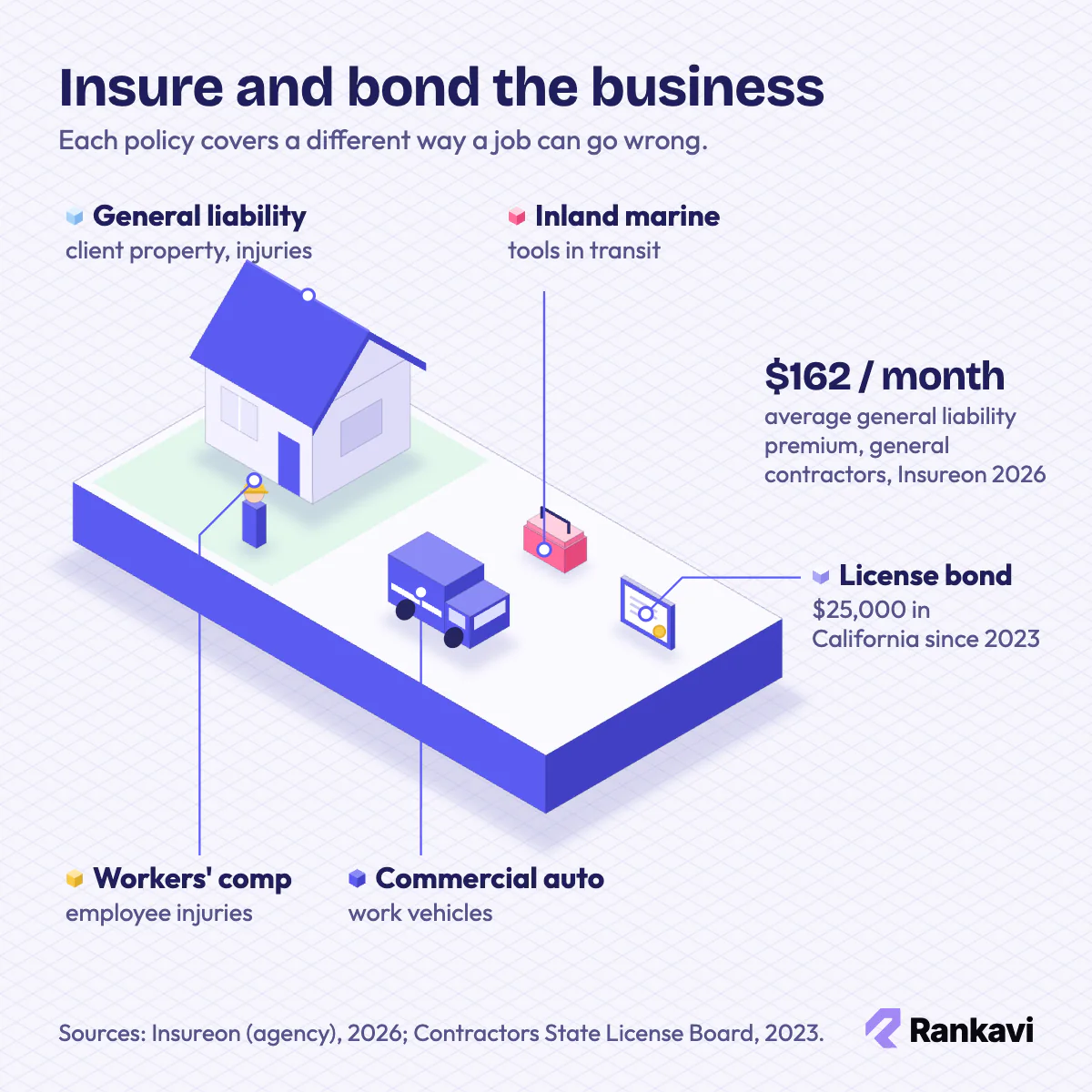
Core contractor coverage:
| Coverage | Protects against |
|---|---|
| General liability | Client property damage and third-party injuries |
| Workers’ compensation | Employee injuries on the job |
| Commercial auto | Accidents in work vehicles |
| Inland marine | Tools stolen or damaged in transit or on site |
| Builder’s risk | Damage to a structure under construction |
General liability is the policy clients check first. Insureon, an online insurance agency, reported in 2026 that general contractors buying through it pay an average of $162 a month. That came to about $1,950 a year in 2026.
Workers’ compensation usually becomes mandatory once the first employee is hired. California’s Contractors State License Board (CSLB) requires active-license applicants to file proof of workers’ compensation or an exemption. Anyone with employees cannot claim the exemption. Neither can concrete, roofing, tree service, asbestos abatement and heating and air conditioning contractors.
The CSLB also requires something that is not a policy at all: a contractor license bond. This is a surety bond, which means a company called a surety backs the contractor’s promise to follow the law. It protects clients when a contractor breaks licensing law. The CSLB raised its required contractor bond from $15,000 to $25,000 on January 1, 2023.
A bond is not insurance for the contractor. When a valid claim is made, the surety pays it. The contractor must then repay the surety.
A license is not the only reason to get bonded. Contract bonds back a contractor’s promises on a job, and they come in three main types:
- Bid bond: This bond backs the bid.
- Performance bond: This bond backs finishing the job.
- Payment bond: This bond backs paying suppliers and subcontractors.
Public work often requires these bonds. Under the Miller Act, federal construction contracts above $150,000 required performance and payment bonds in 2026. New firms with little history can struggle to qualify. In 2026, the SBA Surety Bond Guarantee program backed bonds on contracts up to $9 million, or $14 million for federal work.
A certificate of insurance is the usual proof of coverage. It shows each policy and its limits. Many general contractors also want to be named as additional insured on the subcontractor’s policy.
8. Buy Tools, Vehicles and Safety Gear
Equipping a construction company covers the tools, vehicle and protective gear that let a crew work safely on day one. Buying too much too early ties up cash that payroll needs.
Each item gets one of four paths:
- Buy new: Daily tools and the work truck are worth owning.
- Buy used: A used purchase saves cash compared with buying new. The title, service records and liens need checking first. A lien is a lender’s legal claim on the item.
- Lease: Leasing sits between renting and buying. A lease lowers the upfront cost of a truck or machine but adds a monthly bill.
- Rent: Heavy machinery used now and then is cheaper to rent per job. A rental purchase option (RPO) lets rent payments count toward buying the machine later. Some dealers call it a rental purchase agreement.
“ask your equipment dealer for a “RPO” - Rental Purchase Agreement”
— A viewer commenting on a YouTube video about starting a construction business
The starter kit covers trade-specific tools, power tools, levels, saws and ladders. Commercial-grade brands such as Milwaukee, DeWalt, Makita and Bosch hold up to daily site use.
Staying on one cordless battery platform saves money, because batteries and chargers then work across every tool in the kit.
Starter equipment:
| Group | Items |
|---|---|
| Hand and power tools | Drills, impact drivers, saws, levels |
| Access | Ladders, scaffolding |
| Safety gear | Hard hats, gloves, glasses, fall protection |
| Vehicle | Cargo van, pickup with toolboxes or enclosed trailer |
The vehicle doubles as the workshop. Cargo vans suit electrical and plumbing crews. Pickups fit framing, concrete and roofing. Lockable storage and labeled bins cut lost time on every job.
Heavier vehicles bring extra legal rules. In 2026, federal rules required a commercial driver’s license for heavy straight vehicles rated at 26,001 pounds or more. A U.S. Department of Transportation (USDOT) number applied to interstate vehicles rated at 10,001 pounds or more in 2026. Payload and towing limits should match the real load before buying.
Safety gear is the employer’s cost. OSHA’s construction rule requires employers to provide required protective equipment at no cost to workers. Non-specialty safety-toe boots and prescription safety glasses are the main exceptions. Engraved tools and a serial-number list make a theft claim easier to file.
9. Set Up Estimating and Job Costing Software
Setting up construction software keeps estimates, schedules, invoices and job costs in one system. A small company then spends less time on admin and more time billing.
The system can draw on four kinds of tools:
- Takeoff and estimating tools: These tools measure materials from drawings and build bids faster.
- Procore: Procore is a construction management platform. It adds scheduling, client portals and subcontractor management.
- Accounting software: Tools such as QuickBooks Online track invoices, payroll and expenses.
- Buildertrend: Buildertrend is construction software built for home builders and remodelers. It covers scheduling, estimates and client updates.
A small firm can start with accounting software and one estimating tool, then add more as jobs grow.
Setup decides whether the numbers mean anything. It covers three things:
- Cost codes: Owners create cost codes for labor, materials, subcontractors and equipment. A cost code is a label that sorts each expense into a category.
- Estimate templates: Each template holds the labor burden rate, overhead rate and default markup. The labor burden rate covers what a worker costs beyond wages, such as payroll taxes and insurance. Markup is the amount added on top of cost to set the price.
- Field time tracking: Crews log their hours in the field. The software then feeds those actual hours into each job.
Job costing closes the loop. It means tracking what each job really cost. After each job, owners compare estimated and actual labor, materials and overhead. The pattern shows which services earn money and which need new prices.
Written contracts belong in the same system as the estimates and job costs. Each contract states scope, price, schedule, payment terms and how change orders are approved. A change order is a written change to the work or price after the contract is signed.
Change orders follow the same flow inside the software. A request gets priced first. The client signs it, and only then does the extra work start. The signed change order then flows into the invoice.
“…getting estimates signed off digitally before starting any job saves so much headache with payment disputes later.”
— A viewer commenting on a YouTube video for new contractors
10. Market to Homeowners and Builders
Marketing a construction company puts its name in front of clients before they request bids. Referrals help, but a firm that relies on them alone faces feast-and-famine schedules.
Google Business Profile is Google’s free listing behind Maps results for searches like “contractor near me.” The profile needs the service area, real job photos and a steady flow of reviews. A simple website lists services, areas served and past projects. A wrapped truck puts the name in front of people too. It advertises in every neighborhood the crew visits.
Paid lead sources add calls on top of the free profile. Google Local Services Ads is Google’s pay-per-lead ad format for local service businesses. Advertisers pay only for leads, and Google requires a license or business registration. Lead marketplaces such as Angi, Thumbtack and Houzz also sell leads to contractors. Each paid channel needs tracking by cost per lead and jobs won.
Reviews and before-and-after photos give homeowners proof. Owners ask for a review right after the final walkthrough, the last check of the job with the client. That is when the client is happiest.
Asking for reviews comes with federal rules. The Federal Trade Commission (FTC) enforces a rule against fake reviews that took effect on October 21, 2024. The rule also bans rewards offered only for positive reviews. Advertising rules apply too. California requires the license number on contracts, bids, ads, websites and work vehicles.
Relationships bring the larger jobs. They come from three main sources:
- The Associated General Contractors of America: This is a trade group that serves commercial and heavy construction firms. Its local chapters host networking events.
- The National Association of Home Builders: This group runs local home builder associations for residential firms.
- Real estate agents, architects and builder events: These contacts lead to subcontract and referral work. Subcontract work is a piece of a larger job that another contractor hires the firm to do.
Larger builders hire trades through their own bid lists. A bid list is the group of firms a builder invites to bid on its jobs. To get on one, the firm needs a one-page capability statement. It lists the trade, service area, license, insurance and past projects. Owners send it to general contractors to get invited to bid.
11. Hire Crews and Grow With Subcontractors
Growing a construction firm involves adding people and services once demand outgrows the owner’s own hours. The first hire is often a helper or apprentice. That hire frees the owner to spend more time on estimates and sales.
Once the owner decides to add help, the next choice is what kind of worker to bring on. Employees give continuity and control. They also add payroll, insurance and training costs. Subcontractors add flexibility for busy months. Most small builders use a blend of both.
The owner can’t just pick a label for each worker. The label must match how the work actually happens. The IRS common-law test looks at three factors:
- Behavioral control: This asks whether the business directs and schedules the work.
- Financial control: This asks whether the business controls the money side of the job, such as who supplies the tools.
- Type of relationship: This asks how the two sides understand their working arrangement.
A worker the owner directs, schedules and equips is usually an employee. Calling that worker a subcontractor is misclassification. It can bring back taxes and penalties.
The correct label also decides which paperwork the owner must handle. Subcontractors fill out a Form W-9, which gives the owner their tax number. The owner then reports their pay on Form 1099. For payments made after 2025, the reporting threshold for nonemployee pay on Form 1099 rose from $600 to $2,000.
Employees need tax withholding and workers’ compensation in place before their first day. Workers’ compensation is insurance that covers injuries on the job.
Each sub also needs vetting, which starts with referrals from other builders. Members of a local Associated General Contractors of America chapter are one source. Next, the owner checks the sub’s license, insurance and references. The owner then visits a finished job site.
Once a sub passes these checks, the deal belongs in writing. A written subcontract sets the terms before work starts. It covers these points:
- Scope: This spells out the work the sub will do.
- Schedule: This sets when the work happens.
- Price: This states what the owner will pay.
- Change orders: This explains how written changes to the work or price get handled.
- Warranty: This covers the sub’s promise to stand behind its work.
- Insurance: This names the coverage the sub must carry.
The owner collects a lien waiver with each payment. A lien is a legal claim against a property for unpaid work. The waiver confirms that the sub and its suppliers were paid.
Supervision becomes the next hire as projects overlap. A full construction manager costs the most. The Bureau of Labor Statistics (BLS) reported a median annual wage of $114,990 for construction managers in May 2025. That salary only pays off once several jobs run at once.
A foreman costs less. The BLS put the median annual wage for first-line construction supervisors at $79,920 in May 2025. Construction laborers earned a median of $47,120 a year in May 2025.
Hiring is one way to grow, and adding related services is another. A remodeler can add additions, maintenance or energy upgrades. Those services can smooth out slow seasons. New services should arrive only after the core work runs on repeatable systems.
12. Win a Spot on AI Contractor Shortlists
Reaching AI shortlists requires mentions on the trusted sites that assistants read. More homeowners and property managers now ask ChatGPT, Claude, Gemini or Google AI Overviews which local builders to call.
Those assistants draw on directories, review platforms, local news and “best contractors” roundups for a city. A builder named on those pages early has a better chance of appearing when someone asks for a remodeler nearby.
The free groundwork comes first. The company name, address and phone number should match on every profile and directory. Each listing should state the trade, service area and license number. Owners can test this by asking each assistant what their clients would ask, such as the best remodeler in town. Repeating those checks each month shows whether the company starts to appear.
Rankavi is a software as a service (SaaS) platform that publishes brand mentions in articles on indexed third-party websites. Builders can order articles from $12 each, published as written. Contractors who want to get named in Claude when owners ask it for a builder can begin there.