

Starting a coffee business takes a clear format, a priced menu, a funded build-out and a passed health inspection. The National Coffee Association (NCA), which publishes yearly drinking data, found 66% of American adults drank coffee in the past day in spring 2026.
I’m Michal Sieroslawski, and I help coffee shops get found online. Chat-based search is changing how coffee drinkers find coffee shops. That makes a place in those answers worth working toward.
The order fixes the concept, menu and prices before any lease is signed. Funding, permits and espresso gear then serve a plan that already pays. Here are the thirteen steps to start a coffee business, from first idea to first customers, listed below.
- Choose Your Coffee Business Model
- Research Local Coffee Demand
- Write a Coffee Shop Business Plan
- Design a Focused Coffee Menu
- Price Every Drink for Profit
- Fund the Build-Out and Cash Reserve
- Register and Insure the Business
- Secure a Cafe Location and Lease
- Obtain Health and Food Service Permits
- Buy Espresso Equipment and Supplies
- Hire and Train Baristas
- Market the Soft and Grand Opening
- Make the Google AI Mode Coffee Shortlist
1. Choose Your Coffee Business Model
Choosing a coffee business model decides how much space, equipment and money the launch needs. Formats range from a full cafe with seating to a cart, a kiosk or an online coffee brand.
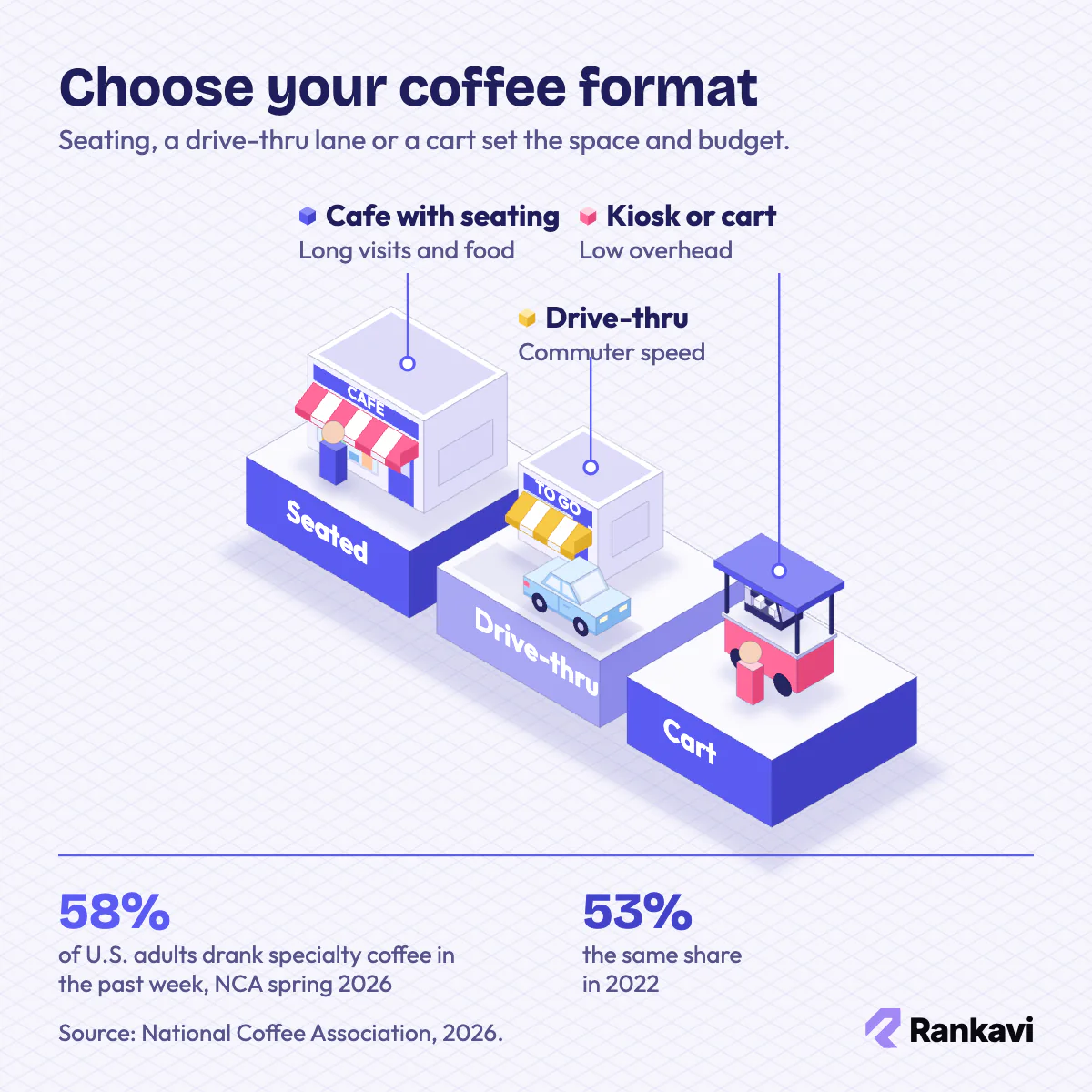
Each format trades cost against reach. A seated cafe earns from long visits and food, while a drive-thru lives on speed. Kiosks and carts skip most build-out but serve fewer drinks at once.
Common coffee business formats:
| Format | Main trait |
|---|---|
| Cafe with seating | Long visits, food sales and the largest build-out |
| Drive-thru | Commuter speed and a smaller footprint |
| Kiosk or cart | Low overhead inside malls, offices or events |
| Roastery | Wholesale bean sales to cafes and offices |
| Online coffee brand | Bagged beans shipped under a private label |
The choice also depends on control and risk. A cart costs less to leave, while a cafe lease ties the owner down for years.
Franchising is the other fork. A franchise such as Caribou Coffee brings a known name and a playbook but limits creative control. An independent shop keeps full control over brand, menu and suppliers.
Specialty coffee is the growing concept. In spring 2026, the NCA found 58% of American adults drank specialty coffee in the past week, up from 53% in 2022. Aesthetic, signature drinks and food then decide who walks in and how long they stay.
2. Research Local Coffee Demand
Researching local coffee demand means checking who already sells coffee nearby and who still lacks a good option. That evidence shapes the concept before money goes into a lease.
Away-from-home demand is the market a cafe serves. The NCA reported that 28% of past-day coffee drinkers had coffee prepared away from home in spring 2026. The rest brewed at home, so convenience and quality must beat a kitchen machine.
Competitor visits come next. A founder notes each shop’s drinks, prices, busy hours, seating and reviews. Weak spots such as slow lines or no food reveal the gap a new cafe can fill.
Demographics set the ceiling on price and style. A premium specialty bar fits a higher-income area, while a value drive-thru suits suburban commuter routes. Office workers, students and families also visit at different hours.
Location data adds to the picture. Foot traffic, nearby offices and parking show whether the people who pass by are the ones the concept targets.
A cheap test beats a guess. A farmers market booth, a pop-up or an office coffee service proves demand and pricing before any lease. Sales from those weeks also give lenders real data.
3. Write a Coffee Shop Business Plan
A coffee shop business plan sets the concept, sales targets and costs on paper before any money is spent. Lenders ask for it, and the funding request rests on its numbers.
A coffee shop plan usually covers six core sections:
- Executive summary: location, size, ownership and mission.
- Market and competitive analysis: target customers, nearby shops and the gap.
- Product line: drinks, food and bean sourcing.
- Sales and marketing strategy: how the cafe wins and keeps customers.
- Management plan: team, roles and employee costs.
- Financial projections: startup costs, cash flow and break-even.
The sales forecast drives the rest. Daily customers multiplied by the average ticket gives daily revenue. A bottom-up forecast starts from realistic traffic, not from the profit an owner hopes to earn.
“Too many businesses work the other way, starting with profit they want and working backwards to find the sales figure they need.”
— A member of the MoneySavingExpert forum
A break-even point differs by format. A cart needs few daily sales, while a large cafe needs a steady crowd to cover rent and payroll.
Projections usually run three years out and link profit to cash flow. The U.S. Small Business Administration (SBA), which backs small business loans, offers free business plan templates for this step.
4. Design a Focused Coffee Menu
A coffee menu shapes the equipment list, the supplier orders and the speed of the bar. Every drink on it needs a machine, an ingredient and a trained barista.
Most coffee menus cover espresso drinks, brewed coffee, cold coffee, decaf and tea. Chai, matcha and hot chocolate serve non-coffee drinkers. Lattes, cappuccinos and cold brew carry the volume.
Food lifts the average ticket. Pastries, breakfast sandwiches and grab-and-go items pair with morning coffee. Baking in-house needs a kitchen, so many cafes buy pastries from a local bakery instead.
Alternative milks are now standard. Oat, almond and soy sit next to whole milk on most bars. Each one adds a cooler slot and a supplier line.
Every extra item raises waste. Fresh milk, pastries and syrups spoil, so a long menu ties up cash in stock that may not sell.
A short menu opens faster and wastes less. Seasonal drinks then test new ideas without a permanent commitment. Strong sellers stay, and weak ones leave quietly.
5. Price Every Drink for Profit
Pricing coffee drinks determines whether each cup covers its ingredients, its share of overhead and a profit. The calculation starts with a recipe card for every item.
Ingredient cost comes first. Beans, milk, syrup, cup, lid and sleeve add up to the true cost of one latte. The U.S. Bureau of Labor Statistics (BLS) publishes the average retail price of ground coffee every month.
That retail price reached $9.30 a pound in August 2026, up from $8.87 in August 2025. Cafes buy beans wholesale, but the trend shows where bean costs are heading.
Cafes usually choose among four pricing methods:
- Food-cost percentage: ingredient cost divided by a target cost share.
- Markup pricing: a fixed amount or share added to the ingredient cost.
- Gross-margin pricing: cost divided by one minus the target margin.
- Full-cost pricing: rent, labor and utilities folded into each price.
Menu prices give the benchmark owners check first. Toast, which runs a restaurant point of sale platform, put the median hot coffee price at $3.75 in June 2026, up from $3.50. Its June 2026 data put cold brew at a median $5.62.
A price too high drives away regulars, while one too low leaves no room for rent. Prices then need a check against nearby shops before the menu is printed.
Overhead then sets the daily sales target. Rent, payroll, utilities and loan payments divided by open days show the revenue needed to break even. The room must also hold that many customers.
“…if you can get that number through the door, and the shop is big enough, hoorah! If the footage isn’t enough, it’s a guaranteed fail.”
— A member of the MoneySavingExpert forum
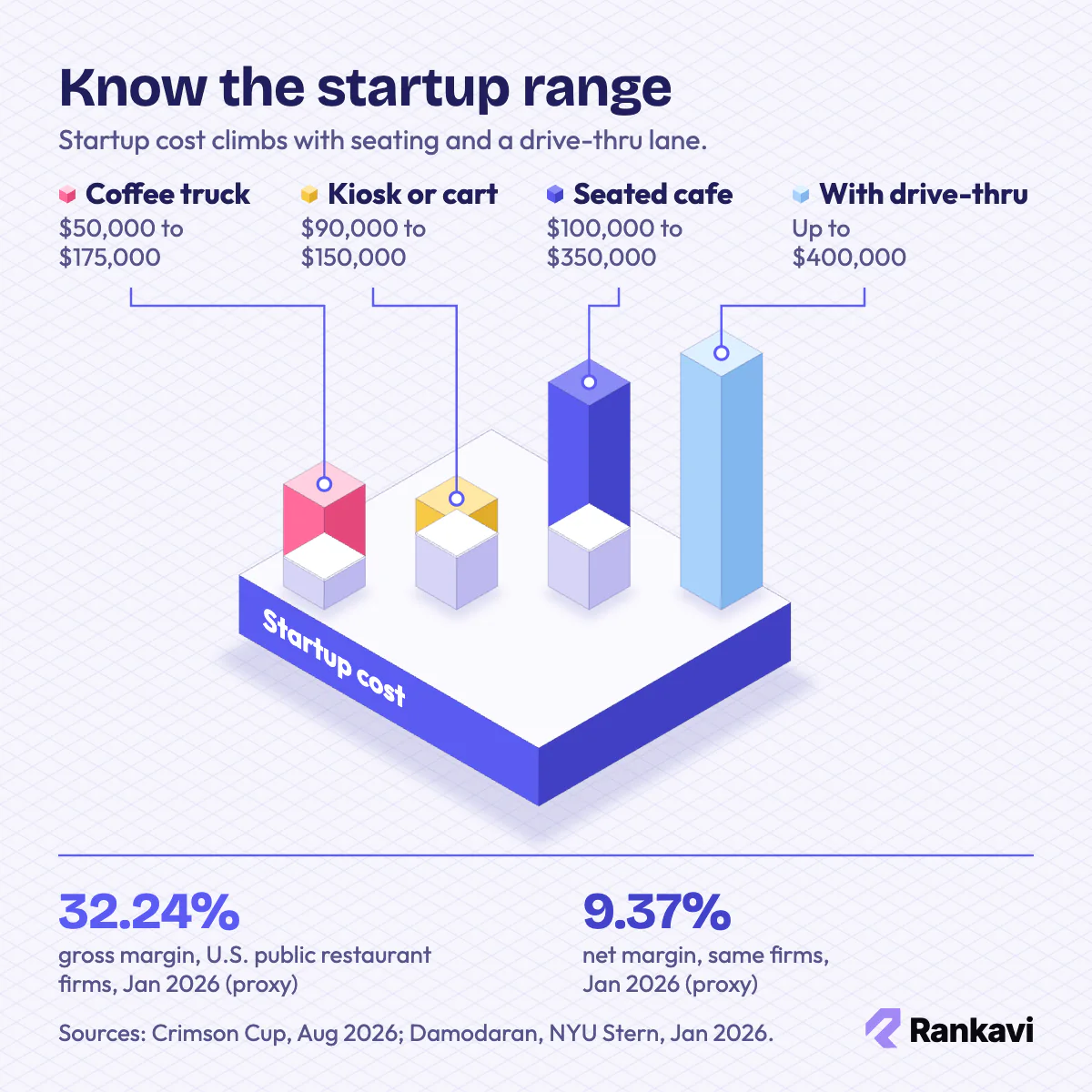
Crimson Cup, a Columbus, Ohio coffee roaster, runs a startup program for independent coffee shops. It publishes cost ranges from the owners in that program, so its figures are vendor estimates.
Startup money at a glance:
| Item | Figure |
|---|---|
| Startup cost | $50,000 to $175,000 for a coffee truck, $90,000 to $150,000 for a kiosk or cart, $100,000 to $350,000 for a seated cafe, up to $400,000 with a drive-thru |
| Main costs | Location and build-out, espresso equipment, drink ingredients, staff training and payroll, permits and insurance |
| Typical margin | 32.24% gross and 9.37% net for U.S. public restaurant firms (proxy, mostly chains) |
| Time to open | Varies with build-out, permit review and inspections; no reliable public benchmark exists |
Sources: Crimson Cup vendor estimates, August 2026; Aswath Damodaran, NYU Stern, sector margins, January 2026.
6. Fund the Build-Out and Cash Reserve
Funding a coffee shop covers the build-out, equipment, furniture, first inventory, permits and a cash reserve. The build-out and espresso equipment usually take the largest share.
A cash reserve matters as much as the build-out. Crimson Cup advises holding enough cash for the first six months of operating expenses. Owners who already hold a building, or add coffee to a bakery, need less.
Common funding sources for a coffee shop:
| Source | Best fit |
|---|---|
| Personal savings | Down payment and signal of commitment to lenders |
| SBA-backed bank loan | Build-out, equipment and working capital |
| Microloan | Carts, kiosks and small first locations |
| Equipment financing | Espresso machines with the gear as collateral |
| Partners or investors | Capital in exchange for equity |
| Crowdfunding | Community cafes with a strong local story |
Loans backed by the SBA are the most common route for storefront cafes. Microloans through nonprofit lenders suit carts and kiosks. Equipment suppliers often finance machines with little down payment.
Each source has a cost. Loans bring monthly payments that start before sales settle, and investors take a share of the future profit.
Partner money needs written terms. A capital partner and an operating partner should agree on equity, salary and exit rules before the lease is signed.
7. Register and Insure the Business
Registering a coffee business protects the owner’s personal assets and creates the entity that signs the lease. Most cafes form a limited liability company (LLC) with the state.
The Internal Revenue Service (IRS) issues the employer identification number (EIN) a cafe needs for payroll and taxes. Bank accounts and supplier credit applications ask for it too.
Partners need an operating agreement. It records each owner’s stake, duties and buyout terms before the first disagreement.
Most coffee shops carry four types of insurance:
- General liability: customer injuries such as a slip near the counter.
- Product liability: illness from food or drinks.
- Commercial property: equipment, furniture and inventory after fire or theft.
- Workers’ compensation: staff injuries such as steam wand burns.
Insureon, which runs an online small business insurance agency, publishes median premiums from its coffee shop customers. Its page updated in October 2024 put general liability at $63 a month.
A business owner’s policy (BOP), which bundles liability and property cover, ran $92 a month on that 2024 page. Workers’ compensation ran $97 a month in the same 2024 data, and landlords usually demand proof of cover.
8. Secure a Cafe Location and Lease
A cafe location involves foot traffic, visibility, parking and a lease the business can survive. The space must also suit the chosen format, such as a drive-thru lane or a seated room.
Morning traffic matters most. Office blocks, campuses, transit stops and busy retail corridors feed the breakfast rush. Street visibility and easy parking turn passersby into regular customers.
Lease terms deserve as much care as the address. Rent escalation, renewal options, remodeling limits and percentage rent all sit in the fine print. Some landlords offer a tenant improvement allowance for unfinished spaces.
A former cafe space saves time and money. Plumbing, drains and electrical capacity for espresso machines may already exist. A space that never served food may need costly upgrades or may not be allowed to change use.
A lease with a short term or no renewal right is a risk, because the build-out money stays in a space the owner may lose. A lawyer can review the lease before signing.
Layout follows the lease. The front of house holds seating and the line. The back of house groups the espresso machine, grinders and milk fridges for speed.
9. Obtain Health and Food Service Permits
A coffee shop requires a business license, a health permit and a passed inspection before serving the first cup. Exact rules vary by city, county and state.
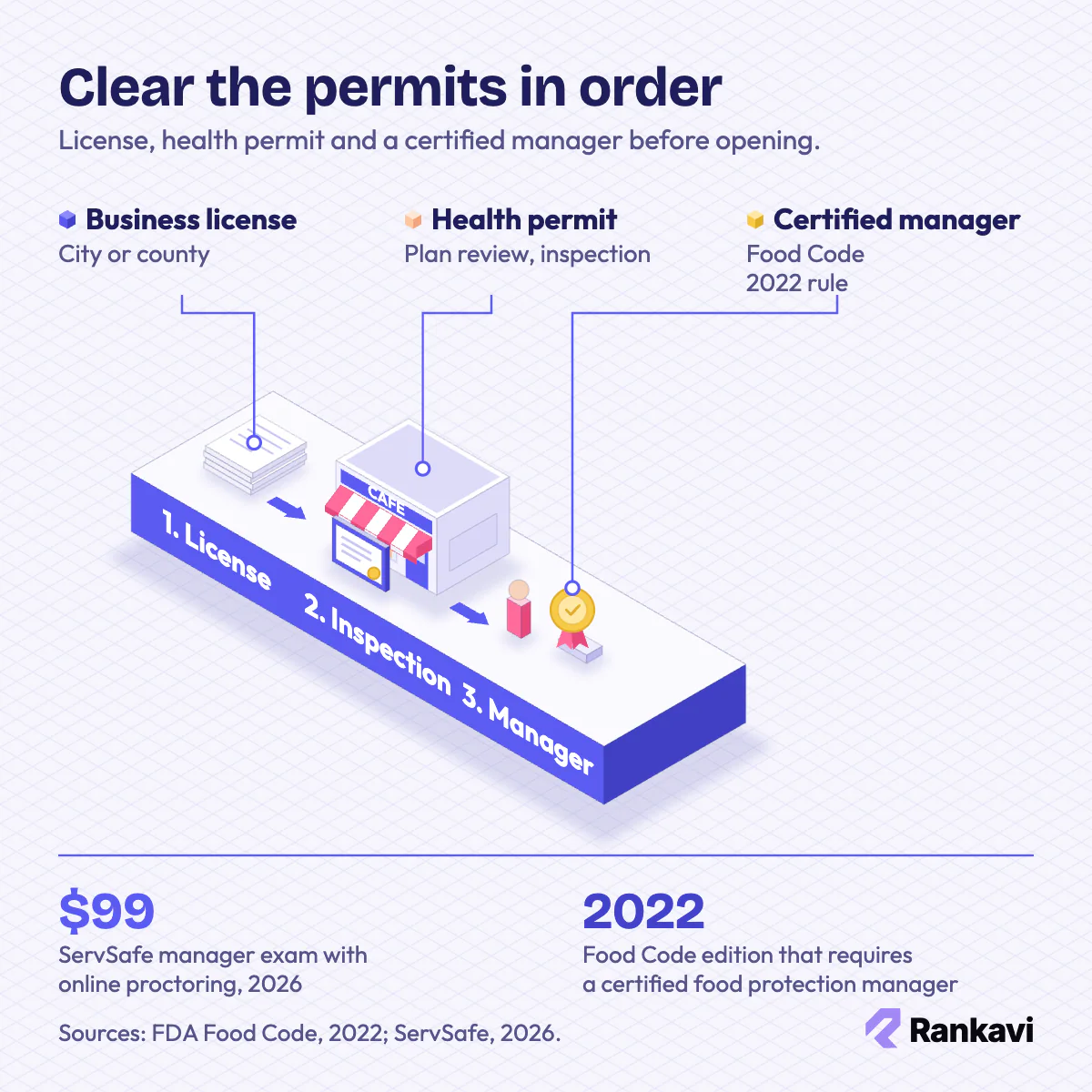
The local health department reviews the build-out plans and inspects the finished space. Sinks, surfaces, refrigeration and food storage must meet the local food code before opening.
Common coffee shop permits:
| Permit | Issued by |
|---|---|
| Business license | City or county |
| Food service or health permit | Local health department |
| Certificate of occupancy | Building and fire officials |
| Seller’s permit | State tax agency |
| Sign permit | City planning or zoning office |
Most local rules follow the Food Code, which the U.S. Food and Drug Administration (FDA) publishes as a model. Its 2022 edition requires the person in charge to be a certified food protection manager.
ServSafe, which the National Restaurant Association runs, is one common route to that certificate. As of 2026, its manager exam with online proctoring costs $99.
Permits take time to clear, so applications go in early. A shop that cannot open on schedule still pays rent while it waits for approval.
Packaged coffee adds federal rules. Bagged beans and bottled cold brew must meet FDA labeling rules. Facilities that make packaged food also register with the FDA.
10. Buy Espresso Equipment and Supplies
Espresso equipment gives the bar its speed, consistency and drink quality. The espresso machine is the centerpiece, and a dedicated espresso grinder matters just as much.
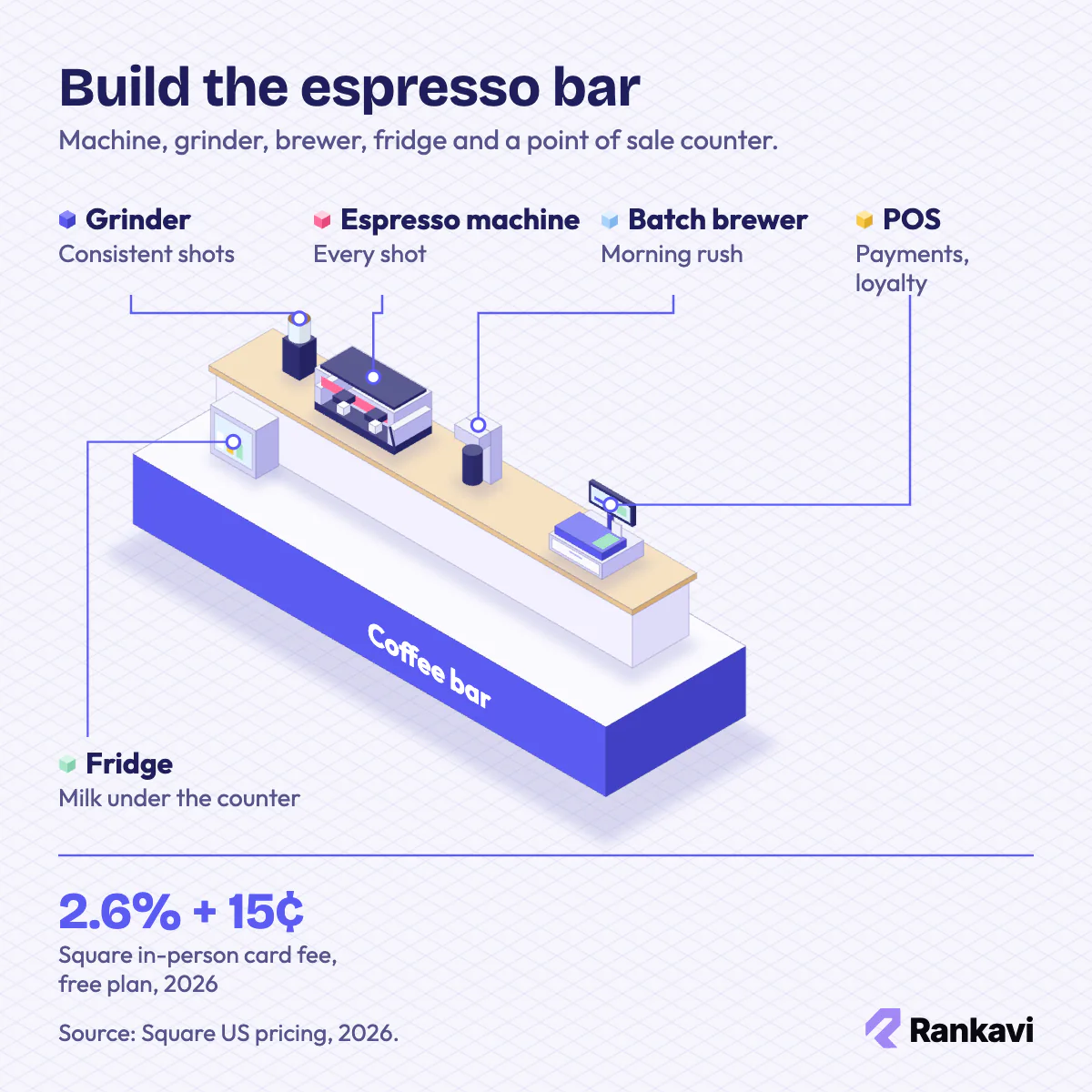
A typical coffee bar needs six core pieces of equipment:
- Espresso machine: pulls every shot for lattes and cappuccinos.
- Espresso grinder: keeps grind size consistent for each shot.
- Batch brewer: serves drip coffee during the morning rush.
- Cold brew system: supplies iced drinks all year.
- Water filtration: protects the machine and the flavor.
- Refrigeration: stores milk and cold ingredients under the counter.
A roaster partner supplies the beans. Many independent cafes buy from a local or regional roaster that also trains staff and helps with recipes. Some roasters lend equipment in exchange for an exclusive supply deal.
A point of sale (POS) system runs the counter. It takes card and mobile payments, tracks inventory and often includes loyalty and staff time tracking.
Card fees belong in the price math. Square, which runs a POS and payments platform, charges 2.6% plus 15 cents per in-person card payment on its free plan, as of 2026.
A machine that breaks in the rush costs sales. A service contract and a technician on call are worth lining up before opening.
Used equipment stretches the budget. Refrigeration, brewers and furniture come from restaurant auctions and closing businesses. Many owners still buy the espresso machine new for its warranty.
11. Hire and Train Baristas
Hiring a barista team turns a well-equipped bar into fast, friendly service. Most cafes need baristas, a shift supervisor and, with a food menu, a prep cook.
Wages set the biggest ongoing cost. The BLS counts baristas within fast food and counter workers, a group that held 3,854,050 jobs in May 2025. That group earned a median wage of $15.00 an hour in May 2025.
Experience costs more but serves faster. Seasoned baristas bring speed and consistency, while junior hires learn the shop’s standards from scratch. A mix lets veterans mentor new staff.
Training starts before opening day. Espresso extraction, milk steaming, drink recipes and customer service all need practice on the actual machine. Even experienced baristas learn the new menu and setup.
Scheduling needs thought too. The morning rush needs the most hands, while slow afternoons need fewer, which keeps payroll in line with sales.
Hiring rules apply from the first employee. Clear job descriptions, wage and hour compliance and new hire paperwork protect the cafe from labor claims.
12. Market the Soft and Grand Opening
Opening marketing puts the new cafe in front of nearby customers before the doors open. Local search, social media and a soft opening do most of the work.
Google Business Profile is the free Google listing for Search and Maps. It shows the cafe’s hours, photos and reviews. Early reviews from the first customers help it rank against established shops.
Social media builds the countdown. Photos of the space coming together, latte art and barista videos on Instagram and TikTok draw nearby followers before launch.
A soft opening tests the bar under real pressure. Friends, neighbors and local business owners order from the real menu, and staff fix slow spots before the public opening.
A loyalty program brings first visitors back. A punch card or a POS-based app rewards repeat visits, and partnerships with nearby businesses spread the word.
13. Make the Google AI Mode Coffee Shortlist
AI visibility places a cafe in the answers people get when they ask chat tools where to buy coffee. Locals and travelers now ask Google AI Mode, ChatGPT and Perplexity for the best coffee nearby.
Those tools draw on what trusted third-party sites already say. Local food guides, “best coffee in town” lists and review sites decide which cafes get named.
Rankavi is a software as a service (SaaS) platform that publishes brand mentions in articles on indexed third-party websites. A new cafe can use it to get brand mentions in Google AI Mode through coffee and local-guide articles.