

Starting a coaching business takes a clear niche, a priced offer and a simple way to book and bill clients. Most life, career and business coaches begin from home. The International Coaching Federation, which runs a global coaching study, counted a record 122,974 coach practitioners worldwide in 2025.
I’m Michal Sieroslawski, and I work on helping coaching businesses get found online. ChatGPT and Google’s AI Overviews now suggest coaching businesses by name, and that list matters.
The order fixes the offer and its price first, so every later cost is measured against real income. Credentials, tools and outreach then build on a registered, insured practice. The following list shows how to start a coaching business in eight steps.
- Choose Your Coaching Niche and Ideal Client
- Package and Price Your Coaching
- Fund a Lean Coaching Launch
- Register and Insure Your Practice
- Decide on Coach Training and Credentials
- Set Up a Home Coaching Studio
- Land Your First Five Clients
- Stand Out When Clients Ask AI for Coaches
1. Choose Your Coaching Niche and Ideal Client
A coaching niche names the problem the coach solves and the person who has it. “Career change for mid-level managers” sells better than “life coaching for everyone”.
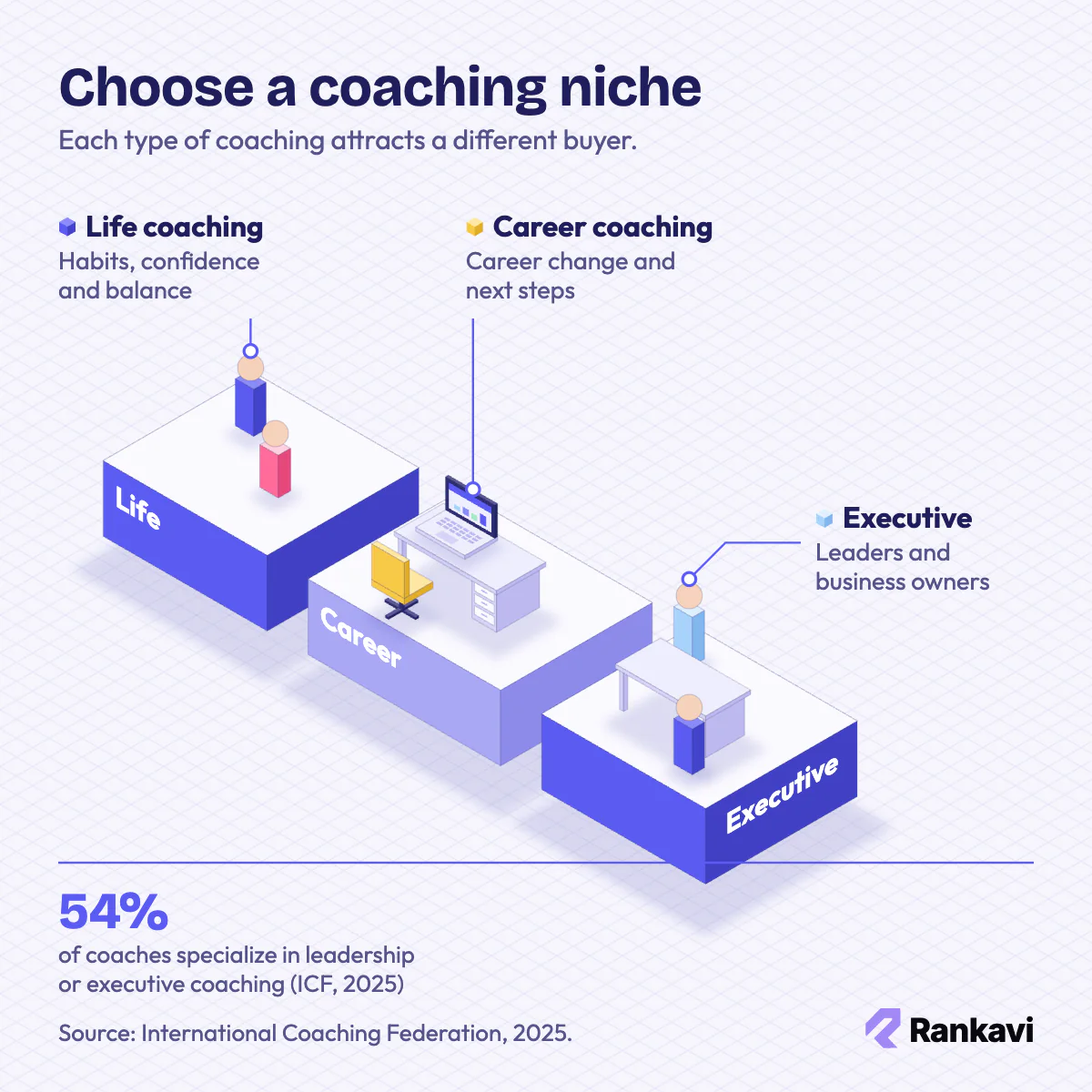
Coaching types cover a wide range. Life, career, executive, business, mindset and financial wellness coaching each attract a different buyer.
Business clients dominate the field. The International Coaching Federation’s 2025 study found that 54% of coaches specialize in leadership or executive coaching.
An ideal client profile describes one buyer in detail. The profile lists the client’s struggles, goals and reasons for seeking help now.
Interviews sharpen the profile. Real conversations with likely clients often reveal pain points that differ from the coach’s first assumptions.
A narrow focus also builds trust faster. Prospects see a specialist instead of a generalist, and referrals travel more easily.
A niche statement names the person, the result and the obstacle in one sentence. A stranger who hears it should know at once whether it applies to them.
Three overlaps point to a strong niche. The coach has real experience in the topic and finds it energizing. A defined group already pays to solve it.
A niche can be too narrow. It fails when few reachable people have the problem or when those people rarely pay for help.
Buyer type shapes the niche as well. Individual clients pay for themselves and decide fast. Employers pay through a manager or the human resources (HR) department, so decisions take longer. Executive and leadership niches usually sit in the second group.
A first niche can change. Early clients often show where results come easiest, and the focus can shift to match.
2. Package and Price Your Coaching
Pricing a coaching business sets what each package costs and what result the client buys. Coaches sell outcomes, not single hours.
Coaching packages usually come in three tiers. A starter tier tests the fit, a core tier adds ongoing support, and a premium tier gives the most access.
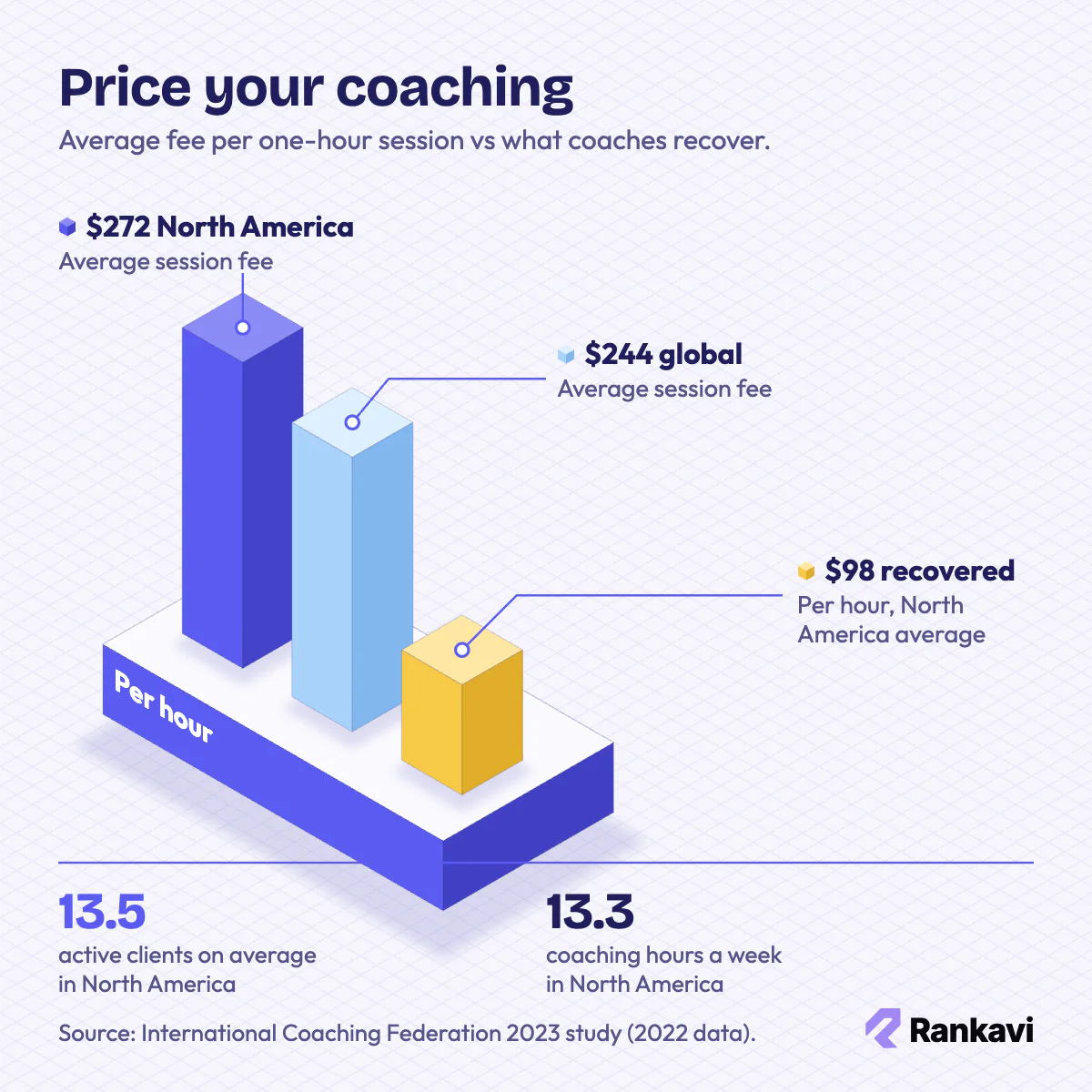
The 2023 study from the International Coaching Federation put the average North American fee per one-hour session at $272, against $244 globally, using 2022 data.
That fee is not take-home pay. The same 2023 study found North American coaches recovered an average of $98 per hour once unpaid work counted.
Client load is the benchmark to track. North American coaches averaged 13.5 active clients and 13.3 coaching hours a week in that 2023 study.
Packages beat single sessions for a simple reason. Clients commit to the full program, cash flow becomes predictable, and the coach avoids rebooking every session.
Each tier needs defined contents. The package states the session length, the number of sessions, the duration and the support allowed between calls.
The 2023 study’s $272 average covers the whole market. A new coach with no track record may price below it at first.
Example: An illustrative new coach sells a 12-session package to five clients in year one.
| Item | Amount |
|---|---|
| Package price (12 sessions at $272) | $3,264 |
| Revenue from five clients | $16,320 |
| Minus yearly liability insurance | $229 |
| Minus yearly client software | $970 |
| Minus credential application fee (member rate) | $175 |
| Left before tax and marketing | $14,946 |
Group coaching sits beside these tiers. Several clients share each session, so the price per person drops while the coach’s hourly income rises.
Beta clients test the offer before a full launch. They pay a reduced rate in exchange for honest feedback and a testimonial.
A free discovery call is where the package is explained and sold. The call shows the client what the work involves before any payment.
Written terms belong to the price. The package states a cancellation window, a limit on rescheduling, an expiry date for unused sessions and a refund policy.
Clients may pay in full or in installments. Installments need a signed coaching agreement.
A full calendar is the usual signal to raise prices. Existing clients can stay on their old rate until the current package ends.
3. Fund a Lean Coaching Launch
Funding a coaching business covers the website, software, training and insurance needed before the first client pays. No inventory or storefront is needed.
Startup money at a glance:
| Item | Figure |
|---|---|
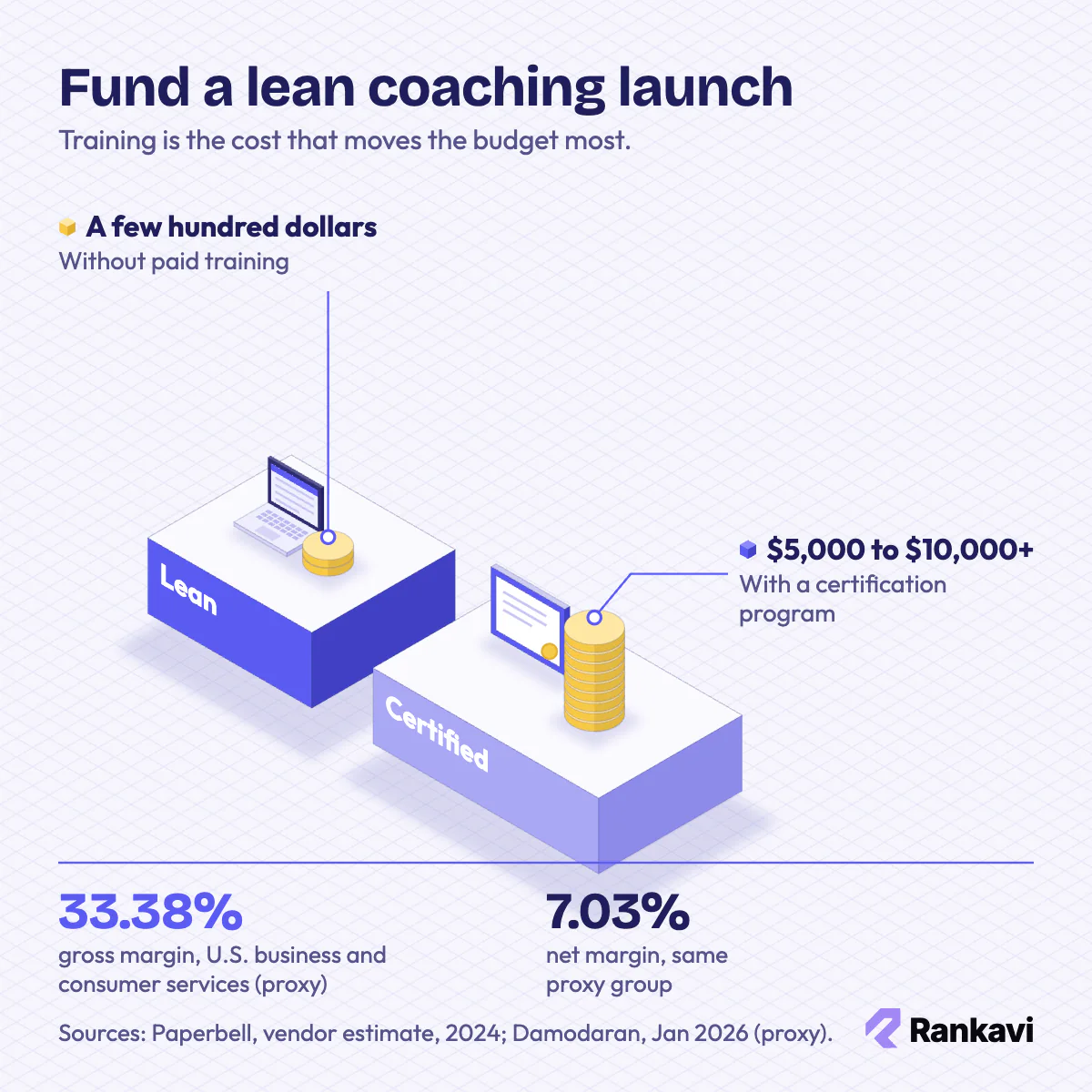
| Startup cost | A few hundred dollars without paid training; $5,000 to $10,000 or more with a certification program |
| Main costs | Coach training, website, client software, liability insurance, state filing |
| Typical margin | 33.38% gross and 7.03% net for listed U.S. business and consumer services firms (a proxy, not solo coaches) |
| Time to open | A few weeks for a solo online coach; no published average exists |
Sources: Paperbell, which offers coaching software (vendor estimates, June 2024); Aswath Damodaran, NYU Stern School of Business, margins by sector (January 2026, proxy).
Paperbell, a client-management platform for coaches, estimated in 2024 that certification runs from a few hundred dollars up to $5,000 to $10,000.
Most coaches pay for the launch from personal savings. A cash reserve matters because income builds slowly.
The budget has one-time and monthly parts. State filing and a certification program are one-time costs. Software, website hosting and video tools bill monthly.
Savings are not the only source. Keeping a day job during the launch lowers risk, and pre-selling the first packages lets early clients fund the tools.
Training is optional for funding purposes. A coach can open without paid training and add a certification program once income covers it. Borrowing heavily for training before the first paying client adds risk.
Break-even arrives when monthly client income covers monthly costs. Training costs are recovered separately and take longer.
Revenue spreads widely across the profession. In its 2023 study, the International Coaching Federation reported that 53% of coaches worldwide earned under $30,000 a year from coaching.
The North American average sits much higher. Coaches there averaged $67,800 in annual coaching revenue in the same 2023 study.
Taxes need a plan from the first session. The Internal Revenue Service (IRS), the federal tax agency, sets self-employment tax at 15.3% as of 2026.
That tax applies once net self-employment earnings reach $400, a threshold the IRS listed in 2026. Software, training and a home office share are common deductions.
No employer withholds tax from coaching income. Self-employed coaches pay estimated tax in quarterly installments. Setting aside part of each client payment in a separate account avoids a large bill at filing time.
4. Register and Insure Your Practice
Registering a coaching practice protects the owner and gives clients a clear business to contract with. Many coaches start as sole proprietors.
A limited liability company (LLC) adds a layer between business claims and personal assets. Paperbell put state LLC filing fees at $50 to $500 in 2024.
An employer identification number (EIN) and a business bank account keep coaching income separate. Payment tools then deposit into that account.
A sole proprietorship needs no state filing and starts with the first paying client. An LLC makes more sense once a coach has recurring clients, group programs or savings to protect.
An LLC does not shield a coach from claims about the coach’s own advice. Insurance covers that gap. Mixing personal and business money can also weaken LLC protection, so the separate bank account matters.
A business name other than the owner’s legal name usually needs a fictitious name filing. A search of the state business database and a trademark search catch conflicts before filing.
Professional liability insurance covers claims that coaching advice caused a loss. Insurance Canopy, an agency that offers life coach policies, listed general and professional liability from $229 a year in 2026.
That 2026 Insurance Canopy policy also came monthly at $21.08, with $1,000,000 per claim and $2,000,000 in total cover.
The per-claim limit is the most paid on a single claim. The total limit is the most paid across all claims in a policy year. Paying monthly costs more over a year than the annual price.
Other policy types cover other risks. General liability covers injury or property damage, such as a client slipping in the coach’s space. A homeowner’s or renter’s policy may exclude business activity.
A written coaching agreement completes the setup. The agreement states the scope, session terms, refunds and the fact that coaching is not therapy.
The agreement also covers fees, the payment schedule, cancellation terms and the limits of confidentiality. This section is general information, not legal or tax advice.
5. Decide on Coach Training and Credentials
Coach certification is a voluntary credential that signals training and ethics. No state requires a license to work as a life or business coach.
Clients still look for proof. In the 2023 International Coaching Federation study, 80% of coaches agreed that clients expect a credential, and 85% held one.
Credentials weigh most with corporate buyers. Private clients often judge a coach by testimonials and results.
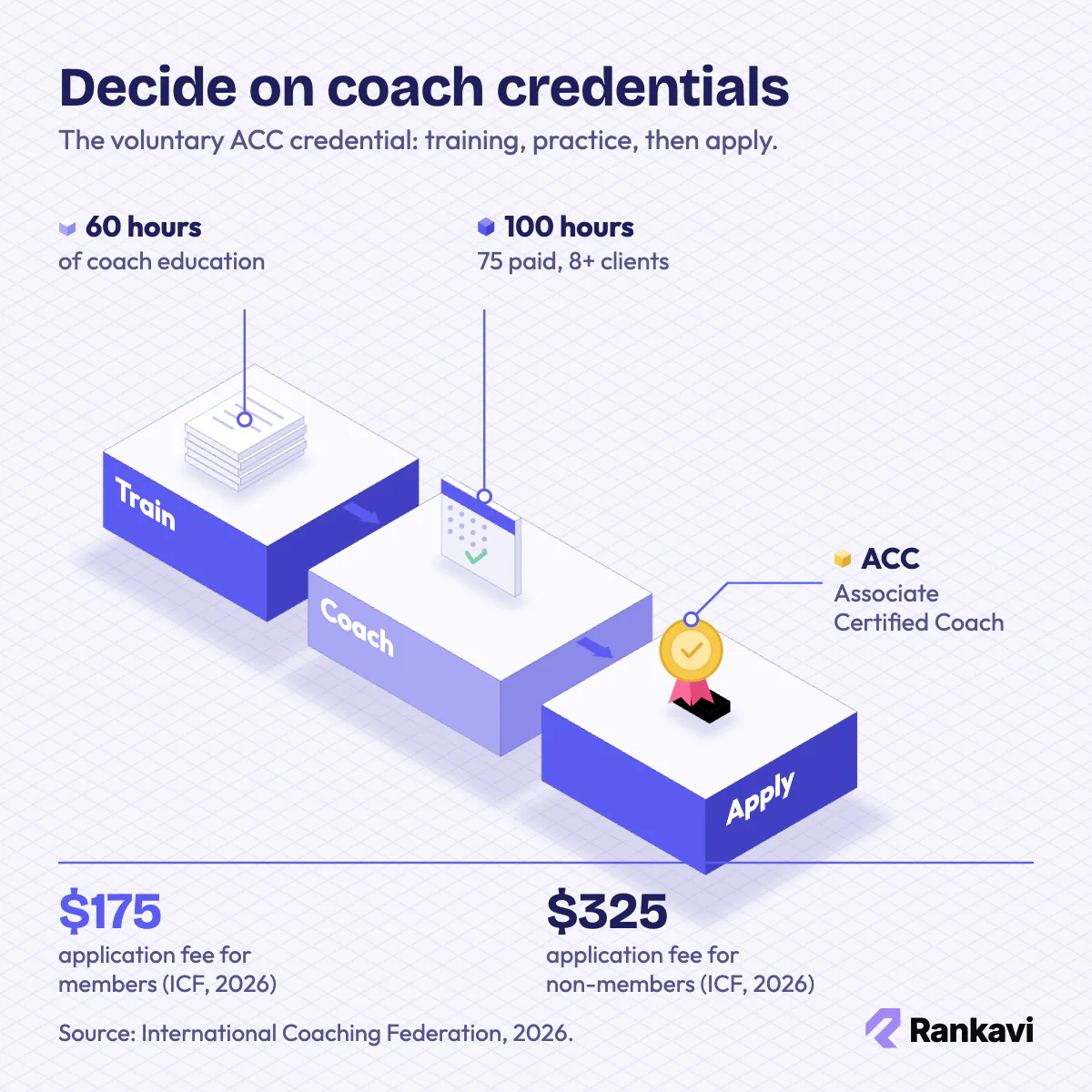
The International Coaching Federation (ICF) is a global nonprofit that accredits coach training and awards coaching credentials. Its entry credential is the Associate Certified Coach (ACC).
As of 2026, the ACC requires 60 hours of coach education and 100 hours of coaching experience, 75 of them paid, with at least eight clients.
A certificate and a credential differ. A certificate shows a program was finished. A credential such as the ACC also needs logged coaching hours and an exam.
The ICF also offers the Professional Certified Coach and Master Certified Coach credentials above the ACC. Credentials must be renewed with continuing coach education.
The ACC application on the training-program path cost $175 for members and $325 for non-members in 2026. Those fees covered a first exam attempt.
Those amounts are application fees only. Tuition for the training program is the larger cost, as step 3 shows.
Anyone can issue a certificate, because the title coach is unprotected. Accreditation applies to the training program. The ICF’s directory of accredited programs shows which ones qualify before payment.
A coach states only the credential actually held. A coach who finished an accredited program says so, instead of calling oneself credentialed.
Scope matters as much as skill. Coaching does not treat mental health conditions, so coaches refer those clients to licensed therapists.
Health and wellness coaches may look at the National Board for Health & Wellness Coaching. State rules on dietary advice also need a check.
A local business license may still apply. Cities and counties set their own rules for home-based businesses.
6. Set Up a Home Coaching Studio
A coaching tech stack keeps sessions, bookings and payments running without manual follow-up. Most of it runs from one spare room.
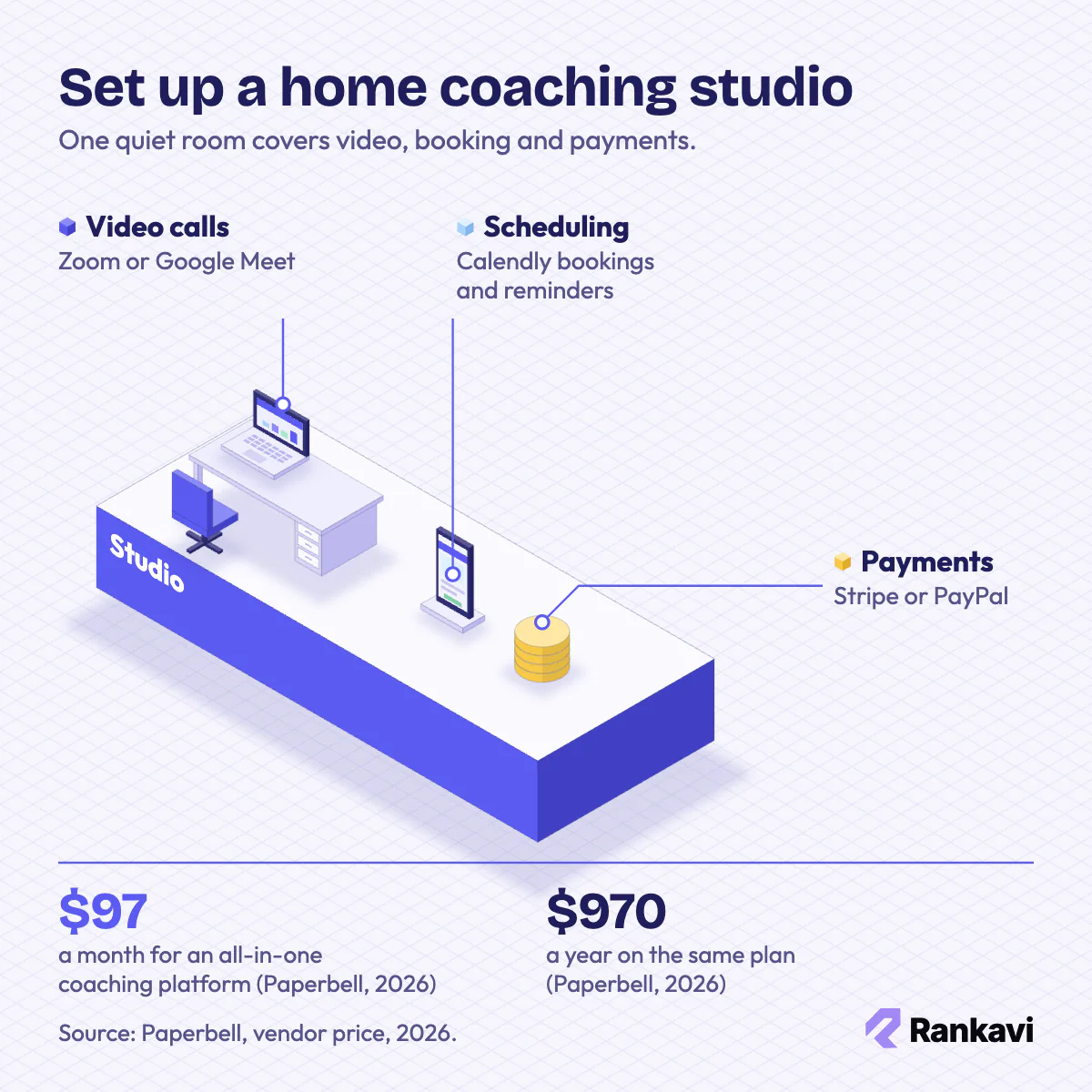
The room needs quiet, good light and a tidy background. A clear webcam and a dedicated microphone matter more than a large desk.
A camera at eye level, light in front and a plain wall make a small space look professional. A rug, curtains or a bookshelf reduce echo.
Zoom is a video meeting platform that records sessions for later review. Calendly is an online scheduling tool that lets clients book open slots and sends reminders.
Core tools come in four groups:
| Tool type | Common options |
|---|---|
| Video calls | Zoom, Google Meet |
| Scheduling | Calendly, Acuity Scheduling |
| Payments | Stripe, PayPal |
| Client management | CoachAccountable, HoneyBook, Dubsado, Paperbell |
All-in-one coaching platforms bundle those jobs. Paperbell listed its plan at $97 a month or $970 a year in 2026.
Separate tools cost less at first but must be stitched together. An all-in-one platform keeps booking, contracts and billing in one place.
Free plans have limits. Zoom’s free plan caps meeting length. Calendly’s free plan limits event types. A longer session may need a paid plan.
A wired internet connection drops less often than Wi-Fi, and a phone hotspot works as a backup. Each client should know the fallback in advance, such as a second video link sent by email.
Recording needs the client’s written consent first. Recording rules vary by state, and some states require every participant to agree. Notes and recordings belong in a password-protected account with two-factor authentication turned on.
A test call before the first paid session checks audio, framing, lighting, screen sharing and the booking email.
“The step most people skip is the scheduling system, getting that right from day one prevents the admin chaos that eats hours every week once clients start coming in.”
— A coach commenting on YouTube
Work hours need limits too. A fixed schedule separates coaching time from home life and keeps burnout away.
7. Land Your First Five Clients
The first five clients are the hardest milestone in coaching. Those clients validate the offer and start the referral chain.
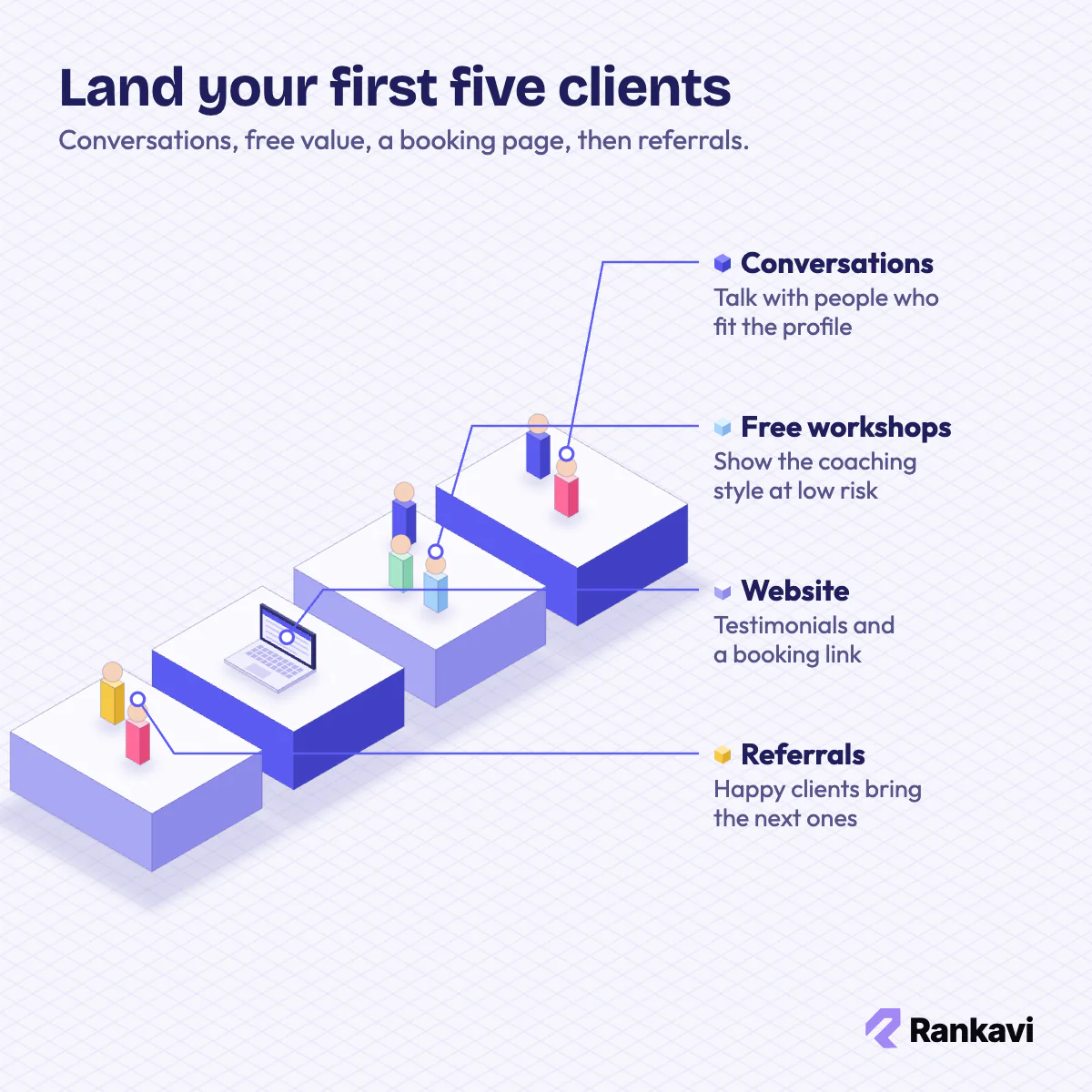
Direct conversations come first. Coaches talk with people who fit the client profile, ask about their goals and explain how the offer helps.
Warm contacts come first: former colleagues, managers and friends of friends who match the client profile. Communities where the ideal client already gathers follow. A short message that names one problem and offers a brief chat reads as help, not a pitch.
The chat is a discovery call. The coach asks about the situation and the goal, explains the offer and states the next step. Common objections are price, timing and doubt that coaching works. Returning to the outcome the prospect described keeps each answer concrete.
“I would also recommend getting involved in groups (ie Facebook or forums) that have your target customer. Don’t do any selling or promoting, …”
— A member of the r/lifecoaching community on Reddit
A repeatable way to give value keeps prospects coming. Free workshops, short challenges and checklists show the coaching style at low risk.
Founding-client spots at a reduced rate suit early clients. A fixed number of spots and an end date keep the offer from turning into unpaid work.
A simple website turns that attention into bookings. It states who the coach helps, shows testimonials and links to a booking page.
An email list keeps the relationship going. Subscribers receive useful tips, and many book a call once the timing suits them.
A tracker in Google Sheets or Notion records names, sources and next steps, so it is clear which channel works. If conversations happen but nobody books, the offer or the call needs work. If nobody agrees to talk, the message or the channel does.
Growth follows from happy clients. Referral rewards, group programs and online courses reach more people without more one-on-one hours.
Referral requests work best after a visible win. Client identities stay confidential when a coach asks for introductions.
8. Stand Out When Clients Ask AI for Coaches
AI visibility earns a coaching business a place in the answers prospects read before they book a discovery call. People now ask ChatGPT and Google AI Overviews which coach suits their goal.
Those tools repeat what trusted third-party pages say. Coach directories, podcast show notes and “best coaches” roundups shape which names appear.
A coach can check the starting point first. Five buyer-style prompts in ChatGPT and Google AI Overviews show which coaches appear. One example is “best executive coach for first-time managers”. A monthly repeat tracks change.
The coach’s own pages come first. One name, niche statement and bio on the website, LinkedIn and every directory help the tools describe the coach correctly. Credentialed coaches can also list themselves in the ICF’s coach directory.
Rankavi is a software as a service (SaaS) platform that publishes brand mentions in articles on indexed third-party websites. New coaches use its ChatGPT mention campaigns to appear on pages ChatGPT may read for coach requests.
No campaign guarantees a placement, and new pages take time to be found. Progress shows in the monthly prompt checks and in leads who say an AI tool sent them. Sponsored mentions should be labeled where rules require it, and claims about credentials or results must be true.