

Starting a clothing business means turning a clear idea for a specific customer into garments that sell at a profit. The U.S. Bureau of Labor Statistics (BLS), which publishes federal wage data, reported a median fashion designer wage of $80,960 in May 2025.
I am Michal Sieroslawski, and I help clothing brands show up in Google and AI search. Tools like ChatGPT and Google’s AI Overviews now suggest clothing brands by name. A mention in those replies can bring in customers before any ad does.
This order moves from cheap tests to costly commitments. Each step settles a question before the next one spends real money on fabric, factories or ads. Opening a clothing business follows the twelve steps below.
- Choose Your Clothing Niche
- Validate Demand Before Production
- Write a Clothing Business Plan
- Design and Sample Each Garment
- Pick a Production Model
- Price Your Garments
- Fund the First Collection
- Register and Protect Your Brand
- Build the Online Store
- Market Your Clothing Brand
- Grow With Repeat Buyers
- Get Named When Shoppers Ask AI
1. Choose Your Clothing Niche
Choosing a clothing niche means deciding exactly who the brand dresses and why they should buy from it. The niche shapes every later choice, from fabric to marketing.
A niche is a specific group of people, such as fitness fans, dog owners or plant lovers. A clearly defined group makes products easier to design and easier to sell.
Generic “lifestyle apparel” rarely works for a new label. Big brands already own that space. Arc’teryx, for example, began with technical gear for climbers, and its wider appeal followed the utility.
Picking a group means learning who those people are. A handful of plain questions builds that picture.
Questions that profile the target customer:
| Area | What to find out |
|---|---|
| Location | Local or international buyers |
| Demographics | Age, gender, job, income level |
| Psychographics | Values, hobbies, lifestyle |
| Buying habits | Yearly clothing spend, brand loyalty, favourite stores |
Clothing niches tend to fall into five broad types:
- Activity: running, yoga, cycling, golf or skating.
- Body and fit: petite, tall, plus-size or maternity.
- Values: sustainable, vegan or modest wear.
- Subculture: streetwear, gaming or music scenes.
- Occasion: workwear, loungewear or bridal.
Breadth matters as much as the group. “Activewear” is a category, while “women’s running apparel” is a niche. “Running apparel for plus-size women” narrows it to a micro-niche, a small slice inside a niche. A narrow first niche is easier to win, though it limits size until the brand expands.
Founder-market fit means the founder belongs to the group the brand dresses, and it lowers the risk. A founder inside the group spots fit and fabric problems outsiders miss. That insight is harder for bigger brands to copy.
What the group is built on matters too. A niche built on a passing trend carries extra risk. A viral print can fade before the first production run arrives. A lasting community, such as a sport or a body type, keeps buying season after season.
A strong niche also answers what makes the clothing different. One useful test is a positioning statement, a single sentence naming the garment, the group and the benefit it delivers. A founder who can’t say it in one breath has a niche that is still too vague.
2. Validate Demand Before Production
Before any money goes into stock, market validation shows whether real shoppers want the designs. Tests at this stage cost very little. Each one prevents an expensive production mistake later.
Five sources show what shoppers want before a single shirt is printed:
- Competitor accounts: Rival brands reveal a lot for free. Their followers, comments and reviews show who buys and what those buyers dislike. The Meta Ad Library is a public archive of ads running on Facebook and Instagram. It shows which audiences rival brands target with paid ads.
- Trend and search tools: These point to themes worth designing around. Google Trends, Pinterest Trends and TikTok’s Creator Search Insights each show what people search for and save. Google Trends shows relative interest, not counts. Google Keyword Planner adds the hard numbers, showing monthly searches for a term such as “oversized graphic hoodie”.
- Niche communities: Subreddits, Discord servers and Facebook groups give honest feedback for free. They show what buyers praise and complain about in their own words.
- Direct polls: Polls ask buyers instead of guessing about them. An Instagram Story poll can pit two designs against each other. A short Google Forms survey asks followers what they would pay and which sizes they need.
- Marketplaces: Etsy is an American online marketplace for handmade and vintage goods, including apparel. Its search results reveal whether similar shirts or hoodies already sell and at what level of competition.
A mockup ad test is the strongest early signal. The founder places designs on mockups and runs a small social ad. Weak clicks mean the design changes before any production run.
Clicks only help if the founder knows what counts as enough. The pass mark for any test is set before it starts. The founder decides in advance what result justifies a sample order. Judging the numbers afterwards invites wishful reading.
A waitlist page measures intent before any ad spend. A simple “coming soon” page collects emails for the first drop. The sign-up count gives a number to judge the launch against.
Real orders are stronger proof than clicks. A print-on-demand listing through Printful or Printify sells the design with no stock held. Pre-orders go further. Kickstarter funds a campaign only when it reaches its goal. If the goal is missed, backers are not charged and no money changes hands.
3. Write a Clothing Business Plan
A clothing business plan sets the route from idea to profitable label in writing. The plan also serves as the blueprint for partners, lenders and investors.
A clothing business plan covers eight core sections:
- Executive summary
- Market research
- Business structure
- Products and their unique value
- Financing needs and projections
- Sales channels
- Pricing strategy
- Marketing plan
How much detail the plan needs depends on who reads it. The U.S. Small Business Administration (SBA) is the federal agency that supports small businesses. It describes two formats. A traditional plan can run dozens of pages, and lenders and investors commonly request it. A lean startup plan is typically one page, so it suits a founder who launches quickly and revises often.
Market research gains structure from a strengths, weaknesses, opportunities and threats (SWOT) analysis. It compares the brand with its rivals. A buyer persona then describes the target customer’s age, style and spending habits.
The financing section turns the projections into three documents:
- Profit and loss statement: This document projects sales, costs and profit.
- Cash flow statement: This document shows when money comes in and goes out.
- Break-even analysis: This document sets out the sales needed to cover all costs.
The launch timeline deserves its own page. New founders often underestimate how long a clothing line takes to reach market. A sensible rule is to triple the first time estimate and list every task with a deadline.
The plan also fixes where the brand sells. An online store, a boutique and a marketplace each reach different shoppers. That choice changes branding, startup costs and logistics.
The plan stays a living document. The founder revisits it after the first production run and again after the first sales data.
4. Design and Sample Each Garment
Product development turns sketches into garments a factory can make the same way every time. Clear documents and tested samples protect the brand from costly production errors.
Design work comes first, and it does not require a fashion degree. Adobe Illustrator and Canva handle the graphics. A hired pattern maker handles fit. Mockups, which place a design on a product image, show the result before any photoshoot.
A tech pack is the garment’s blueprint for the manufacturer. Factories that receive vague photos often guess, and a wrong guess ruins a run.
A tech pack contains five parts:
- Flat sketches: drawings of the front, back and sides of the garment.
- Bill of materials: the list of fabric, trims and fabric weight.
- Grading measurements: the measurements for every size.
- Colour references: the colours used and the print placement.
- Stitching details: how the pieces get sewn together.
Colour and fabric get their own approvals. A Pantone code gives the factory an exact colour target. A lab dip is a small dyed swatch the factory sends for colour approval before bulk dyeing. Fabric weight is usually stated in grams per square metre (GSM).
A trim card holds the approved buttons, zippers, labels and drawstrings. It stops a factory from swapping in cheaper parts.
Samples come before any production run. A muslin, or toile, is a rough version cut in cheap cloth to test fit and construction. Owners wear and wash each sample several times to check stretch, shrinkage and print cracking. A flawed sample predicts a flawed production run.
Samples move through four stages:
- Proto sample: the first rough build that checks construction.
- Fit sample: tested on a fit model to confirm sizing.
- Pre-production sample: the final approved copy before bulk cutting.
- Top-of-production sample: pulled from the real run to confirm it matches.
3D design software can cut the number of physical rounds. Programs such as Browzwear simulate fit and drape on a digital body before any fabric is cut. Physical samples still confirm feel and stretch.
Pattern makers and technical designers can be hired freelance. Upwork and Fiverr, two freelance hiring sites, list both, and local sample rooms build physical samples.
The first collection works best when small. A tee, a hoodie and a cap give enough choice without multiplying inventory risk. Each extra style adds cost and complexity.
5. Pick a Production Model
A production model decides who makes the clothes, how much stock the brand holds and how much control it keeps. The choice depends on cash, risk tolerance and quality goals.
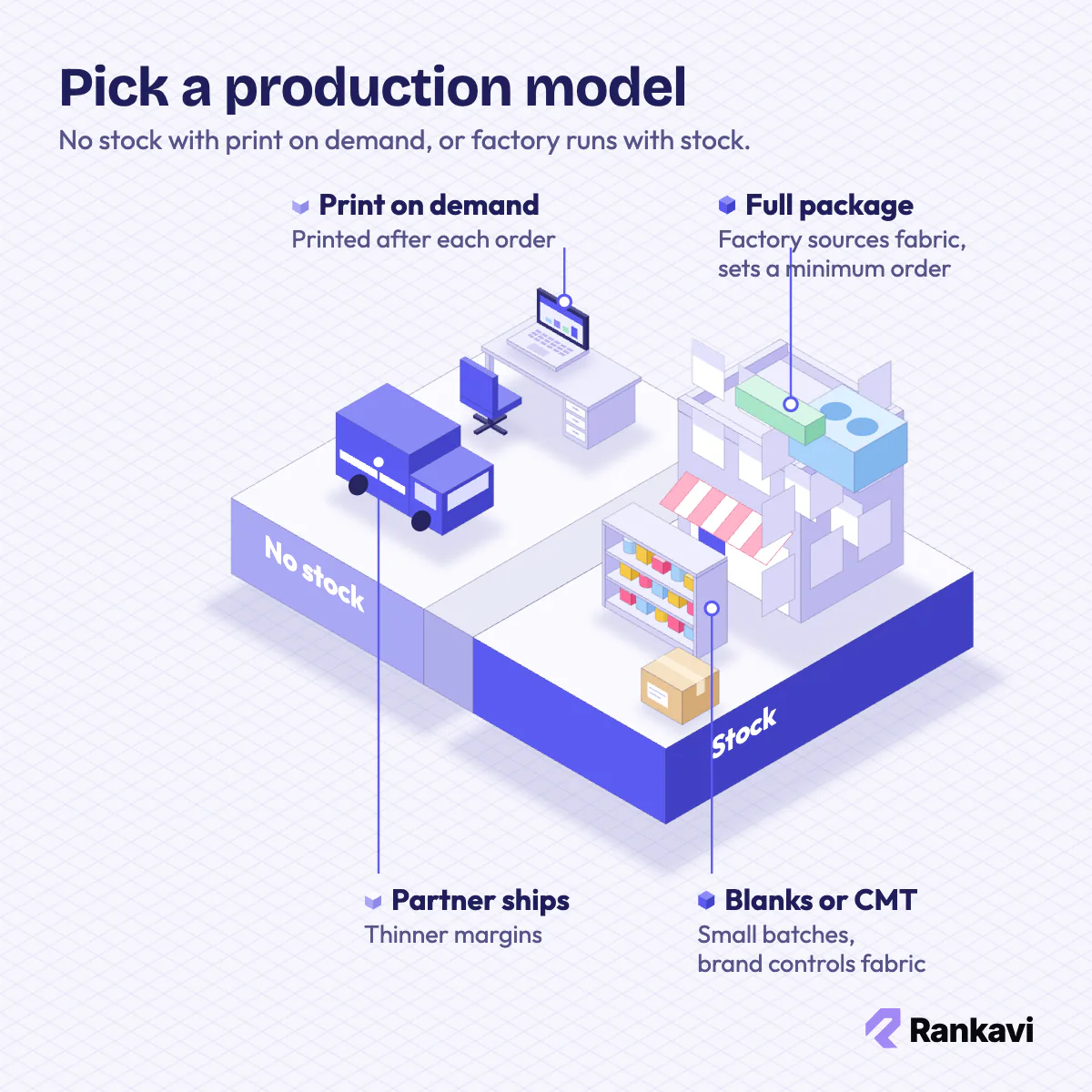
Print on demand (POD) prints each item only after a customer orders it. Printful and Printify are POD services that handle the printing and the shipping. The brand holds no inventory, but margins are thinner and the brand controls less of the delivery.
Blank garments offer a middle ground. The brand buys quality pre-made shirts and pays a local screen printer to add designs and tags. The result feels custom without a full factory run.
Blank garment brands differ in fit, weight and price. Gildan, Bella+Canvas and Comfort Colors all sell blank tees and hoodies for printing.
Garments are decorated in five main ways:
- Screen printing: A printer pushes ink through a stencil onto the fabric. Each colour in the design needs its own screen.
- Direct-to-garment (DTG): An inkjet printer prints the design straight onto the fabric.
- Embroidery: Stitched thread forms the design, such as a logo on a cap.
- Heat transfer vinyl (HTV): A heat press applies cut vinyl to the garment.
- Sublimation: Heat bonds dye into polyester fabric.
Private label sits between blanks and custom production. The brand picks a factory’s existing design and adds its own labels and trims. It costs less than a custom pattern but gives less control over fit.
Common garment production options:
| Model | How it works | Best for |
|---|---|---|
| Print on demand | Printed after each order | Testing designs with no stock |
| Blanks plus printing | Pre-made garments, local printing | Small custom batches |
| Cut, make, trim | Factory sews from supplied fabric | Small runs with full control |
| Full package production | Factory sources and produces everything | Brands ready for larger orders |
Cut, make, trim (CMT) factories cut, sew and finish garments from materials the brand supplies. They usually charge by time and accept small runs. Full package production (FPP) factories also source fabric and patterns. They set the higher minimums covered in step 7.
Factory location changes speed and cost. Maker’s Row is an online directory of manufacturers in the United States. Alibaba, by comparison, lists overseas suppliers. Domestic production costs more but ships faster and makes fixes easier.
US production clusters in two areas. The Los Angeles Fashion District and New York’s Garment District hold many cutting and sewing shops.
Overseas orders need a quality check before shipment. Third-party inspectors examine goods at the factory before they ship. Worldwide Responsible Accredited Production (WRAP) certifies factories for lawful, humane and ethical production.
6. Price Your Garments
Garment pricing determines whether each sale covers its costs and funds the next collection. Price sits on top of a clear cost per unit.
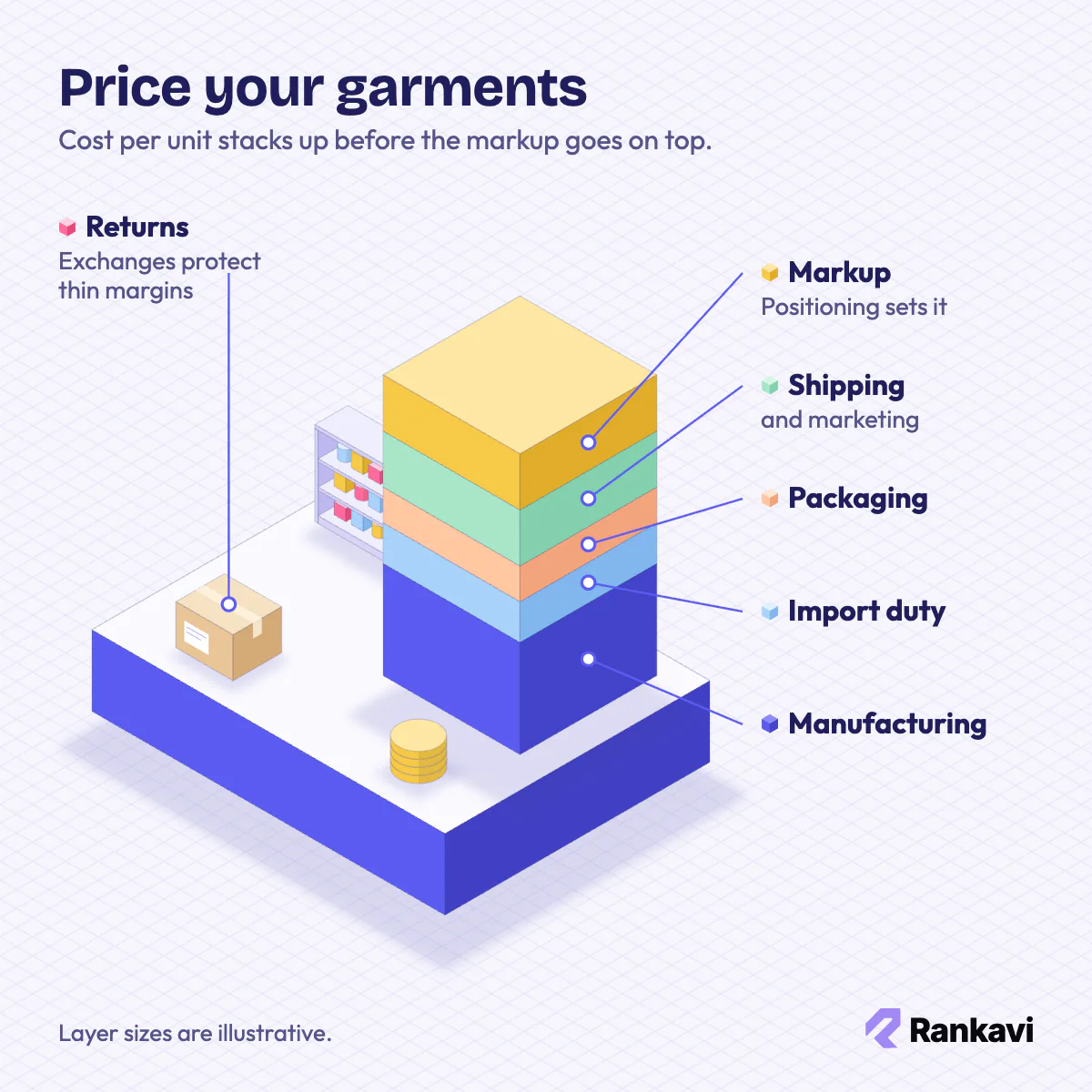
The cost per unit adds up every expense behind one garment. Manufacturing, import duty and packaging form the base. Promotional materials, shipping and marketing complete the total.
Landed cost is the part paid to get a garment into stock. It covers making the garment, freight, duty and insurance.
With a cost in hand, the next job is turning it into a price and checking the profit left over. Three measures do that work:
- Markup: Markup is profit as a share of cost.
- Gross margin: Gross margin is profit as a share of the selling price.
- Keystone pricing: Keystone pricing is a common starting point in apparel wholesale. RepSpark, a wholesale software vendor, defined it in 2026 as a retail price set at double the wholesale or production cost. By that 2026 definition, doubling yields a 50% gross margin.
Selling through shops adds a second price to work out. A boutique buys at the wholesale price and sells at retail. Selling below that retail price in the brand’s own store would undercut the boutiques that stock it.
Platform fees come off every sale. Marmalead, an Etsy research tool, listed Etsy’s fees in February 2026. In 2026, Etsy charged a $0.20 listing fee and a 6.5% transaction fee. US payment processing added 3% plus $0.25 per order in 2026.
Whatever the channel, every price must clear two kinds of cost. Fixed costs, such as equipment and premises, stay the same each month. Variable costs, such as fabric and postage, rise with every order.
Break-even shows how many garments must sell. Fixed costs divided by the profit per garment gives the break-even unit count.
Positioning sets the markup. Heavyweight hoodies and garment-dyed tees support premium prices. Basic blanks and accessories often sell better at lower prices and higher volume.
Mixing those price levels on purpose shapes a whole collection. Lower-priced basics bring first-time buyers in. One or two hero pieces carry higher prices and show what the brand stands for.
Returns belong in the pricing too. Some buyers will order the wrong size. Free returns can erase thin margins, so many small labels offer exchanges or store credit instead.
7. Fund the First Collection
Funding a clothing line covers samples, the first factory run and launch costs before any revenue arrives. Running out of cash between sampling and the first sale is one of the most common ways new labels stall.
Startup money at a glance:
| Item | Typical figure |
|---|---|
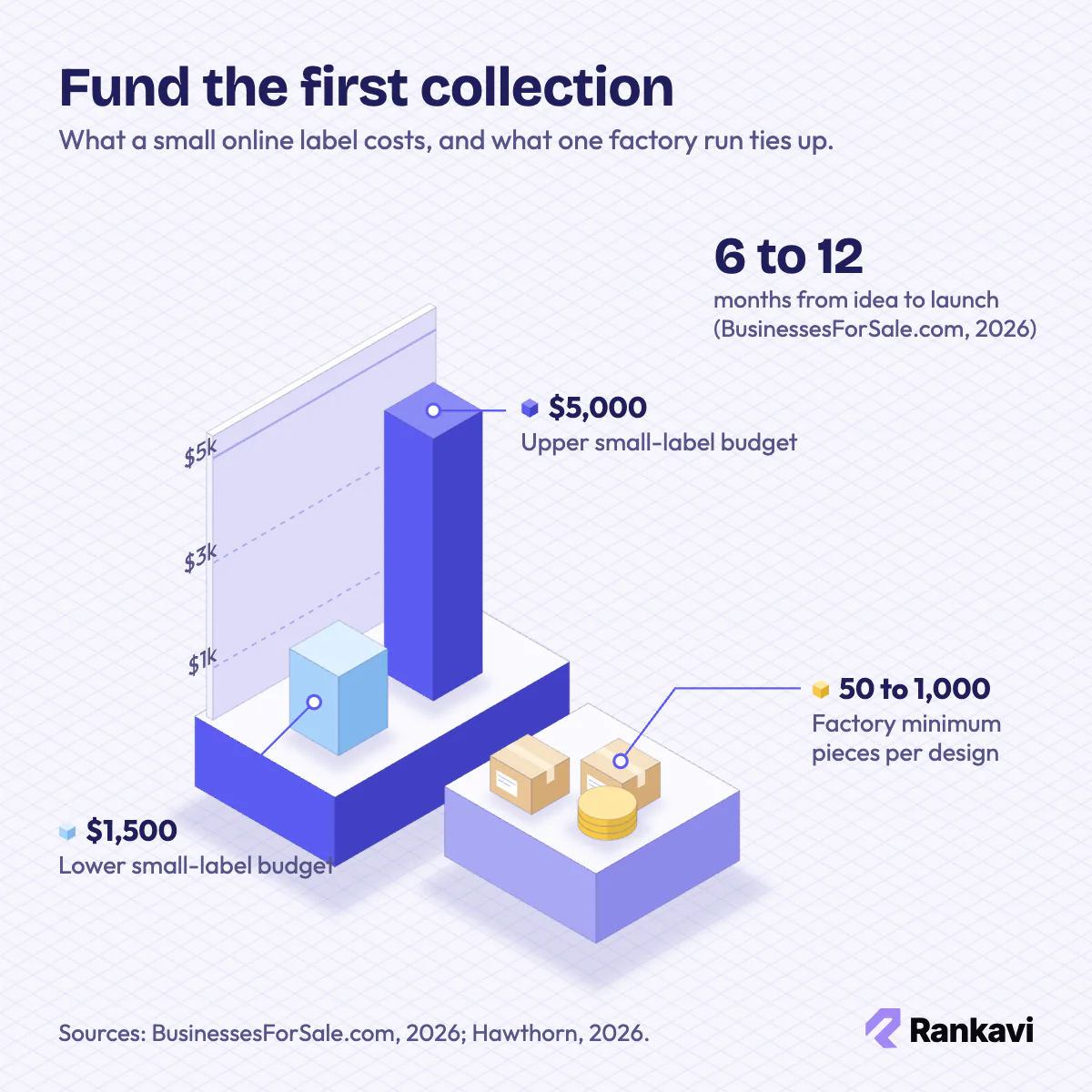
| Startup cost | $1,500 to $5,000 for a small online label; $20,000 to $100,000 for a wholesale apparel company |
| Main costs | Samples, the first production run, website and photography, trademark filing, packaging and launch marketing |
| Typical margin | 30% to 40% profit margin on print-on-demand products (vendor estimate) |
| Time to open | 6 months to 1 year from idea to launch |
Sources: BusinessesForSale.com, accessed 2026 (page undated); Printify, a print-on-demand vendor, 2026 (margin estimate).
Minimum order quantity (MOQ) is the smallest number of pieces a factory will make at once. It sets how much cash a single design locks up, so most founders check it first.
Hawthorn, a clothing manufacturer, puts full package MOQs at 50 to 1,000 pieces per design, as of 2026. Printful, a print-on-demand company, cites about 500 pieces per style in its guide. Some factories apply the minimum per size or colour, which multiplies the order.
Worked example: Picture an illustrative first drop of 100 hoodies at $20 each, or $2,000 of stock. Samples, website, photos and a trademark add $1,500, so launch needs $3,500. At $55 retail, the label breaks even after about 64 sales, a 64% sell-through. That excludes ad spend, returns, owner pay and taxes.
That money has to be in hand before the first hoodie sells, and it comes from five main sources:
- Savings: Savings fund most first collections. Paying from savings also keeps full ownership with the founder.
- Kickstarter: Kickstarter runs reward-based crowdfunding, so backers pre-order garments that don’t exist yet. A funded campaign turns the MOQ into a pre-sold order.
- SBA microloans: As of 2026, SBA microloans go up to $50,000 for working capital such as a first run. Nonprofit community lenders issue them and set the terms, so approval rules vary by lender. The money can buy stock, supplies and equipment.
- Kiva: Kiva is a nonprofit that crowdfunds loans for small businesses. Its borrower page listed U.S. loans of $1,000 to $15,000 at 0% interest in 2026. Those loans carry no fees and need no collateral.
- Angel investors: Angel investors usually arrive only after sales prove demand.
Cash also has to cover the reorder. A drop that sells out needs a second pool of money to restock best sellers. A contingency line covers sample revisions, shipping delays and defective units.
8. Register and Protect Your Brand
Registering a clothing brand creates the legal business that signs contracts, pays tax and owns the name. Clothing sellers handle this step once funding is lined up and before printing a single label.
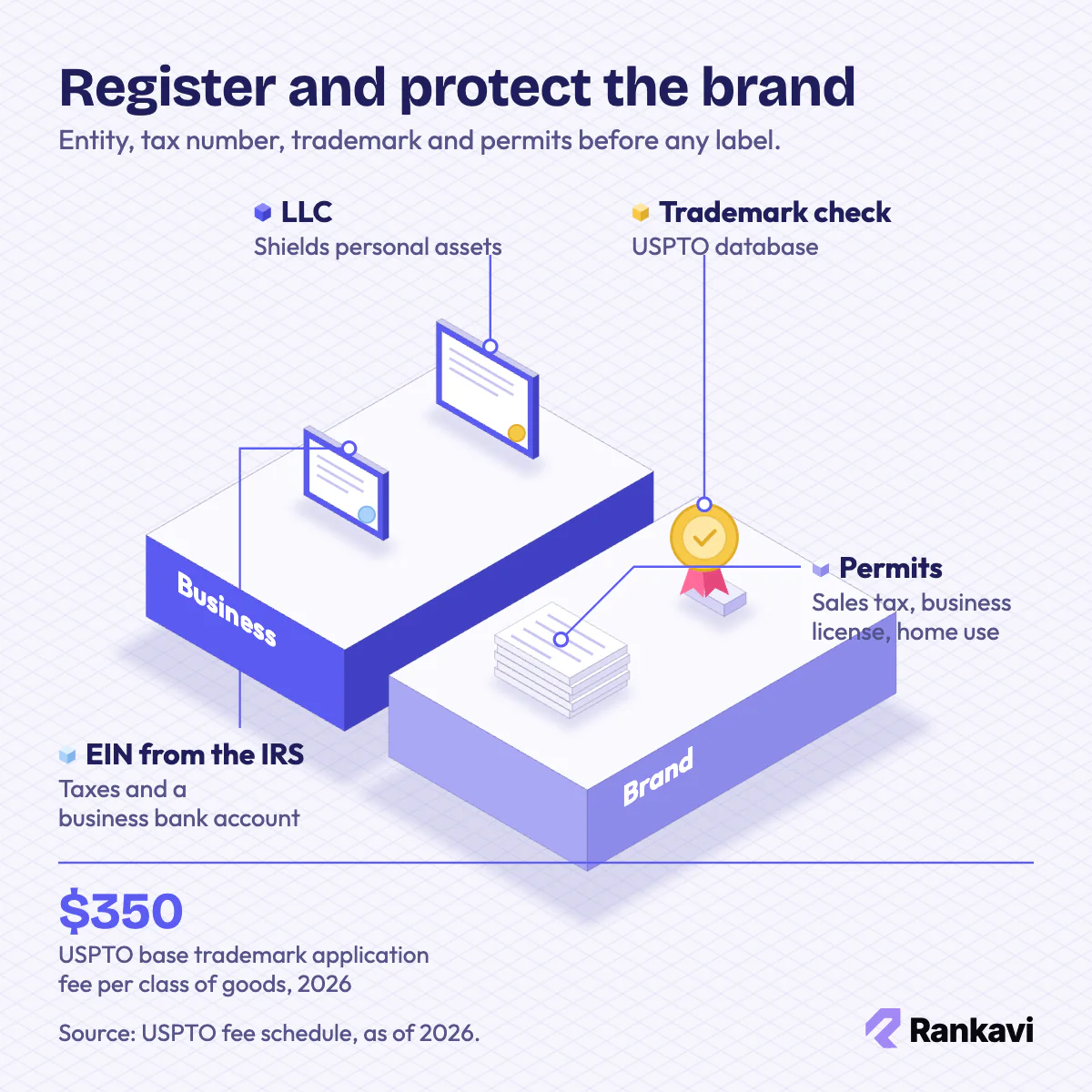
Most new owners choose a sole proprietorship or a limited liability company (LLC). A sole proprietor stays personally liable for business debts. An LLC separates personal assets from claims against the brand.
The business registers with the state where it operates. An LLC files articles of organization, usually with the Secretary of State. The filing names a registered agent to receive legal papers. The legal entity and the shop name do not have to match. A “doing business as” (DBA) name lets that entity trade under the brand name.
Next, the owner gets an employer identification number (EIN) from the Internal Revenue Service (IRS), which issues it free. The IRS warns against websites that charge for an EIN. Banks ask for that EIN before opening a business account.
The brand name still needs protection of its own. A trademark check covers that gap.
The United States Patent and Trademark Office (USPTO) runs the federal trademark register. Its search database shows whether another company already uses the name. As of 2026, the USPTO fee schedule lists a $350 base application fee per class of goods. A clash found after printing neck labels can bring a cease-and-desist letter.
The fee applies to each class the filing covers. Clothing falls under Class 25 of the Nice Classification, which covers clothing, footwear and headwear. A filing that also covers other goods adds a fee for each extra class. The ™ symbol can go on a brand name before any filing. The ® symbol is allowed only after federal registration, and only for the listed goods.
A trademark guards the name, so the designs need separate cover. Copyright protects the artwork, not the garment. The U.S. Copyright Office is the federal office that registers copyrights. It treats clothing as a useful article. It will not register a garment’s shape or cut. Original prints and graphics on fabric can be registered as artwork.
Clothing labels carry legal rules too. The Federal Trade Commission (FTC) enforces the Textile Fiber Products Identification Act. That law requires three label details:
- Fiber content: each fiber’s generic name and percentage by weight.
- Country of origin: where the garment was processed or made.
- Maker identity: the company name or a Registered Identification Number (RN).
Those three details share the label with other required marks. A separate FTC rule, the Care Labeling Rule, requires care instructions on clothing.
Children’s clothing adds a tracking label. The U.S. Consumer Product Safety Commission (CPSC) is the federal agency that sets safety rules for consumer products. It requires permanent marks on products for children 12 and under. The marks name the maker, the place and date of production, and the batch.
State and local agencies add three more registrations:
- State sales tax permit: most clothing sellers need one from their state.
- General business license: most clothing sellers need this license as well.
- Home occupation permit: a brand run from home may also need this permit.
Online-only brands still need these registrations. Local and state agencies confirm which permits apply in each area.
9. Build the Online Store
The online store gives the brand a place to sell around the clock without a physical shop. Most new clothing labels start online before testing any retail space.
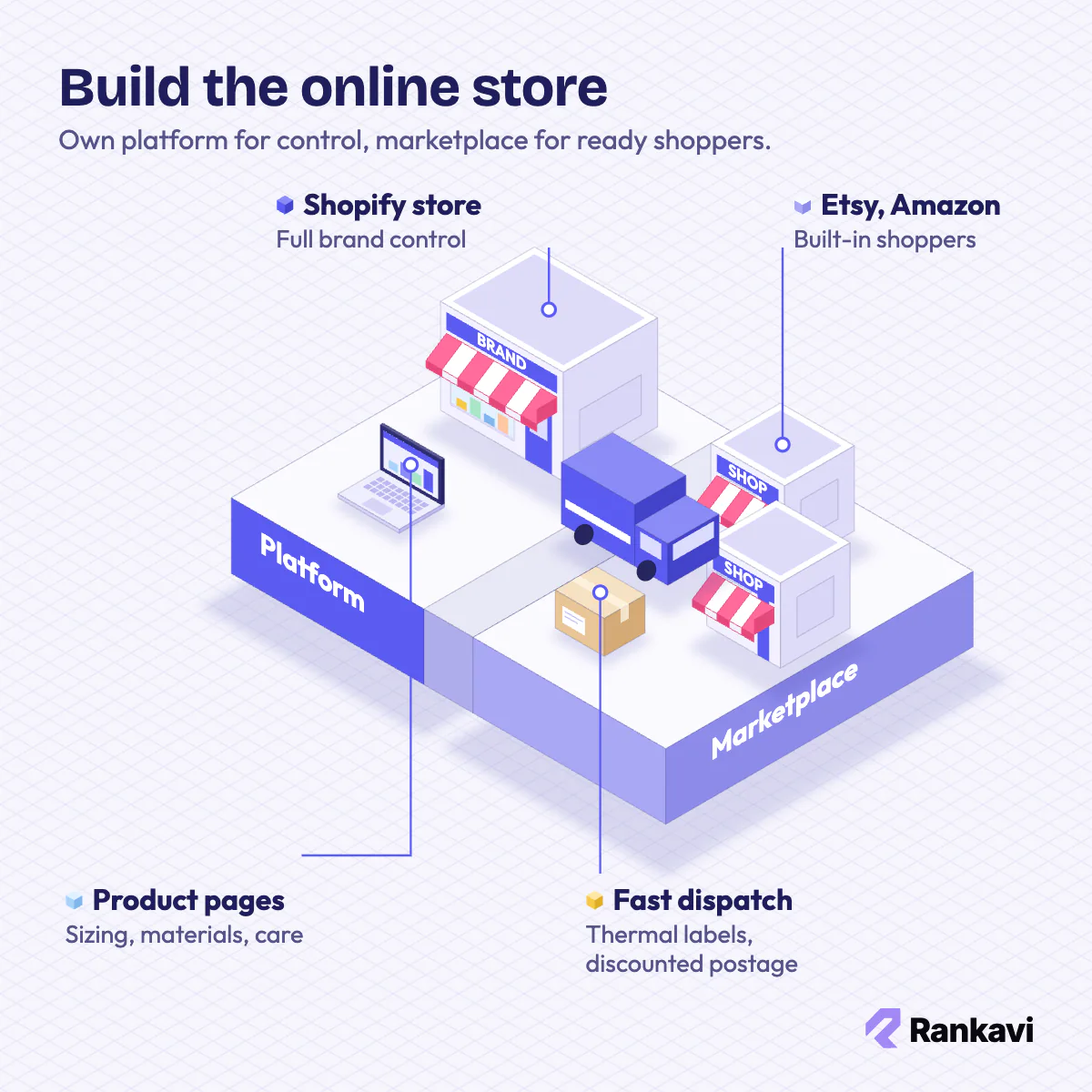
A store can live on an ecommerce platform or a marketplace. Shopify is a Canadian ecommerce platform that runs online stores for brands of every size. Marketplaces work differently and share their shoppers with many sellers.
Where a clothing brand can sell online:
| Channel type | Examples | Main trade-off |
|---|---|---|
| Ecommerce platform | Shopify, WooCommerce | Full brand control, own traffic needed |
| Marketplace | Etsy, Amazon | Built-in shoppers, less brand control |
Shopify and the large marketplaces are not the only choices. Other platforms suit different budgets. Big Cartel, Squarespace and Wix also run small online shops. Depop and Poshmark are app-based fashion marketplaces.
Once the channel is set, the checkout needs attention. Checkout options affect whether a shopper finishes the order. Shopify Payments, PayPal, Apple Pay and Google Pay handle card and wallet payments. Buy now, pay later services such as Klarna and Afterpay sit alongside them. They split a price into instalments.
Product pages carry much of the sale. Each listing needs sizing, materials and care instructions. Clear details reduce returns and build trust with first-time buyers.
Four elements complete a clothing listing:
- Variants: Apparel listings need variants. Each style comes in several sizes and colours. Each combination gets its own stock-keeping unit (SKU), the code that tracks one exact version of a product.
- Size charts: A size chart app such as Kiwi Sizing shows measurements on every product page.
- Reviews: Reviews with customer photos build trust for new buyers. Apps such as Judge.me and Loox add them to product pages.
- Photos: Photos do the work a fitting room would. Sharp product shots and on-body images help shoppers judge fit and fabric. Mockups fill the gap until a real photoshoot is affordable.
Shipping speed shapes repeat business. A thermal label printer and discounted postage tools like Pirate Ship save hours per week. Fast dispatch helps a small brand compete with big retailers. The U.S. Postal Service (USPS), United Parcel Service (UPS) and FedEx carry small parcels. Poly mailers keep shipping weight low.
Some pages have to be ready before the first order arrives. The store also needs policy pages before launch. A privacy policy, terms of service, a shipping policy and a return policy answer common buyer questions. Tax arrives with each order too.
Sales tax collection can be automated: Shopify Tax and Avalara calculate the rate for each order’s address. Not every shopper reaches the payment step. An abandoned checkout email, built into Shopify, reminds shoppers who left before paying.
Orders bring admin with them. Simple systems keep the back office manageable. Scheduled social posts, a bookkeeping spreadsheet, automatic postage labels and saved email replies each save time as orders grow.
10. Market Your Clothing Brand
Marketing a clothing brand builds the story and audience that turn first visitors into buyers. People buy clothes partly for who they feel they become in them.
“…the brands that actually make it past the first two years are the ones with founders who are, or have, exceptional marketers.”
— A clothing production veteran in a YouTube comment
A brand identity ties the marketing together. The name, story, logo, colours and fonts stay consistent everywhere. A logo also needs to work in embroidery as well as print.
Behind-the-scenes content performs well for small labels. Three platforms suit a small clothing label:
- TikTok: Videos of sampling, rejected fabrics and packing show the work behind each piece. TikTok Shop, the platform’s built-in store, lets viewers buy straight from a video.
- Instagram Reels: Reels are Instagram’s short videos, so the same behind-the-scenes clips work here too.
- Pinterest: Pinterest is a visual search platform where shoppers save outfit ideas.
The brand focuses on the platform its niche uses most.
Three methods put the product in other hands:
- User-generated content (UGC): Customers post photos in the clothes, and the brand reposts them with permission. UGC creators work differently. They are paid a flat fee for ad-style videos and need no audience of their own.
- Influencer seeding: The founder gifts a best piece to micro-influencers in the niche with no strings attached. Genuine posts follow when the product is good. Seeding beats paid posts at the start.
- Affiliate program: Each creator gets a unique discount code, and the brand pays a commission on sales from it. The code shows which creator actually drives orders.
Seeding comes first, and an affiliate program follows once the seeding works.
Paid ads scale what organic posts prove. Meta Ads Manager runs ads on Facebook and Instagram, and TikTok Ads Manager runs ads on TikTok. A tracking pixel is a small piece of code on the store. It lets both platforms retarget visitors who left without buying, meaning show them the product again. Two numbers track the result.
Customer acquisition cost (CAC) is the ad spend per new buyer. Return on ad spend (ROAS) is the revenue earned per ad dollar.
An email list belongs to the brand, while social reach does not. Collecting emails before launch with an early-access sign-up gives every drop a ready audience. Klaviyo and Mailchimp send the welcome series and launch alerts. Text message (SMS) tools such as Postscript and Attentive text drop alerts to subscribers. Those subscribers opted in, meaning they agreed to receive them.
Limited drops create urgency. A small batch that sells out keeps cash moving and stops old stock piling up. Pop-up shops and local markets add face-to-face sales and quick feedback.
Press and collaborations widen reach. A press kit with the brand story and a lookbook supports pitches to niche fashion blogs. A co-branded capsule is a small shared collection. Making one with a small label or artist puts the brand in front of a second audience.
11. Grow With Repeat Buyers
For an established label, growth keeps first-time buyers coming back while the range expands carefully. Loyal buyers matter over the long run. BLS data from 2025 shows only 34.7% of private establishments across all industries opened in March 2015 were still operating ten years later.
Collections keep the brand fresh. A summer drop in lighter fabrics and a winter drop of heavier hoodies give regular buyers a reason to return.
A loyalty program rewards buyers who return. Smile.io and LoyaltyLion, two apps built for online stores, run points, very important person (VIP) tiers and referral rewards. The reward does not have to be money off. Early access to a new drop rewards loyal buyers without a discount.
Sales data shows where to expand. The brand doubles down on designs that already sell and drops styles that stall. Simple metrics, such as repeat rate and best sellers, guide each new collection.
Three measures track how buyers behave over time:
- Repeat purchase rate: This shows what share of a label’s buyers place a second order.
- Customer lifetime value (CLV): This is the total a buyer spends with the brand over time.
- Recency, frequency and monetary (RFM) segmentation: This groups buyers by when, how often and how much they buy. It shows who gets VIP perks and who needs a win-back email.
Win-back flows reach lapsed buyers automatically. Klaviyo, an email marketing tool, can email anyone who has not ordered in months. Paper works too. A handwritten note or a code for the next order inside the package also prompts a return visit.
New sales channels widen reach. One route is Amazon, where Amazon Brand Registry protects a trademarked brand’s listings from counterfeits. Amazon’s August 2025 seller guidance says it needs an active registered trademark or a pending application. Wholesale to boutiques adds another route once production is steady. Apparel trade shows such as Coterie in New York connect brands with retail buyers.
Customer feedback reveals “brand heat”. Messages asking about the next drop and tagged photos signal real loyalty. Reviews and fit complaints point to the next product fix.
12. Get Named When Shoppers Ask AI
AI visibility means a clothing label appears by name when shoppers ask an AI assistant what to wear or buy. Questions like “best heavyweight hoodie” or “ethical activewear brand” now go to ChatGPT, Perplexity and AI Overviews.
Shoppers also ask Google Gemini, Microsoft Copilot and Amazon Rufus, Amazon’s shopping assistant. This practice is often called generative engine optimization (GEO). The goal is a sentence inside the answer, not a ranked link.
Those assistants build their picks from what independent sites already say. Style roundups, gift guides, niche fashion blogs and fit reviews supply the outside mentions an answer can quote. A label that earns those write-ups early is easier to name. Latecomers find the lists already full of bigger brands. Asking those shopper questions in each assistant shows whether the label appears yet.
Rankavi is a software as a service (SaaS) platform that publishes brand mentions in articles on indexed third-party websites. Fashion labels pay $12 per mention with the 50-credit pack. Labels focused on Google’s assistant can start with Google Gemini citations.