

Starting a cleaning business takes a chosen market, a price list, a legal entity, insurance and basic supplies. The U.S. Bureau of Labor Statistics (BLS), which publishes federal job data, counted 2,432,600 janitor and building cleaner jobs in 2025.
My name is Michal Sieroslawski, and I help cleaning companies build their visibility online. Homeowners now ask AI chats the same questions they once typed into Google. Being one of the names those tools mention is becoming important.
The order follows how money and paperwork really move. Prices shape the budget, the entity unlocks licenses, and coverage comes before the first client key. The ten steps below show how to start a cleaning business, in order.
- Choose a Cleaning Niche and Plan
- Price Your Cleaning Services
- Fund Your Startup Costs
- Register Your Cleaning Company
- Get Local Licenses and Permits
- Insure and Bond the Business
- Buy Equipment, Supplies and Software
- Market to Your First Clients
- Hire Cleaners and Grow
- Land in AI Cleaning Recommendations
1. Choose a Cleaning Niche and Plan
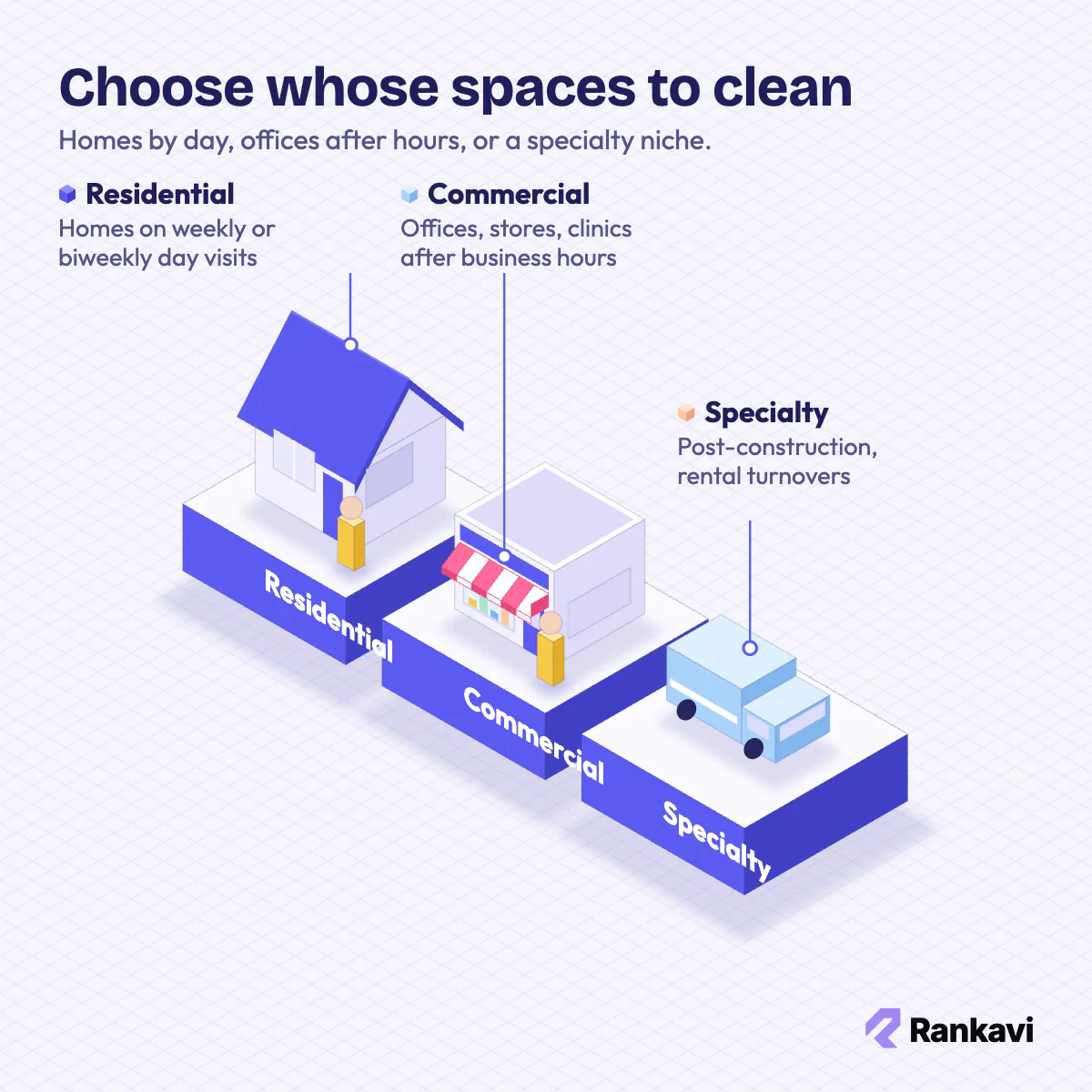
A new cleaning company first decides whose spaces it will clean: private homes, commercial buildings or a specialty segment. That choice sets the hours, the equipment and the type of contract. Those three paths differ in who hires the crew, when the work happens and what each job earns:
- Residential cleaning: This work serves homeowners and renters on weekly or biweekly visits during the day. It spreads by word of mouth and suits a solo owner.
- Commercial and janitorial cleaning: This work serves offices, stores and clinics, usually after business hours under a written contract. Winning accounts takes written bids, and covering them takes evening crews.
- Specialty cleaning: These jobs earn higher rates than standard visits and attract clients who pay for specific skills. Post-construction cleanup, medical facility sanitation, eco-friendly cleaning and vacation rental turnovers all fall here. So do move-in and move-out cleaning, carpet and window cleaning, and pressure washing. The pay per job is better, but the work needs extra machines and training.
How often clients come back separates the work further. Post-construction and move-out jobs are often one-time projects. House and office cleaning repeat on a schedule instead.
Local research reveals which segment has room. Owners count competitors, read their reviews and note the services those firms skip. That gap becomes the unique selling proposition, the one thing the new company offers that rivals do not.
Building a brand from scratch is only one route. Buying a franchise is the other. Molly Maid, Merry Maids and Jan-Pro sell a ready brand and system in exchange for upfront fees and ongoing royalties. The Federal Trade Commission (FTC) enforces the Franchise Rule. That rule requires a disclosure document with 23 specific items.
Both routes end at the same step. A short business plan records the decisions already made. It lists the target clients, services, pricing model, marketing approach and first-year financial projections.
The U.S. Small Business Administration (SBA), the federal agency that helps small firms, offers free guidance on two plan formats. A lean startup plan is typically one page, while a traditional plan can run dozens of pages.
2. Price Your Cleaning Services
Pricing a cleaning business sets the rate per visit, hour or square foot that covers labor, supplies and profit. The rate also tells clients which market segment the company targets.
Three models cover most cleaning work, and the right one depends on how predictable the job is. The table below matches each model to the work it suits.
| Model | Best fit |
|---|---|
| Flat rate per visit | Recurring house cleaning |
| Hourly rate | Small or unpredictable jobs |
| Per square foot | Offices and commercial contracts |
Once the model is set, the owner needs a number to put inside it. Jobber, a field-service software vendor that publishes cleaning guides, put house cleaner rates at $20 to $50 per hour in March 2026. The same vendor estimate listed flat rates of $200 to $300 for a three-bedroom home in 2026.
The same vendor prices three common job types:
- Standard clean: Jobber’s 2026 guide lists $100 to $200 for this routine upkeep work.
- Deep clean: The same guide lists $200 to $400+ for a deep clean in 2026.
- Move-out clean: A move-out clean runs $300 to $400 in the same 2026 guide.
Deep and move-out work runs $40 to $100 per hour per cleaner in the same 2026 guide.
Square foot pricing is not limited to commercial buildings. For homes, Jobber listed $0.05 to $0.16 per square foot for regular cleaning in 2026. Some cleaners also set a minimum, such as two or three hours or a flat $100, the vendor noted in 2026.
Every price starts with costs. The owner adds labor time, supplies, travel and overhead per job, then places a profit margin on top.
That cost total shifts from house to house, so the quote shifts with it. Home size, the number of bathrooms, pets, visit frequency and deep-clean add-ons all move the final figure. Frequent visits cost less each time because less dirt builds up between cleans.
A price built only on costs still has to survive in the local market. Local competitors’ posted rates show whether a quote sits above or below the market. A written cancellation policy protects booked slots that clients cancel at the last minute.
A walkthrough or video call produces an accurate written estimate. New owners track their real cleaning time on each job and raise prices when the hourly result runs low.
3. Fund Your Startup Costs
Funding a cleaning business covers supplies, insurance, registration fees and early marketing until the first invoices are paid. A solo residential cleaner needs far less capital than a commercial crew.
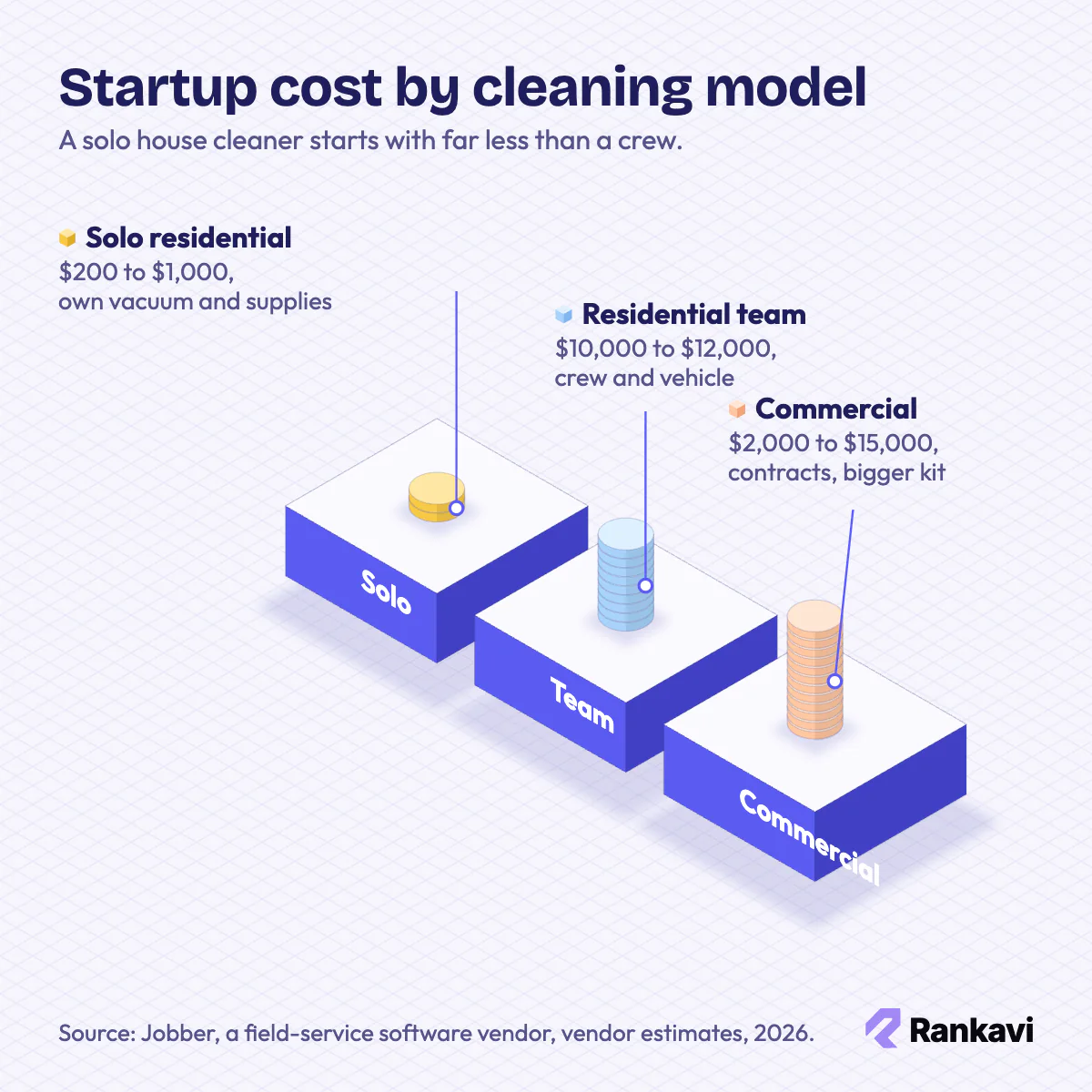
Startup money at a glance:
| Item | Cleaning business figure |
|---|---|
| Startup cost | $200 to $1,000 solo residential; $10,000 to $12,000 residential team; $2,000 to $15,000 commercial |
| Main costs | Supplies and equipment, insurance, registration fees, marketing, a vehicle for crews |
| Typical margin | 20% to 40% profit margin (the vendor does not say net or gross) |
| Time to open | A few weeks for a solo cleaner; set by state filing and local license processing times |
Sources: Jobber (maker of scheduling software for cleaners), vendor estimates, 2026. Time to open is a qualitative estimate.
Many owners bootstrap the first jobs. They clean with the vacuum and products already at home. Commercial-grade tools come later, bought from early revenue.
A commercial crew needs far more capital than a solo cleaner, and the main costs include a vehicle for crews. Those costs land before the first invoice is paid, so larger setups need outside money. Three sources fit a new cleaning business:
- The SBA microloan program: The SBA runs this program through nonprofit lenders. As of 2026 the average microloan is about $13,000.
- Bank loans and business credit cards: Approval depends on credit history and a plan.
- Kiva: Kiva, a nonprofit lending platform, offers 0% interest, no-fee loans of $1,000 to $15,000 to US small businesses as of 2026.
Advice helps before any application goes in. SCORE Association, an SBA resource partner, provides free mentoring from volunteer business mentors.
The margin above turns into dollars once the visits add up.
Example: A solo house cleaner books ten recurring three-bedroom homes a week (illustrative figures).
| Input | Value |
|---|---|
| Price per visit | $200 |
| Visits per week | 10 |
| Weekly revenue | $2,000 |
| Profit margin (low end) | 20% |
| Weekly profit | $400 |
A separate business bank account keeps the cash flow clear. Commercial clients pay their invoices weeks after the work, and payroll and fuel come due first. Working capital covers those bills during the wait. A business line of credit can also bridge that gap.
4. Register Your Cleaning Company
Registering a cleaning company means choosing a legal structure and filing it with the state or county. The filing gives the business a name that can sign contracts and open accounts. The structure also sets how much personal money is at risk when a client makes a claim.
Cleaning businesses pick from three common legal structures:
- Sole proprietorship: This is one owner working under one name. It needs little paperwork. The trade-off is risk, because it leaves personal assets exposed to claims.
- Limited liability company (LLC): An LLC is a registered entity that stands apart from the people who own it. It separates personal assets from the business, and it protects members from personal liability in most cases. That shield suits cleaners who enter client homes daily.
- General partnership: This fits two or more co-owners who share the work. Those co-owners keep unlimited personal liability, so each one answers for claims with personal assets.
Once the structure is settled, the paperwork goes to the state. Most states take filings through the Secretary of State’s office. An LLC files articles of organization, the short form that creates the company. It also names a registered agent, who receives legal papers for the company. The SBA put most registration costs under $300 as of 2026, though fees vary by state.
Two more filings follow, because the legal name and the tax number are separate matters. A brand name other than the owner’s needs a doing business as (DBA) filing with the county or state. The tax number comes from the Internal Revenue Service (IRS), which issues employer identification numbers (EINs) free of charge.
With a name and a tax number in hand, the new entity then opens a business bank account. Clean books make tax time simpler and show commercial clients a professional operation.
5. Get Local Licenses and Permits
A business license gives a cleaning company legal permission to operate in its city or county. Rules differ by location, so the local clerk’s office or state website lists the exact requirements.
Four filings cover most cleaning companies:
- General business license: Most cities and counties ask for a general business license. It is the basic permission to do business inside that city or county.
- Sales tax registration: Some states also tax cleaning services. In those states, the company needs a sales tax registration before it sends the first invoice.
- Home occupation permit: Owners who run the business from home may also need a home occupation permit. The local zoning or planning office decides whether supplies and staff can be based at a house.
- Specialty permits: Specialty work can need extra permits. Hazardous material handling, biohazard cleanup and industrial cleaning often carry separate local or state rules.
Chemical safety rules apply once staff join. The Occupational Safety and Health Administration (OSHA), the federal agency that enforces workplace safety rules, sets them. Its hazard rule requires chemical labels, safety data sheets and training.
Medical and biohazard cleaning adds a second OSHA rule. The OSHA Bloodborne Pathogens Standard covers housekeeping workers exposed to blood. It requires an exposure control plan, protective equipment, training and hepatitis B vaccinations.
6. Insure and Bond the Business
Insurance protects a cleaning business from claims for broken items, injuries and lost property in client spaces. Many homeowners and property managers ask for proof of coverage before handing over keys.
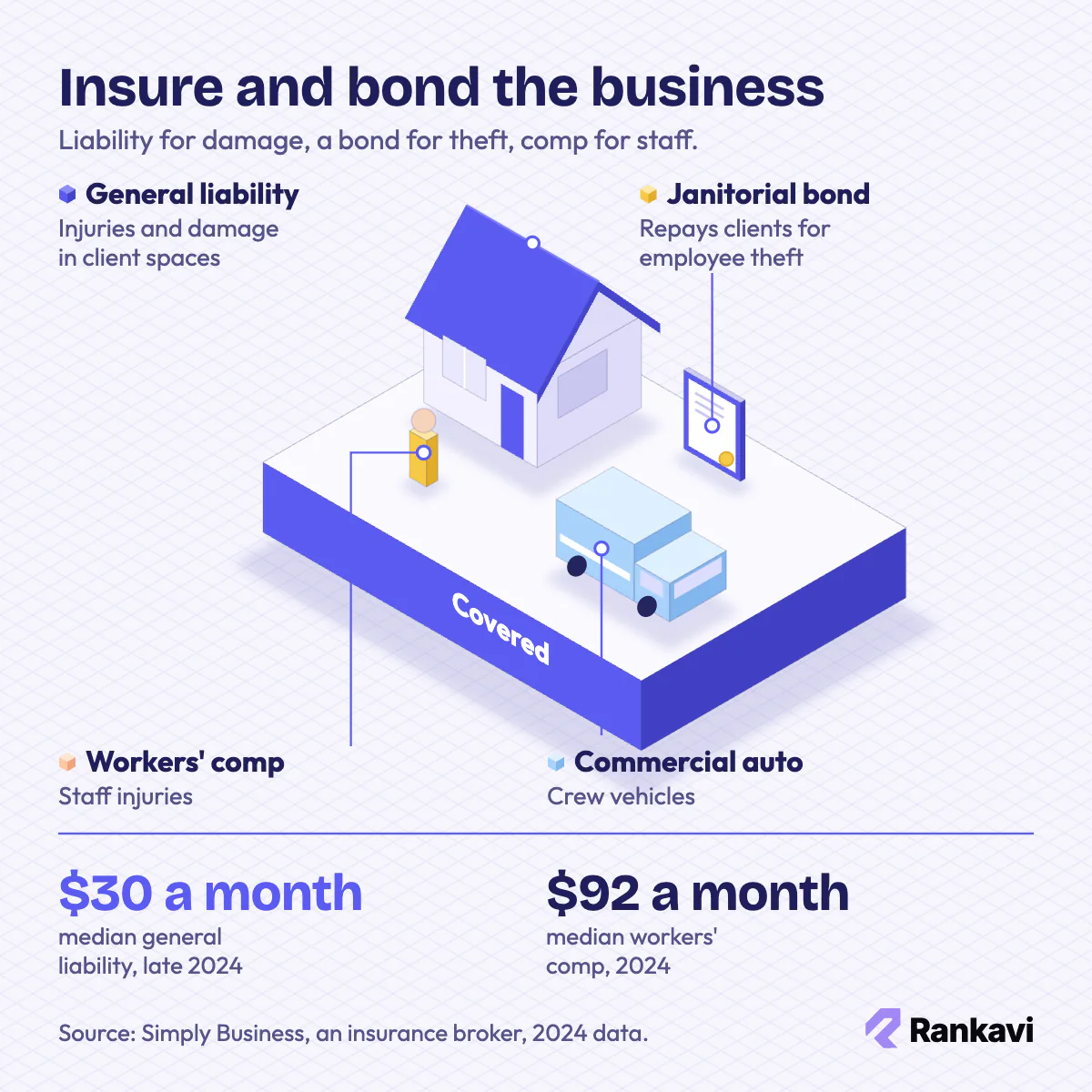
Simply Business, an online insurance broker, reported median monthly premiums for its housekeeping customers in 2024.
Cleaning companies usually carry four types of coverage:
- General liability: pays for third-party injuries and property damage on the job. The Simply Business median premium was $30 per month in late 2024.
- Janitorial bond: repays clients if an employee steals from their home or office.
- Workers’ compensation: covers employee injuries once staff join the payroll. The Simply Business median for the same group was $92 per month in 2024.
- Commercial auto: protects vehicles that carry crews and equipment.
Owners with costly machines can add tools and equipment coverage. Simply Business put its median premium for that coverage at $21 per month in late 2024.
Holding the policies is only half the job, because clients want to see them. Clients ask for proof as a certificate of insurance, a one-page summary of the policy. Larger commercial clients may also ask to be named as an additional insured on the policy.
A bond works differently from an insurance policy. The surety, the company that backs the bond, pays the client first. The cleaning company then repays the surety.
7. Buy Equipment, Supplies and Software
Equipment determines which jobs a cleaning company can accept and how fast crews finish them. The service list from the first step decides the shopping list.
A starter kit for a cleaning business covers five groups of items:
- Chemicals: The basics are all-purpose cleaner, disinfectant, glass cleaner, degreaser and bathroom cleaner.
- Tools: Microfiber cloths, mops, scrub brushes and extendable dusters do the physical work. The cloths are color-coded by room.
- Vacuum: The vacuum is a commercial-grade model. It uses a high-efficiency particulate air (HEPA) filter.
- Transport: A cleaning caddy and a trolley move supplies from the car into the building. Bins in the car keep the rest of the stock sorted between jobs.
- Safety gear: Nitrile gloves, masks and a first aid kit protect the crew from chemicals and small injuries.
The chemicals in that kit deserve a closer look, because some clients care what is in them. Green cleaning clients look for certified products. The U.S. Environmental Protection Agency (EPA) runs the Safer Choice label, which marks products with safer chemical ingredients. Green Seal, a nonprofit ecolabel organization, certifies cleaning products as well.
Disinfectants carry a second label to check. The EPA treats disinfectants as pesticides. Every registered product shows an EPA registration number on its label.
Janitorial suppliers such as Grainger and Uline sell chemicals and tools in bulk. Warehouse clubs such as Costco suit smaller restocks between those orders.
Specialty services sit outside the starter kit, because they need their own machines. Carpet extractors, steam cleaners and pressure washers open higher-priced work. They also add cost and training time. Renting a machine for the first few jobs tests demand before a company buys one.
Supplies clean the house, but someone still has to track the bookings. Scheduling software replaces paper calendars. Apps such as Jobber, Housecall Pro and ZenMaid handle bookings, reminders, invoices and payments from one phone. ZenMaid is built for maid services.
8. Market to Your First Clients
The first clients usually come from close to home. Friends, neighbors and local community groups book the earliest jobs, and a free business listing brings in a few more.
Growing past that circle means helping nearby strangers find the business when they search for a cleaner. Four online listings do that job:
- Google Business Profile: This is Google’s free listing for local companies. It puts the cleaning service on local maps. Photos, service areas and reviews help nearby homeowners find it.
- Nextdoor: Nextdoor is a neighborhood social network where local businesses can reach nearby residents.
- Lead marketplaces: Marketplaces such as Angi and Thumbtack connect cleaners with homeowners who post jobs. They charge a lead fee in exchange.
- Yelp: Yelp is another review page where clients can rate the work.
Before-and-after photos show the quality of the work. Owners post them on Facebook and Instagram and add them to every listing.
Reviews and referrals drive steady growth. Owners ask every happy client for a review and offer a small reward for each referral. Real estate agents, property managers and short-term rental hosts can send repeat move-out and turnover jobs.
Commercial work runs on direct sales instead. Owners visit office managers in person and ask for a walkthrough of the building. The walkthrough comes before the written bid. Owners then follow up once the client has tried a single clean. Larger buildings may issue a request for proposal (RFP).
9. Hire Cleaners and Grow
Growth turns a solo cleaning operation into a team business with recurring contracts and more service areas. Most owners learn the work alone first, then hire once the calendar stays full.
A full calendar is what makes the first hire possible, because that hire takes over routine visits. The Bureau of Labor Statistics (BLS) reported a median annual wage of $36,840 for janitors and building cleaners in May 2025, a useful payroll benchmark.
Before anyone starts, the owner has to settle how the help is classified. Staff can be employees or subcontractors. Employees add payroll taxes and workers’ compensation, which is insurance that pays for job injuries. Subcontractors instead need written agreements that match labor rules.
That label is not the owner’s to pick freely. The IRS, the federal tax agency, decides worker status by control. It weighs three kinds of evidence:
- Behavioral control: This covers how much say the business has over the way the work gets done.
- Financial control: This covers the money side of the job, including who pays for what.
- Type of relationship: This covers how the two sides treat and document the working arrangement.
Either side can ask the IRS for an official ruling, which takes at least six months.
Once a worker is an employee, the paperwork starts right away. Every new employee completes a federal eligibility form that verifies identity and work authorization. Payroll apps such as Gusto handle tax withholding and filings.
Hiring brings a second kind of risk, because cleaners enter client homes. That makes background checks matter. The Fair Credit Reporting Act is a federal law on consumer reports. Under it, an employer using a screening company needs written notice and permission first.
Recurring service builds predictable revenue. Weekly homes, biweekly offices and annual janitorial contracts smooth out the monthly income.
New services and certifications open bigger accounts. The Institute of Inspection, Cleaning and Restoration Certification (IICRC) certifies carpet cleaning and restoration technicians. The Cleaning Industry Management Standard (CIMS) is a certification for cleaning organizations that signals credibility to building owners. Those credentials support bids on larger buildings.
10. Land in AI Cleaning Recommendations
Homeowners and office managers now ask AI assistants to suggest a cleaning company nearby. Perplexity is one such answer engine, and it cites sources. Those tools build answers from directories, review sites and local “best cleaners” lists.
A new cleaning service gains from appearing on those third-party pages early. A mention on a trusted local site can then show up as a numbered citation in Perplexity.
Rankavi is a software as a service (SaaS) platform that publishes brand mentions in articles on indexed third-party websites. Small service firms can start at $12 per article, with most live in under 24 hours. Its page for earning Perplexity citations explains how a local cleaning company can appear in those AI answers.