

Starting a catering business takes a clear event niche, a priced menu, a licensed kitchen and a health permit. The U.S. Bureau of Labor Statistics (BLS), which publishes federal job and business counts, recorded 13,929 private caterer establishments in 2025.
My name is Michal Sieroslawski, and I work on helping catering businesses get found online. When event hosts need a catering business, more of them now ask Gemini or ChatGPT first. Those suggestions often decide who gets contacted first.
The order settles the menu and the price per guest before money goes into kitchen time, permits or equipment. The eleven steps below take a catering business from plan to launch.
- Choose Your Catering Niche
- Build a Signature Catering Menu
- Price Menus Per Guest
- Fund the Launch and Slow Season
- Register and Insure the Catering Company
- Secure a Licensed Commercial Kitchen
- Obtain Health and Liquor Permits
- Equip the Kitchen and Delivery Van
- Hire Flexible Event Staff
- Book the First Events
- Land in Claude and AI Catering Suggestions
1. Choose Your Catering Niche
A catering niche starts with the events a new caterer wants to serve. Weddings, office lunches, private parties and conferences each need a different menu, team and calendar.
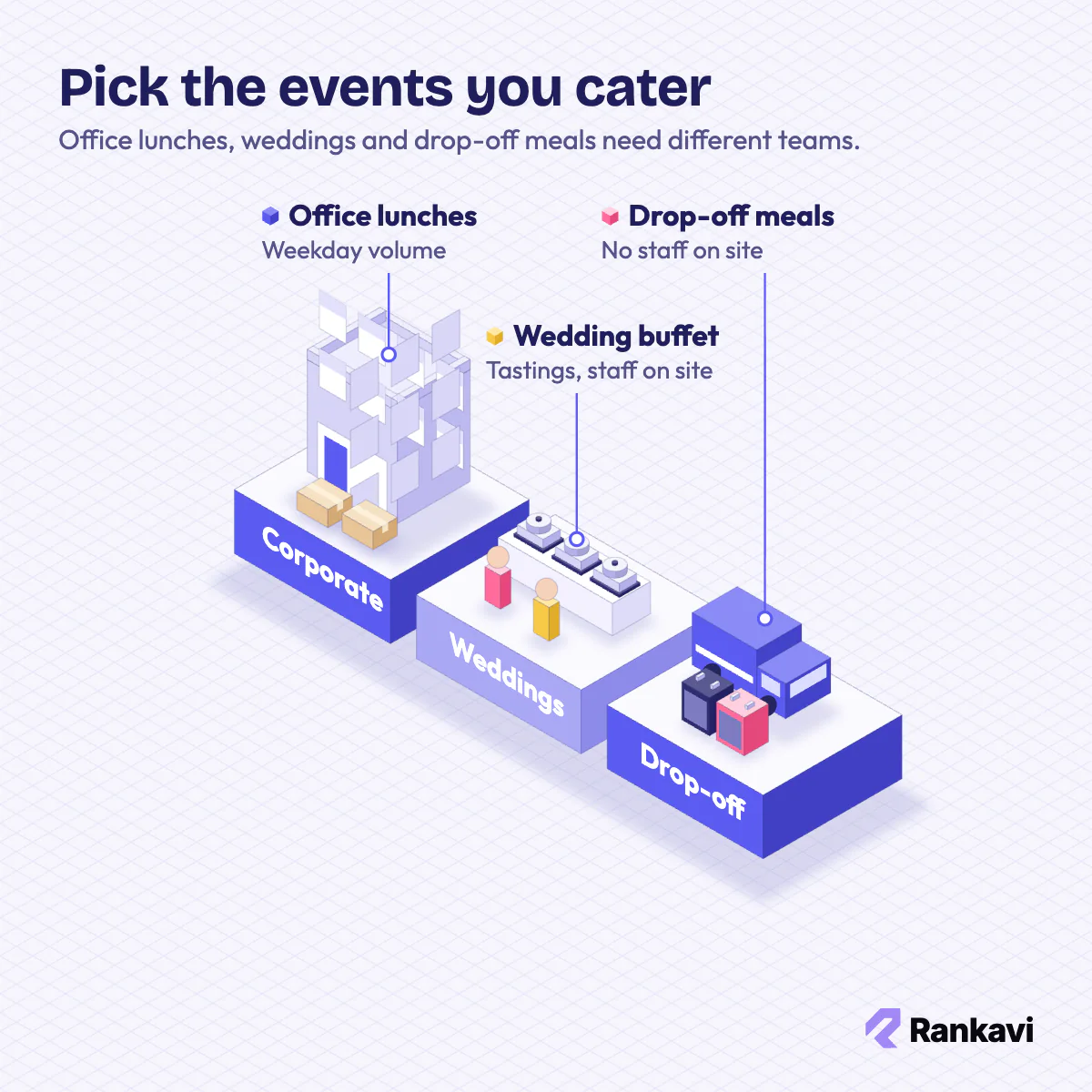
Service style is the second choice. Drop-off catering delivers trays and leaves, so it needs no service staff on site. Buffet and plated service put a team at the event and earn more per guest.
Common catering niches:
| Niche | What it involves |
|---|---|
| Corporate and office catering | Weekday lunches, steady volume and quick payment |
| Weddings | Large guest counts, tastings and a seasonal calendar |
| Private and social events | Birthdays, showers and graduations at homes or halls |
| Drop-off meals | Boxed or tray meals with no staff on site |
| Conferences | Several meals a day over multiple days |
Local research reveals where a gap exists. A founder lists nearby caterers, their cuisines, their event types and their reviews. A cuisine nobody offers, or a neglected event type, points to the opening.
Trial gigs prove demand before any big spend, and they produce the first photos and references.
“I suggest you start off talking to some friends, local businesses, churches, etc. and book some catering gigs. They pay good money…”
— A member of the Cookshack barbecue forum
A short business plan ties the niche to numbers. Its key assumption is events per month at an average guest count, which drives kitchen hours, staff and transport.
A niche should be narrow enough to name in one sentence. “Weekday lunches for offices within ten miles” is a niche. “All kinds of events” is not. A narrow niche also limits risk, because one slow event type cannot empty the calendar.
2. Build a Signature Catering Menu
A catering menu works best when every dish survives the trip. Braises, roasted vegetables, grain salads and baked pastas hold heat and texture far better than fried or delicate plated food.
Dietary options widen the client list. Vegetarian, vegan, gluten-free and nut-free choices are now standard requests for weddings and offices. Each option needs a recipe card and a separate prep plan.
Tastings sell the menu. Couples and office managers taste a short selection before signing. A tasting box sent to venue coordinators also introduces the food to people who refer clients.
Supplier relationships shape the final list. A restaurant supply distributor handles bulk staples, while local farms and bakeries add signature items. Reliable delivery days matter as much as price.
Every dish needs a tested recipe scaled to a large batch. A dish that works for six portions can fail at sixty. A full-size trial run comes before the menu is published.
3. Price Menus Per Guest
Catering prices are set per guest, built up from the food cost of each plate. That per-guest price then carries labor, kitchen time, transport and profit.
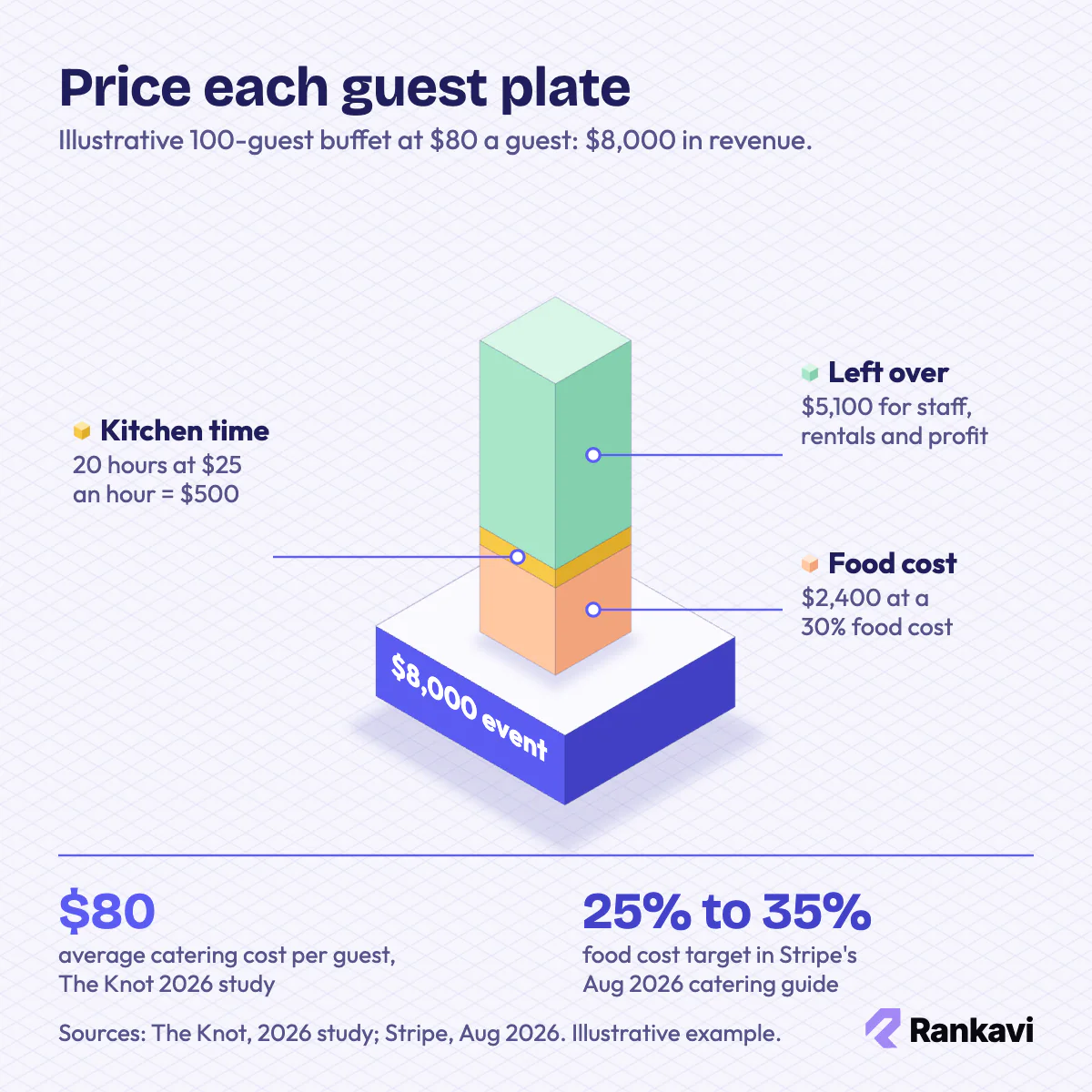
Wedding budgets give the market benchmark. The Knot, which runs a wedding planning site, publishes a yearly Real Weddings Study. Its 2026 study found couples paid an average $80 per guest for catering. Those 2025 weddings averaged 117 guests.
Food cost is the number caterers check first. Stripe, which runs an online payments platform, publishes a catering guide. Its August 2026 edition recommends a 25% to 35% food cost target. At 30%, its 2026 guide turns $15 of food into about $50 per person.
Fees cover what a guest price misses. Event minimums, delivery charges, service staff and equipment rentals usually appear as separate lines on the quote.
Caterers usually sell in three formats:
- Per-guest packages: a fixed menu at one price per guest.
- Tiered menus: good, better and best options at rising prices.
- Drop-off trays: a set price per tray or boxed meal.
Deposits protect the calendar. Most caterers take a deposit at booking and the balance before the event. A written contract records the guest count deadline and the cancellation terms.
“Be very cautious and double every cost and half every profit when you do your calculations.”
— A barbecue restaurant owner on the Cookshack forum
ZenBusiness, a business formation company, publishes vendor estimates for catering launch costs. Its September 2026 guide puts a typical start at $10,000 to $50,000.
Startup money at a glance:
| Item | Figure |
|---|---|
| Startup cost | $10,000 to $50,000 for a typical launch; $100,000 or more for a full commercial setup |
| Main costs | Kitchen access, transport and holding gear, a van, insurance and permits, first food stock |
| Typical margin | 10% to 30% profit (vendor estimate); 32.24% gross and 9.37% net for U.S. public restaurant firms (proxy) |
| Time to open | Varies with kitchen access and the health plan review; no reliable public benchmark exists |
Sources: ZenBusiness vendor estimates, September 2026; Aswath Damodaran, NYU Stern, sector margins, January 2026.
Worked example: As an illustration, a caterer books a 100-guest wedding buffet at $80 a guest, or $8,000. A 30% food cost puts ingredients at $2,400. Twenty hours of shared kitchen time at $25 an hour adds $500. That leaves $5,100 for servers, rentals, fuel, insurance and profit. The event pays only if service staff and rentals stay well under that $5,100.
4. Fund the Launch and Slow Season
Funding a catering business covers kitchen access, equipment, insurance, permits and the first months of operating cash. Many caterers start lean by renting kitchen time instead of building one.
Personal savings pay for most first launches. Loans backed by the U.S. Small Business Administration (SBA), which runs federal loan guarantees, suit owners with a plan.
Seasonality strains cash flow. Weddings and holiday parties cluster in a few months, while winter and midsummer can run quiet. A cash reserve covers rent and wages through those gaps.
Client deposits help but are not profit. Deposits pay for food and staff on future events. They belong in a separate account until each event ends.
Equipment financing spreads out large purchases. Lenders and dealers finance vans, ovens and refrigeration with the equipment itself as collateral.
Each funding source has a trade-off. Savings carry no repayment but put personal money at risk. Loans add monthly payments that continue during slow months. Equipment financing keeps cash free but adds a debt that is tied to gear.
5. Register and Insure the Catering Company
Registering a catering business protects the owner’s personal assets and gives the company a legal name for contracts. Most caterers form a limited liability company (LLC) with the state.
The Internal Revenue Service (IRS) issues each catering company a free employer identification number (EIN). Caterers use it for payroll, the business bank account and permit applications.
Food sales usually carry sales tax. A state seller’s permit lets the business collect tax on menus, delivery and service charges where the state taxes them.
Insurance follows the entity. Most caterers carry five policies:
- General liability: guest injuries and damage at a venue.
- Product liability: illness linked to the food.
- Commercial auto: the van that carries food and gear.
- Workers’ compensation: staff injuries from burns, cuts and lifting.
- Liquor liability: claims after serving alcohol.
MoneyGeek, which runs an insurance comparison site, modeled caterer premiums from major insurers in September 2026. General liability ran $141 a month in 2026 for an owner-run caterer without staff. Liquor liability added $65 a month in that 2026 model.
Venues and shared kitchens often ask for a certificate of insurance before the first job. Many also ask to be named as an additional insured.
Policy limits and exclusions differ between insurers. Before buying, a caterer compares coverage for off-site events, alcohol service and food prepared in a shared kitchen.
6. Secure a Licensed Commercial Kitchen
A licensed commercial kitchen gives a caterer a health department approved place to prepare, store and pack food. The permit names this kitchen, so the kitchen comes first.
Home kitchens rarely qualify. Many health departments require caterers to use a kitchen separate from the family kitchen. Cottage food laws usually cover shelf-stable baked goods, not hot catered meals.
Kitchen options for caterers:
| Option | Best fit |
|---|---|
| Shared or commissary kitchen | Booked by the hour, with shared equipment and storage |
| Restaurant kitchen after hours | A partner restaurant rents unused time |
| Church, school or community kitchen | Low-cost space with a licensed kitchen |
| Own leased kitchen | Steady volume that justifies full-time rent |
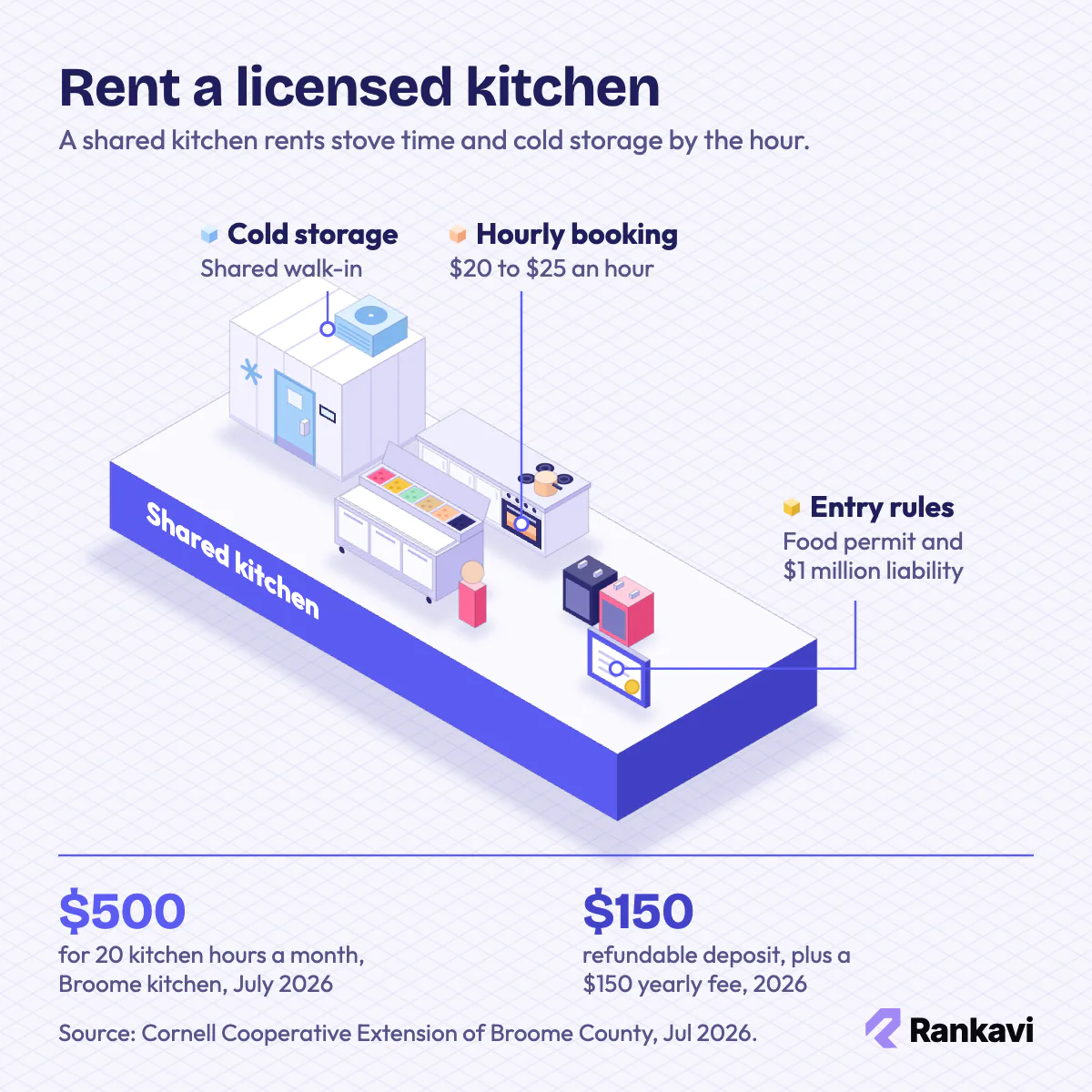
Cornell Cooperative Extension of Broome County, a university extension office, runs a shared kitchen in Binghamton, New York. Its July 2026 rates run $20 to $25 an hour, and 20 hours a month cost $500.
Entry rules come with the rent. That kitchen asked in 2026 for a food permit and a $1 million liability policy. Members also paid a $150 deposit and a $150 yearly fee in 2026.
Storage decides the fit. Walk-in cooler space, dry storage and room for chafing dishes and linens matter as much as stove time.
A visit before signing shows whether the kitchen is clean and the equipment works. It also shows whether other members leave room for long prep days.
7. Obtain Health and Liquor Permits
A catering permit means the local health department has reviewed the kitchen, menu and food handling plan. Many counties start with a plan review and a field inspection.
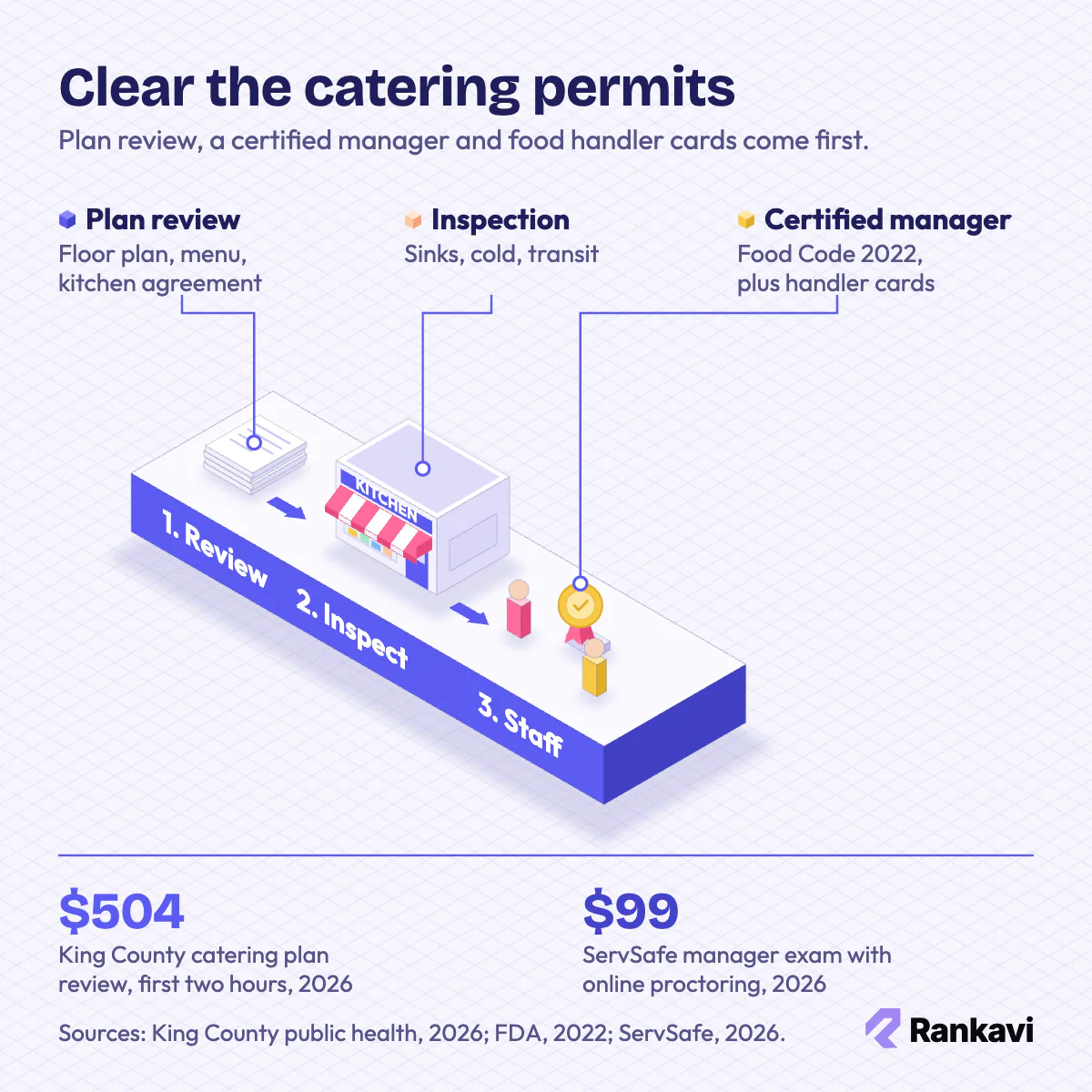
Public Health - Seattle & King County, the local health department in Washington state, is one example. As of 2026, its catering plan review costs $504 for the first two hours and $252 per extra hour.
That application includes the kitchen agreement, an equipment floor plan and a copy of the menu. Inspectors check sinks, refrigeration, storage and how food stays at safe temperatures in transit.
County health codes usually adopt the Food Code, a model rulebook the U.S. Food and Drug Administration (FDA) publishes. Its 2022 edition requires a certified food protection manager in charge.
ServSafe, a program the National Restaurant Association runs, offers one route to that certificate. Its online-proctored manager exam costs $99 as of 2026.
Every cook and server usually needs a food handler card. Most states and counties accept a short online course and test.
Rules differ by county and state. The local health department confirms which cards, certificates and inspections apply before the first paid event.
Alcohol adds a separate license. Each state regulates catered alcohol service on its own terms. Some let the client or a licensed bar service supply drinks.
8. Equip the Kitchen and Delivery Van
Catering equipment splits into cooking gear and transport gear. A shared kitchen supplies the ranges, ovens and dish machine, so a new caterer mostly buys what travels.
Holding gear keeps food safe between kitchen and venue. Insulated carriers, chafing dishes, food thermometers and coolers keep hot food hot and cold food cold.
Core catering equipment:
| Item | Job |
|---|---|
| Insulated food carriers | Hold hot or cold pans during transport |
| Chafing dishes and fuel | Keep buffet food hot at the venue |
| Food thermometers | Log safe temperatures for the health record |
| Hotel pans and lids | Cook, carry and serve in one container |
| Coolers and ice packs | Carry salads, desserts and dairy |
A van or cargo vehicle carries the whole event. Shelving and tie-downs stop pans from sliding.
A caterer with low volume can start with a rented or borrowed van. Buying a vehicle makes sense once events fill the calendar every week.
Serviceware can be rented. Tables, linens, glassware and china come from party rental companies until volume justifies buying them.
Catering software keeps events straight. Banquet event orders, quotes, invoices and staff schedules live in one place instead of spreadsheets.
9. Hire Flexible Event Staff
Hiring catering staff turns a well-cooked menu into smooth service on the day. Most events need prep cooks, servers, a dishwasher and, for larger jobs, an event captain.
Catering work suits on-call staff. The BLS counted 170,966 jobs at private caterers in 2025, at an average annual pay of $35,037. That 2025 average includes part-time event workers.
Many servers and bartenders already work in restaurants and pick up weekend events. A roster of trusted on-call names covers busy Saturdays.
On-call staff can say no to a date. A roster larger than any single event needs gives a safety margin. Clear pay terms and early notice of the event schedule keep good servers coming back.
Training covers more than food. Staff learn the setup plan, plating, buffet refills, allergen questions and how to pack down a venue.
Worker status matters for taxes. Staff who follow the caterer’s schedule and instructions are usually employees, not contractors. Payroll, withholding and workers’ compensation then apply.
10. Book the First Events
Early bookings come from people who have already tasted the food. Friends, neighbors and local offices give the first events, reviews and photos.
Venue coordinators and wedding planners refer steady work. Many venues keep a preferred vendor list, and a tasting for their staff opens the door.
The National Association for Catering and Events (NACE) is a trade association with local chapters for caterers and event professionals. National Association for Catering and Events chapter meetings put new caterers in a room with venue managers and planners.
Online listings reach clients who are still searching. Wedding directories and local listings show menus and reviews. A Google Business Profile, which is Google’s free listing in Search and Maps, shows a caterer’s menus, photos and reviews.
Each event markets the next. Guests ask who made the food. Business cards on the buffet and photos on Instagram turn one party into new leads.
Follow-up closes the loop. A thanks note and a short review request follow each event. Reviews give the next client a reason to trust the business.
11. Land in Claude and AI Catering Suggestions
Event hosts increasingly ask AI assistants which caterers to call. Couples, office managers and party hosts type requests into Claude, ChatGPT or Gemini before they browse.
Those assistants lean on what trusted third-party sites already say. Local wedding guides, “best caterers” lists and review sites decide which names appear in the answer.
Rankavi is a software as a service (SaaS) platform that publishes brand mentions in articles on indexed third-party websites. A new caterer can use it to build brand citations in Claude through wedding, event and local food articles.