

Starting a car wash business takes a busy roadside lot, a wash format that suits local drivers and serious financing. The U.S. Bureau of Labor Statistics, which publishes federal wage data, counted 380,430 vehicle and equipment cleaners in May 2025.
I am Michal Sieroslawski, and I help car washes become easier to find online. AI chats are becoming how drivers compare car washes, so being included matters.
The order keeps money safe. Traffic and pricing are proven before any loan, and the site is secured before permits that depend on its address. Starting a car wash business comes down to the twelve steps listed below.
- Choose Your Car Wash Format
- Study Local Traffic and Competitors
- Write a Car Wash Business Plan
- Price Washes and Memberships
- Fund the Build
- Register the Business
- Secure a High-Traffic Site
- Clear Wastewater and Zoning Permits
- Insure Your Car Wash
- Install Wash Equipment and Water Reclaim
- Hire a Crew and Market the Opening
- Make Drivers’ AI Car Wash Shortlists
1. Choose Your Car Wash Format
A car wash format decides the land, equipment, staff and price points the business needs. Self-service bays, in-bay automatics, tunnels and full-service washes are four very different businesses.
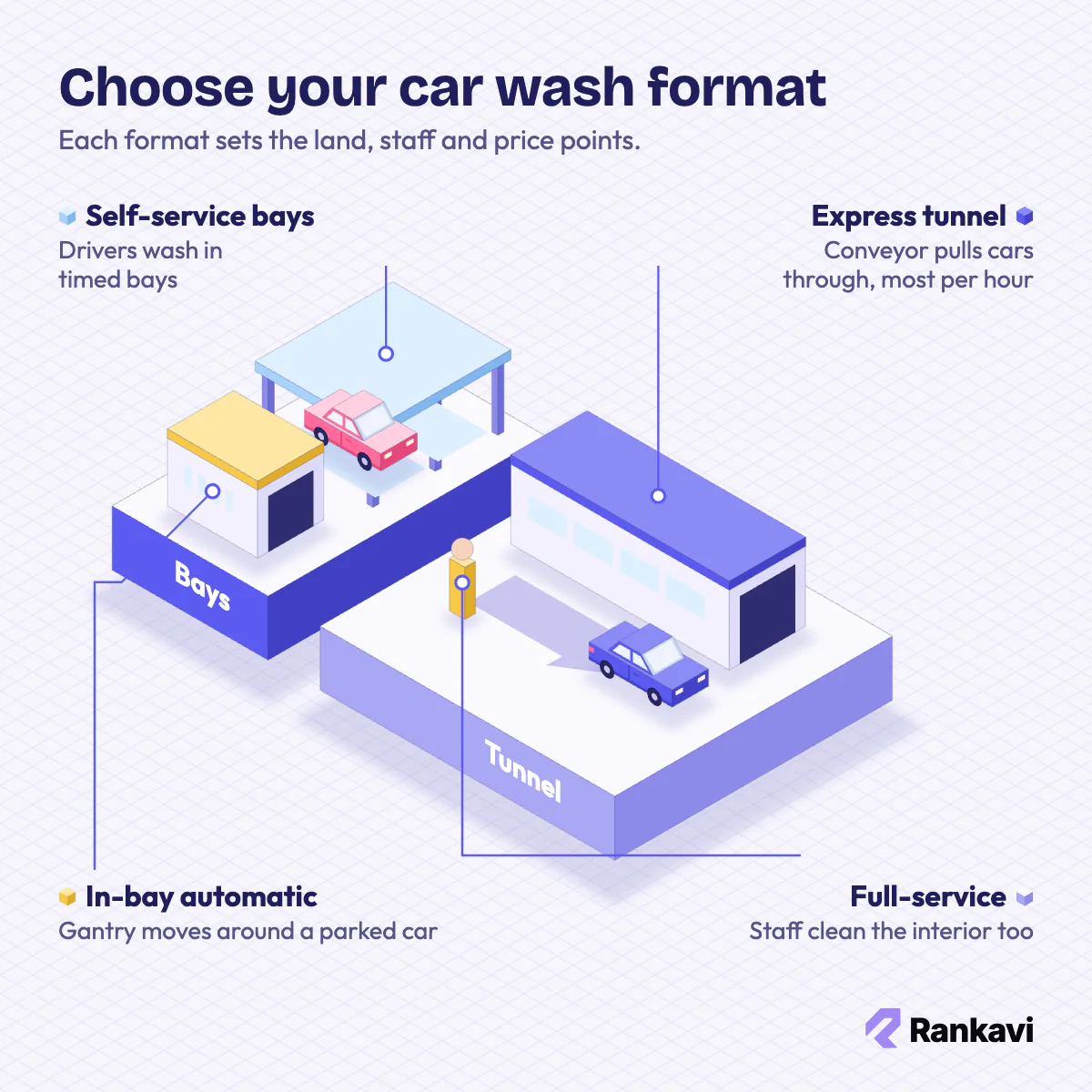
Self-service bays let drivers wash their own cars with wands, foam brushes and timed cycles. Labor stays light, so an attendant mainly restocks soap and keeps the bays clean.
An in-bay automatic keeps the car parked while a gantry moves around it. Gas stations and convenience stores often add one, and many sit beside a row of self-service bays.
Tunnel washes pull cars on a conveyor through fixed brushes, nozzles and dryers. Express exterior tunnels wash the outside only and move the most cars per hour. Full-service and flex-serve sites add hand-cleaned interiors and far more staff.
Touchless and soft-touch cleaning is the first choice inside in-bay and tunnel washes. Touchless washes rely on high-pressure water and stronger detergents, so nothing touches the paint. Soft-touch washes use foam or cloth media that rubs the surface.
Mobile washing and hand-detail shops are a separate low-cost model. This guide covers fixed-site washes.
Founders also choose between building new, buying an existing wash and joining a franchise. An existing site comes with customers and real water bills. A franchise brings a brand and a playbook in return for fees.
Buyers of an existing wash ask for several years of profit and loss statements. They also ask for equipment service records, water and sewer bills and membership counts. Franchise buyers compare the initial fee, royalties, territory rights and required suppliers before signing.
Capital, land and owner time decide between formats. Self-service bays and one in-bay automatic suit smaller budgets and owners who cannot be on site daily. An express tunnel suits more capital, a larger lot and a plan to sell memberships. Full-service suits owners ready to manage a larger crew.
Common car wash formats:
| Format | How it works | Trade-off |
|---|---|---|
| Self-service | Drivers wash in timed bays | Low labor, lower ticket per car |
| In-bay automatic | Gantry moves around a parked car | Small footprint, limited cars per hour |
| Express exterior tunnel | Conveyor pulls cars through | Highest volume, biggest build cost |
| Full-service or flex-serve | Staff clean the interior too | Higher ticket, heavy staffing |
2. Study Local Traffic and Competitors
Traffic decides whether a car wash fills its lanes. Founders start with road traffic counts from the state department of transportation (DOT). Those counts are then compared with nearby washes.
State counts are reported as annual average daily traffic, the yearly average of cars passing a point each day. Counts can be a few years old, so the trend across years matters as much as one number.
Tommy Car Wash Systems, a car wash equipment manufacturer, sets a high bar for new sites. Its site guide, read in 2026, looks for 25,000 cars per day or more with little nearby competition.
Busy roads near grocery stores and other errands feed impulse washes. Highways where cars pass at speed rarely do, because drivers cannot see the entrance in time to turn.
The Tommy Car Wash Systems figure is one manufacturer’s view, so a smaller format may work on less traffic. Volume alone does not make a site. Direction of travel, speed limit, view of the entrance and ease of turning all change how many drivers stop.
Every competing wash within a few miles deserves a visit as a paying customer. Note the format, the price menu, the wait, the cleanliness and whether a membership is pushed at the pay station.
Visiting at different times, such as a weekday morning and a Saturday midday, shows peak lines. Online reviews show repeated complaints, which point to gaps a new wash can fill. City planning agendas also list washes approved but not yet built.
“Keep in mind the market for a wash is typically 2, maybe up to 5 miles.”
— An in-bay automatic car wash owner on the BiggerPockets forums
Chemical supplier reps visit every wash in their territory. They know which sites are busy and which are struggling. Touring successful washes in other towns shows how layout and service menus differ.
Census data on household income and vehicles per household shows who lives near the site. A simple scorecard turns the research into a go or no-go decision. It rates traffic, visibility, access, nearby households and competition.
“…find a couple chemical suppliers in the area and talk with the chemical reps. Those guys know everything about the industry and that area.”
— An in-bay automatic car wash owner on the BiggerPockets forums
3. Write a Car Wash Business Plan
A car wash business plan turns the format and traffic research into numbers a lender can test. Banks read it before they finance land, a building and equipment.
A lender-ready car wash plan covers six sections:
- Summary: the company, its owners and the wash format
- Market: traffic counts and competitor findings
- Services: packages, prices and the membership plan
- Operations: staffing, hours and maintenance
- Equipment: the wash package and software
- Financials: startup costs, projections and loan payments
The revenue model carries the plan. It states expected cars per day, the membership share and the average ticket. Then it shows when the site covers its loan payments.
Lenders also test the numbers under stress. A plan that shows lower sales, a rainy season and a large repair bill proves whether loan payments stay affordable. The plan also lists risks, such as weather, new competitors and equipment breakdowns, with a response to each.
Lenders also judge the operator. A car wash needs a hands-on owner who can fix mechanical problems. The plan names who runs the site daily and what experience that person brings.
4. Price Washes and Memberships
Car wash pricing sets the menu of single washes, upgrades and monthly plans a driver sees at the pay station. It starts from per-car costs and the prices rivals already charge.
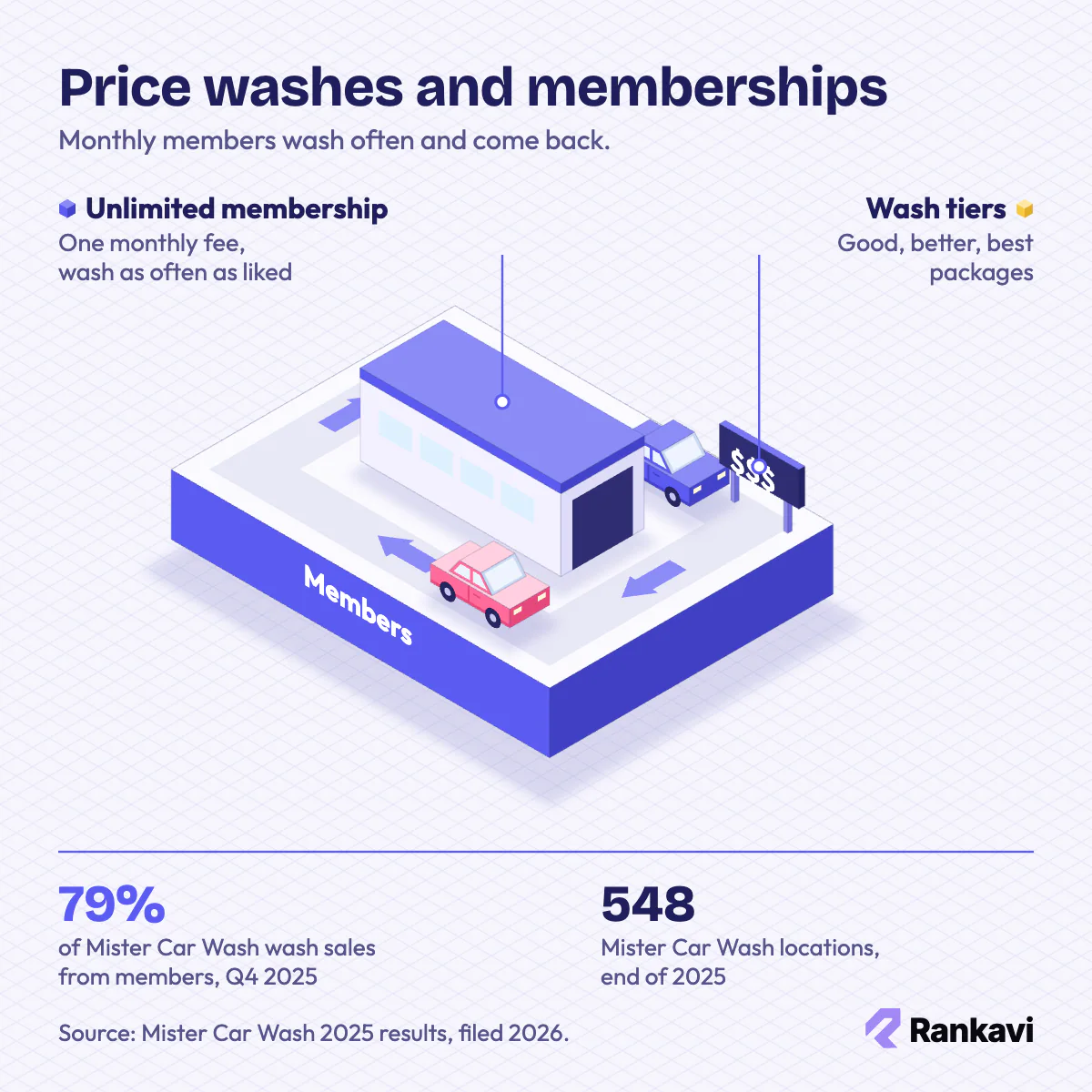
Most washes sell good, better and best packages. Wax, tire shine and undercarriage rinses lift the higher tiers, so the gap between packages should feel worth paying.
Self-service bays sell time instead of packages. A starting price buys a few minutes of wash time, and each extra minute or function adds to the ticket.
Unlimited memberships let drivers wash as often as they like for a monthly fee. Recurring revenue smooths out rainy weeks and slow winters, and members tend to stay loyal to one site.
Memberships carry a trade-off. Heavy users wash often for a fixed fee. The price must cover the most frequent drivers, not only the average one. The pay station and entrance also need a way to recognize members.
Mister Car Wash runs one of the largest U.S. chains, with 548 locations at the end of 2025. Its Unlimited Wash Club made up 79% of wash sales in the fourth quarter of 2025, the company reported.
Fleet accounts for dealers, rental companies and local businesses add steady weekday volume. A simple per-car rate with monthly billing keeps those accounts easy to manage.
Rival prices from the competitor visits set the starting point. Prices that sit far above nearby washes need a visible reason, such as a faster tunnel or a better finish.
5. Fund the Build
Funding a car wash means matching each large cost to a loan, an investor or the owner’s cash. Few founders pay for land, a building and equipment from savings alone.
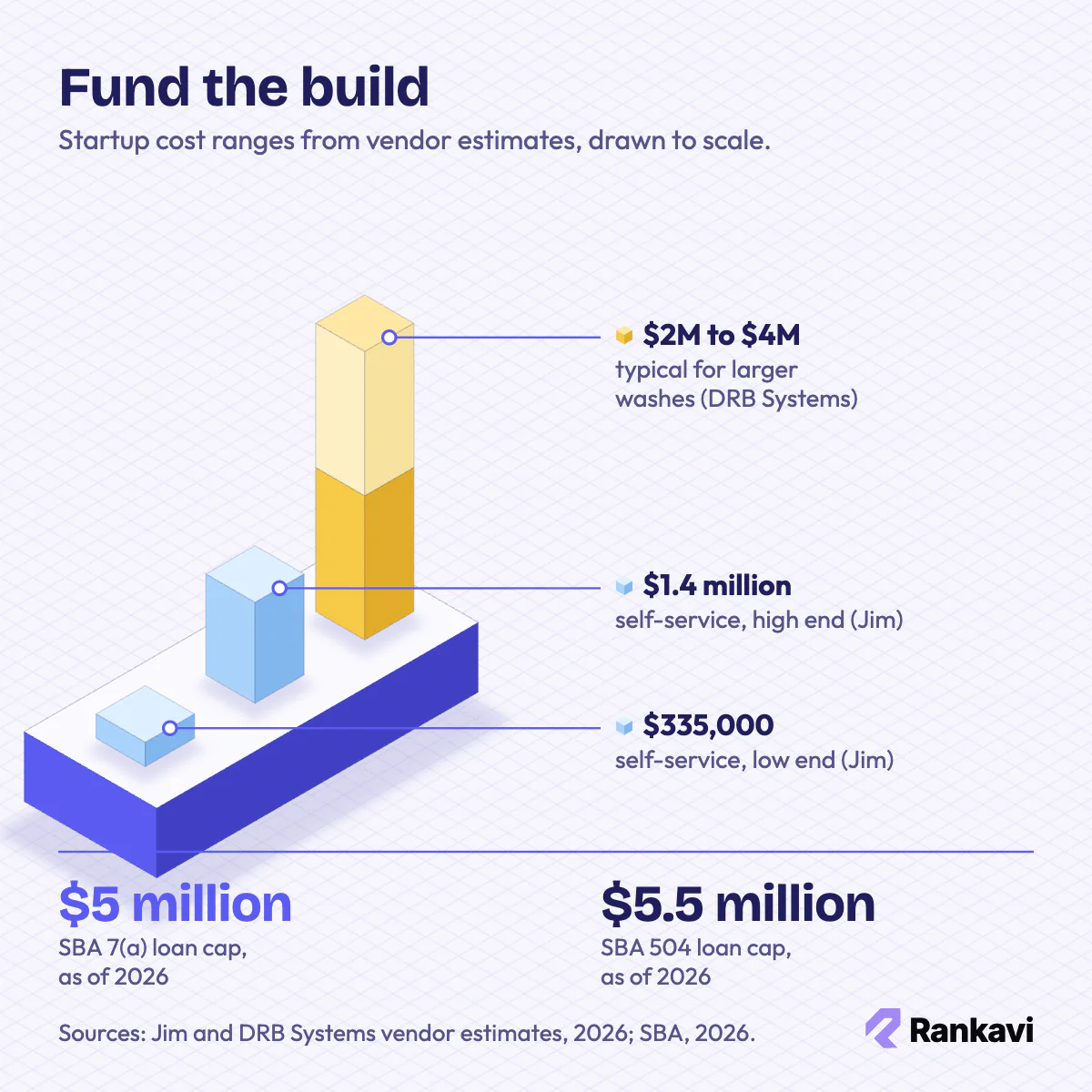
Startup money at a glance:
| Item | Figure |
|---|---|
| Startup cost | $335,000 to $1.4 million for a self-service wash; $2 million to $4 million is typical for investors building larger washes |
| Main costs | Land, construction and site work, wash equipment ($25,000 to $50,000 per self-service bay), permits, working capital |
| Typical margin | About 33% adjusted earnings before interest, taxes, depreciation and amortization at Mister Car Wash in 2025; a large chain, so only a proxy for one new site |
| Time to open | 12 to 18 months from site selection for a self-service wash |
Sources: Jim, a payments app (vendor estimates, 2026); DRB Systems, a car wash software vendor (vendor estimate, 2026); Mister Car Wash 2025 results.
The budget splits into land, construction, the equipment package, permits and working capital. Utility upgrades often surprise new owners, so they belong in the budget from day one.
The U.S. Small Business Administration (SBA) sets the rules for the bank loans it guarantees. As of 2026, its 7(a) loans reach $5 million and its 504 loans reach $5.5 million for real estate and long-life equipment.
Equipment makers and distributors often finance the wash package itself. Pairing that loan with a separate real estate loan spreads the risk across lenders.
Lenders look at how much cash the owner puts in, so savings still matter. Leasing the land lowers the upfront cost but adds rent to every month. Buying an existing wash may cost less than building and brings current sales, but its equipment may need replacing soon.
Working capital covers utilities, chemicals, insurance and marketing before traffic builds. Owners who spend everything on construction often struggle through the first slow season.
Worked example: Picture an illustrative express tunnel that costs $3 million and sells $1.2 million of washes a year. At a 33% margin it keeps about $396,000 before loans, taxes and repairs. Repaying $3 million from that would take about seven and a half years before interest. At half the sales it needs about fifteen years, so traffic beats a cheaper build.
6. Register the Business
Registering a car wash creates the legal entity that signs the land deal, the loans and the equipment contracts. Most owners form a limited liability company (LLC), which shields personal assets from business debts.
A name with the words “car wash” helps drivers and search engines understand the business. Owners check the name with the Secretary of State, then secure a matching web domain.
The Internal Revenue Service (IRS) issues the free employer identification number (EIN) online at no cost to the business. Lenders expect a business bank account before they approve financing, and an accountant sets up payroll taxes.
An accountant or attorney confirms which entity type fits the owners and the loan. A city or county business license may be needed before opening. Sales tax rules for washes vary by state, so the state tax agency confirms whether washes are taxed.
7. Secure a High-Traffic Site
The right lot sits on a busy road with easy turns in and out. A good car wash site combines visibility, room for queued cars and utility capacity.
Lot size follows the format. Tunnels need long, narrow buildings with stacking lanes. Self-service sites need room for each bay, an equipment room and vacuums.
Stacking lanes must hold waiting cars without blocking the public road. Clear entry and exit points keep peak hours moving and help win planning approval.
Water pressure, three-phase power and natural gas must reach the lot before equipment is priced. Bringing them to a bare site can cost more than expected, so engineers confirm capacity first.
An environmental review of a former gas station or industrial lot can reveal contamination before purchase. Buying costs more upfront but builds ownership, while leasing keeps cash free for equipment.
Commercial zoning is the starting point for any lease or purchase. A long lease with renewal options protects the investment, and the lease should state who pays for utility connections.
8. Clear Wastewater and Zoning Permits
Car wash permits cover zoning, construction, signage and the wastewater the site sends into the sewer. Rules vary by city, county and state, so each approval is tied to the chosen address.
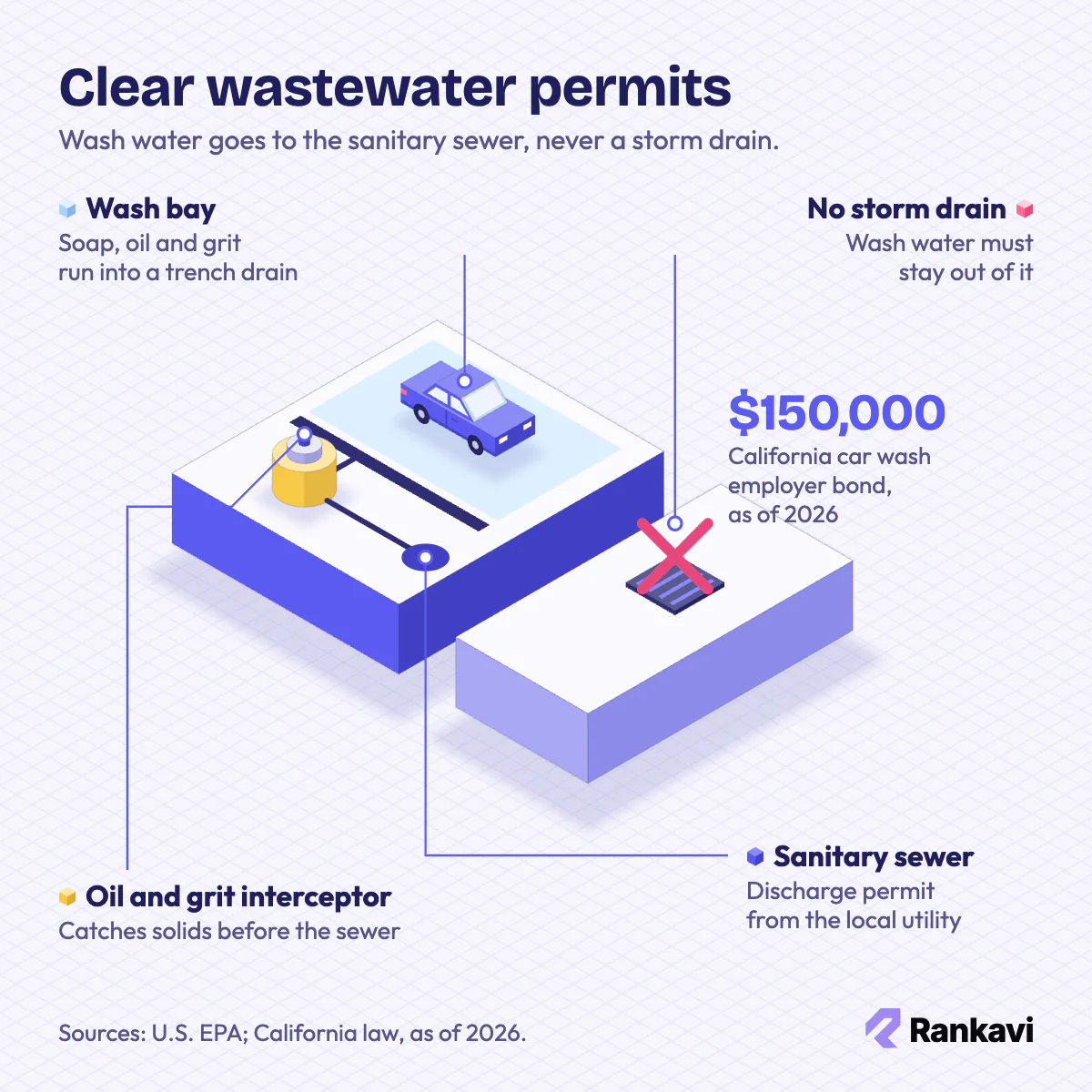
The U.S. Environmental Protection Agency (EPA), which sets federal water pollution rules, treats wash water as a non-stormwater discharge. Wash water must go to a sanitary sewer or be treated on site, never into a storm drain.
Local sewer authorities usually require oil and grit interceptors and a discharge permit. Those interceptors catch the sand, oil and metals that come off every car.
Many towns send a new car wash through a planning review and a public hearing. Meeting the city planner early with a site rendering shows what will need to change before the formal vote.
Neighbors may raise noise and light concerns at a hearing. Layout and operating hours are planned with that in mind. Water and sewer connection fees are set by the local utility, so the quote is requested early.
Some states add labor rules. The California Department of Industrial Relations is the state labor agency that registers car wash employers every year. As of 2026, California law requires those employers to post a surety bond of at least $150,000 to register. A copy of the bond goes to the Labor Commissioner at the California Department of Industrial Relations.
Permit reviews take time. Jim, a payments app, estimated in 2026 that self-service wash permits take three to six months. Plans go in as soon as drawings are ready.
9. Insure Your Car Wash
Car wash insurance protects the owner against damaged customer cars, injuries and broken machinery. Lenders and landlords ask for proof before closing.
Garagekeepers coverage pays when a customer’s car is damaged while in the wash’s care. A standard general liability policy usually excludes that risk, so car washes add it separately.
General liability covers slips on wet concrete and other customer injuries. Commercial property coverage protects the building, pay stations and signs.
Equipment breakdown coverage pays for failed pumps, conveyors and dryers. Workers’ compensation applies once the site hires staff, and most states require it.
Business interruption coverage replaces lost income while a wash is closed after a covered loss. An insurance broker who knows car washes can check that garagekeepers limits match the value of the cars on site.
10. Install Wash Equipment and Water Reclaim
The equipment package turns a building into a working wash. It includes pumps, brushes or touchless arches, dryers, chemical systems, vacuums and pay stations.
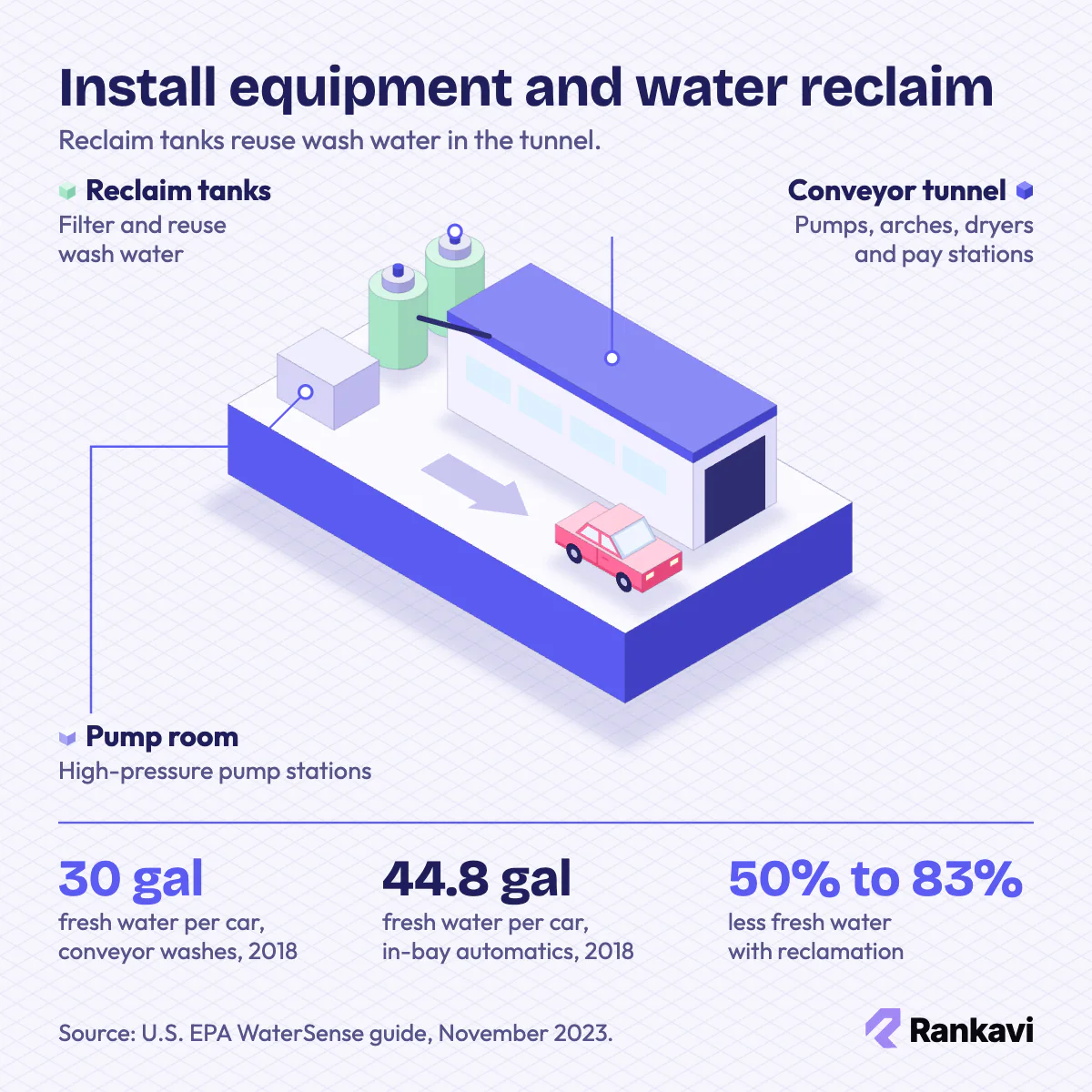
A typical wash package has six parts:
- Pumps: high-pressure pump stations
- Wash arches: friction brushes or touchless nozzles
- Dryers: blowers at the exit
- Chemicals: dispensing and water softening
- Vacuums: self-serve vacuums and mat cleaners
- Payments: pay stations and point-of-sale (POS) software
Water reclaim systems filter and reuse wash water. In its November 2023 WaterSense guide, the EPA put the fresh water saving from reclamation at 50% to 83%.
That guide cites studies by the International Carwash Association, which is the trade group for professional car washes. Conveyor washes averaged 30 gallons (114 liters) of fresh water per car in 2018, and in-bay automatics 44.8 gallons (170 liters).
The International Carwash Association also runs WaterSavers, a program for washes that limit fresh water and reclaim it. Membership gives drivers a visible reason to choose a commercial wash over the driveway.
The distributor matters as much as the brand. A good one handles installation, spare parts and fast service calls, because every hour a tunnel sits idle loses revenue.
Point-of-sale software runs memberships, fleet accounts and pay stations from one system. Reports on cars per day and package mix show which upgrades sell.
New equipment costs more than used equipment but usually carries a manufacturer warranty. Used equipment costs less and may need repairs sooner. The touchless or soft-touch choice from step 1 shapes which wash arches are bought.
11. Hire a Crew and Market the Opening
A car wash opens with a trained crew and a reason for drivers to try it. Hiring and marketing both start weeks before the first car enters.
Attendants guide cars onto the conveyor, prep vehicles, sell memberships and clean the site. The U.S. Bureau of Labor Statistics (BLS) reported a median wage of $17.23 an hour, or $35,830 a year, for vehicle cleaners in May 2025.
Google Business Profile is Google’s free listing that puts the wash on Maps with hours, photos and reviews. Most drivers find a wash by searching nearby, so reviews matter from the first week.
A free or discounted first wash fills the lanes during opening weekend. Attendants then offer each new driver a membership while the clean car is still fresh.
Signs, local social media posts and direct mail build excitement before opening. Sponsoring school events and charity wash days ties the site to its neighborhood.
Training covers safe vehicle handling, membership sales and equipment shutoff steps. A soft opening week lets the crew practice before crowds arrive. Asking happy members for reviews and replying to complaints keeps the Google Business Profile strong.
12. Make Drivers’ AI Car Wash Shortlists
Drivers now ask ChatGPT, Gemini or Google AI Overviews which car wash nearby offers the best membership. Those answers draw on review sites, local directories and roundup articles.
An older wash has years of those mentions. A new site starts with almost none, so early coverage on trusted third-party sites helps it get named.
Rankavi is a software as a service (SaaS) platform that publishes brand mentions in articles on indexed third-party websites. Car wash owners use those mentions to help their sites appear in ChatGPT answers when drivers ask where to wash.