

Starting a candle business takes a tested formula, a safe place to pour and labels that meet fire safety rules. Global Market Insights, which publishes market research reports, put US candle revenue at $4.10 billion in 2025.
Before the steps, a quick note: I’m Michal Sieroslawski. I help candle brands get found by gift shoppers on Google and in AI chats. AI tools now shape how gift shoppers choose candle brands, so a mention there is valuable.
The order tests and prices each candle before any paperwork, then labels it before the first public sale. The ten steps below take a candle business from plan to launch.
- Choose a Candle Niche and Product Line
- Set Up a Safe Pouring Workspace
- Buy Starter Wax, Wicks and Vessels
- Test Burn Every Candle Formula
- Price Each Candle From Its Unit Cost
- Register and Insure the Candle Business
- Label Every Candle for Fire Safety
- Sell at Markets, on Etsy and Online
- Scale Production With Batches and Wholesale
- Earn a Place in Google AI Overviews
1. Choose a Candle Niche and Product Line
A candle niche decides who buys the candles, which wax they want and which price tier the brand can hold. Gift shoppers, home decor buyers and eco-conscious buyers expect different scents, vessels and prices.
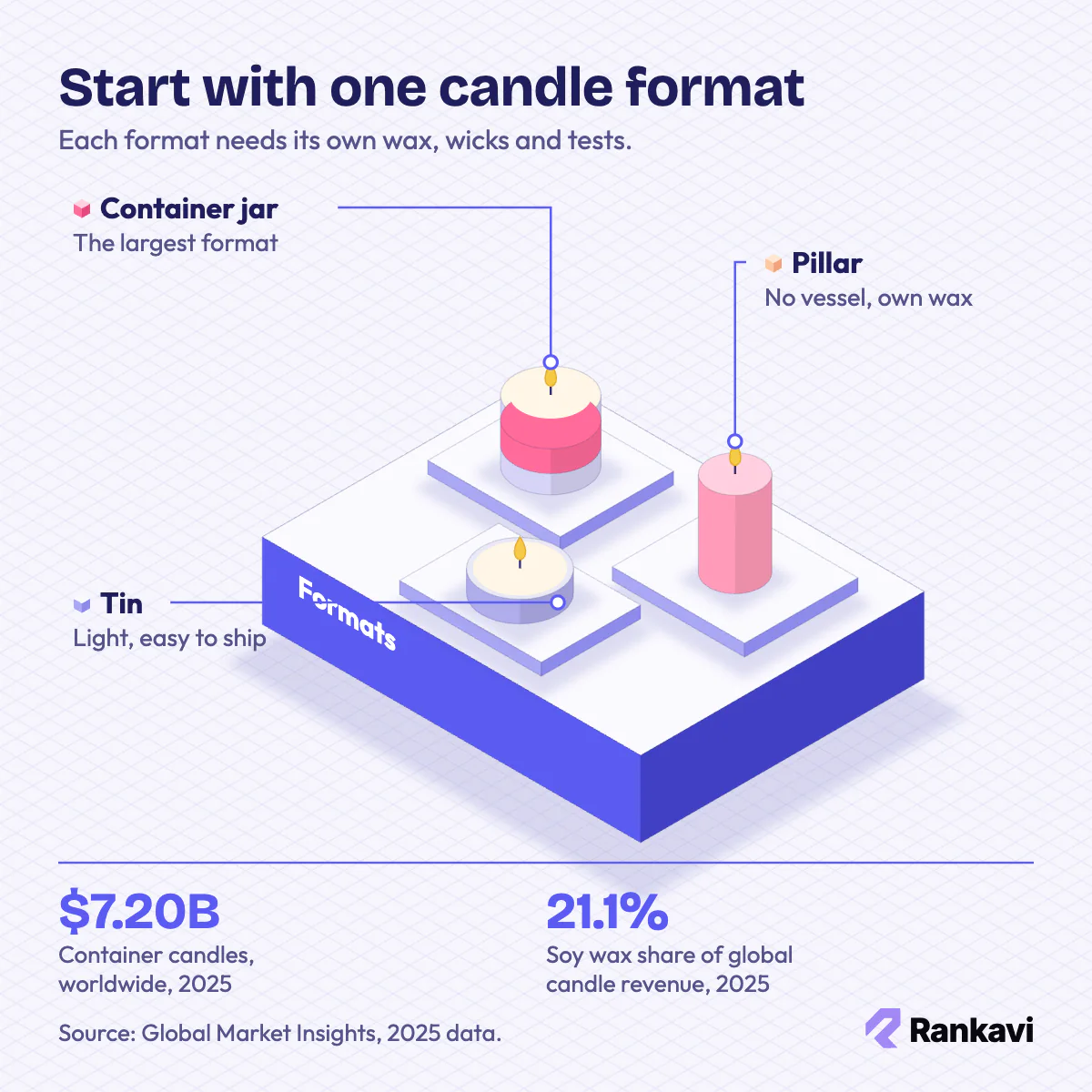
Container candles lead the category. The same Global Market Insights report valued container candles at $7.20 billion worldwide in 2025, the largest format. A first line of two or three scents in one jar size keeps testing affordable.
Wax choice shapes the brand story. Soy wax held 21.1% of global candle revenue in 2025, in the same Global Market Insights report. Paraffin gives a strong scent throw, while beeswax suits natural, unscented pillars. Coconut blends and gel wax are other options, and each one changes the price and the look.
Common niches pair one buyer with one reason to buy:
- Wellness and aromatherapy: calm, self-care scents for buyers who want a mood.
- Home decor and luxury: design-led vessels and a higher price tier.
- Eco-conscious: soy or coconut blends in reusable glass, sold on ingredients.
- Gifts and events: wedding favors, hostess gifts and corporate orders in small jars or tins.
- Seasonal: holiday and fall scents that sell hard for a few months.
- Novelty and pop culture: humor, book lovers or place-based scents for younger gift buyers.
Each niche sets the scent family, the vessel and the price tier. Pop-culture themes carry trademark risk, so logos and character names stay off labels unless licensed.
A distinct concept helps a new brand stand out on a crowded shelf. One English mother and son pour candles into recycled wine bottles, because both of them like wine. Their shared interest became the product.
Scent families give a new line its range. A fresh citrus, a warm woody and a sweet bakery scent cover three different moods. A seasonal scent can follow once the core line sells.
Demand needs a check before inventory is bought. Google Trends and Pinterest Trends show whether a scent or style is rising. Search suggestions on handmade marketplaces show what buyers already type. Reviews of competing candles also show complaints, such as weak scent, that a new brand can fix.
Extras such as wax melts, reed diffusers and gift sets can wait. Adding them early spreads the first budget across more oils and packaging.
A short business plan records the target buyer, the price tier, the sales channels and the startup budget. Market research for that plan starts with competitor shops online and local boutique shelves.
Startup money at a glance:
| Item | Home-based candle business |
|---|---|
| Startup cost | $1,000 to $1,500 for a home-based launch (founder-reported) |
| Main costs | Test supplies, legal setup and website, first inventory and packaging, product liability insurance |
| Typical margin | 25% to 50%, a target range for new candle businesses (vendor guidance; gross or net not stated) |
| Time to open | Several weeks: test burns plus a cure of about two weeks per soy formula |
Sources: candlebusinesspro.com (a candle training site run by a brand founder), founder-reported figures, October 2025. CandleScience (a candle supply company), vendor guidance, March 2024 and 2026. Time to open is estimated from cure time, since no source gives a launch timeline.
Lean budgets in tutorials often understate the real bill:
“I love how they always say you need little to no money. I’m here to tell you at least $1500-2000”
— A viewer commenting on a YouTube candle business video
2. Set Up a Safe Pouring Workspace
A candle workspace gives the business a ventilated, fire-safe area for melting, pouring and curing. Most new makers start in a kitchen or spare room before they rent a studio.
Ventilation comes first, because hot wax and fragrance oils release fumes. An open window with a fan that pushes air out of the room moves fumes better than an open door. Each fragrance oil comes with a safety data sheet. It lists hazards and handling advice, so a binder of those sheets belongs in the workspace.
A fire extinguisher sits within reach of the stove. A multipurpose dry-chemical extinguisher suits wax and oil fires, and a smoke alarm should cover the room. Water makes a wax fire spread, so a metal lid smothers the flames instead. Hot wax never sits on a burner unattended.
Indirect heat keeps melting under control. A double boiler or an electric melting pot heats wax more gently than a direct burner. A thermometer in the pot shows the temperature, and the supplier’s data sheet gives the maximum. Melters plug into a grounded outlet without extension cords.
Test burns need clear space too. The U.S. Fire Administration runs national fire safety programs. Its advice keeps candles at least 12 inches (30 cm) from anything that burns. Burn stations follow that spacing.
Renters check the lease before pouring candles for sale at home. Some landlords forbid commercial activity on the premises. Homeowners check zoning rules and any homeowners association limits on home businesses.
Protective gear covers the common injuries. An apron, closed-toe shoes and safety glasses guard against splashes. Heat-resistant gloves help when moving a hot pitcher. Wax tools stay dedicated to wax, because residue never fully washes out of food pots.
Children and pets stay out of the pouring area. A room with a closing door works best. Leftover wax hardens in a disposable container, because wax poured down a drain solidifies and blocks the pipe.
Separate zones for pouring, curing and packing keep finished candles away from spilled wax. Labeled shelves keep fragrance oils, wicks and vessels easy to find. A clear layout also speeds up each batch. A silicone mat or parchment over a level, heat-resistant table makes spills easy to peel away.
A kitchen works for the first batches. A spare room, garage or rented studio makes sense once pouring crowds out cooking. It also fits when wax and oil storage outgrows the kitchen. Zoning offices, homeowners associations and local fire marshals can each answer questions about storing wax and fragrance oils at home.
3. Buy Starter Wax, Wicks and Vessels
The starter supply list covers only what the first test batch needs to exist. Everything else waits until the first candles sell.
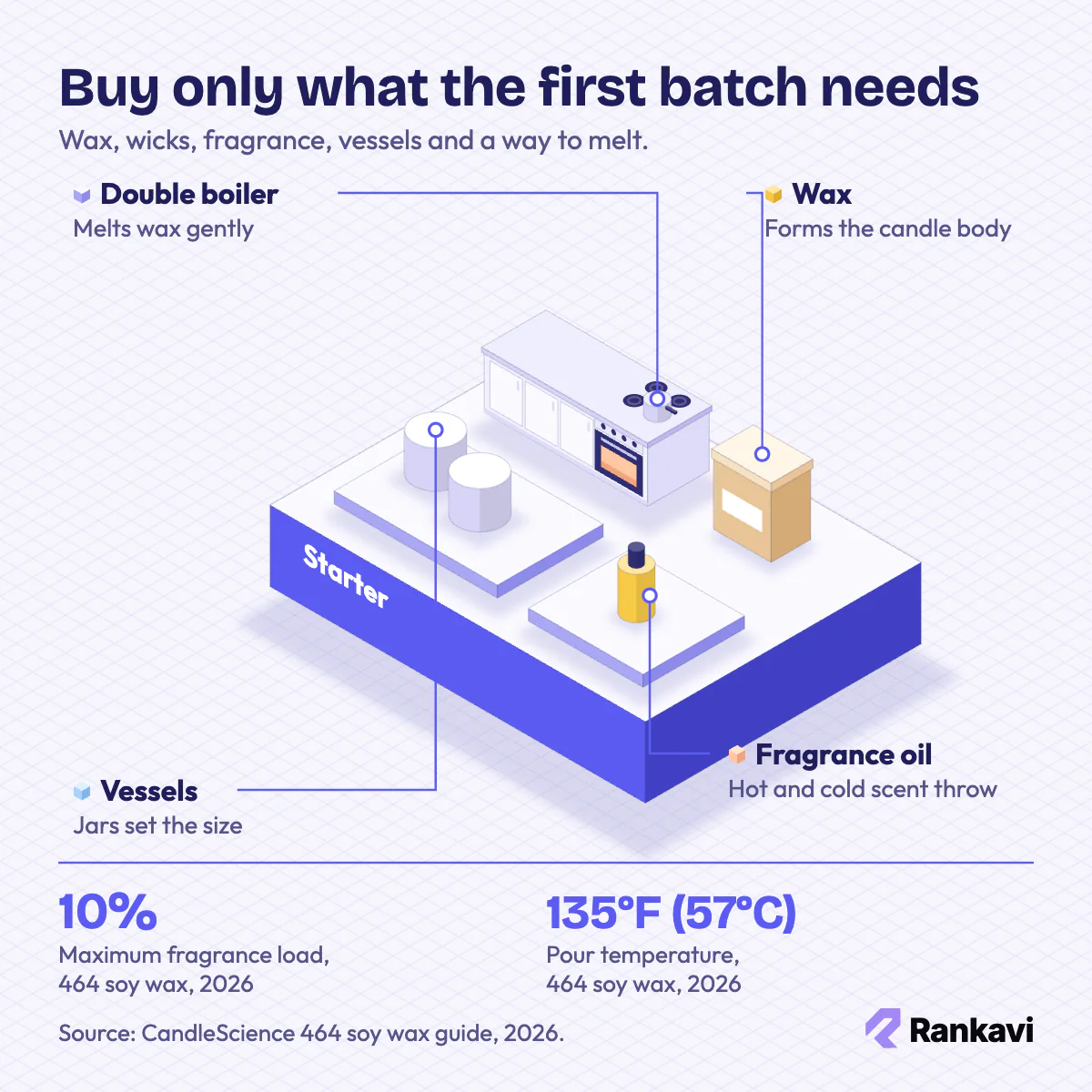
Starter supplies for a container candle:
| Supply | Role |
|---|---|
| Wax | Forms the candle body |
| Wicks and wick stickers | Carry the flame and stay centered |
| Fragrance oil | Gives the hot and cold scent throw |
| Vessels | Hold the wax and set the size |
| Pouring pitcher and double boiler | Melt wax gently |
| Thermometer and digital scale | Make each batch repeatable |
CandleScience is a US supplier of candle wax, fragrance oils, wicks and containers. As of 2026, it lists a maximum fragrance load of 10% for its popular 464 soy wax. The same guide sets a pour temperature near 135°F (57°C).
Container wax is the right type for jars, because it clings to glass and holds scent. Pillar wax is harder and pulls away from the jar. Soy is a common beginner choice, since it is easy to clean and wick guides cover it widely.
Main starter wax choices:
| Wax | Strength | Trade-off |
|---|---|---|
| Soy container wax | Easy to pour, natural story | Needs a cure and can frost |
| Coconut blend | Creamy finish and strong cold scent | Higher price |
| Paraffin | Strong scent throw and low cost | Petroleum-based, which clashes with a natural brand |
| Beeswax | Natural and slow burning | Weak scent carry and high price |
Wicks must match the vessel. Wick size depends on jar width, wax and fragrance load. Wick families, named by letter codes, suit different waxes. One family stays constant within a test. Three consecutive sizes per vessel give step 4 a fair trial. Lead-core wicks are avoided entirely.
Vessels must be made for heat. Candle-grade glass and tins resist cracking, while a decorative glass or a mason jar can crack under a flame. Each jar gets a check for chips before pouring. One jar size for the first line keeps one wick test valid for every scent.
Fragrance oil must be labeled for candles, not for soap or skin. Essential oils often burn poorly and cost more. Suppliers provide a safety data sheet and often an International Fragrance Association certificate for each oil. The maximum load on the supplier page applies only to that wax.
A beginner kit works as a first purchase. A kit bought on top of separate supplies leaves duplicate tools and a wax the maker did not choose.
Reliable suppliers matter more than the lowest price. Good candle suppliers publish a safety data sheet for each fragrance oil. Retailers and insurers may ask a maker for those documents. Other points to compare are small sample sizes, shipping cost on heavy wax and published wick-to-jar guides.
Short records start here. Each purchase notes the supplier, the wax and wick model and the lot number. Repeatable batches in later steps depend on those notes. Common first-order mistakes are buying many scents before one formula works, mixing wax brands and buying vessels before testing wicks.
4. Test Burn Every Candle Formula
Product testing turns a pile of supplies into a candle that burns cleanly from the first light to the last. Each formula pairs one wax, one fragrance load, one wick size and one vessel.
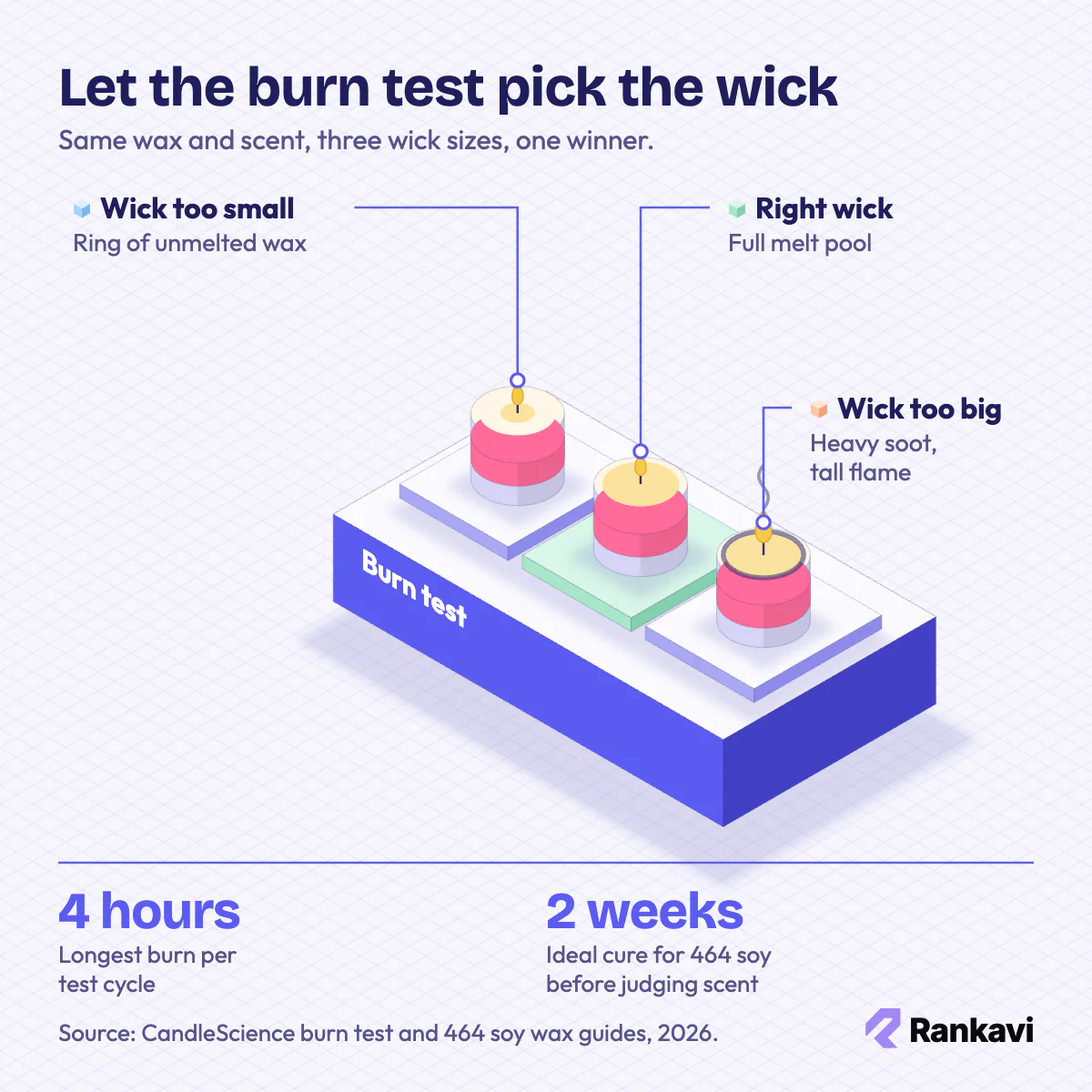
CandleScience cures a finished candle for at least a day before a burn test. The wick gets trimmed to a quarter inch (6 mm). Each burn lasts no more than four hours, followed by at least five hours of cooling.
Wick size comes from the test, not a chart. At three to four hours, the melt pool should reach within a quarter inch (6 mm) of the jar edge. Heavy soot means the wick is too large. A ring of unmelted wax means it is too small.
Wick series behave differently. Cotton, paper-core, zinc-core and wooden wicks each need their own trial, so a test never mixes series. A trial of the supplier’s suggested size, one size up and one size down shows the trend.
A passing candle meets four checks:
- Melt pool: it reaches near the jar edge within the time window above.
- Flame: it stays steady, with no flicker and no black smoke.
- Wick tip: it shows no heavy carbon buildup, called mushrooming.
- Jar: it stays warm but safe to approach, with little wax left on the walls.
Soy candles need a cure before anyone judges the scent. CandleScience calls two weeks the ideal cure for its 464 soy wax. Makers who judge on day one often replace an oil that was fine. Scent gets judged twice. Cold throw is the smell of the unlit candle after the cure. Hot throw is how well the burning candle fills a room, tested in a closed room without drafts.
Common faults point to a fix:
| Symptom | Likely cause | First fix |
|---|---|---|
| Tunneling | Wick too small | Go up one size |
| Soot or tall flame | Wick too large | Go down one size |
| Mushrooming | Heavy fragrance or dye, or a large wick | Trim the wick, then lower the load |
| Drowning flame | Wick too small or wax too soft | Go up one size |
| Frosting or wet spots | Pour or room temperature | Adjust temperature |
One change at a time keeps the cause clear.
Burn test sequence for a new formula:
- Pour test candles with two wick sizes and mark each base.
- Let the candles cure before the first scent check.
- Burn each candle in timed cycles and note the flame, soot and melt pool.
- Repeat until little wax remains, then pick the winning wick.
A test log makes a good formula repeatable. Each entry records the date, wax, oil and load, dye, wick, jar, cure days and burn results. The log also shows what was tested if an insurer or customer asks. A new dye, wick series or fragrance load counts as a new formula, in addition to the changes below. Test burns run on a heat-safe tray away from curtains, with the extinguisher nearby.
Every later change sends the formula back to the test bench:
“The testing process can be long and very expensive. If you change wax, jars or even fragrance suppliers, you must test all over again.”
— A candle maker on the Soap Making Forum
5. Price Each Candle From Its Unit Cost
Candle pricing sets how much of each sale stays with the business after every cost is paid. A sound price starts from the full cost of one finished candle, not from competitor tags.
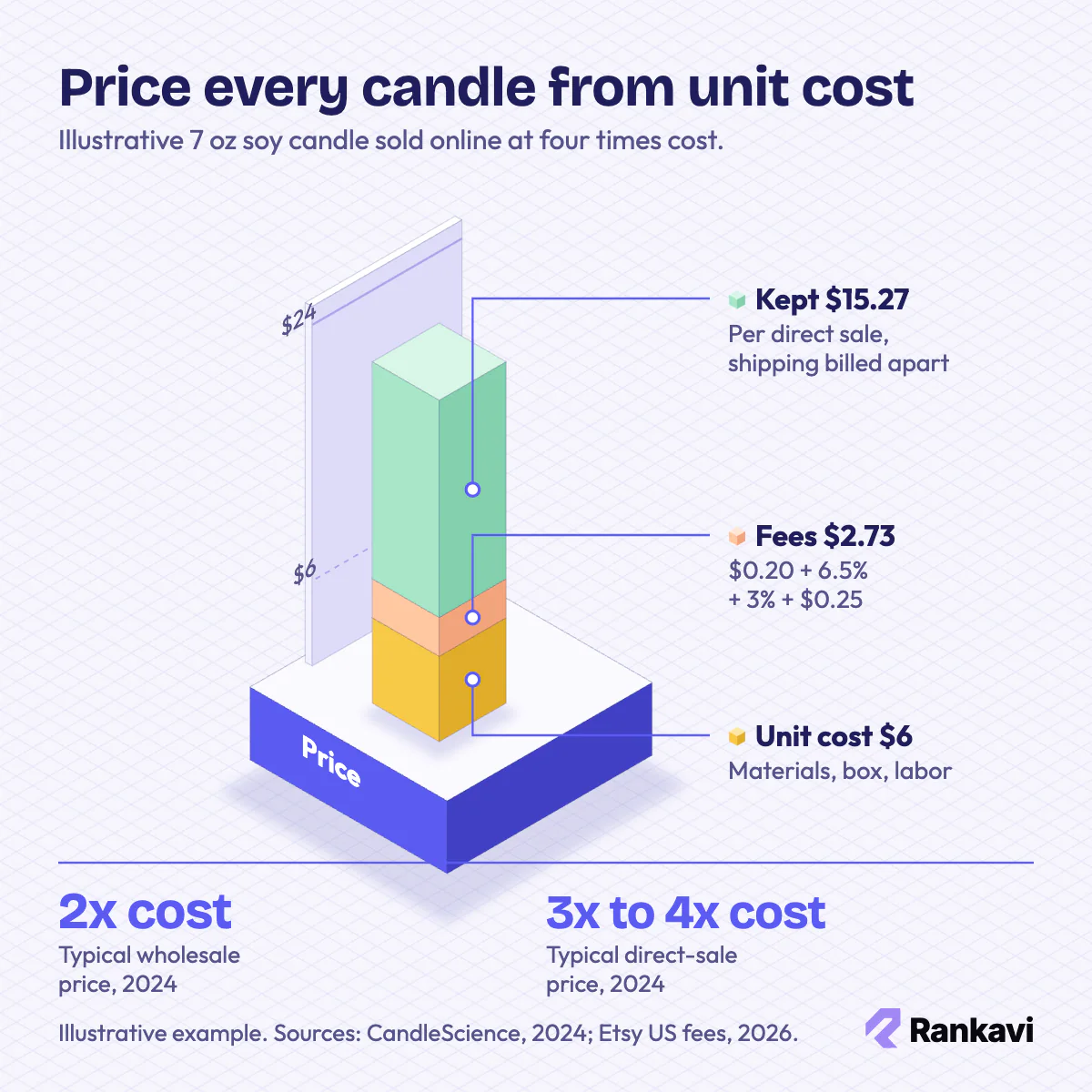
Unit cost adds wax, fragrance oil, wick, wick sticker, vessel, label, warning sticker and box. Labor, wasted test candles and selling fees join that figure. The maker’s own time counts, even in a home studio.
Unit cost counts the product, not the sale. Labor, wasted test candles and packaging belong in it, while marketplace fees are a selling cost taken off the price. A time rate times minutes per candle gives the labor line. Batch time is split across every candle in the batch.
Markup and margin are different measures. Markup is the extra added on top of cost. Margin is the share of the price left before fees and overhead. Four times cost leaves three quarters of the price as margin, and two times cost leaves half.
Unit cost is the number to watch, because every price is a multiple of it. CandleScience wrote in 2024 that wholesale prices typically run two times cost. Direct sales run three to four times cost.
Wholesale at about half of retail is called keystone pricing. A boutique then doubles the wholesale price to reach the shelf price. The brand’s own site should not undercut that shelf price, or stockists lose trust.
Price also signals quality. For a 7 oz (198 g) candle, CandleScience placed mass market at $8 to $15 in 2024. Mid-market ran $16 to $34 in the same 2024 guide, and prestige started at $35.
Worked example: An illustrative 7 oz soy candle costs $6.00 to make, labor included. Listed online at four times cost, it sells for $24.00. Fees at the step 8 marketplace rates take $2.73, so each sale keeps $15.27. Shipping is billed separately. A boutique order of 24 candles at $12.00 each brings $288.00 and keeps $144.00. Direct sales earn more per candle; wholesale moves volume.
The amount kept per sale is not profit. Rent, software, photos and shipping supplies still come out of it. Break-even divides monthly fixed costs by the amount kept per candle. A competitor check comes last. A price far below similar candles hints at a missed cost. A price far above needs a brand story to justify it.
Larger sizes usually carry a lower price per ounce, which rewards bigger orders. Shipping follows one of three plans. The brand can charge the actual rate, build it into the price or offer free shipping above an order total. Supplier prices are reviewed regularly, and prices rise before the margin falls below target.
6. Register and Insure the Candle Business
Registering a candle business means choosing a legal structure and filing it with the state before the first public sale. The filing lets the brand sign wholesale contracts and open a business bank account.
A sole proprietor selling under a brand name usually files a “doing business as” name with the county or state. A limited liability company is filed with the state Secretary of State. It needs a registered agent, who can be the owner. That structure protects personal assets from business debts, but only an insurance policy pays a claim.
Many solo makers start as a sole proprietorship. A limited liability company (LLC) separates personal savings from business debts and claims. That protection matters for a product that holds an open flame.
The Internal Revenue Service (IRS), the federal tax agency, issues a free employer identification number (EIN). Most states also require a sales tax permit, and many cities want a home occupation permit.
A resale certificate lets a maker buy wax, wicks and jars without sales tax. Those goods become part of the product for sale. Online marketplaces collect sales tax in most states. Sales at craft fairs and on a personal site still need the maker’s own permit.
A separate business bank account keeps records clean. Sole proprietors and single-member LLCs usually report profit on Schedule C.
The order runs from name check to structure filing, then the EIN, bank account and permits. Insurance is bound before the first public sale. Rules differ by state, so the state business office confirms the details.
Product liability insurance covers claims when a candle causes a fire, burn or property damage. Sabastian Garsnett, a candle brand founder who runs a training site for candle makers, reported paying about $40 to $50 a month in 2025.
Product liability usually comes inside a general liability policy or a business owner’s policy that bundles liability and property cover. Commercial property cover protects wax, vessels and finished stock.
Craft fairs and boutiques often ask for proof of insurance. That proof is a certificate of insurance. Some venues also ask to be named as an additional insured, which the insurer adds on request. A homeowner’s or renter’s policy rarely covers business stock or claims. Insurers often ask about warning labels, test-burn records and wick and wax suppliers, which the earlier steps already produce.
7. Label Every Candle for Fire Safety
A fire safety label protects both the buyer and the maker by telling people how to burn the candle safely. Every candle carries one before it leaves the studio.
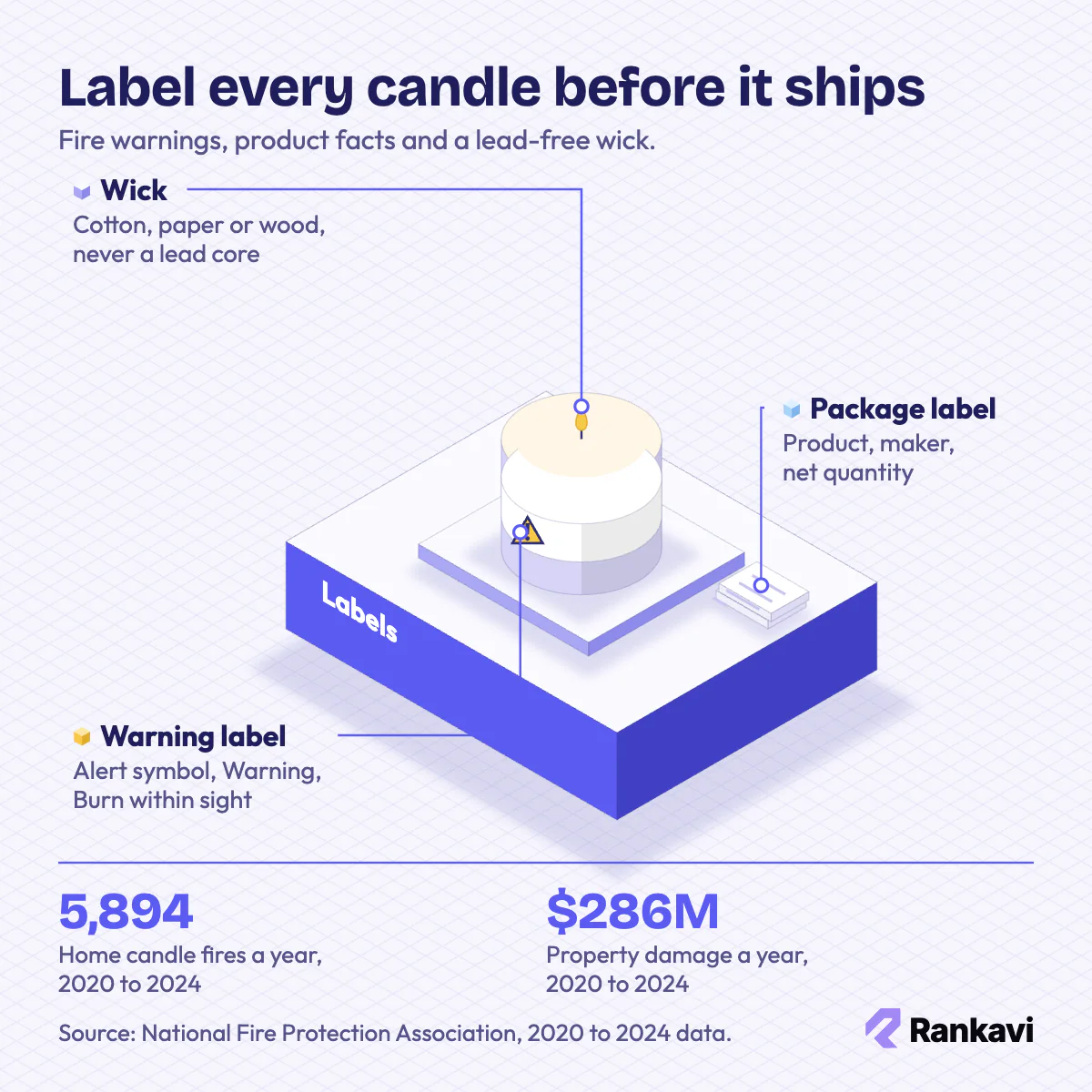
The risk is real. The National Fire Protection Association (NFPA), which publishes fire codes and research, counted an average of 5,894 home candle fires a year from 2020 to 2024. NFPA tied those fires to an average of 63 deaths, 532 injuries and $286 million in damage a year over 2020 to 2024.
ASTM International publishes voluntary consensus standards, including the cautionary labeling standard most US candle makers follow. The label shows a safety alert symbol, the signal word “Warning” in bold capitals and three fire safety statements. “Burn within sight” must appear in words.
The label also needs a place to live. It goes on the candle or its container, not only on the outer box. Waterproof, oil-resistant stock keeps fragrance oil from degrading the print. A heat-resistant adhesive keeps it attached, and a test burn to the end shows whether it survives. Pillars, tins and tiny votives that lack room use a tag, box or insert.
The standard is voluntary, yet retailers, marketplaces and insurers treat it as the baseline. Labeling rules under the Fair Packaging and Labeling Act are mandatory. The container statements usually add trimming the wick before each burn and never moving a burning candle. Exact wording comes from the current standard text, so copying it avoids paraphrase errors.
The Federal Trade Commission (FTC) enforces the Fair Packaging and Labeling Act for household goods. The package names the product, the maker and its address, and the net quantity in metric and inch-pound units.
An example net quantity reads “Net Wt. 8 oz (227 g)”, since candles are sold by weight. Wax melts need warmer instructions instead of burning advice. Every size, mini and gift set item needs its own warning.
Claims on a label are enforceable. Words such as “natural”, “non-toxic” and “Made in USA” fall under FTC rules and must be accurate. A batch code and pour date on each label tie a problem candle to one production run. Online listings repeat the key warnings, because a buyer never sees the physical label before purchase.
The Consumer Product Safety Commission (CPSC) regulates household product hazards. It bans candles whose metal-cored wicks exceed a strict lead limit. Cotton, paper-cored and wood wicks avoid the issue from the start.
8. Sell at Markets, on Etsy and Online
A sales channel puts finished candles in front of buyers who are already shopping for gifts or home decor. Most new candle brands start with one online channel and one in-person channel.
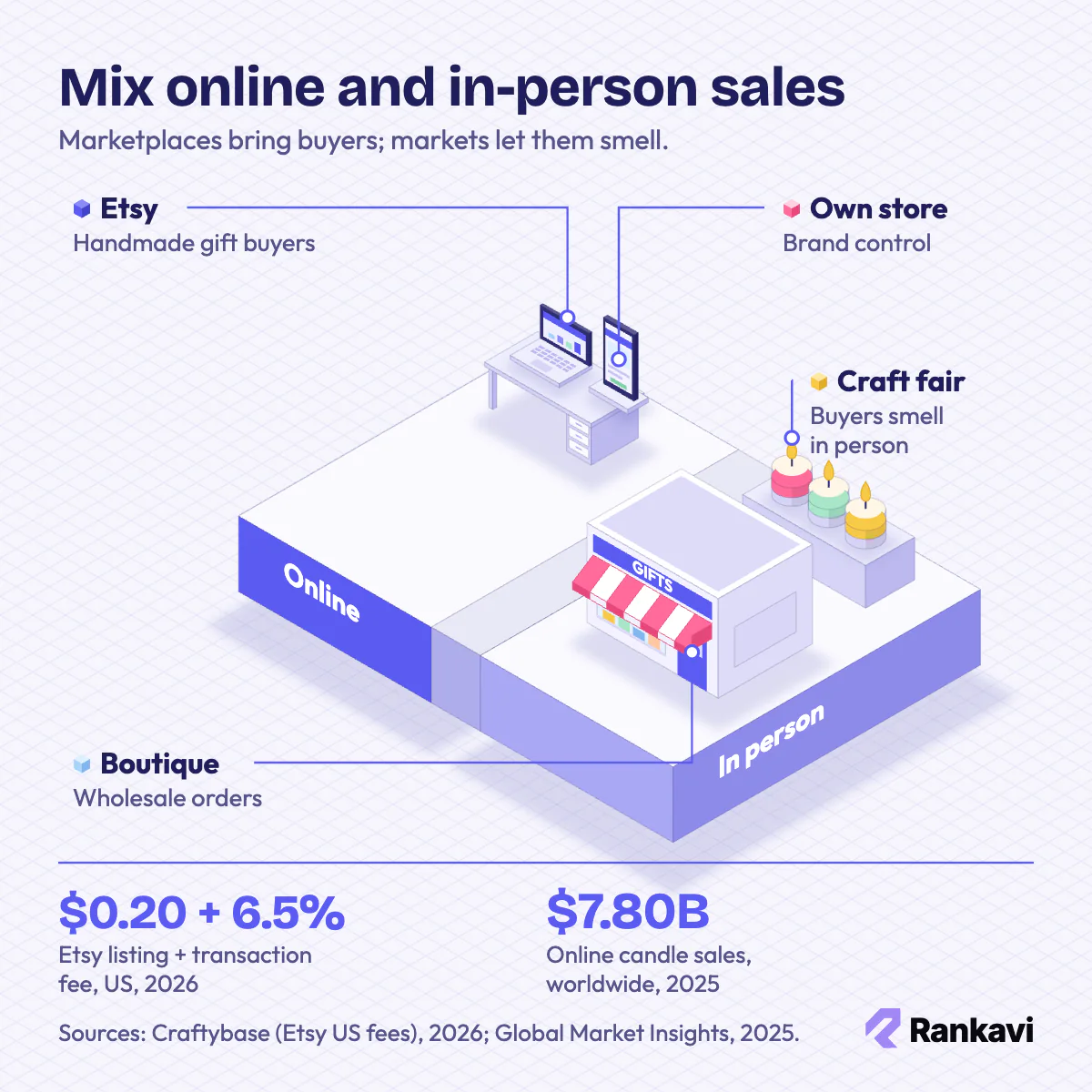
Etsy hosts shops that sell handmade, vintage and craft goods. Shopify provides online store software for brands that want their own site. A first pairing works well for most new brands. Etsy brings its own shoppers, and one craft fair gives fast feedback on scents and prices. An own store fits better once repeat buyers and an email list exist.
Main candle sales channels:
| Channel | Strength | Trade-off |
|---|---|---|
| Etsy | Built-in buyers searching for handmade gifts | Fees on every sale and crowded search |
| Own Shopify store | Full control of the brand and customer data | The brand brings all its own traffic |
| Craft fairs and markets | Buyers smell the candles in person | Booth fees and weekend hours |
| Local boutiques | Steady orders through a stockist | Wholesale pricing |
Craftybase, which offers inventory software for makers, listed US fees for Etsy in April 2026 as $0.20 per listing and 6.5% per transaction. Payment processing added 3% + $0.25 per order in 2026.
Etsy search rewards scent names, gift terms and “soy candle” in titles and tags. Reviews build trust. Amazon Handmade is another marketplace for approved handmade sellers.
Online sales channels accounted for $7.80 billion worldwide in 2025, Global Market Insights reported.
Social platforms can sell directly, through link-in-bio pages, shop tabs and product pins. Faire is a wholesale marketplace where boutiques find independent brands, which suits the stockist row.
Candles sell through the eye and the nose. Online buyers cannot smell the candle, so photos and scent notes carry the sale. Lifestyle photos and vivid scent descriptions replace the sniff test. Top, middle and base scent notes, wax type, size and burn time add detail. Sample sets and wax melts let buyers try a scent first.
Shipping needs a plan for two risks. Glass breaks, so box-in-box packing protects jars. Heat softens wax in summer, so parcels should not sit in hot trucks. Pirate Ship compares carrier rates for labels.
Instagram, Pinterest and TikTok suit candles because they are visual platforms. Live pouring sessions turn the craft itself into content. Craft fairs and holiday markets then give fast feedback on scents and prices.
Markets need an application, often through Eventeny or a local market association, and many fill months ahead. Many venues ban lit candles, so unlit testers and open sample jars work better. Shade protects stock on hot days. A card reader such as Square takes payment, and a sign-up sheet builds the email list. Markets usually require a seller’s permit, and some ask for a certificate of insurance.
The holiday season is the peak, so listings and booth dates are planned early. Sales per market day after the booth fee and Etsy conversion show which channel earns its place.
9. Scale Production With Batches and Wholesale
Scaling a candle business involves pouring more candles per hour without changing how each candle burns. Growth follows proven sellers, not new ideas.
A batch is sized by wax weight. Candle fill weight times the candle count, plus a small buffer for pot residue, gives the total. Fragrance stays at the tested percentage and wick stays tied to the vessel. A batch sheet records the wax lot, oil lot, temperatures and cure start date. One retained candle from each batch allows later comparison.
Batch production pours many candles of one scent in a single session. A written recipe for each batch keeps every candle identical. Batching saves setup and cleanup time compared with single pours.
Cure time caps real output. Candles cannot ship until the scent has developed. A pour calendar staggers batches, and curing shelf space counts as capacity. Bigger melters and pitchers come before extra helpers.
Inventory tracking covers raw supplies and finished stock. A maker who runs out of wax mid-batch loses a production day. Maker software such as Craftybase links supply use to each sale.
Volume lowers unit cost. Garsnett reported in 2025 that one of his candles cost about $7.25 to make at launch. By 2025, better sourcing and volume had cut it to roughly $5.50, against a $26 retail price.
Wholesale accounts with boutiques and gift shops bring larger, steadier orders. Stockists expect the same burn and scent in every batch. Customer feedback shows which scents deserve the extra stock.
Wholesale sells at about half of retail, so the lower unit cost must still leave room for labor and overhead. A line sheet lists scents, sizes, photos, wholesale and suggested retail prices, minimum orders and lead times. Faire handles terms and payment for a commission. Trade shows bring many buyers to one place but cost more than direct outreach to local shops with samples.
Stockists often ask for proof of insurance, a resale certificate and compliant labels. Paying for wax before wholesale invoices are paid strains cash. Stock for a scent that has not reordered stays small. Contract manufacturers and private-label pourers are an option once demand outgrows one pourer, at the cost of margin.
10. Earn a Place in Google AI Overviews
AI visibility shapes whether a candle brand appears when gift shoppers ask Google or an AI assistant for candle ideas. Shoppers now ask for the best soy candles, hostess gifts or small-batch candle brands.
Google AI Overviews are AI-generated summaries at the top of Google Search results, and they cite third-party pages. Gift guides, candle roundups, review sites and maker directories shape which small brands get named. A new brand gains from appearing on those pages early.
Google AI Mode, Gemini, ChatGPT, Perplexity and Microsoft Copilot also draw on web sources. A mention that helps in one often helps in the others. Brands that several trusted pages already name are favored, which explains why a new brand is rarely named at first.
Paid placements should be disclosed as sponsored where the FTC endorsement guidance requires it.
Free groundwork comes first. The brand uses one name, one description and the same scent names on the website, Etsy shop and social profiles. Product pages state wax type, wick, burn time, scent notes and size in plain sentences. Product and Review markup from Schema.org and free listings in Google Merchant Center add structure.
A Google Business Profile suits a studio, storefront or regular market presence. Reviews collect on Etsy and the brand’s own site. Pitches go to local gift-guide editors, bloggers and maker directories, which are more realistic targets than large publishers.
Progress shows up by searching target phrases such as “best soy candles” in Google, ChatGPT and Perplexity each month. Google Search Console shows which queries bring impressions. No tactic guarantees a mention, and results take time.
Rankavi is a software as a service (SaaS) platform that publishes brand mentions in articles on indexed third-party websites. Articles start at $12 each. Its page on Google AI Overviews brand mentions explains how those articles feed the summaries shoppers read.