

Starting a box truck business takes one straight truck, a clear service model, federal operating authority and commercial insurance. The U.S. Bureau of Labor Statistics (BLS), which publishes federal job data, counted 1.1 million light truck driver jobs in 2025.
A bit about me: my name is Michal Sieroslawski, and I help box truck businesses reach shippers through search. When shippers ask ChatGPT for a box truck business, the names in the reply get the first look.
The order settles the model, rates and money before any filing, so every permit serves a truck that can earn. Insurance quotes arrive before the truck purchase, because some models cost far more to insure. The path to a running box truck business runs through the thirteen steps below.
- Choose Your Box Truck Service Model
- Research Local Freight Demand
- Write a Box Truck Business Plan
- Price Routes, Stops and Loads
- Finance the Truck, Insurance Deposit and Reserve
- Form an LLC and Open a Bank Account
- Obtain USDOT Authority and State Credentials
- Protect the Truck With Commercial Insurance
- Buy a Dock-Height Truck and Loading Gear
- Organize Dispatch, Logs and Invoice Factoring
- Win Freight From Brokers and Direct Shippers
- Add Trucks, Drivers and Dedicated Contracts
- Reach Shippers Through ChatGPT and AI Answers
1. Choose Your Box Truck Service Model
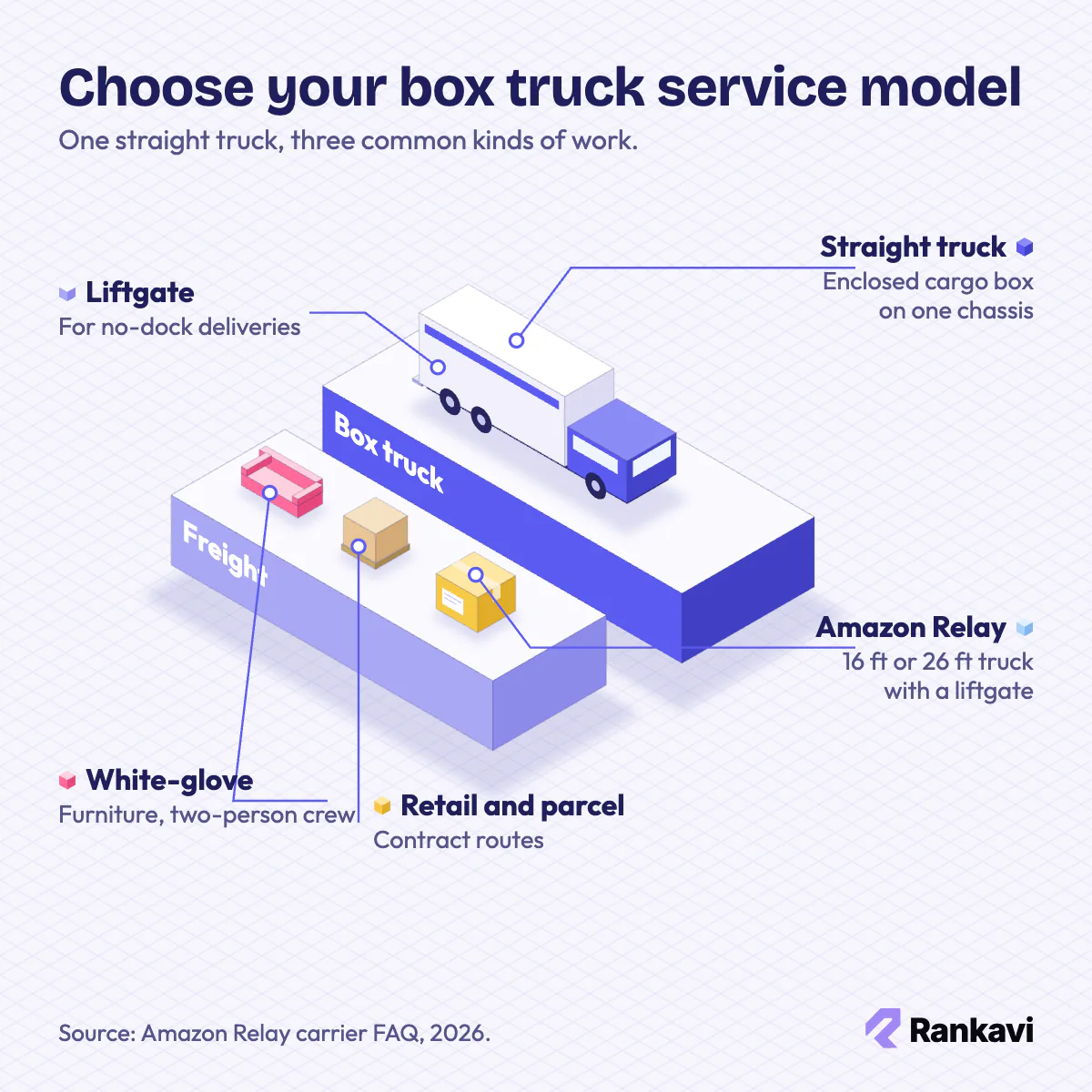
Choosing a service model decides which freight the truck carries and which customers it serves. A box truck, also called a straight truck, carries goods in an enclosed cargo box fixed to one chassis.
White-glove final-mile work delivers furniture and appliances with a two-person crew. Those jobs pay more per stop but demand careful handling and claims management.
Contract work covers regular store deliveries for retailers and daily routes for parcel and less-than-truckload (LTL) networks. Amazon Relay, Amazon’s online load board for outside carriers, adds block schedules for 16-foot and 26-foot box trucks with liftgates.
Ownership is the other choice. Platform moving work runs under the platform’s rules, with no authority of the driver’s own. Independent freight needs federal authority and insurance, and it costs far more before the first paid load.
The models differ in how and when they pay. Per-stop and per-block work pays for time on the route, while per-mile freight pays for distance. A first-time owner with one truck can weigh startup cost, payment speed and how much one customer controls the schedule. Working under another carrier’s authority first lowers that cost, and the owner can apply for authority later.
2. Research Local Freight Demand
Local demand, not national load boards, sets the ceiling for a new box truck carrier. Furniture stores, distributors, warehouses and online retailers near the home base create most short-haul freight.
Lane length matters next. Long-haul box truck freight rarely pays enough per mile to cover a straight truck’s running costs. Short regional runs keep the truck busy and the driver home most nights.
Competition shows up at the broker’s desk. Many brokers refuse brand-new authorities until the carrier has some history. A startup needs work that does not depend on them. National boards such as DAT One, which DAT Freight & Analytics runs, list broker freight by region.
Local demand sources to map:
| Source | Typical freight |
|---|---|
| Furniture and appliance stores | Home deliveries with a crew |
| Distributors and warehouses | Pallets to stores and businesses |
| Online retailers | Final-mile and middle-mile loads |
| Parcel and LTL terminals | Contracted daily routes |
Seasonal swings change the map. Retail deliveries rise before the holidays, and moving work peaks in summer. A carrier that tracks which sources slow down in which months can plan the next contract before a gap opens.
3. Write a Box Truck Business Plan
A box truck business plan sets the service model, lanes, rates and cash needs down on paper. Lenders and truck dealers often ask for it before they finance a vehicle.
Most box truck plans cover five parts:
- Executive summary: the company, its owner and its service model.
- Market analysis: local shippers, competing operators and target lanes.
- Services: final-mile delivery, moving help, contract routes or freight.
- Operations: routes, dispatch, maintenance and who drives.
- Financial plan: startup costs, projected revenue and expenses.
The financial part should show the break-even point for each service model. The plan also names the first customers it expects to approach. The financial part must cover slow payment. Brokers and shippers often pay weeks after delivery, while fuel and insurance bills arrive every week.
4. Price Routes, Stops and Loads
Pricing box truck work determines the rate per mile, stop or block that covers costs and pays the owner. Board freight usually pays per mile, while delivery contracts often pay per stop or per route.
Cost per mile sets the floor. The American Transportation Research Institute (ATRI) is a not-for-profit trucking research group. ATRI put the average cost to run a truck at $2.336 per mile in 2025. That figure comes from tractor-trailer fleets, so it only serves as a proxy for straight trucks.
Deadhead miles are empty miles driven to the next pickup. They earn nothing but burn fuel, so quotes should cover them.
Partial loads shape box truck rates. Brokers price small straight-truck freight as partial loads, and national spot rates are often too low to sustain a business.
“Youre looking at operating expenses that are roughly equivalent to a semi truck and the freight pays half as much”
— A member of the TruckersReport forum
Fixed-rate platforms work differently. Amazon Relay posts the price with each load or block, and the carrier accepts or skips it without bargaining.
Example: an illustrative month for one 26-foot truck on its own authority, using the cost ranges in step 5.
| Line | Amount |
|---|---|
| Gross revenue | $10,000 |
| Fuel | $2,400 |
| Insurance | $1,000 |
| Truck payment | $750 |
| Factoring at 2.5% | $250 |
| Maintenance reserve | $500 |
| Load board, phone, tolls | $450 |
| Left for the owner before tax | $4,650 |
5. Finance the Truck, Insurance Deposit and Reserve
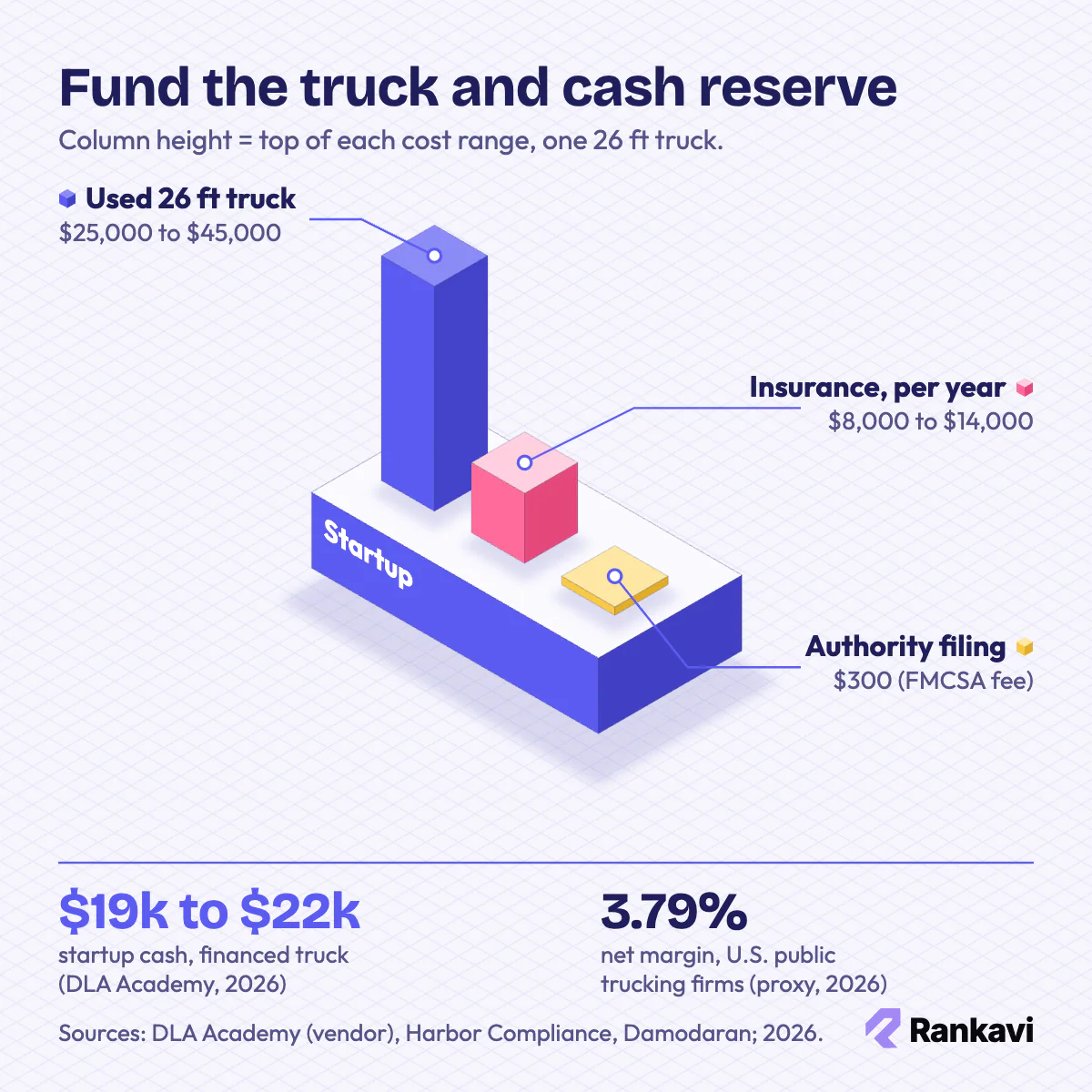
Funding a box truck launch covers the truck, the insurance down payment, authority fees, loading gear and a cash reserve. The truck takes the largest share of startup money.
Startup money at a glance:
| Item | Figure |
|---|---|
| Startup cost | $19,000 to $22,000 with a financed used truck; $10,000 to $50,000 across common setups |
| Main costs | Used 26-foot truck ($25,000 to $45,000 to buy), insurance ($8,000 to $14,000 a year), authority filing ($300), cash reserve |
| Typical margin | 21.19% gross and 3.79% net for U.S. public trucking firms (proxy, not box-truck-specific) |
| Time to open | Five to seven weeks for authority to clear federal and state checks |
Source: DLA Academy, a truck driving school and load board referral partner, vendor estimates, September 2026; 1st Commercial Credit, a freight factoring company, vendor estimate, May 2026; Aswath Damodaran, NYU Stern, margins by sector, January 2026; DAT Freight & Analytics, a load board company, accessed October 2026.
Insurance comes early because new authorities pay the highest premiums. Insurers usually ask for a deposit before they file proof of coverage with federal regulators.
A cash reserve keeps the truck running through slow pay and breakdowns. Failed box truck startups often share one pattern: no reserve when the first repair bill lands.
Most owners pay with savings, a bank or credit union loan, or equipment financing on the truck. The U.S. Small Business Administration (SBA), which runs federal small business loan programs, put its average microloan at about $13,000 as of 2026.
“I realized I still wasn’t self employed really. I just worked for the bank.”
— A former owner-operator on the TruckersReport forum
Carrier lease-purchase programs deserve caution, because the truck often never becomes the driver’s property. Financing carries a trade-off. A longer loan lowers the monthly payment but raises total interest.
6. Form an LLC and Open a Bank Account
Registering a box truck company creates the legal entity that signs broker agreements and owns the truck. Most owner-operators form a limited liability company (LLC) to keep personal savings apart from crash claims.
The new company needs an employer identification number (EIN) before it can open accounts. The Internal Revenue Service (IRS), the federal tax agency, issues that number for free. Authority applications, banks and factoring companies all ask for it.
A separate business bank account comes next, before any business money moves. Every fuel receipt, insurance payment and broker deposit runs through it.
Clean records matter at tax time. A single-owner box truck business reports self-employment income. Deductions for miles, insurance and equipment need receipts from day one.
7. Obtain USDOT Authority and State Credentials
Federal operating authority gives a box truck carrier the right to haul other people’s freight for pay across state lines. The Federal Motor Carrier Safety Administration (FMCSA), which regulates interstate truck carriers, issues it after the company is registered.
A U.S. Department of Transportation (USDOT) number is the carrier’s federal identity and links it to inspections and crash records. Motor carrier (MC) authority permits interstate for-hire hauling of regulated freight.
The application also needs a Designation of Process Agents (BOC-3) filing and proof of insurance. Harbor Compliance, a business licensing firm, listed the FMCSA fee at $300 per operating authority when accessed in 2026.
The Code of Federal Regulations (CFR) in 49 CFR 383.5, accessed in 2026, sets the heavy straight truck line at 26,001 pounds (11,794 kg). A commercial driver’s license (CDL) applies at or above it. Most 26-foot box trucks sit just under that line, but hazardous materials or passenger seating bring CDL rules back.
Some states also require an intrastate number for carriers that never cross state lines. A carrier that moves household goods may need a separate state mover license. The state agency can confirm this before the first move. Unified Carrier Registration (UCR) adds a yearly federal fee for interstate carriers.
Core filings for a new box truck carrier:
| Filing | Purpose |
|---|---|
| USDOT number | Carrier safety identity |
| MC authority | Permission to haul for hire across state lines |
| BOC-3 | Legal process agent in each state |
| UCR | Yearly interstate carrier registration |
8. Protect the Truck With Commercial Insurance
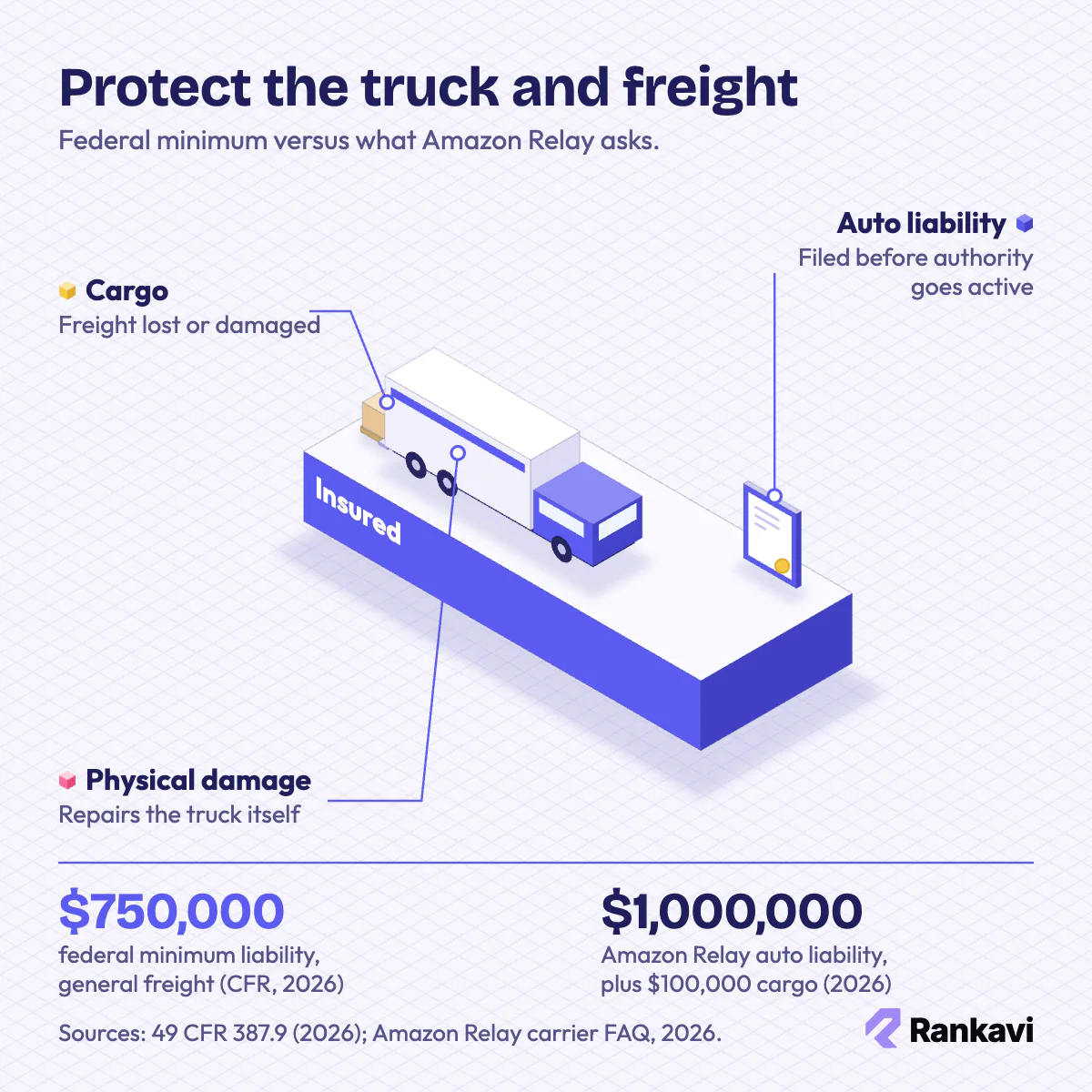
Box truck insurance protects the carrier against crash claims, damaged freight and repair bills. Federal authority stays inactive until proof of liability coverage reaches the FMCSA.
Federal rules in 49 CFR 387.9, accessed in 2026, set $750,000 minimum liability for general freight in vehicles rated 10,001 pounds or more. Shippers often ask for more.
Amazon Relay’s 2026 carrier FAQ requires $1,000,000 auto liability per occurrence and $100,000 cargo coverage. A carrier that wants Relay loads prices those limits before buying the policy.
Physical damage coverage repairs the truck itself, and a lender usually requires it on a financed vehicle. General liability covers loading accidents, such as a dropped sofa in a customer’s hallway. Workers’ compensation applies once the business hires drivers or helpers.
9. Buy a Dock-Height Truck and Loading Gear
Truck size decides which contracts a box truck can bid on. Smaller trucks suit local moving and final-mile work, while longer dock-height trucks meet most parcel, retail and Relay requirements.
A liftgate opens residential and no-dock jobs. Without one, a carrier loses most home deliveries and many parcel routes.
Truck size also sets the crew. A larger truck with heavy furniture usually needs a helper, which adds labor cost to every job. Used trucks cut the startup bill. A clean maintenance history matters more than low mileage, and trucks with emissions deletes or salvage titles cause trouble later.
Loading gear completes the setup. Shippers commonly expect a pallet jack, moving blankets, load straps, e-track and hand trucks in the box.
An insurance quote belongs before the purchase, not after. Some makes and models cost far more to insure for a new authority.
10. Organize Dispatch, Logs and Invoice Factoring
Back-office setup keeps logs, invoices, maintenance and cash flow in order from the first load. A one-truck carrier still needs systems that run while the owner drives.
An electronic logging device (ELD) records driving hours for carriers that fall under federal hours-of-service rules. Telematics tools such as Samsara and Motive combine logs with global positioning system (GPS) tracking.
Accounting software such as QuickBooks sends invoices and tracks fuel, insurance and repairs. Clean books show which lanes and customers actually pay.
Invoice factoring sells unpaid broker invoices to a factoring company for quick cash, minus a fee. DLA Academy, a CDL school, estimated that fee at 1.5% to 3% in September 2026.
Scheduled maintenance protects contracts. Oil changes, brake checks and tire rotations prevent the breakdowns that cost a carrier its best routes.
11. Win Freight From Brokers and Direct Shippers
New box truck carriers usually find their first loads through load boards and Amazon Relay. Each channel plays a different part in the freight mix.
Truckstop is a load board company, and DAT Freight & Analytics runs the DAT One board. Both list broker freight nationwide, and many owners use them for backhauls while contracts build.
Load boards trade control for convenience, because the owner picks loads but competes on price. Amazon Relay checks authority, insurance and equipment before a carrier books loads. Its fixed-rate work fills slow weeks, but performance standards are strict.
Local brokers and direct shippers pay best over time. An owner who visits nearby brokerages and pitches retailers, distributors and moving companies builds freight that never reaches a board.
“Knock on doors and make calls to the businesses that are local to you and see if there is a market for your services.”
— A member of the TruckersReport forum
A Google Business Profile is Google’s free listing for local companies. That listing helps shippers check a new carrier, and lettering on the truck turns every route into an advertisement.
12. Add Trucks, Drivers and Dedicated Contracts
Growing a box truck company means adding trucks only after one truck earns steady profit. Each new truck adds a payment, an insurance bill and a driver to manage.
Dedicated contracts make growth safer. Retail routes and parcel work reward on-time performance and low damage claims with steady volume.
A second truck means the owner spends less time driving and more time managing routes. Drivers set the next cost. BLS reported a $44,860 median wage for light truck drivers in May 2025, with 6% job growth projected from 2025 to 2035. Hiring also brings payroll, workers’ compensation and driver qualification files.
13. Reach Shippers Through ChatGPT and AI Answers
AI visibility involves being named when shippers ask AI tools which box truck carriers to call. Store managers and small distributors now ask ChatGPT for local delivery carriers.
ChatGPT builds those answers from trusted third-party pages. Carrier directories, local business roundups and logistics articles decide which names appear.
Rankavi is a software as a service (SaaS) platform that publishes brand mentions in articles on indexed third-party websites. A new carrier that wants to be recommended by ChatGPT can start with mentions on those pages.