

Starting a bookkeeping business means selling recurring record-keeping to small companies from a home office. The U.S. Bureau of Labor Statistics (BLS), which publishes federal job data, projects about 144,100 bookkeeping clerk openings a year through 2035.
My name is Michal Sieroslawski. I help bookkeeping businesses get recommended in AI search. Tools like ChatGPT and Google’s AI Overviews now suggest bookkeeping businesses by name. Being one of the names those tools mention is becoming important.
The order puts decisions before spending, so money, paperwork and software all follow the niche the practice chose first. The path to a running bookkeeping business runs through the nine steps below.
- Choose Your Bookkeeping Niche
- Write a Lean Business Plan
- Fund Startup Costs and Set Rates
- Register and Insure the Practice
- Earn a Bookkeeping Certification
- Build a Secure Software Stack
- Market the Practice to First Clients
- Grow Through Referrals and Hiring
- Win Bookkeeping Mentions in AI Overviews
1. Choose Your Bookkeeping Niche
Choosing a bookkeeping niche decides which industry the practice serves and which problems it solves first. A narrow focus shapes the services, the software and the marketing message.
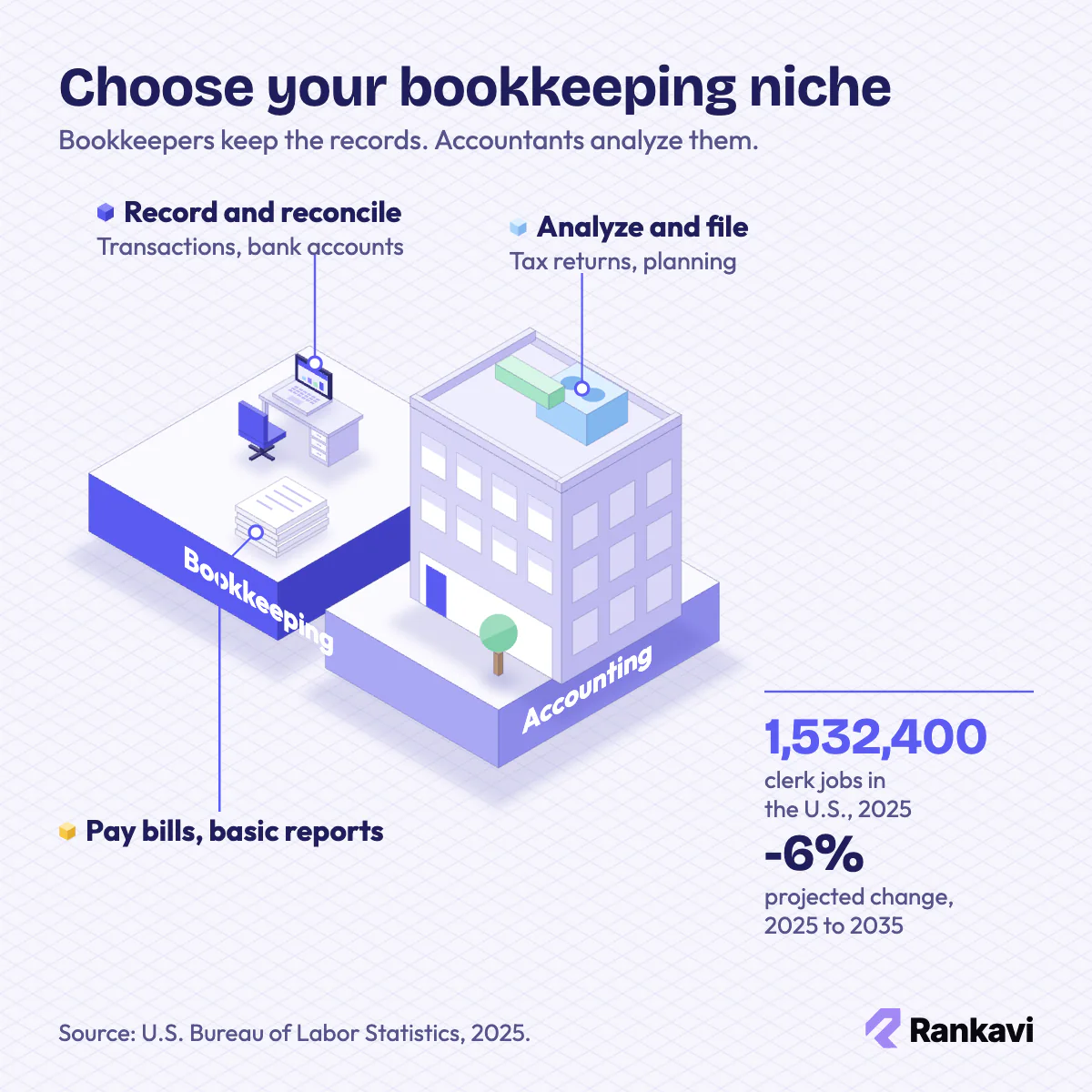
Industry focus gives a new bookkeeper a clear specialty. Healthcare practices, retail shops, contractors and online stores all keep books differently. A bookkeeper with past work in one field usually starts there, because the client language already feels familiar.
Common niches fall into six groups, and each keeps different records:
- Contractors: job costing and progress billing sit at the center of the books.
- E-commerce sellers: marketplace fees, inventory costs and sales tax records drive the work.
- Restaurants: daily sales from the point-of-sale system must match the bank deposits.
- Medical and dental practices: insurance payments and patient payments are tracked apart.
- Real estate investors: each property needs its own set of books.
- Nonprofits: fund accounting tracks donations and grants by purpose.
Bookkeeping and accounting are separate jobs. A bookkeeper records and categorizes transactions, reconciles bank accounts, pays bills and produces basic reports. An accountant analyzes those reports, files tax returns and advises on planning. Clear scope protects the practice from promising work it cannot deliver.
The BLS counted 1,532,400 bookkeeping, accounting and auditing clerk jobs in 2025. The BLS also projects a 6 percent decline in those jobs over 2025 to 2035, so a niche specialty matters.
The ideal client profile turns a niche into a person. Owners in that profile have specific worries, read specific publications and gather in specific online groups. Knowing those habits tells the bookkeeper where to show up and what to say.
Competitor research closes the loop. New owners study online bookkeepers in the chosen niche, note their services and compare their packages. Gaps in those offers point to a sharper position.
Google results for the niche, the QuickBooks ProAdvisor directory and LinkedIn show which bookkeepers already serve it. A niche with demand but few specialists is the better bet. The first choice is not permanent. It can change once the first few clients show which work fits best.
2. Write a Lean Business Plan
A bookkeeping business plan sets the services, the target market and the capacity the practice can handle alone. Lenders read it, but the owner uses it most. A lean plan fits on a few pages. The U.S. Small Business Administration (SBA), the federal small business agency, publishes a plan guide with lean startup templates.
Core plan sections:
| Section | What it covers for a bookkeeping practice |
|---|---|
| Services | Monthly reconciliations, payroll, payables and receivables, software training |
| Target market | The chosen niche and its ideal client profile |
| Technology | The ledger software, file sharing and practice tools |
| Marketing | Referral partners, website and online communities |
| Operations | Client onboarding, the monthly close checklist and the engagement letter that sets scope |
| Financial snapshot | Owner pay target, monthly revenue goal and break-even client count |
| Risks | Client concentration, scope creep, data security and owner burnout |
| Growth | Solo practice or a small team later |
The service list is the plan’s backbone. Monthly reconciliation anchors most packages, while payroll and cleanup projects add separate income. Software training suits owners who want to keep some tasks in house.
Each service needs a defined scope, such as the accounts covered and what triggers an extra fee. Tax advice and audits stay outside that scope and go to a certified public accountant (CPA).
Capacity is the key assumption. A solo bookkeeper can only serve a limited number of monthly clients well. The plan states the client count that triggers the first hire and the systems that will support it.
Capacity is simple arithmetic. 100 billable hours a month divided by 5 hours per client gives 20 clients (illustrative). Hiring at about 80 percent of that limit leaves room for cleanup projects and sick days.
3. Fund Startup Costs and Set Rates
Funding a bookkeeping business means covering a small setup budget and the months before recurring fees cover expenses. Pricing decides how fast that gap closes.
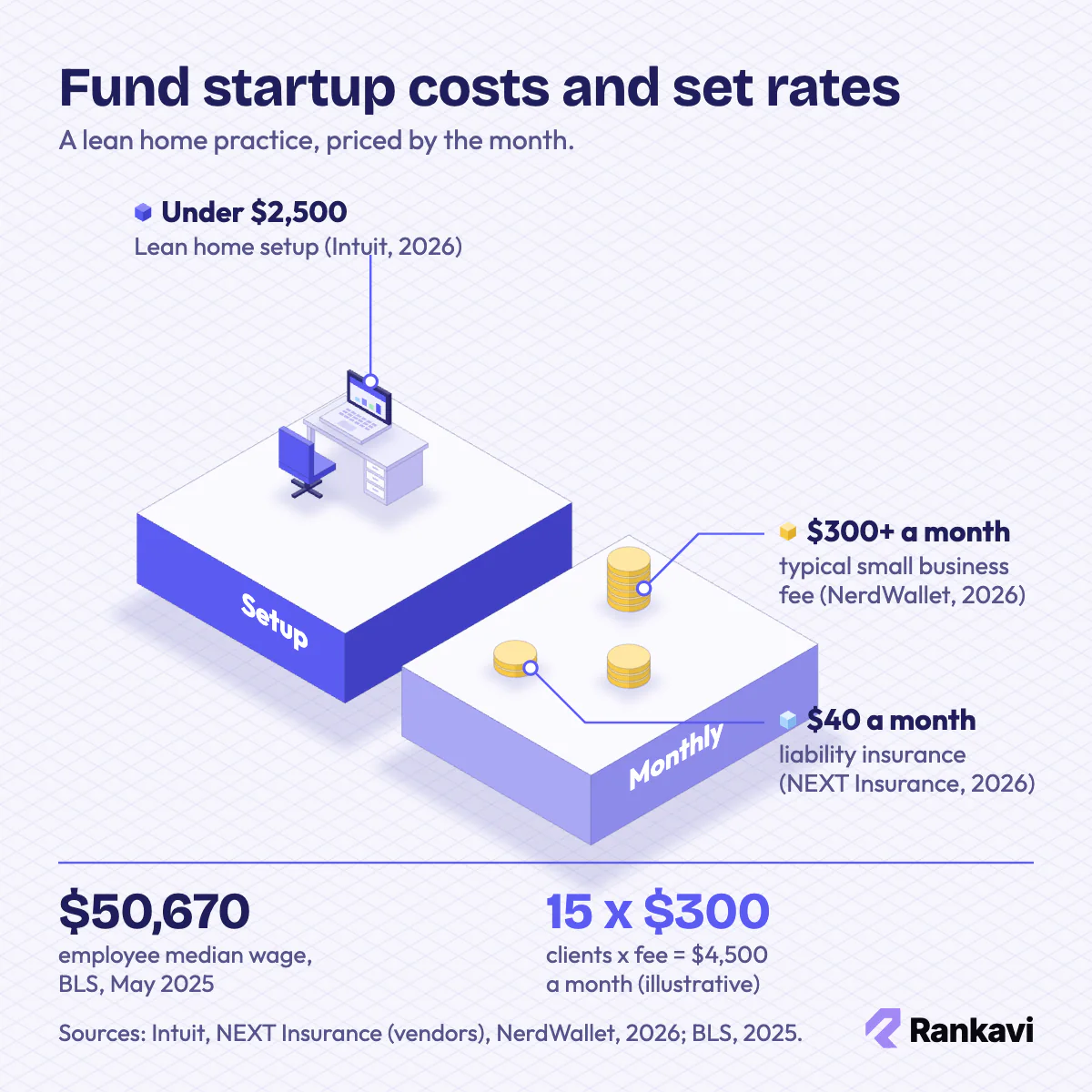
Intuit is the company behind QuickBooks. Its 2026 guide estimated that a lean home-based practice may cost less than $2,500 to start. That vendor estimate assumes the owner already has a computer and a home workspace.
Startup money at a glance:
| Item | Figure |
|---|---|
| Startup cost | Less than $2,500 for a lean home setup |
| Main costs | Laptop, accounting software, liability insurance near $40 a month, website, exam prep |
| Typical margin | No published figure for solo bookkeepers; owner time is the main cost |
| Time to open | Days to weeks; a free federal tax number is issued online the same day, state filing times vary |
Sources: Intuit (QuickBooks maker), 2026 vendor estimate; NEXT Insurance (insurer), April 2026 vendor customer data; Internal Revenue Service, which issues the free tax number, 2026.
The BLS reported a median wage of $50,670 a year, or $24.36 an hour, for bookkeeping clerks in May 2025. That employee benchmark is the number a solo owner must beat to justify going independent. The comparison is rough, because an owner also pays self-employment tax, buys software and cannot bill every hour.
The Internal Revenue Service sets the self-employment tax rate at 15.3 percent as of 2026. That is 12.4 percent for Social Security plus 2.9 percent for Medicare. Owners also pay estimated tax each quarter, so a share of each client payment is set aside.
Pricing follows three models. Hourly rates fit cleanup projects, fixed monthly packages fit recurring work, and value-based fees fit advisory work.
NerdWallet, a consumer finance publisher, wrote in March 2026 that small businesses should expect to pay around $300 or more a month. Its 2026 basic service tier ran $250 to $350 a month.
NerdWallet also cited an average Upwork freelancer rate of $43 an hour in that March 2026 article. Hourly billing suits cleanups, while fixed packages with set account and transaction limits keep monthly income predictable.
Example: a solo bookkeeper signs 15 small business clients on a basic monthly package (illustrative).
| Input | Amount |
|---|---|
| Clients | 15 |
| Monthly fee per client | $300 |
| Monthly revenue | $4,500 |
| Liability insurance per month | $40 |
| Monthly revenue after insurance | $4,460 |
| Yearly revenue after insurance | $53,520 |
| Result | Slightly above the $50,670 employee median, before software, taxes and other costs |
Working capital covers the slow first months. Many owners fund the practice from savings and keep a part-time job until monthly fees cover living costs. A business credit card can bridge gaps but charges interest on any balance carried over.
Pricing mistakes are costly early. Underpricing to win the first clients makes later rate increases harder. Taking messy books at a flat fee can turn a package into unpaid cleanup. Billing the first month in advance and writing the scope into an engagement letter protect cash flow and limit disputes.
4. Register and Insure the Practice
Registering a bookkeeping business protects the owner by separating personal assets from client claims and business debts. Most solo bookkeepers choose between a sole proprietorship and a limited liability company (LLC).
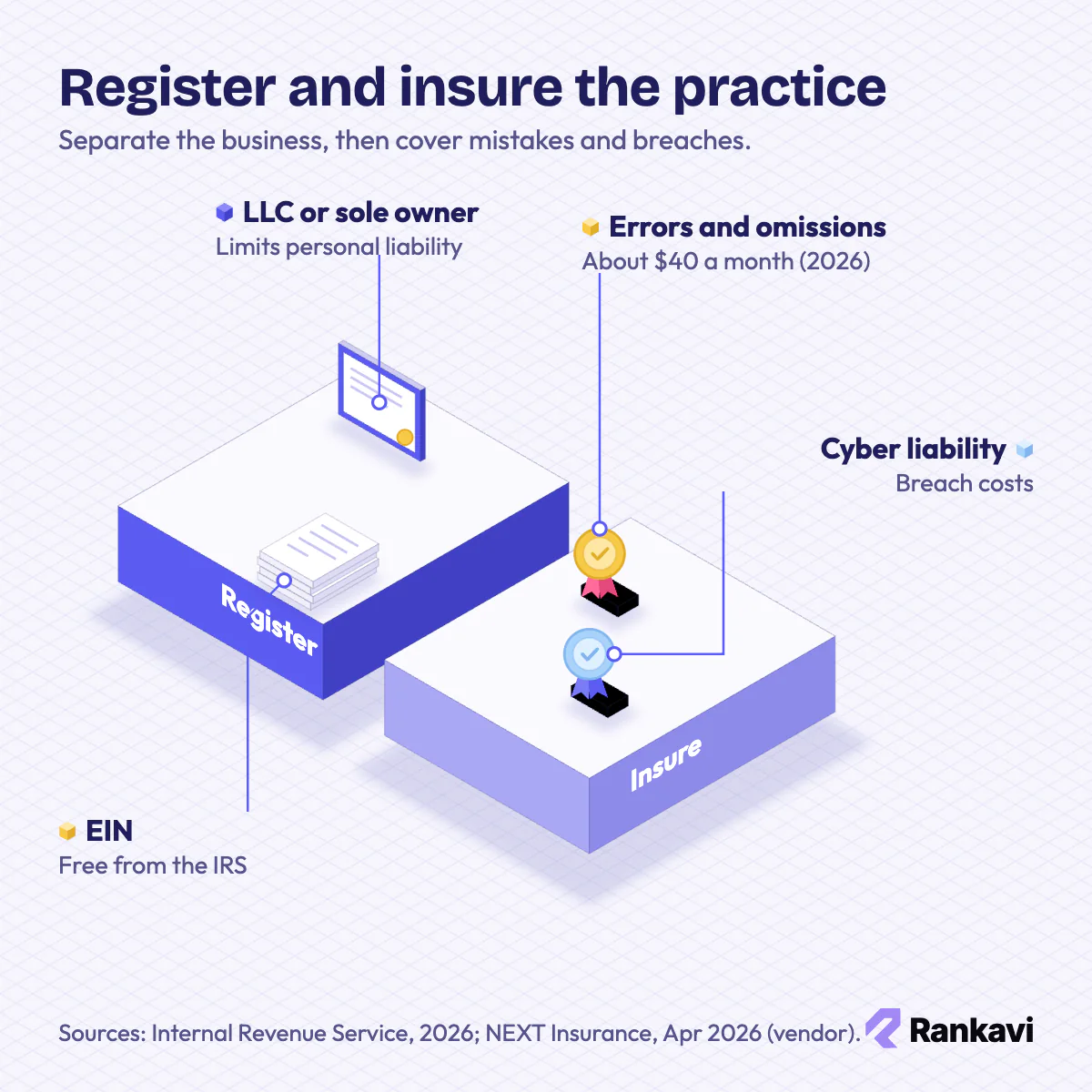
An LLC keeps pass-through taxation, so profits are taxed at the owner’s personal level. The owner files with the Secretary of State and checks local business license rules. Sole proprietors skip that filing but carry full personal liability. Local licensing rules vary, so the city or county clerk confirms what a home-based office needs.
An employer identification number (EIN) comes from the Internal Revenue Service (IRS), which never charges a fee for one. Clients ask for a tax number on payment forms, and the EIN keeps the owner’s Social Security number private.
Professional liability insurance, also called errors and omissions insurance, is the policy that matters most. It covers claims when a data entry mistake triggers a penalty for a client. NEXT Insurance, an insurer, listed an average of $40 a month for bookkeepers in April 2026.
Cyber liability insurance covers breach costs such as client notification and data recovery. A separate business bank account then keeps the bookkeeper’s own books clean.
5. Earn a Bookkeeping Certification
Certification gives a new bookkeeper outside proof of skill, even though no license is required to keep books. Clients cannot judge ledger quality before hiring, so credentials carry real weight.
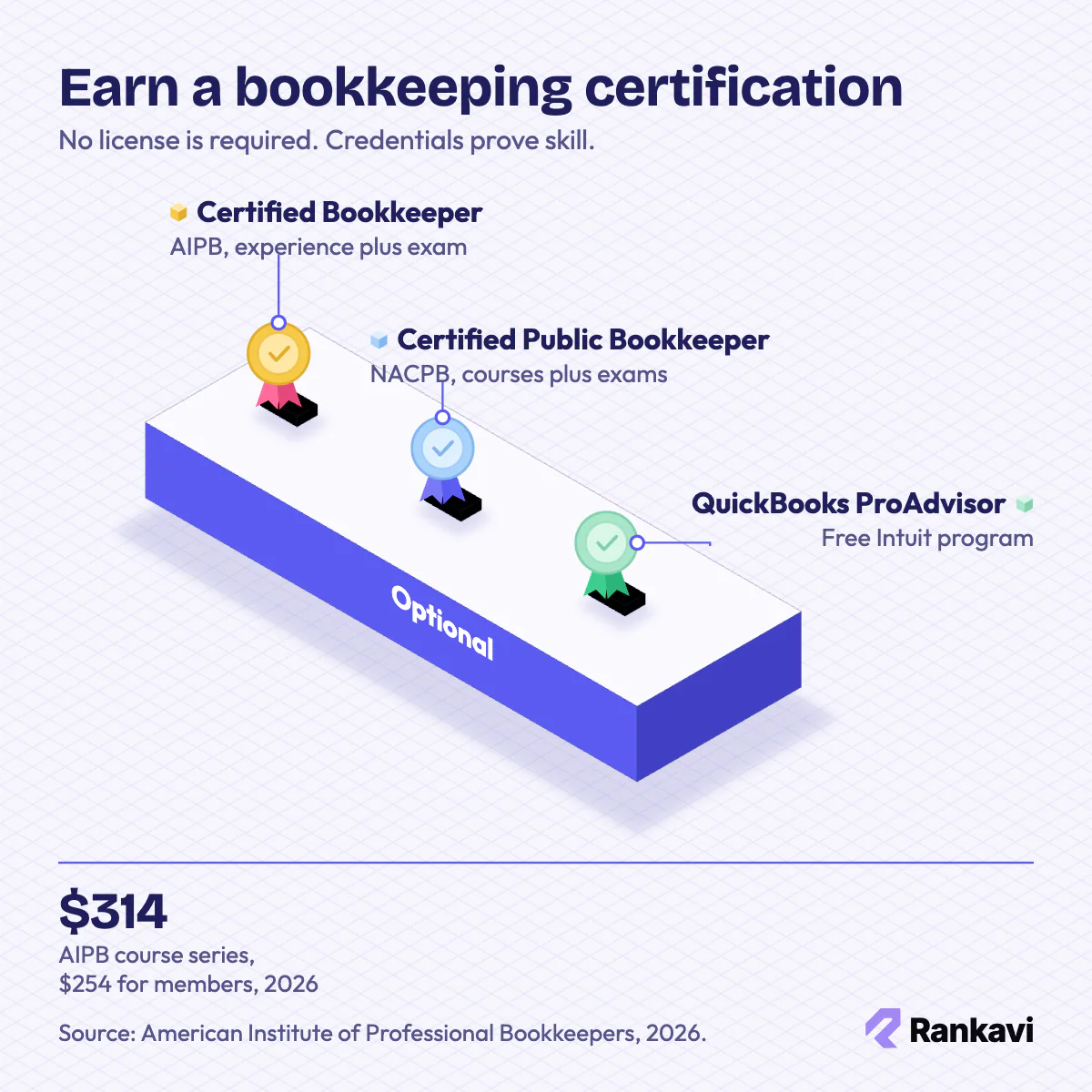
New bookkeepers usually pick from three credentials:
- Certified Bookkeeper: The American Institute of Professional Bookkeepers (AIPB) is the profession’s national association. It grants this credential to experienced bookkeepers who pass its exam.
- Certified Public Bookkeeper: The National Association of Certified Public Bookkeepers (NACPB) is a small business bookkeeping group. It pairs self-study courses with certification exams.
- QuickBooks ProAdvisor: QuickBooks ProAdvisor is a free Intuit program that offers QuickBooks training, certification and digital badges.
AIPB sold its six-workbook Certified Bookkeeper course series for $314, or $254 for members, as of 2026. The workbooks cover adjusting entries, payroll, depreciation, inventory and internal controls.
Software certification often comes first because it costs nothing and adds a badge to the website.
Tax preparation is a separate field with its own federal rules. Bookkeepers who prepare returns need separate registration before offering that service. A Preparer Tax Identification Number (PTIN) is the IRS number that paid federal tax return preparers must hold. Bookkeepers who stay with ledgers and reports do not need one.
Cost and time decide the order. Free badges can come first. Exam credentials such as the Certified Bookkeeper suit owners who want a recognized title.
6. Build a Secure Software Stack
A bookkeeping software stack keeps client data organized, encrypted and available from one home workstation. The tools also decide which clients the practice can serve.
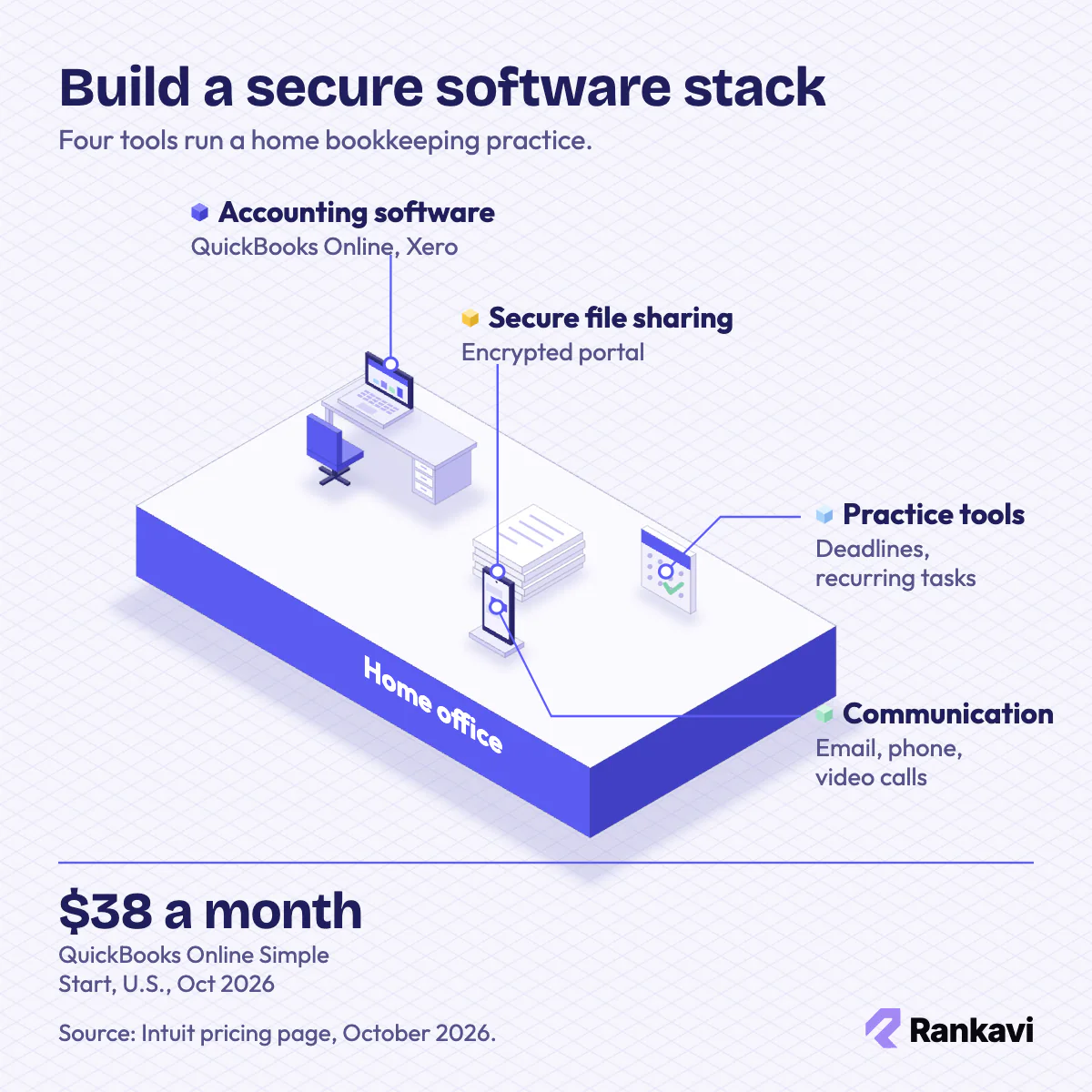
A home practice runs on four core tools:
- Accounting software: QuickBooks Online is the common ledger, and Xero is a cloud rival with its own advisor program.
- Secure file sharing: an encrypted portal or cloud drive with audit trails.
- Practice management: Karbon or Canopy for deadlines and recurring tasks.
- Communication: email, a business phone line and video calls.
QuickBooks Online dominates small business ledgers, so most practices learn it first. Its Simple Start plan listed at $38 a month in the US as of October 2026. Clients usually pay that subscription themselves. Client logins need protection, so a password manager and two-factor authentication belong in the setup from day one.
Intuit is retiring QuickBooks Online Accountant on December 31, 2026, and its free Accountant Suite Core takes over the bookkeeper’s dashboard. Learning Xero, FreshBooks or Wave as a second platform widens the client pool.
The home office needs a fast connection, a reliable laptop and a second monitor. A written onboarding checklist then collects logins, prior statements and the scope agreement before work starts.
7. Market the Practice to First Clients
Marketing a bookkeeping practice earns signed monthly clients through referrals, a clear website and steady visibility. Owners hire bookkeepers they believe will keep their numbers private and correct.
A professional website acts as the digital storefront. It lists packages, explains the onboarding process and shows the chosen niche. WordPress, Wix and Squarespace let the owner edit pages without a designer.
LinkedIn and niche online communities reach owners where they already ask questions. Helpful answers build credibility faster than paid ads. Local business groups and chamber events add face-to-face contact.
Referral partners bring the warmest leads. Accountants, tax preparers and financial advisors often need a reliable bookkeeper for their clients. Word of mouth from the first happy clients then compounds. A clear package with a set price is easy to pass on. The referring accountant can describe exactly what the client receives.
Testimonials and short case studies prove results. With client permission, the website shows how the practice cleaned up books or saved an owner time.
8. Grow Through Referrals and Hiring
Growing a bookkeeping practice turns a solo workload into a small team with documented processes. Growth starts once the owner’s calendar is full.
Hiring the first bookkeeper frees the owner for sales and review work. Written procedures for each client keep quality steady when someone new handles the books. Contractors suit uneven workloads before a full hire.
Add-on services raise revenue per client. Xero’s 2025 US State of the Industry Report, a vendor survey of 250 accountants and bookkeepers, found 85% offered advisory services, up from 41% in 2023.
The same Xero survey, published in June 2025, found 73% of practices reported higher profits in the past year. Payroll, cleanups and software training sit close to monthly bookkeeping and deepen each client relationship.
Franchising is the long-term option for a proven model. It requires an attorney, a franchise disclosure document and protected brand assets. Few practices reach that stage, but the option shapes how systems are built.
9. Win Bookkeeping Mentions in AI Overviews
Visibility in AI search places a bookkeeping practice in the answers small business owners read before they call anyone. Owners now ask Google, ChatGPT and Perplexity which bookkeeper fits a restaurant, a contractor or an online shop.
Google AI Overviews summarize what trusted third-party pages already say. Directory profiles, software partner listings, reviews and “best bookkeeper” roundups feed those summaries. A new practice gains from appearing on those pages while its reputation is still forming.
Rankavi is a software as a service (SaaS) platform that publishes brand mentions in articles on indexed third-party websites. Bookkeepers who want Google AI Overviews brand citations can start with accurate articles about their niche and software skills.