

Starting a beauty business means turning a licensed skill in skin, nails or hair into a studio with repeat clients. The U.S. Bureau of Labor Statistics, which publishes federal job data, counted 104,200 skincare specialist jobs in 2025.
Before the steps, a quick note: I’m Michal Sieroslawski, and I help beauty businesses get found online. AI search is a growing way for clients to find beauty businesses, and recommended names start ahead.
This order fixes the specialty and prices before any money goes into a lease. The studio space then comes before licences, because state inspectors need a real address. Below are the twelve steps, in the order most beauty founders take them.
- Choose a Beauty Specialty and Business Model
- Research Local Clients and Rival Studios
- Write a Plan Around the Treatment Menu
- Price Every Treatment for Profit
- Fund the Opening and Working Capital
- Form an LLC for the Beauty Studio
- Lease a Salon Suite or Storefront
- Obtain State Beauty and Salon Licenses
- Insure Treatments, Products and Premises
- Equip Stations and Stock Professional Products
- Book First Clients and Keep Them Returning
- Appear in AI Overviews for Beauty Searches
1. Choose a Beauty Specialty and Business Model
A beauty specialty decides which treatments the business sells and which licence and equipment it needs. Skincare, nails, lashes, brows, makeup and hair each lead to a different studio.
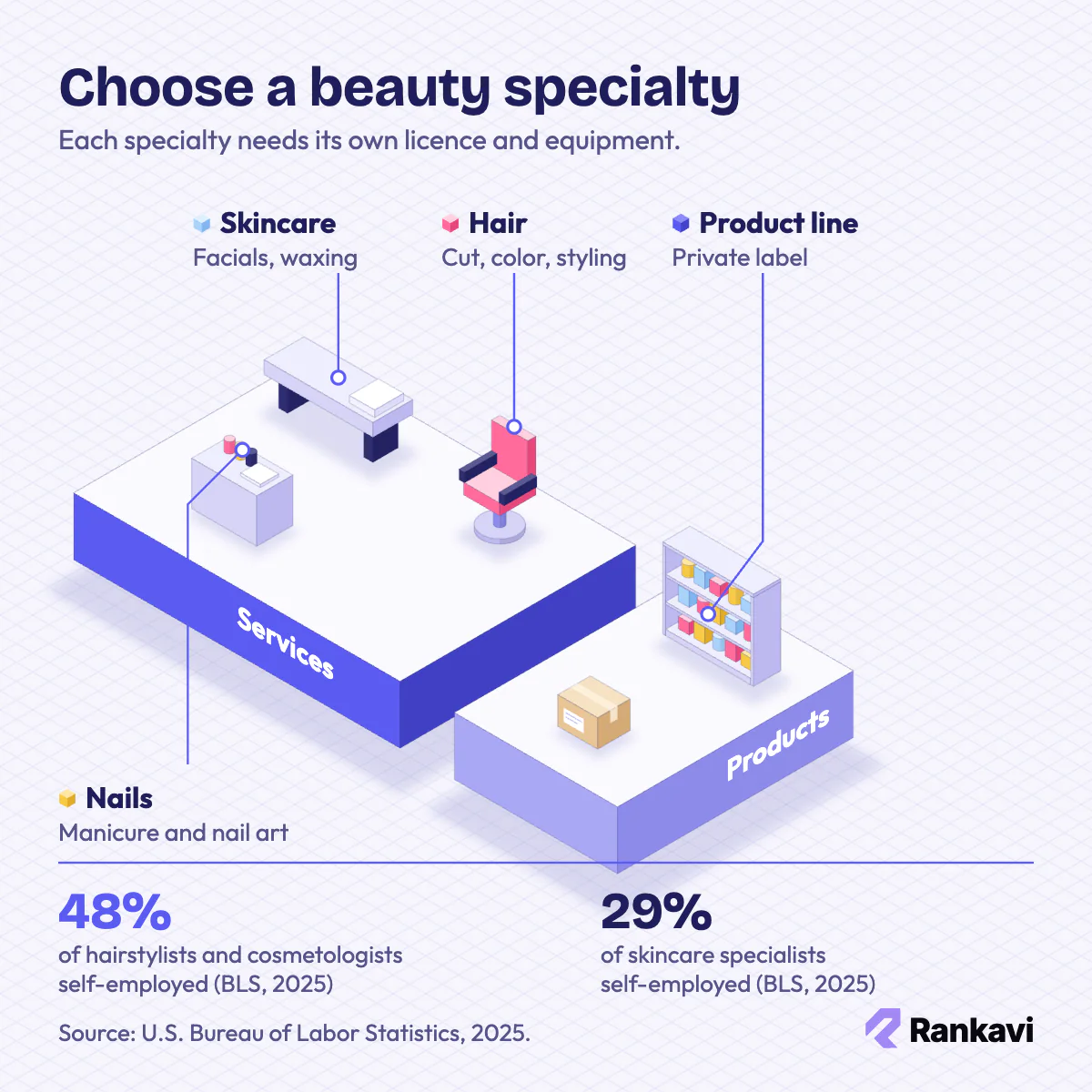
Most new owners pick from a handful of service lines. Facials, waxing, nail care and massage form the classic menu. Light-emitting diode (LED) facials and brow lamination draw trend-driven clients.
The business model matters as much as the service. Each model trades startup cost against control and income ceiling:
- Mobile artist: the lowest cost and full control, but travel time limits the clients served per day.
- Home studio: low overhead, though zoning and home-occupation rules decide whether clients may visit.
- Booth or chair rental: a licensed professional rents one station inside another owner’s salon and keeps the client base, but follows house rules.
- Salon suite: a private room with more branding freedom, paid for with steady monthly rent.
- Storefront: room for staff and growth, with the highest build-out and payroll burden.
- Private label products: a product line sold online or in the studio, which brings inventory and cosmetics rules.
Specialty also sets how often clients return. Lashes, nails and waxing bring repeat visits within weeks, while makeup for events is mostly one-off. A short repeat cycle gives steadier monthly income.
Licence rules differ by specialty and state. Esthetics, nails, hair and massage are licensed separately, so a skincare licence does not cover cutting hair. Step 8 covers the process.
Solo work is already normal in beauty. The U.S. Bureau of Labor Statistics (BLS), which publishes federal job data, found 48% of hairstylists and cosmetologists self-employed in 2025. The BLS put the share for skincare specialists at 29% in 2025.
Startup money at a glance:
| Item | Figure |
|---|---|
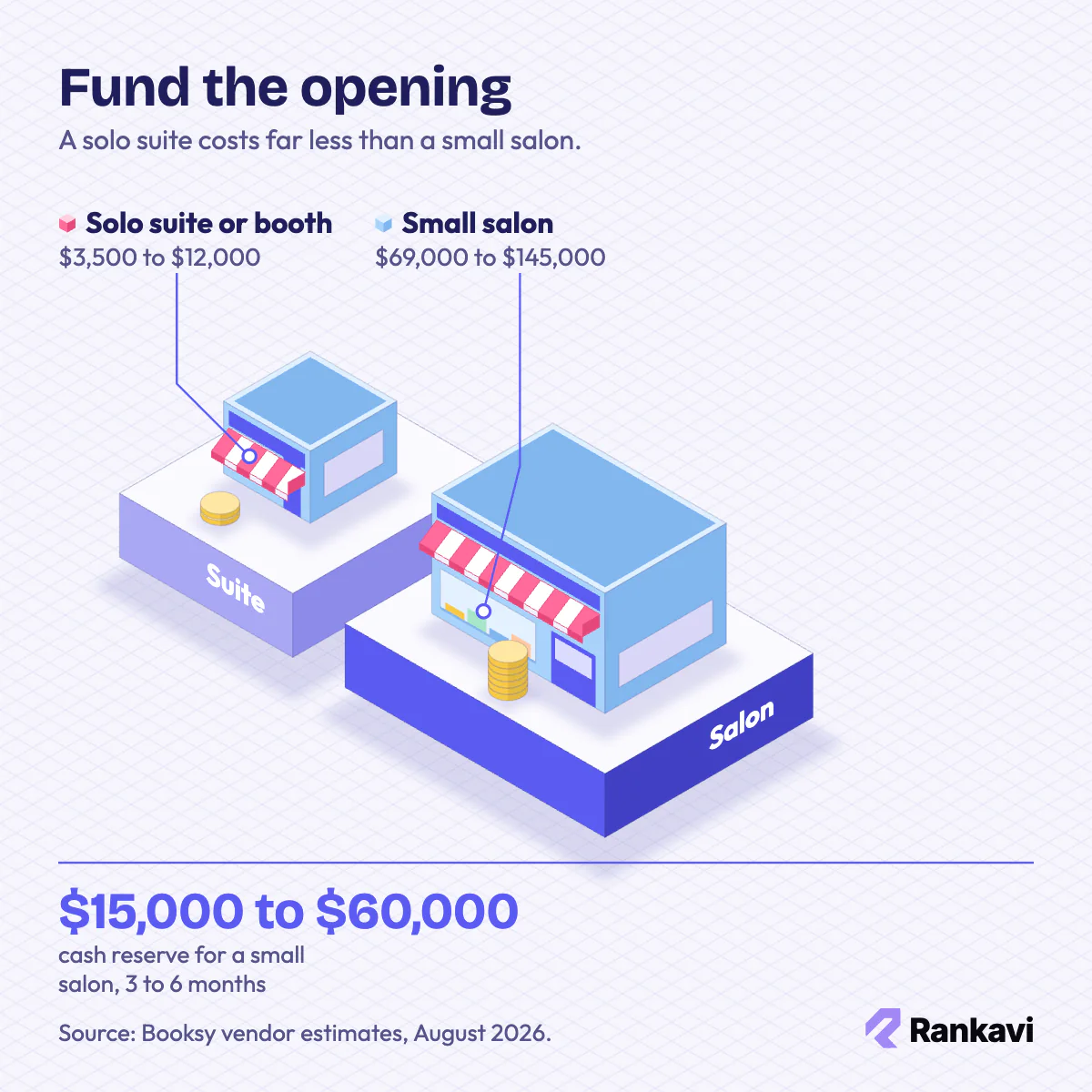
| Startup cost | $3,500 to $12,000 for a solo suite or booth; $69,000 to $145,000 for a small salon with three or four stations |
| Main costs | Build-out and plumbing, chairs and treatment beds, opening product stock, working capital |
| Typical margin | 8.2% average salon profit margin (net or gross not stated), within a 2% to 17% range |
| Time to open | About 13 to 22 weeks for a commercial build-out, from design to final inspection |
Sources: Booksy, which offers salon booking software, vendor estimates, August 2026. Boulevard, which offers salon software, vendor estimate, August 2024. Optima Salon Suites, which operates franchised salon suites, phase estimates added together, October 2024.
2. Research Local Clients and Rival Studios
Market research starts with the client the studio wants to serve. Age, budget, neighborhood and preferred treatments shape the menu and the opening hours.
Rival studios show what the area already offers, and they come in several types. Salon suites, chain studios and independent artists attract different clients at different prices. Their menus, prices, reviews and booking options reveal gaps, such as no brow specialist nearby or no late appointments.
Demand for skin care is growing fast. The BLS projects 9% job growth for skincare specialists from 2025 to 2035, against 7% for barbers, hairstylists and cosmetologists.
Faster growth hints at where new clients will come from. A national growth rate says little about one town, so local review counts and booking availability are the better test.
Review pages show recurring complaints, such as long waits or rushed treatments. A studio that fixes one of those gaps has a clear reason for clients to switch. Skin and hair clients also return on a regular cycle, which suits a studio built on repeat visits.
3. Write a Plan Around the Treatment Menu
A beauty business plan works best when the treatment menu sits at its center. Every forecast in the plan depends on which treatments sell and how long each one takes.
A beauty plan covers four core sections:
- Concept: the specialty, target client and studio format.
- Menu: the treatments, their length and their prices.
- Marketing: how the first clients will find the studio.
- Finances: the startup budget, monthly costs and sales forecast.
The menu also drives the operating side of the plan. Treatment length sets how many clients fit in a day, and product use per treatment sets the supply budget.
A plan should also name the main risks, such as slow early bookings, a late licence or a lost lease. A short fallback for each shows lenders that the owner has thought it through.
Lenders and landlords often ask to see the plan. A clear menu also helps a suite operator judge whether the business fits the building.
4. Price Every Treatment for Profit
Treatment pricing sets a fee for each service from its chair time, product use and local going rates. A long facial needs a higher price than a quick brow tidy.
Owners usually start from a target hourly rate. Rent, supplies, insurance and owner pay go into that rate, and each treatment price follows from its length.
Employed pay gives a floor for that rate. The BLS reported a median annual wage of $45,330 for skincare specialists in May 2025.
Product cost per treatment belongs in the price as well. A facial with a costly serum needs a higher fee than one with basic supplies.
Price tiers help clients choose. A short, standard and premium version of one treatment lets each client pick a budget while the calendar stays full.
Beauty training rarely covers sales or pricing. Many owners undercharge at first, so planned price reviews keep fees in line with rising costs.
Deposits protect long bookings. A no-show on a lash set or a full facial leaves a gap that no walk-in can fill.
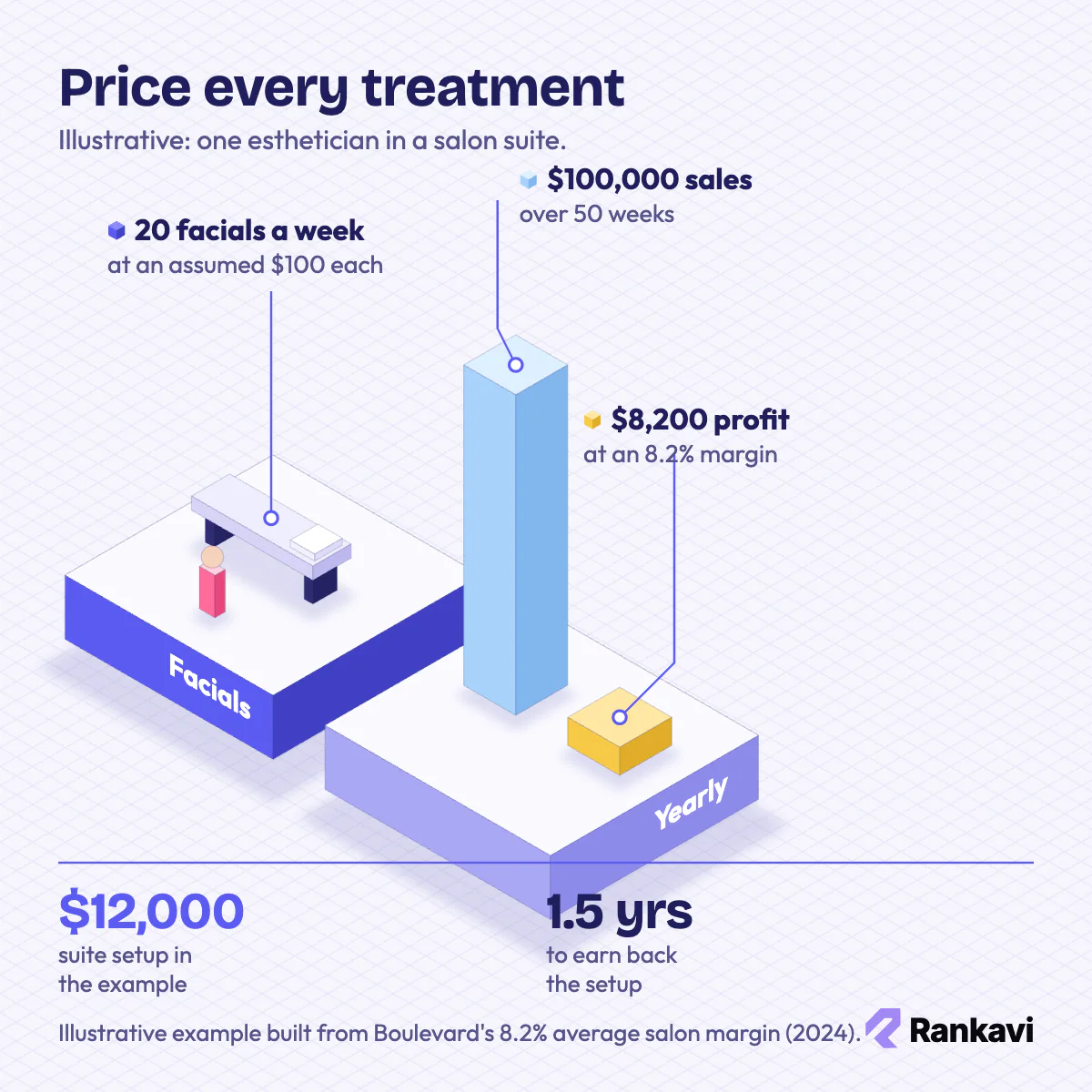
Worked example: In this illustrative case, an esthetician spends $12,000 to open a salon suite. She sets an assumed price of $100 per facial and books 20 facials a week. That brings in $2,000 a week, or $100,000 over 50 working weeks. At an 8.2% margin after rent, products and her own pay, profit is $8,200 a year. The $12,000 setup therefore takes about a year and a half to earn back.
5. Fund the Opening and Working Capital
Funding a beauty studio covers the build-out, chairs and beds, opening stock and several months of working capital. A suite renter needs far less money than a storefront owner.
Startup money goes into four main areas:
- Space: deposits, build-out and plumbing for wash or treatment areas.
- Equipment: chairs, treatment beds, lamps and sterilizers.
- Stock: backbar products and a small retail range.
- Working capital: cash for rent and wages while bookings grow.
Cash reserves keep a new salon alive until bookings fill. Booksy, the booking software vendor, estimated in 2026 that a small salon should hold $15,000 to $60,000 for three to six months.
Funding routes carry different trade-offs. Savings cost nothing to repay but put personal money at risk. Loans keep savings intact but add monthly payments before bookings are steady.
Equipment financing spreads the cost of beds and chairs over time. Used equipment cuts the opening bill, if it passes a sanitation check.
Personal savings fund many first studios. Some owners build a client base through mobile work first. They then open a fixed space with a partner or family backer.
Microloans suit studios with modest budgets. The U.S. Small Business Administration (SBA), which backs small business loans, lists an average microloan of about $13,000 as of 2026.
6. Form an LLC for the Beauty Studio
Forming a limited liability company (LLC) means registering the studio as a legal entity separate from its owner. Client claims then stay with the business.
That shield matters in beauty work. A wax burn, a peel reaction or a faulty retail serum lands on the business entity first.
An employer identification number (EIN) comes next from the Internal Revenue Service (IRS), which is the federal tax agency. The number opens a business bank account and keeps treatment income apart from personal money.
An LLC does not replace insurance. Owners still need liability cover, because the shield may not stop a claim over the owner’s own work.
An LLC also helps when signing a suite or booth rental agreement. Landlords and suppliers treat a registered entity as a more credible tenant.
7. Lease a Salon Suite or Storefront
A salon suite suits most first beauty studios. The renter gets a private, move-in ready room inside a larger building that shares utilities and laundry.
Sola Salon Studios, which operates suites for independent beauty professionals, lists more than 750 locations and 21,000 professionals as of 2026. Its flat weekly rate covers utilities, Wi-Fi and laundry access.
A storefront gives more control and room for staff. It also brings a full build-out, from wiring and lighting to plumbing for every sink.
Plumbing drives that bill. Booksy estimated in 2026 that salon tenant improvements cost $120 to $200 per square foot (about 0.09 square meters).
Booth or chair rental sits between the two. It costs less than a suite, but the salon owner sets the hours, the products and the house rules.
Lease terms deserve a careful read. Owners check who pays for plumbing changes, how long the term runs and whether the space allows chemical services.
8. Obtain State Beauty and Salon Licenses
State licensing gives each practitioner and each salon the legal right to perform beauty services. A state board of cosmetology or a licensing agency issues both licences.
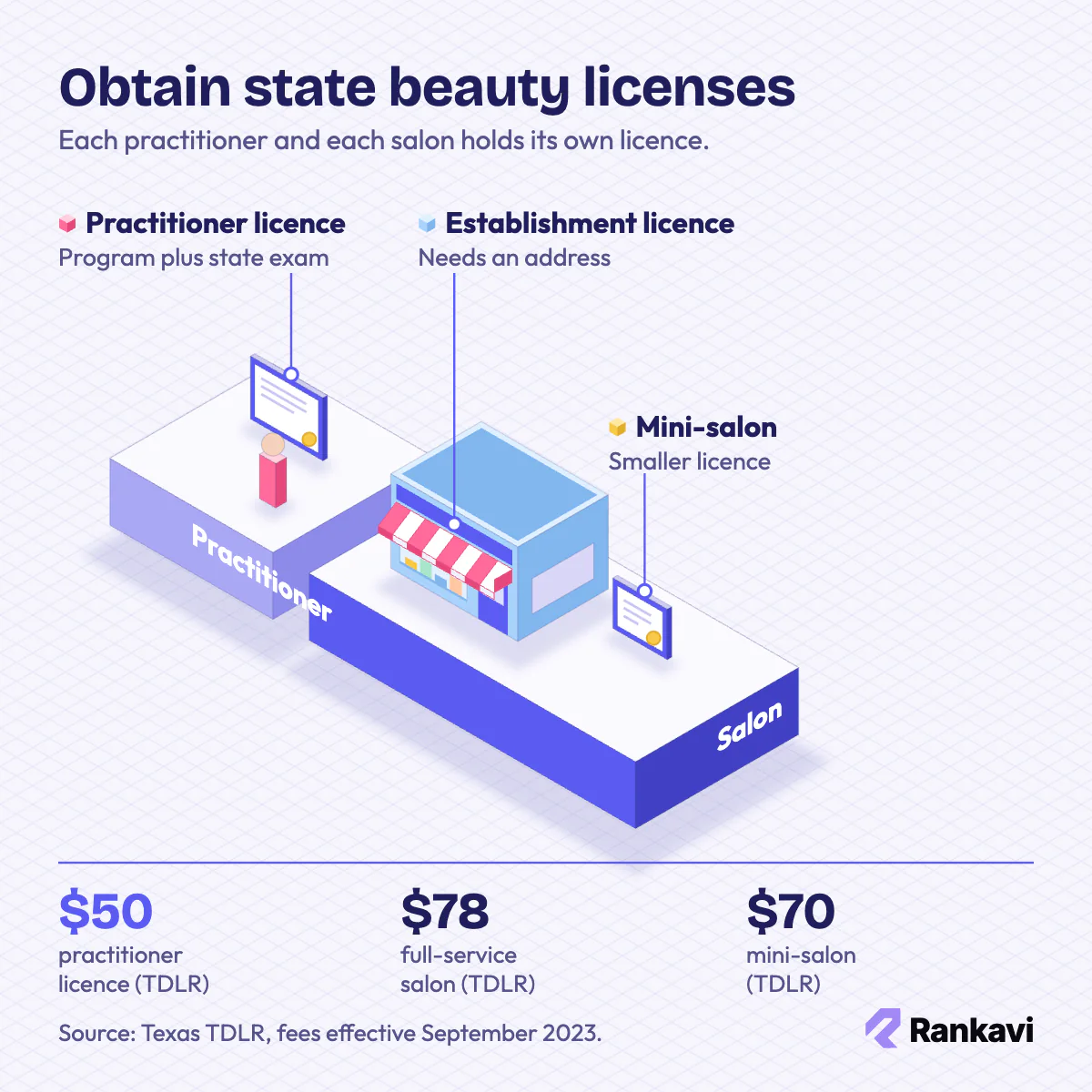
Every state licenses barbers, hairstylists and cosmetologists. Applicants finish a state-approved program, then pass a written exam and often a practical one.
The salon itself needs an establishment licence once it has an address. In Texas, the Texas Department of Licensing and Regulation (TDLR) issues these licences and charged $78 for a full-service salon in 2023.
That Texas schedule, effective September 2023, also set $70 for a mini-salon and $50 for each practitioner licence. Inspectors then check sanitation and the licences on display.
Moving to another state usually means a new application. Some states honor out-of-state licences, but each board sets its own terms, so the board should be asked first.
Mobile and home studios still need a licence, and many states add a separate permit for the location. Rules differ by state, so the local board gives the final answer.
Product lines follow different rules. The U.S. Food and Drug Administration (FDA), which regulates cosmetics, does not approve them before sale. The Modernization of Cosmetics Regulation Act (MoCRA) of 2022 adds registration and listing duties instead.
9. Insure Treatments, Products and Premises
Business insurance protects the studio when a treatment, a product or the premises harms a client. Beauty work carries risks that office work does not.
Beauty studios usually weigh four policies:
| Policy | What it covers |
|---|---|
| General liability | Slips, falls and damage to client property |
| Professional liability | Burns, allergic reactions and treatment errors |
| Product liability | Claims tied to products the studio sells or makes |
| Workers’ compensation | Staff injuries once the studio hires |
Suite operators and landlords usually ask for proof of liability cover before move-in. Owners who formulate their own skincare need product cover from day one.
Policies often come as a bundle. A business owner’s policy combines general and property cover in one plan. That can cost less than separate policies.
Chemical services raise the stakes. Lash glue, peels and hair color can cause reactions, so insurers ask which treatments the studio offers.
10. Equip Stations and Stock Professional Products
Equipment follows the menu chosen earlier. A nail studio needs manicure tables and dust extraction. A skincare room needs a treatment bed and a magnifying lamp.
Sanitation gear protects clients and the licence. Sterilizers, disinfectant and single-use tools sit beside every station.
Chemical safety covers staff too. Salons using formaldehyde smoothing products answer to the Occupational Safety and Health Administration (OSHA), which enforces workplace safety rules. Its rules call for air testing, ventilation and worker training.
New equipment costs more but comes with a warranty. Used equipment saves money, yet sterilizers and beds should be checked before use.
Supplier terms matter for stock. Some professional lines require a licence to open an account, and some set minimum orders.
Products split into backbar and retail. Backbar stock goes into treatments, while a small retail shelf adds sales between visits.
11. Book First Clients and Keep Them Returning
The first clients usually come from people who already know the owner. Friends, former salon clients and local networking fill the first weeks.
A Google Business Profile is Google’s free listing for local businesses. It puts the studio on Google Maps and in local search. Photos, opening hours and reviews help nearby clients choose it.
Instagram shows the work itself. Before-and-after posts of nails, brows and skin results act as a portfolio for new clients.
Early offers can speed up the first weeks. A new-client discount or a referral reward gives a reason to book. A discount that is too deep trains clients to wait for deals.
Online booking keeps the calendar full. Clients book, pay deposits and rebook from a phone, and the owner sees every gap at a glance.
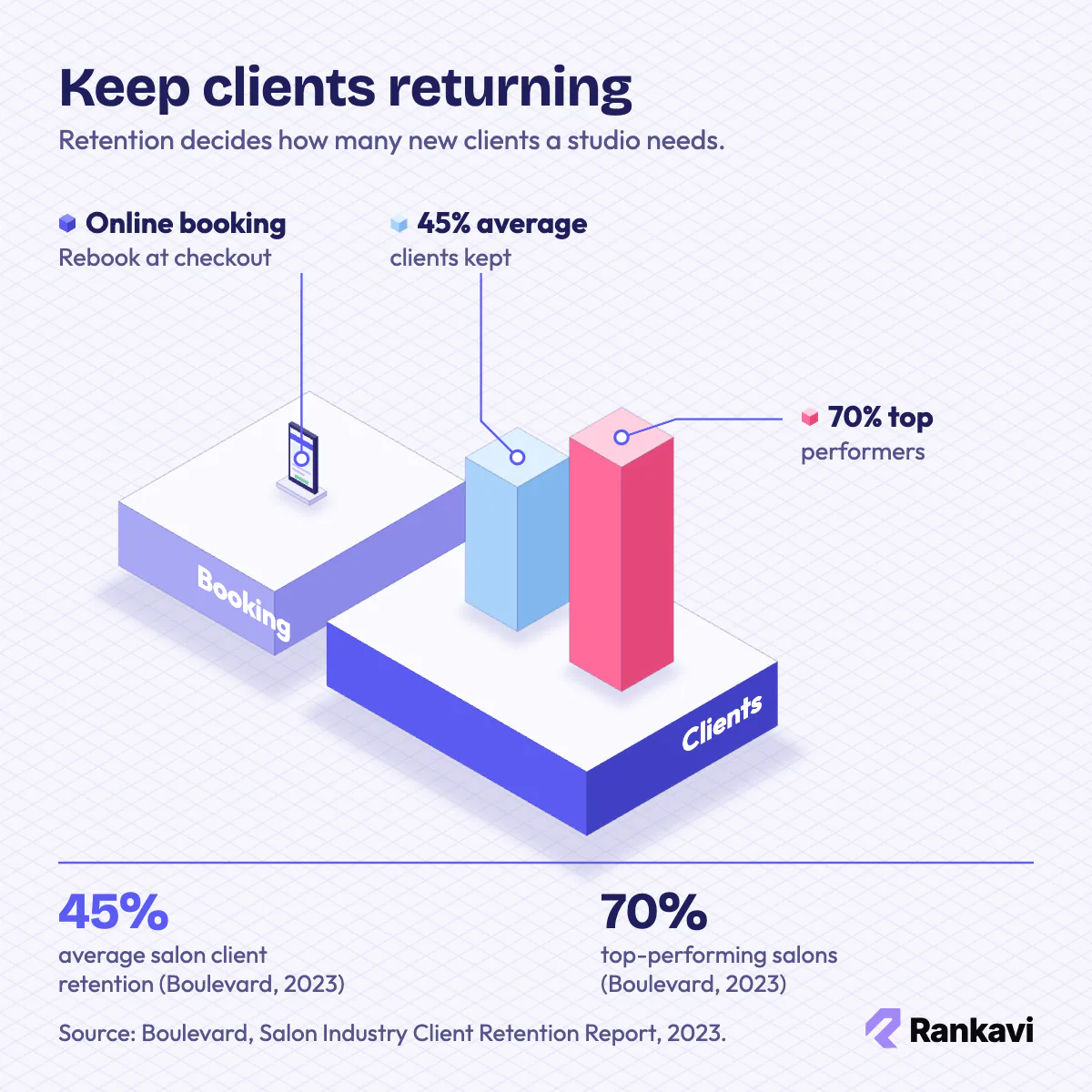
Retention is the number most owners watch first. Boulevard, a salon software vendor, found in its 2023 report that salons keep about 45% of clients, while top performers reach 70%.
Reminders reduce no-shows, and a note on each client’s last treatment makes the next visit feel personal. Every lost client must be replaced to hold the bookings that cover rent. A rebooking prompt at checkout keeps that gap small.
12. Appear in AI Overviews for Beauty Searches
Clients hunting for a facial or a nail artist now ask Google and read the AI Overview first. Those summaries lean on directories, review sites and local beauty roundups.
A new studio gains when those trusted sites mention it early. Rankavi is a software as a service (SaaS) platform that publishes brand mentions in articles on indexed third-party websites. Studios that want more brand references in AI Overviews can place mentions there over time.