

Starting a baking business means turning tested recipes into a licensed food operation, usually from a home kitchen first. The U.S. Bureau of Labor Statistics (BLS), the federal jobs data agency, counted 9,853 private retail bakeries in the first quarter of 2026.
Before the steps, a quick note: I’m Michal Sieroslawski, and I help bakeries reach local customers through search. As AI search grows, local customers ask ChatGPT for suggestions, and being recommended there counts.
Product and price come before money, because the menu decides the budget. The kitchen then comes before permits, since every permit needs an address. Each of the ten steps below builds on the last, from baking idea to first paying customer.
- Choose Your Baking Niche
- Write a Bakery Business Plan
- Develop and Test a Focused Menu
- Price Every Bake for Profit
- Fund the Startup Costs
- Secure a Home Kitchen or Storefront
- License, Register and Insure the Bakery
- Equip the Kitchen and Source Ingredients
- Market the Bakery to First Customers
- Feature in AI Bakery Recommendations
1. Choose Your Baking Niche
A baking niche decides what the bakery sells, who buys it and where it sells. Custom cakes, cookies, artisan bread and gluten-free goods each draw a different customer.
Specialty sets the bakery apart from grocery store shelves. Wedding cakes, decorated cookies, doughnuts, savory pastries and vegan treats all fill distinct demand. Kosher and gluten-free lines serve customers that mainstream bakeries often skip.
Niches differ in workload and shelf life. Wedding cakes bring large orders but need decorating skill and weekend delivery. Sourdough needs an early start every day, while cookies and bars batch easily and ship well. Cream-filled and custard items spoil quickly. That limits how far they can travel and whether a home kitchen may sell them.
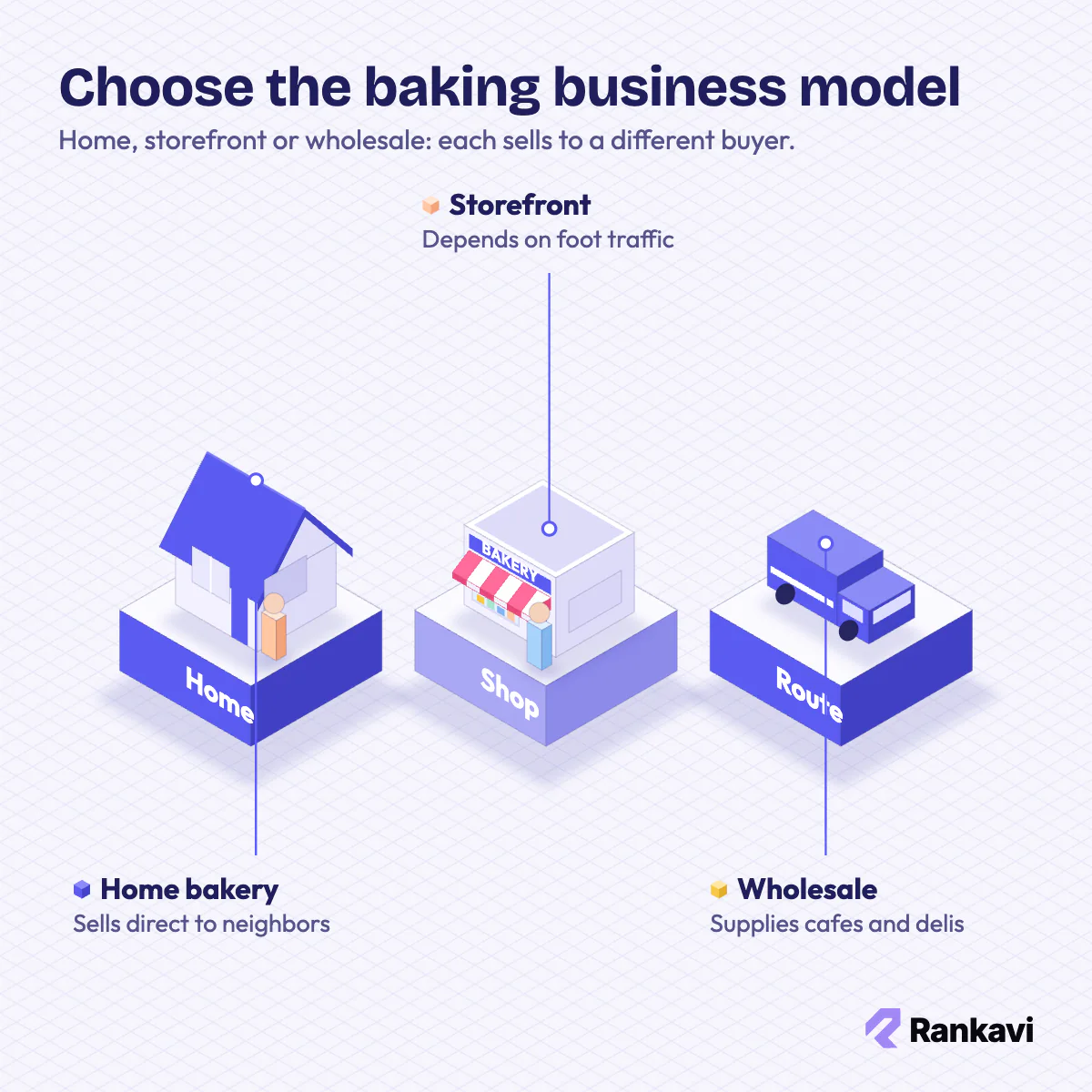
Business model matters as much as product. A home bakery sells direct to neighbors. A storefront depends on foot traffic, and a wholesale bakery supplies cafes and delis. Many owners start at home and move up later. Sales channels follow the model: pre-orders, farmers markets, online shipping and cafe supply each suit a different product.
Each model has its own trade group. Retail Bakers of America is a nonprofit membership group for retail bakers. It runs certifications such as Certified Master Baker. The American Bakers Association represents the U.S. commercial baking industry that supplies stores and food service. The Bread Bakers Guild of America is a trade group that supports artisan bread bakers.
Target customers shape the menu. Busy parents want birthday cakes, offices order catering trays, and coffee shops need daily pastries. Local gaps show the opening: new owners check what nearby home bakers, cafes and grocery stores already sell. Google Trends is a free Google tool. It shows how searches for a term, such as sourdough, change over time and by state.
A pre-order batch or one market stall tests a niche cheaply, since repeat orders say more than compliments. A niche statement keeps the choice clear: one product, one customer and one area or channel. Mixing cakes, bread, cookies and vegan lines at the start spreads skills and budget too thin.
Home baking and production baking are different skills:
“Get a job in a bakery. Baking at home and on a commercial scale are very different things, and the best way to learn the latter is hands-on.”
— A baker answering on Reddit’s r/Baking
2. Write a Bakery Business Plan
A bakery business plan sets the sales goal that every later step must reach. Lenders and landlords read it before they sign, so it states the menu, the customer and the numbers.
A full bakery plan covers seven sections:
- Market: analysis of nearby bakeries and customer demand
- Concept: service style, such as counter, custom orders or wholesale
- Menu: sample products with prices
- Site: building design and location
- Team: staffing needs
- Finances: projected revenue and expenses
- Marketing: how the bakery wins and keeps customers
A full plan also opens with an executive summary, a short overview that is easiest to write last. A self-funded owner still gains from a plan, since it works as a sales roadmap. A home bakery can start with a one-page plan. Products, target customer, pricing and a monthly revenue goal fit on a single sheet. That page grows into a full plan once a lender is involved.
The revenue goal turns into an order count. The owner divides the monthly target by the average order to see weekly orders needed. Holiday peaks and slow summer weeks belong in that forecast too.
3. Develop and Test a Focused Menu
Menu development turns favorite recipes into products a bakery can repeat every day. A short list of items, made the same way each time, beats a long menu of inconsistent bakes.
Consistency starts with standardized recipes. Each recipe lists exact weights, times and temperatures. A digital scale replaces cups and spoons, since weighing gives the same result in every batch.
Home bakers choose shelf-stable items first. Cottage food rules often exclude foods that need refrigeration, such as cream cheese frosting or custard fillings. Cookies, brownies, breads and muffins travel well at room temperature.
Allergens shape recipes as much as taste. The U.S. Food and Drug Administration (FDA) regulates food labels and recognizes nine major food allergens. Sesame became the ninth on January 1, 2023, and wheat, milk and eggs fill most bakery recipes.
A short menu has trade-offs. It limits choice, but it cuts waste, speeds up each bake and makes costing simple. A few core items plus one seasonal bake leave room to test new ideas without a full menu rewrite.
Real feedback tests the menu before launch. Bakers hand samples to coworkers, neighbors and friends of friends. Direct questions about sweetness, size and price reveal more than general praise.
“I’ve literally given away hundreds of cookies to perfect my recipes. The feedback from taste testers is invaluable. It’s also led to a ton of business.”
— A home cookie seller in a YouTube comment
4. Price Every Bake for Profit
Bakery pricing determines whether each sale covers ingredients, labor and overhead with profit left over. Many new bakers undercharge because they count only flour, sugar and butter.
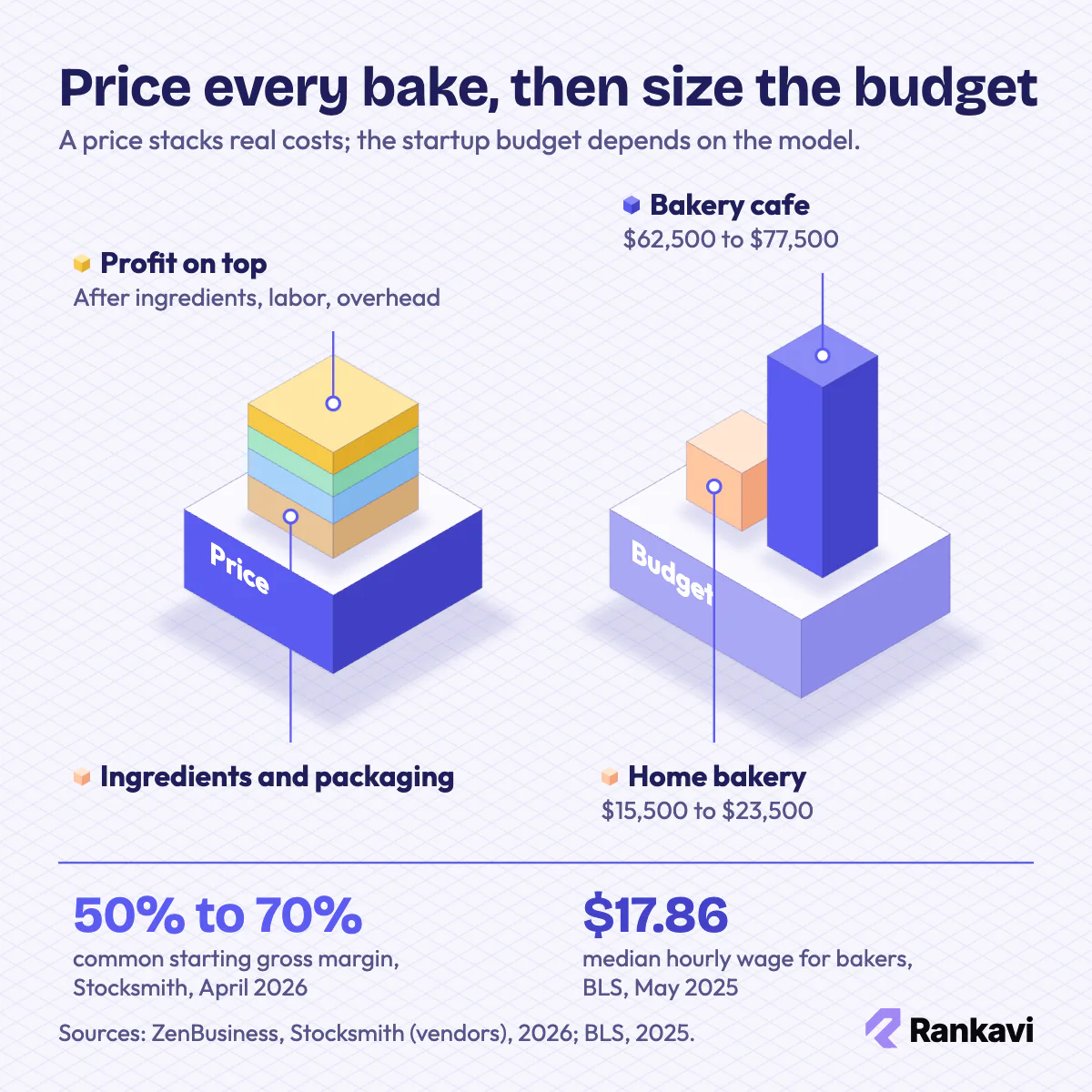
Recipe costing comes first. The baker divides each ingredient’s package price by its weight, then multiplies by the amount used. Boxes, labels and ribbons join the cost of every item.
Labor belongs in the price, even when the owner bakes alone. The BLS reported a $17.86 median hourly wage for bakers in May 2025, a fair floor for the owner’s own time. Market fees, software and delivery miles complete the overhead.
Gross margin is the number bakers check first. Stocksmith, an inventory and costing software vendor, named 50% to 70% gross margin as a common pricing starting point in April 2026. Custom cakes take longer, so they carry a higher labor charge.
Startup money at a glance:
| Item | Typical figure |
|---|---|
| Startup cost | $15,500 to $23,500 for a home bakery; $62,500 to $77,500 for a bakery cafe; $71,700 to $102,700 for a commercial bakery (vendor estimates) |
| Main costs | Equipment and cookware ($5,000 for a home bakery), construction and furniture, ingredients, advertising and insurance |
| Typical margin | A 10% to 20% profit margin target (vendor, gross or net not stated); 23.23% gross and 2.82% net for U.S. public food processing firms, a proxy |
| Time to open | About 8 weeks for a home bakery plan; a storefront takes longer because the lease, build-out and health inspection come first |
Sources: ZenBusiness (business formation vendor), 2026, vendor estimates; Aswath Damodaran, NYU Stern, January 2026, proxy margins; Plastic Container City (bakery packaging supplier), 2026, vendor plan.
Price also signals quality. A custom cake priced like a grocery store sheet cake invites bargain hunters. A clear premium needs visible skill, good packaging and a story. Wholesale prices sit below retail prices, so the margin must still work after the discount to a cafe.
Order minimums protect the baker’s time. A minimum order and a lead time of a few days let the kitchen batch production. Clear policies on deposits and cancellations prevent unpaid work.
5. Fund the Startup Costs
Bakery funding covers equipment, permits, ingredients and the cash needed before sales arrive. A home bakery needs a small budget, while a storefront needs a lease deposit, build-out and commercial ovens.
The main startup costs for a bakery:
| Cost category | What it covers |
|---|---|
| Permits and courses | Cottage food or health permits, food safety training |
| Registration | Business name, company filing, licenses |
| Equipment | Mixer, ovens, pans, scale, storage |
| Packaging | Boxes, bags, labels |
| Insurance | General liability coverage |
| Working capital | Ingredients and bills before steady sales |
Home bakers often fund the start themselves. Existing kitchen tools, a short menu and reinvested profits keep borrowing low. Upgrades then follow real demand. The trade-off is slower growth, since savings limit how fast equipment and stock can expand. Borrowing speeds growth but adds a monthly payment that bakes must cover in slow weeks.
Storefront bakeries usually combine several sources. A bank loan, investors and crowdfunding can cover the build-out. The U.S. Small Business Administration (SBA) is the federal agency that backs small business loans through partner lenders.
As of 2026, SBA microloans go up to $50,000, a size that fits a home bakery or a small bakery cafe. Chambers of commerce sometimes list local startup grants or tax incentives as well.
6. Secure a Home Kitchen or Storefront
The kitchen choice gives the bakery its legal address and its production limit. A home kitchen keeps costs low, while a commercial kitchen or storefront opens up wholesale and walk-in sales.
A home kitchen needs a production layout. Separate zones for prep, baking, cooling and packaging keep orders moving. Pets, clutter and family meals stay away from the work area during bakes.
A rented commercial kitchen fills the gap between home and storefront. Some counties require licensed space for any food sale. A shared kitchen or a space with existing ovens avoids a full build-out.
A retail bakery depends on its location. Owners check where target customers live and shop, how much foot traffic passes, and how close competitors sit. Safety and a public restroom matter for walk-in sales.
Each option has a trade-off. A home kitchen is cheapest but caps volume and may bar walk-in sales or wholesale. A shared kitchen adds rent and booking schedules. A storefront adds foot traffic and a lease that must be paid in slow months.
Access shapes daily operations. Customers picking up cake trays need parking near the door. Wholesale bread routes need room for delivery vans to load.
7. License, Register and Insure the Bakery
Bakery licensing protects the owner by making every sale legal under state and local food law. Rules change with the state, the county and the kitchen type.
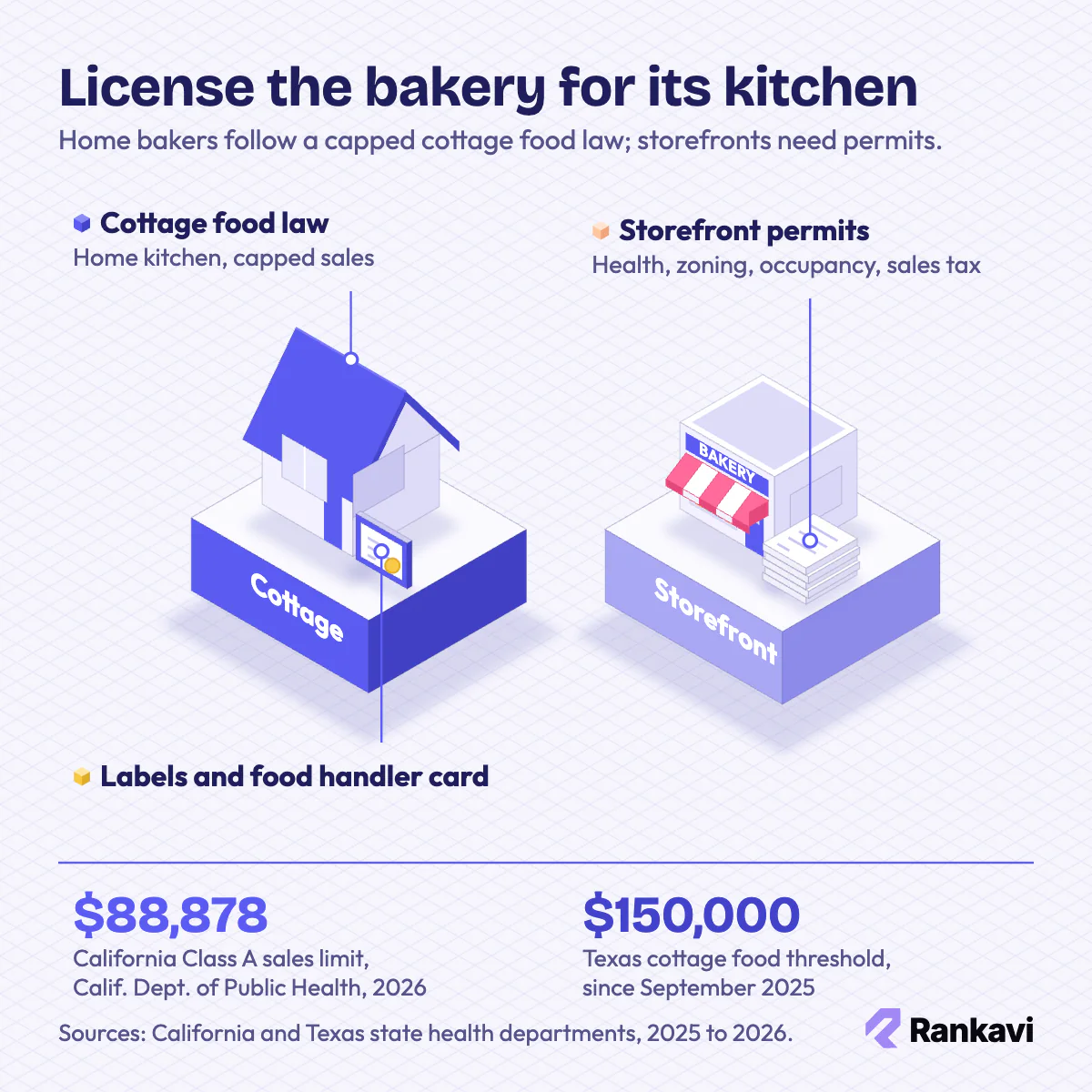
A cottage food law covers food made in a home kitchen. Each state sets which foods qualify, where sales happen and what labels say. The Institute for Justice is a public interest law firm that tracks homemade food laws. It reported cottage food programs in all 50 states and D.C. by July 2026.
Sales caps differ widely. The California Department of Public Health is the state agency that registers cottage food operations. It set 2026 gross annual sales limits of $88,878 for Class A and $177,756 for Class B operations.
Texas sets its cap through the Texas Department of State Health Services, which oversees cottage food production. That agency raised the annual gross income threshold to $150,000 on September 1, 2025.
A storefront bakery needs more approvals:
- Business license: permission to operate in the city or county
- Food establishment permit: health department approval after inspection
- Zoning permit: approval for the building’s use
- Certificate of occupancy: proof the space meets code
- Seller’s permit: registration to collect sales tax
Cottage food limits usually cover sales channels as well as income. Shipping, wholesale and resale at other stores may fall outside the law. The state health department answers these questions.
Labels carry legal weight. Most states require the business name, ingredients, allergens and a note that the food came from a home kitchen. ServSafe is the National Restaurant Association’s food safety training program, and as of 2026 its online Food Handler course costs $15.00.
Registering the bakery keeps its money apart from personal money. Many owners form a limited liability company (LLC), which limits personal exposure to business debts. The Internal Revenue Service (IRS) is the agency that issues the employer identification number (EIN) free. Banks and tax forms ask for it.
Liability insurance covers claims such as allergic reactions or foodborne illness. The Food Liability Insurance Program is an insurance program for small food businesses. As of 2026, its bakers policy costs $299 a year, and markets often ask vendors for this proof.
8. Equip the Kitchen and Source Ingredients
Equipping a bakery involves buying the tools the menu needs and the suppliers that keep them stocked. A cookie business needs mixers and sheet pans, while a bread bakery needs proofing space and larger ovens.
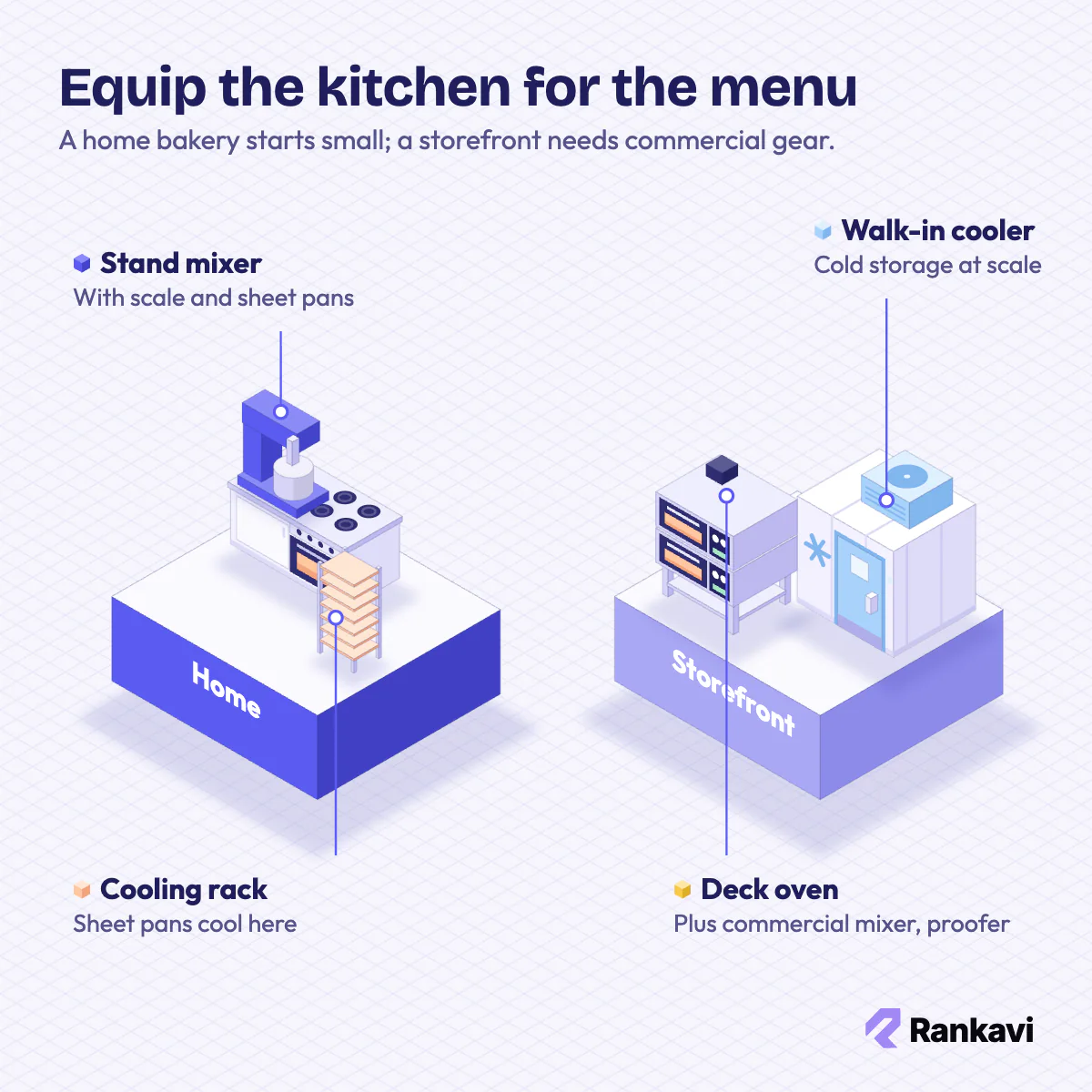
Common bakery equipment by scale:
| Bakery type | Typical equipment |
|---|---|
| Home bakery | Stand mixer, digital scale, sheet pans, cooling racks, airtight bins |
| Storefront bakery | Commercial mixer, deck or convection oven, proofer, walk-in cooler |
| Retail counter | Display cases, point of sale system, packaging station |
Used equipment stretches the budget. Restaurant auctions and online marketplaces sell secondhand mixers and ovens. Buyers check the condition, parts supply and fit with the kitchen before paying.
Ingredient suppliers set the bakery’s costs. Wholesale distributors and baking supply stores sell flour, sugar and butter in bulk. Some large food distributors also help with food costing and menu planning.
Buy-or-wait decisions follow the menu. A stand mixer and accurate scale pay off at once. A proofer or deck oven can wait until orders prove the need. A bakery buys equipment for products that already sell.
Packaging runs out faster than expected. Bakers buy boxes, bags and labels in bulk and keep extra on hand. Running short the night before a large order is a common early mistake.
Order and payment tools keep sales organized. Card readers from Square or Stripe take payments at markets. Preorder apps such as Hotplate collect online orders and payment in one step.
9. Market the Bakery to First Customers
Bakery marketing builds the first customer base through people who already know the baker. Friends, neighbors and coworkers place the first orders and spread the word.
A brand makes the bakery easy to remember. The name should be simple to spell and free as a social media handle. A clean logo and consistent packaging carry that brand to every order.
Instagram and Facebook act as a bakery’s shop window. Regular photos, behind-the-scenes clips and weekly menus keep followers ordering. Google Business Profile is Google’s free listing, and it puts hours, photos and reviews on Search and Maps.
Photos sell baked goods because buyers judge by sight first. Natural light, a clean background and a close shot of the crumb show quality better than a crowded table. A pinned menu post with an order link shortens the path from browsing to buying.
In-person events let customers taste before they buy. Farmers markets, craft fairs and holiday pop-ups draw shoppers who value local food. Samples and a sign-up sheet turn tasters into repeat buyers.
Local businesses become steady wholesale accounts. Coffee shops stock muffins and scones, and breweries partner on themed bakes. Reviews, referral rewards and an email list then keep orders coming.
10. Feature in AI Bakery Recommendations
AI visibility means a bakery gets named when locals ask a chatbot where to buy cakes or bread. Shoppers now type questions like “best custom cakes near me” into ChatGPT and Google AI Overviews.
Those assistants draw on what other sites say. Local food blogs, wedding vendor lists, review pages and “best bakeries in town” roundups shape their answers. A new bakery mentioned on those pages early gives the tools a name to repeat.
Results build gradually and are never guaranteed. Rankavi is a software as a service (SaaS) platform that publishes brand mentions in articles on indexed third-party websites. Bakers who want OpenAI’s chatbot to name them can use those articles to get cited in ChatGPT.